

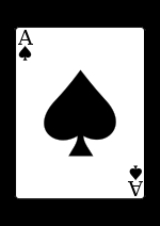
Ace of Spades

Encyclopedia
At least in English-speaking countries, the ace of spades (also known as the spadille) is traditionally seen as the highest card in the deck of playing card
s, although the actual value of the card varies from game to game. In popular myth and folklore, it is also known as the "death card".
and later Queen Anne imposed laws requiring the Ace of Spades to bear an insignia of the printing house. Stamp duty, an idea imported to England by Charles I
, was extended to playing cards in 1711 by Queen Anne and lasted until 1960.
Over the years a number of methods were used to show that duty had been paid. From 1712 onwards, one of the cards in the pack, usually the ace of spades, was marked with a hand stamp. In 1765 hand stamping was replaced by the printing of official ace of spades by the Stamp Office, incorporating the royal coat of arms. In 1828 the Duty Ace of Spades (known as "Old Frizzle") was printed to indicate a reduced duty of a shilling
had been paid.
The system was changed again in 1862 when official threepenny duty wrappers were introduced and although the makers were free to use whatever design they wanted, most chose to keep the ornate ace of spades that is popular today. The ace of spades is thus used to show the card manufacturer's information.
The exact design of the ace card was so important, it eventually became the subject of design patents and trademarking. For example, on December 5, 1882, George G. White was granted US design patent US0D0013473 for his 'Ace of Spades' playing card design. His ace design was adorned with male and female figures leaning onto the spade from either side.
of the American
101st Airborne Division
were marked with the spades symbol painted on the sides of their helmets. In this capacity, it was used to represent good luck, due to its fortunate connotations in card playing. All four card suits were used for ease of identification of regiments within the airborne division following the confusion of a large scale combat airborne operation. Battalions within the regiments were denoted with tic marks or dots, marked from top clockwise; Headquarters at the twelve o'clock position, 1st Battalion at the three o'clock, etc.
Some twenty years later, the ace of spades was again used by American soldiers—this time as a psychological weapon in the Vietnam War
. US troops believed that Vietnamese traditions held the symbolism of the spade to mean death and ill-fortune and in a bid to scare away NLF
soldiers without firefight, it was common practice to leave an ace of spades on the bodies of killed Vietnamese and even to litter the forested grounds and fields with the card. This custom was believed to be so effective, that the United States Playing Card Company
was asked by Charlie Company, 2nd Battalion 35th Infantry Regiment, 25th Infantry Division, to supply crates of that single card in bulk. The crates were often marked with "Bicycle Secret Weapon".
The ace of spades, while not a symbol of superstitious fear to the NLF, did help the morale of American soldiers. It was not unheard of for US soldiers and Marines to stick this card in their helmet band as a sort of anti-peace sign.
More recently, in 2003 a deck of most-wanted Iraqi playing cards
issued to US soldiers during Operation Iraqi Freedom
, each card had the picture of a wanted Iraqi official on it. Saddam Hussein
got the nickname "Ace of Spades" as his was the face which adorned that card.
s involving the ace of spades include "black as the ace of spades" (which can refer either to color
or to race
), and the French
expression « fichu comme l'as de pique » – that is, "filthy as the ace of spades".
Playing card
A playing card is a piece of specially prepared heavy paper, thin cardboard, plastic-coated paper, cotton-paper blend, or thin plastic, marked with distinguishing motifs and used as one of a set for playing card games...
s, although the actual value of the card varies from game to game. In popular myth and folklore, it is also known as the "death card".
Design
The ornate design of the ace of spades, common in packs today, stems from the 17th century, when James IJames I of England
James VI and I was King of Scots as James VI from 24 July 1567 and King of England and Ireland as James I from the union of the English and Scottish crowns on 24 March 1603...
and later Queen Anne imposed laws requiring the Ace of Spades to bear an insignia of the printing house. Stamp duty, an idea imported to England by Charles I
Charles I of England
Charles I was King of England, King of Scotland, and King of Ireland from 27 March 1625 until his execution in 1649. Charles engaged in a struggle for power with the Parliament of England, attempting to obtain royal revenue whilst Parliament sought to curb his Royal prerogative which Charles...
, was extended to playing cards in 1711 by Queen Anne and lasted until 1960.
Over the years a number of methods were used to show that duty had been paid. From 1712 onwards, one of the cards in the pack, usually the ace of spades, was marked with a hand stamp. In 1765 hand stamping was replaced by the printing of official ace of spades by the Stamp Office, incorporating the royal coat of arms. In 1828 the Duty Ace of Spades (known as "Old Frizzle") was printed to indicate a reduced duty of a shilling
Shilling
The shilling is a unit of currency used in some current and former British Commonwealth countries. The word shilling comes from scilling, an accounting term that dates back to Anglo-Saxon times where it was deemed to be the value of a cow in Kent or a sheep elsewhere. The word is thought to derive...
had been paid.
The system was changed again in 1862 when official threepenny duty wrappers were introduced and although the makers were free to use whatever design they wanted, most chose to keep the ornate ace of spades that is popular today. The ace of spades is thus used to show the card manufacturer's information.
The exact design of the ace card was so important, it eventually became the subject of design patents and trademarking. For example, on December 5, 1882, George G. White was granted US design patent US0D0013473 for his 'Ace of Spades' playing card design. His ace design was adorned with male and female figures leaning onto the spade from either side.
War
The ace of spades has been employed, on numerous occasions, in the theater of war. In the Second World War, the soldiers of the 506th Parachute Infantry Regiment506th Parachute Infantry Regiment
The 506th Infantry Regiment is a unit assigned to the 4th Brigade Combat Team of the 101st Airborne Division. During World War II, the unit was designated the 506th Parachute Infantry Regiment ....
of the American
United States
The United States of America is a federal constitutional republic comprising fifty states and a federal district...
101st Airborne Division
101st Airborne Division
The 101st Airborne Division—the "Screaming Eagles"—is a U.S. Army modular light infantry division trained for air assault operations. During World War II, it was renowned for its role in Operation Overlord, the D-Day landings on 6 June 1944, in Normandy, France, Operation Market Garden, the...
were marked with the spades symbol painted on the sides of their helmets. In this capacity, it was used to represent good luck, due to its fortunate connotations in card playing. All four card suits were used for ease of identification of regiments within the airborne division following the confusion of a large scale combat airborne operation. Battalions within the regiments were denoted with tic marks or dots, marked from top clockwise; Headquarters at the twelve o'clock position, 1st Battalion at the three o'clock, etc.
Some twenty years later, the ace of spades was again used by American soldiers—this time as a psychological weapon in the Vietnam War
Vietnam War
The Vietnam War was a Cold War-era military conflict that occurred in Vietnam, Laos, and Cambodia from 1 November 1955 to the fall of Saigon on 30 April 1975. This war followed the First Indochina War and was fought between North Vietnam, supported by its communist allies, and the government of...
. US troops believed that Vietnamese traditions held the symbolism of the spade to mean death and ill-fortune and in a bid to scare away NLF
National Front for the Liberation of South Vietnam
The Vietcong , or National Liberation Front , was a political organization and army in South Vietnam and Cambodia that fought the United States and South Vietnamese governments during the Vietnam War . It had both guerrilla and regular army units, as well as a network of cadres who organized...
soldiers without firefight, it was common practice to leave an ace of spades on the bodies of killed Vietnamese and even to litter the forested grounds and fields with the card. This custom was believed to be so effective, that the United States Playing Card Company
United States Playing Card Company
The United States Playing Card Company, started in 1867, produces and distributes many brands of playing cards, including Bicycle, Bee, Hoyle, Kem, and others, plus novelty and custom cards, and other playing card accessories such as poker chips. The company was once based in Cincinnati, Ohio, but...
was asked by Charlie Company, 2nd Battalion 35th Infantry Regiment, 25th Infantry Division, to supply crates of that single card in bulk. The crates were often marked with "Bicycle Secret Weapon".
The ace of spades, while not a symbol of superstitious fear to the NLF, did help the morale of American soldiers. It was not unheard of for US soldiers and Marines to stick this card in their helmet band as a sort of anti-peace sign.
More recently, in 2003 a deck of most-wanted Iraqi playing cards
Most-wanted Iraqi playing cards
In the 2003 invasion of Iraq by a United States-led coalition, the U.S. military developed a set of playing cards to help troops identify the most-wanted members of President Saddam Hussein's government, mostly high-ranking Baath Party members or members of the Revolutionary Command Council...
issued to US soldiers during Operation Iraqi Freedom
2003 invasion of Iraq
The 2003 invasion of Iraq , was the start of the conflict known as the Iraq War, or Operation Iraqi Freedom, in which a combined force of troops from the United States, the United Kingdom, Australia and Poland invaded Iraq and toppled the regime of Saddam Hussein in 21 days of major combat operations...
, each card had the picture of a wanted Iraqi official on it. Saddam Hussein
Saddam Hussein
Saddam Hussein Abd al-Majid al-Tikriti was the fifth President of Iraq, serving in this capacity from 16 July 1979 until 9 April 2003...
got the nickname "Ace of Spades" as his was the face which adorned that card.
Idioms
Various idiomIdiom
Idiom is an expression, word, or phrase that has a figurative meaning that is comprehended in regard to a common use of that expression that is separate from the literal meaning or definition of the words of which it is made...
s involving the ace of spades include "black as the ace of spades" (which can refer either to color
Black
Black is the color of objects that do not emit or reflect light in any part of the visible spectrum; they absorb all such frequencies of light...
or to race
Black people
The term black people is used in systems of racial classification for humans of a dark skinned phenotype, relative to other racial groups.Different societies apply different criteria regarding who is classified as "black", and often social variables such as class, socio-economic status also plays a...
), and the French
French language
French is a Romance language spoken as a first language in France, the Romandy region in Switzerland, Wallonia and Brussels in Belgium, Monaco, the regions of Quebec and Acadia in Canada, and by various communities elsewhere. Second-language speakers of French are distributed throughout many parts...
expression « fichu comme l'as de pique » – that is, "filthy as the ace of spades".
See also
- List of poker hand nicknames
- Spades (suit)
- Playing Cards
- Black Spot (Treasure Island)Black Spot (Treasure Island)The Black Spot is a literary device invented by Robert Louis Stevenson for his novel Treasure Island. In the book, pirates are presented with a "black spot" to officially pronounce a verdict of guilt or judgment. It consists of a circular piece of paper or card, with one side blackened while the...
- Ace of Spades (song)Ace of Spades (song)"Ace of Spades" is a song by the English band Motörhead, released in 1980 as a single and the title track to the album Ace of Spades. The song spent 12 weeks in the United Kingdom Singles Chart, peaking at #15.-Overview:...
- Ace of Spades (video game)Ace of Spades (video game)Ace of Spades is a free-to-play sandbox building and FPS game developed by Ben Aksoy for the PC. The game notably uses Ken Silverman's Voxlap engine.-Summary:...