
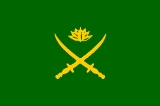
The
Bangladesh Army is the
land forcesAn army An army An army (from Latin arma "arms, weapons" via Old French armée, "armed" (feminine), in the broadest sense, is the land-based military of a nation or state. It may also include other branches of the military such as the air force via means of aviation corps...
branch and the largest of the three uniformed service of the Bangladesh Armed Forces. The primary mission of the Army is to provide necessary forces and capabilities in support of Bangladesh's security and defense strategies including defense of the nation's territorial integrity against external attack. Control and operations are administered by the Department of the Army of the Armed Forces Division. The civilian head is the Prime Minister, who by law also holds the defense ministry portfolio. In addition to its primary mission the Bangladesh Army is also constitutionally obligated to assist the civilian government during times of national emergency. This role is commonly referred to as “aid to civil administration”.
Early history
The martial tradition of Bengal has its roots in the
Bengal ArmyThe Bengal Army was the army of the Presidency of Bengal, one of the three Presidencies of British India, in South Asia. Although based in Bengal in eastern India, the presidency stretched across northern India and the Himalayas all the way to the North West Frontier Province...
during
MughalThe Mughal Empire , or Mogul Empire in traditional English usage, was an imperial power from the Indian Subcontinent. The Mughal emperors were descendants of the Timurids...
rule since the early 18th century, when three successive Persian Muslim dynasties, namely the Nasiri, Afshar and Najafi, ruled Bengal. During the Colonial Rule of the British, Bengal was principally a bulwark of British power and trade in the South Asian region. The British under Robert Clive defeated a 50,000 strong Bengal Army of Nawab Siraj-ud-daullah in the
Polashey(Plassey)The Battle of Plassey , 23 June 1757, was a decisive British East India Company victory over the Nawab of Bengal and his French allies, establishing Company rule in South Asia which expanded over much of the Indies for the next hundred years...
in 1757 and later the forces of Nawab
Mir QasimMir Qasim was Nawab of Bengal from 1760 to 1764. He was installed as Nawab by the British East India Company replacing Mir Jafar, his father-in-law, who had himself been installed by the British after his role in the Battle of Plassey...
at the
Battle of BuxarThe Battle of Buxar was fought on 22 October 1764 between the forces under the command of the British East India Company, and the combined armies of Mir Qasim, the Nawab of Bengal; Shuja-ud-Daula Nawab of Awadh; and Shah Alam II, the Mughal Emperor...
in 1764. The
Army of BengalThe Bengal Army was the army of the Presidency of Bengal, one of the three Presidencies of British India, in South Asia. Although based in Bengal in eastern India, the presidency stretched across northern India and the Himalayas all the way to the North West Frontier Province...
was formed, which later became part of a united
Indian ArmyThe British Indian Army, officially simply the Indian Army, was the principal army of the British Raj in India before the partition of India in 1947...
from 1895 to 1947. The eastern part of the region was a prominent place for military and police recruitment, with entire horse-mounted cavalry and lancer units being recruited there prior to the
Bengal Sepoy MutinyThe Indian Rebellion of 1857 began as a mutiny of sepoys of the British East India Company's army on 10 May 1857, in the town of Meerut, and soon escalated into other mutinies and civilian rebellions largely in the upper Gangetic plain and central India, with the major hostilities confined to...
of 1857. Post-mutiny, units with the epithet "Bengal" in their name, such as Bengal Sappers and Bengal Cavalry, were largely recruited from non-Bengali peoples from Bihar, Varanasi and Uttar Pradesh which were technically still part of
Bengal PresidencyThe Bengal Presidency originally comprising east and west Bengal, was a colonial region of the British Empire in South-Asia and beyond it. It comprised areas which are now within Bangladesh, and the present day Indian States of West Bengal, Assam, Bihar, Meghalaya, Orissa and Tripura.Penang and...
at that time. After the creation of the nation of
PakistanPakistan , officially the Islamic Republic of Pakistan is a sovereign state in South Asia. It has a coastline along the Arabian Sea and the Gulf of Oman in the south and is bordered by Afghanistan and Iran in the west, India in the east and China in the far northeast. In the north, Tajikistan...
, recruitment from erstwhile East Pakistan began in 1948 into the
East Bengal Regiment-History:The East Bengal Regiment was formed in 1948 following Pakistan's creation from the Partition of British Raj in South Asia. As part of the agreement, the Muslim population of what was previously known as British Empire in South Asia were given their own state of Pakistan, made up of West...
, newly created with all Bengali personnel, part of the
Pakistan ArmyThe Pakistan Army is the branch of the Pakistani Armed Forces responsible for land-based military operations. The Pakistan Army came into existence after the Partition of India and the resulting independence of Pakistan in 1947. It is currently headed by General Ashfaq Parvez Kayani. The Pakistan...
till 1971.
Formation during Bangladesh Liberation War 1971
Military operations were formally launched after the Sector Commanders Conference during 11–17 July 1971. The conference was held three months after the oath of the newly formed Bangladesh Government at Meherpur, Kushtia. During this conference the structure and formation as well as resolving issues surrounding the organization of the various sectors, strategy and reinforcements of the Bangladeshi forces was determined. It was of considerable historical importance from a tactical point of view, as it determined the command structure of the Bangladeshi forces throughout
Bangladesh Liberation WarThe Bangladesh Liberation War was an armed conflict pitting East Pakistan and India against West Pakistan. The war resulted in the secession of East Pakistan, which became the independent nation of Bangladesh....
that was fought between Bangladesh(East Pakistan until 25 March 1971) and West Pakistan in 1971.
This conference was presided over by the Bangladesh interim government in exile, headed by then Prime Minister Tajuddin Ahmed and
ColonelColonel , abbreviated Col or COL, is a military rank of a senior commissioned officer. It or a corresponding rank exists in most armies and in many air forces; the naval equivalent rank is generally "Captain". It is also used in some police forces and other paramilitary rank structures...
(Retd.) M A G Osmani. M A G Osmani was reinstated into active duty and promoted to General as the Commander-in-Chief of the Bangladesh Forces. Principal participants of this conference included:
Wing CommanderWing commander is a commissioned rank in the Royal Air Force and the air forces of many other Commonwealth countries...
Khademul BasharAir Vice-Marshal M Khademul Bashar was Chief of Air Staff of the Bangladesh Air Force during 1976. He also held the office of Deputy Chief Martial Law Administrator and was in charge of the Ministry of Petroleum, the Ministry of Food and Civil Aviation and the Department of Tourism.He served as...
,
Squadron LeaderSquadron Leader is a commissioned rank in the Royal Air Force and the air forces of many countries which have historical British influence. It is also sometimes used as the English translation of an equivalent rank in countries which have a non-English air force-specific rank structure. In these...
M.Hamidullah Khan, Major
Ziaur RahmanPresident Ziaur Rahman, Bir Uttam, was a Bangladeshi politician and general, who read the declaration of Independence of Bangladesh on March 26, 1971 on behalf of Sheikh Mujibur Rahman. He later became the seventh President of Bangladesh from 1977 until 1981...
, Major Abdul Jalil, Captain ATM Haider, Lt. Col. Abdur Rab and
Group CaptainGroup captain is a senior commissioned rank in the Royal Air Force and the air forces of many other Commonwealth countries. It ranks above wing commander and immediately below air commodore...
A. K. KhandkerAir Vice Marshal A K Khandker, Bir Uttom, MP is the current Planning Minister of Government of Bangladesh. He is a retired diplomat and was the Deputy Chief of Staff of the Bangladesh Armed Forces during the Bangladesh Liberation War.-Early life:...
. Lt.Col Rab was appointed as Chief of Army Staff.
As a result of this meeting, Bangladesh was divided into
eleven sectors. These sectors were placed under the control of Sector Commanders, who would direct the guerilla war against Pakistani occupation forces. For better efficiency in military operations each of the sectors were also divided into a number of sub-sectors. As a point of note, the 10th Sector was under direct command of the Commander-in-Chief and included the Naval Commando Unit as a C-in-C’s special force.
Following the conference a period of prolonged guerilla warfare was launched by Bangladesh Forces, which continued for a number of months. A further restructuring was undertaken, and the Bangladesh Forces were organized into three brigade size combat groups.
- K Force, under Major Khaled Mosharraf
Khaled Mosharraf was a Bangladeshi military officer who was a the Sector Commander of BDF Sector 2 and K-Force Brigade Commander during the Bangladesh War of Liberation. He was awarded Bir Uttam for his gallantry actions during the war...
, was created with 4th, 9th and 10th East Bengal Regiment-History:The East Bengal Regiment was formed in 1948 following Pakistan's creation from the Partition of British Raj in South Asia. As part of the agreement, the Muslim population of what was previously known as British Empire in South Asia were given their own state of Pakistan, made up of West...
.
- S Force, under Major K M Shafiullah
K M Shafiullah was a Major General and 2nd Chief of Staff of Bangladesh Army. During the Bangladesh Liberation War of 1971, he was the Second in Command of Second East Bengal Regiment that revolted with six officers on the night of March 25, 1971. He was also the Brigade commander of S-force of...
, was created with 2nd and 11th East Bengal Regiment-History:The East Bengal Regiment was formed in 1948 following Pakistan's creation from the Partition of British Raj in South Asia. As part of the agreement, the Muslim population of what was previously known as British Empire in South Asia were given their own state of Pakistan, made up of West...
.
- Z Force, under Major Ziaur Rahman
President Ziaur Rahman, Bir Uttam, was a Bangladeshi politician and general, who read the declaration of Independence of Bangladesh on March 26, 1971 on behalf of Sheikh Mujibur Rahman. He later became the seventh President of Bangladesh from 1977 until 1981...
, was created with 1st, 3rd and 8th East Bengal Regiment-History:The East Bengal Regiment was formed in 1948 following Pakistan's creation from the Partition of British Raj in South Asia. As part of the agreement, the Muslim population of what was previously known as British Empire in South Asia were given their own state of Pakistan, made up of West...
.
On 3 December 1971, (West) Pakistan launched a futile and poorly planned pre-emptive attack on the western border of India, which marked the official entry of India into Bangladesh's liberation war. Finally, on 16 December 1971, after the Pakistan Armed Forces surrendered en masse to Indian Forces, the independent nation of Bangladesh emerged.
Post 1971: The emergence of the Bangladesh Army
Bangladesh Army has expanded considerably albeit erratically since its formation on 21 November 1971. During the sensitive and formative years after the end of the war, personnel of the
Mukti BahiniMukti Bahini , also termed as the "Freedom Fighters" or FFs, collectively refers to the armed organizations who fought against the Pakistan Army during the Bangladesh Liberation War. It was dynamically formed by Bengali regulars and civilians after the proclamation of Bangladesh's independence on...
were absorbed into different branches of Bangladesh Army. Sheikh Mujib's Awami League government created disenchantment among army personnel when his party formed and operated state funded separate militia groups around the nation run locally by his party men at the command of his son Sheikh Kamal. These policies and actions laid the foundation and formed the bedrock of disputes between professional army officers and the ruling administration.
Coups, uprisings and assassinations
The year 1975 was a turning point year in the history of Bangladesh as a nation. On 15 August 1975 few disgruntled members of the Bangladesh Armed Forces have been involved in two assassinations and coups albeit without the knowledge or participation of the entire Bangladesh Armed Forces. In 1975 a few sacked, disgruntled junior officers and NCOs secretly planned and assassinated the entire immediate family of Sheikh Mujibur Rahman at his personal residence in Dhanmondi, Dhaka, with the exception of his two daughters who were abroad. Some of those responsible officers were finally brought to justice in January 2010. Some are still at large. A new government led by Khandkar Mushtaq Ahmed and almost the entire cabinet of Sheikh Mujib's government was set in place. Three months later on 3 November 1975, several senior officers and NCO's led by Brig. Gen. Khaled Musharraf and Colonel
Shafaat Jamil-Early life:He was born on March 1, 1940. His father A.H. Karimullah was an East Pakistan Civil Service Officer. Jamil was educated at Dhaka College, University of Dhaka and Pakistan Military Academy, Kakul....
led their own forces to untangle another internal conspiracy and removed Khandakar Mushtaq's government from power whom they believed was an unlawful government in the first place. That same day the same group of disgruntled army personnel who assassinated Sheikh Mujib and his family took action that resulted in the assassination and jailing of several senior Army officers and noted civilians who were involved in the
nations war of independenceThe Bangladesh Liberation War was an armed conflict pitting East Pakistan and India against West Pakistan. The war resulted in the secession of East Pakistan, which became the independent nation of Bangladesh....
. Those jailed and later assassinated inside the jail premises were
Syed Nazrul IslamSyed Nazrul Islam was a Bangladeshi politician and a senior leader of the Awami League. During the Bangladesh Liberation War, he served as the acting President of Bangladesh in the absence of Sheikh Mujibur Rahman.-Early life:...
, Tajuddin Ahmed,
Muhammad Mansur AliMuhammad Mansur Ali was a Bangladeshi politician who was a close confidante of Sheikh Mujibur Rahman, the founding leader of Bangladesh...
and AHM Qamaruzzaman. Chief of Army Staff, Major General Ziaur Rahman was placed under house arrest.
On 7 November 1975, a short but highly organized uprising concentrated only in Dhaka, formed by members of the Jatiya Samajtantric Dal (National Socialist Party) and members of lower-ranking army personnel led by Lt. Col.(Retd.) Abu Taher also resulted in the killing of several army and air force officers and men including Brigadier General Khaled Musharraf, Major ATM Haider to name just a few. Colonel
Shafaat Jamil-Early life:He was born on March 1, 1940. His father A.H. Karimullah was an East Pakistan Civil Service Officer. Jamil was educated at Dhaka College, University of Dhaka and Pakistan Military Academy, Kakul....
was arrested and forcibly retired. Major General Ziaur Rahman was released and took the opportunity to bring order and discipline in the country as well as in the armed forces under temporary martial law. Zia took promotion to Lieutenant General and was appointed Chief of Army Staff and Deputy Chief Martial Law Administrator. Later, in 1977 under a public referendum of a yes no vote he took the helm as President. On 30 May 1981 President Ziaur Rahman was assassinated in the Chittagong Circuit House in a military coup. Less than a year later, the then Chief of Army Staff Lt. Gen. Hussein Muhammad Ershad in 1981 March 24 took power in a silent coup at dawn, suspended the constitution and imposed martial law. He remained in power until 6 December 1990.
Subsequent growth
Following the 1975 coup, additional personnel were absorbed into the regular army when the martial law government abolished the
Jatiyo Rakkhi BahiniThe Jatiyo Rakkhi Bahini was a highly controversial political militia force formed in 1975 with a status of an elite force which was loyal to Sheikh Mujibur Rahman...
. Under Zia's rule, Bangladesh was divided into five military regions. When Ershad assumed power in 1982, army strength had stabilized at about 70,000 troops. Starting in 1985, the army had experienced another spurt in growth. As of mid-1988, it had about 90,000 troops (although some observers believed the number was closer to 80,000), triple the 1975 figure.
The Bangladesh Army structure is similar to the armies of the Commonwealth Nations. However, major changes have taken place following the adoption of U.S. Army tactical planning procedures, training management techniques and noncommissioned officer educational systems. In times of war and national emergency, the Bangladesh Army can also be reinforced by the Border Guard Bangladesh, Bangladesh Ansars,
Village Defence PartiesThe Village Defence Party is a law enforcement force in Bangladesh, organised in distinct units at the level of individual villages and urban towns. It is administered by the Home Ministry of the central Government of Bangladesh...
and other paramilitary organizations.
Bangladesh Army has specialized its peacekeeping operation capabilities around the world through participation in numerous peacekeeping and nation building operations. It has created BIPSOT (Bangladesh Institute of Peace Support Operation Training) which specializes in the training of peacekeepers for employment in all types of UNPSO (UN Peace Support Operations). This institute fulfills the requirement of UNDPKO as per U.N. General Assembly resolution which outlines ‘the necessity and responsibility of every nation to train their armed forces before any deployment. The U.S. Military has taken a keen interest and currently participating in this area.
Bangladesh Liberation War
During the night of 25 March a
sudden,
unprovoked and
brutal crackdown codenamed
Operation SearchlightOperation Searchlight was a planned military operation carried out by the Pakistan Army to curb the Bengali nationalist movement in the erstwhile East Pakistan in March 1971. Ordered by the central government in West Pakistan, this was seen as the sequel to "Operation Blitz" which had been...
was unleashed by Pakistani Armed Forces upon the local Bengali population in major cities of Dhaka, Chittagong, Comilla, Sylhet, Jessore, Rangpur, Syedpur, Rajshahi and numerous other localities. Hundreds of thousand innocent civilians as well as Bengali military, para-military and law-enforcement personnel were executed in cold blood by the Pakistani military with countless instances of
arson,
murder,
rape,
lootingLooting —also referred to as sacking, plundering, despoiling, despoliation, and pillaging—is the indiscriminate taking of goods by force as part of a military or political victory, or during a catastrophe, such as during war, natural disaster, or rioting...
and
massive human rights violation. Important facilities and buildings, religious institutions, hospitals, student dormitories were bombed and set ablaze. Surviving Bengali officers and NCOs organized revolts in military installations around the country and attacked arms depots, while many managed to defect with weapons and ammo. During late afternoon of 26 March, before departing
ChittagongChittagong ) is a city in southeastern Bangladesh and the capital of an eponymous district and division. Built on the banks of the Karnaphuli River, the city is home to Bangladesh's busiest seaport and has a population of over 4.5 million, making it the second largest city in the country.A trading...
city then Major
Ziaur RahmanPresident Ziaur Rahman, Bir Uttam, was a Bangladeshi politician and general, who read the declaration of Independence of Bangladesh on March 26, 1971 on behalf of Sheikh Mujibur Rahman. He later became the seventh President of Bangladesh from 1977 until 1981...
managed to stop by the Kalurghat Radio Station in Chittagong, and by late evening read out the three line declaration of independence he wrote in
Sheikh Mujibur RahmanSheikh Mujibur Rahman was a Bengali nationalist politician and the founder of Bangladesh. He headed the Awami League, served as the first President of Bangladesh and later became its Prime Minister. He headed the Awami League, served as the first President of Bangladesh and later became its...
's name that was transmitted throughout the day. On 27 March while being retransmitted the message was picked up by a Japanese ship in the Bay of Bengal area. 26 March became the official day the nation's independence struggle broke out, and thus became to be the national independence day and the nation was officially proclaimed as Bangladesh.
Arms and ammunition captured and confiscated from the military stations around the country are started being used in guerrilla operations. On 10 April under the leadership of (then)
ColonelColonel , abbreviated Col or COL, is a military rank of a senior commissioned officer. It or a corresponding rank exists in most armies and in many air forces; the naval equivalent rank is generally "Captain". It is also used in some police forces and other paramilitary rank structures...
M A G Osmani in charge of Bangladesh Forces four sectors were formed. By mid-November most of the Pakistani forces at different strategic points all over occupied Bangladesh were severely weakened and demoralized due to constant guerrilla attacks, hostile local population, difficult terrain and overall sheer incompetence of the rank and file. On 21 November 1971, vehemently opposed by Colonel Osmani and without the consent and knowledge of the front line field commanders, the Bangladesh government, handed over the full command and authority of all Bangladeshi Armed Forces and their operations to the Indian armed forces, reasons and intent still unpublished to this day. After Pakistan's desperate and futile last ditch attack on India's western front on 3 December an all out war finally broke out between India and Pakistan. Following a few skirmishes, on 16 December 1971, the already weakened and demoralized Pakistani Armed Forces readily surrendered en masse to the joint Bangladeshi-Indian Military command.
Chittagong Hill Tracts Insurgency
Since its inception, one of the Bangladesh Army's internal tasks has been the conduct of counter-insurgency operations in the
CHTThe Chittagong Hill Tracts comprise an area of 13,295 km2 in south-eastern Bangladesh, and borders India and Myanmar . It was a single district of Bangladesh until 1984. In that year it was divided into three separate districts: Khagrachari, Rangamati and Bandarban. Topographically, this is the...
region. Since 1976, an insurgent group known as the
Shanti BahiniThe Shanti Bahini was the name of the military wing of the Parbatya Chattagram Jana Sanghati Samiti - the United People's Party of the Chittagong Hill Tracts in Bangladesh....
often with clandestine support from
IndiaIndia , officially the Republic of India , is a country in South Asia. It is the seventh-largest country by geographical area, the second-most populous country with over 1.2 billion people, and the most populous democracy in the world...
n Government has demanded better treatment for local tribal peoples and has been fighting a brutal and armed insurgency in the region. However, the situation has calmed in recent years. An international peace accord overseen by the UN, was agreed upon by the Government and representatives of the Shanti Bahini in 1997. Subsequently the deployment of the Bangladesh Army to the region has been gradually reduced.
Contribution to UN Peacekeeping Operations
The Bangladesh Army has been actively involved in a number of United Nations Peace Support Operations (UNPSO) since its formation in the 1970s. Its first deployments came in 1988, when it participated in two operations – UNIIMOG in Iraq and UNTAG in Namibia President HM Ershad initiated these deployments for the first time, starting with the contribution to UNIIMOG in
IraqIraq ; officially the Republic of Iraq is a country in Western Asia spanning most of the northwestern end of the Zagros mountain range, the eastern part of the Syrian Desert and the northern part of the Arabian Desert....
.
Later, as part of the UNIKOM force deployed to Kuwait and Saudi Arabia following the
Gulf WarThe Persian Gulf War , commonly referred to as simply the Gulf War, was a war waged by a U.N.-authorized coalition force from 34 nations led by the United States, against Iraq in response to Iraq's invasion and annexation of Kuwait.The war is also known under other names, such as the First Gulf...
the Bangladesh Army sent a mechanized infantry battalion (approx. 2,193 personnel). Since then, the Bangladesh Army has been involved in up to thirty different UNPKOs in as many as twenty five countries. This has included activities in
AngolaAngola, officially the Republic of Angola , is a country in south-central Africa bordered by Namibia on the south, the Democratic Republic of the Congo on the north, and Zambia on the east; its west coast is on the Atlantic Ocean with Luanda as its capital city...
, Namibia,
CambodiaCambodia , officially known as the Kingdom of Cambodia, is a country located in the southern portion of the Indochina Peninsula in Southeast Asia...
, Somalia,
SudanSudan , officially the Republic of the Sudan , is a country in North Africa, sometimes considered part of the Middle East politically. It is bordered by Egypt to the north, the Red Sea to the northeast, Eritrea and Ethiopia to the east, South Sudan to the south, the Central African Republic to the...
, Eritrea,
UgandaUganda , officially the Republic of Uganda, is a landlocked country in East Africa. Uganda is also known as the "Pearl of Africa". It is bordered on the east by Kenya, on the north by South Sudan, on the west by the Democratic Republic of the Congo, on the southwest by Rwanda, and on the south by...
, Rwanda, Bosnia & Herzegovina, Mozambique, former
YugoslaviaYugoslavia refers to three political entities that existed successively on the western part of the Balkans during most of the 20th century....
, Liberia,
HaitiHaiti , officially the Republic of Haiti , is a Caribbean country. It occupies the western, smaller portion of the island of Hispaniola, in the Greater Antillean archipelago, which it shares with the Dominican Republic. Ayiti was the indigenous Taíno or Amerindian name for the island...
, Tajikistan,
Western SaharaWestern Sahara is a disputed territory in North Africa, bordered by Morocco to the north, Algeria to the northeast, Mauritania to the east and south, and the Atlantic Ocean to the west. Its surface area amounts to . It is one of the most sparsely populated territories in the world, mainly...
, Sierra Leone,
KosovoKosovo is a region in southeastern Europe. Part of the Ottoman Empire for more than five centuries, later the Autonomous Province of Kosovo and Metohija within Serbia...
, Georgia, East Timor,
CongoThe Democratic Republic of the Congo is a state located in Central Africa. It is the second largest country in Africa by area and the eleventh largest in the world...
, Côte d'Ivoire and
EthiopiaEthiopia , officially known as the Federal Democratic Republic of Ethiopia, is a country located in the Horn of Africa. It is the second-most populous nation in Africa, with over 82 million inhabitants, and the tenth-largest by area, occupying 1,100,000 km2...
.
As a result of its contributions to various UN peacekeeping operations, up to 88 Bangladesh soldiers have lost their lives (as of February 2009). However, the performance of Bangladesh's contingents has been described as being of the "highest order" and the appointment of several senior Bangladesh military officers as the Commander of UN peacekeeping missions and Senior Military Liaison Officers, may be seen as further recognition of the Bangladesh Army's growing esteem in the peacekeeping community.
In January 2004,
BBCThe British Broadcasting Corporation is a British public service broadcaster. Its headquarters is at Broadcasting House in the City of Westminster, London. It is the largest broadcaster in the world, with about 23,000 staff...
described the Bangladeshi UN Force as
The Cream of UN Peacekeepers. Bangladesh Armed Forces participated in the Gulf war with finest cause of war of liberation of a sovereign nation; the state of Kuwait in 1991 alongside other multinational forces. Iraq invaded Kuwait, a sovereign and independent state in the year 1990. Bangladesh, being a peace loving member of UN and having respect for the sovereignty of all nations. Bangladesh Army was deployed during "Operation Desert Storm" under Allied Command to defend Kuwait. That was the beginning of Bangladesh Army's involvement in the Gulf Region. Kuwait was liberated on 26 February 1991. However, as the dawn of liberation smiled on Kuwait, closely followed the realization that every inch of its soil remained littered with lethal mines and bombs. Bangladesh came forward in rebuilding Kuwait alongside other countries. Bangladesh Army undertook the challenging task to clearing Kuwait braving all odds and adversaries. In the passage of time, military support and cooperation merely for their agreed formally to bring a contingent if Engineers from Bangladesh Army to undertake the challenging task of reconstruction of the war-devastated Kuwait; under the operational code name "Operation Kuwait Punargathan (OKP)" in English "Operation Rebuilding Kuwait (ORK)". Soldiers undertook the mammoth task of clearing the deadly mines and bombs scattered all over Kuwait. The reputation and the confidence that Bangladeshi soldiers built through their performance paved the way for more Bangladeshi troops to Kuwait. Since the year 1991, Bangladesh Military Contingent(BMC) was working under two different protocols named OKP Protocol and Skilled Technical Men for Kuwait(STMK)Protocol. On 2 May 2004, these two protocols were merged into a single protocol under which the Bangladesh Military Contingent is Presently operating.
Structure
At present the Bangladesh Army has seven regional
InfantryInfantrymen are soldiers who are specifically trained for the role of fighting on foot to engage the enemy face to face and have historically borne the brunt of the casualties of combat in wars. As the oldest branch of combat arms, they are the backbone of armies...
Division HQA division is a large military unit or formation usually consisting of between 10,000 and 20,000 soldiers. In most armies, a division is composed of several regiments or brigades, and in turn several divisions typically make up a corps...
with twenty five+
InfantryInfantrymen are soldiers who are specifically trained for the role of fighting on foot to engage the enemy face to face and have historically borne the brunt of the casualties of combat in wars. As the oldest branch of combat arms, they are the backbone of armies...
Brigades, seven Armoured regiment,One Armoured Brigade, twenty three+
ArtilleryOriginally applied to any group of infantry primarily armed with projectile weapons, artillery has over time become limited in meaning to refer only to those engines of war that operate by projection of munitions far beyond the range of effect of personal weapons...
Regiments and various divisional support formations deployed throughout the country. It also has the following independent units under direct command of Army Head Quarter: 46th & 65th
InfantryInfantrymen are soldiers who are specifically trained for the role of fighting on foot to engage the enemy face to face and have historically borne the brunt of the casualties of combat in wars. As the oldest branch of combat arms, they are the backbone of armies...
Brigade, 14th
EngineersIn military science, engineering refers to the practice of designing, building, maintaining and dismantling military works, including offensive, defensive and logistical structures, to shape the physical operating environment in war...
Brigade , one
ParaParatroopers are soldiers trained in parachuting and generally operate as part of an airborne force.Paratroopers are used for tactical advantage as they can be inserted into the battlefield from the air, thereby allowing them to be positioned in areas not accessible by land...
-
CommandoIn English, the term commando means a specific kind of individual soldier or military unit. In contemporary usage, commando usually means elite light infantry and/or special operations forces units, specializing in amphibious landings, parachuting, rappelling and similar techniques, to conduct and...
Brigade, 6th
Air DefenseNATO defines air defence as "all measures designed to nullify or reduce the effectiveness of hostile air action." They include ground and air based weapon systems, associated sensor systems, command and control arrangements and passive measures. It may be to protect naval, ground and air forces...
ArtilleryOriginally applied to any group of infantry primarily armed with projectile weapons, artillery has over time become limited in meaning to refer only to those engines of war that operate by projection of munitions far beyond the range of effect of personal weapons...
Brigade, one
SignalsHistorically, the first military communications had the form of sending/receiving simple signals . Respectively, the first distinctive tactics of military communications were called Signals, while units specializing in those tactics received the Signal Corps name...
Brigade and three
Army AviationArmy Aviation refers to aviation-related units of a nation's army, often described as an air corps. These units are generally separate from a nation's dedicated air force, and usually comprise helicopters and light support fixed-wing aircraft....
Squadrons. In addition to this, the Army also has a division for Training and Doctrinal policy formulation and conduct, named the Army Training and Doctrine Command (ARTDOC) Division and a number of training institutions spread all over the country that supplement its combat capability. Capability development and training are managed by each
CorpsA corps is either a large formation, or an administrative grouping of troops within an armed force with a common function such as Artillery or Signals representing an arm of service...
, and as such the Bangladesh Army is divided into the following administrative Corps:
Administrative Branches
Combat ArmsCombat Arms is a multiplayer game, free-to-play modern first-person shooter developed by the South Korea-based developer Doobic Studios, and published by Nexon. The game uses the Lithtech game engine to produce its graphics.- Gameplay :...
- Regiment of
A regiment is a major tactical military unit, composed of variable numbers of batteries, squadrons or battalions, commanded by a colonel or lieutenant colonel...
InfantryInfantrymen are soldiers who are specifically trained for the role of fighting on foot to engage the enemy face to face and have historically borne the brunt of the casualties of combat in wars. As the oldest branch of combat arms, they are the backbone of armies...
(EBR-History:The East Bengal Regiment was formed in 1948 following Pakistan's creation from the Partition of British Raj in South Asia. As part of the agreement, the Muslim population of what was previously known as British Empire in South Asia were given their own state of Pakistan, made up of West...
and BIRThe Bangladesh Infantry Regiment is an infantry regiment of the Bangladesh Army. It was raised in 2001 as the second combat regiment after the legendary East Bengal Regiment. The regiment was raised initially by transferring units of the East Bengal Regiment to the new regimental centre, before its...
)
- Armoured Corps
Armoured corps may refer to:* Armor Corps * I Armored Corps * Pakistan Army Armoured Corps* Indian Armoured Corps * Indian Army Armoured Corps * Malaysian Royal Armoured Corps* Rhodesian Armoured Corps...
- Para
Paratroopers are soldiers trained in parachuting and generally operate as part of an airborne force.Paratroopers are used for tactical advantage as they can be inserted into the battlefield from the air, thereby allowing them to be positioned in areas not accessible by land...
-CommandoIn English, the term commando means a specific kind of individual soldier or military unit. In contemporary usage, commando usually means elite light infantry and/or special operations forces units, specializing in amphibious landings, parachuting, rappelling and similar techniques, to conduct and...
Combat SupportIn the United States Army, the term combat support refers to units that provide fire support and operational assistance to combat elements. Combat support units provide specialized support functions to combat units in the areas of chemical warfare, combat engineering, intelligence, security, and...
- Army Aviation
Army Aviation refers to aviation-related units of a nation's army, often described as an air corps. These units are generally separate from a nation's dedicated air force, and usually comprise helicopters and light support fixed-wing aircraft....
Regiment
- Regiment of Artillery
Originally applied to any group of infantry primarily armed with projectile weapons, artillery has over time become limited in meaning to refer only to those engines of war that operate by projection of munitions far beyond the range of effect of personal weapons...
- Air Defense Artillery
NATO defines air defence as "all measures designed to nullify or reduce the effectiveness of hostile air action." They include ground and air based weapon systems, associated sensor systems, command and control arrangements and passive measures. It may be to protect naval, ground and air forces...
- Corps of Engineers
In military science, engineering refers to the practice of designing, building, maintaining and dismantling military works, including offensive, defensive and logistical structures, to shape the physical operating environment in war...
- Military Intelligence
Military intelligence is a military discipline that exploits a number of information collection and analysis approaches to provide guidance and direction to commanders in support of their decisions....
- Corps of Signals
- Corps of Military Police
Military police are police organisations connected with, or part of, the military of a state. The word can have different meanings in different countries, and may refer to:...
Combat Service SupportCombat service support is a subset of military logistics. Combat service support is more limited in depth than logistics, as it primarily addresses those factors directly influencing combat operations.-United States Army:...
- General Staff
- Army Services Corps
The Royal Army Service Corps was a corps of the British Army. It was responsible for land, coastal and lake transport; air despatch; supply of food, water, fuel, and general domestic stores such as clothing, furniture and stationery ; administration of...
- Army Ordnance Corps
- Corps of Electrical and Mechanical Engineering
The Corps of Royal Electrical and Mechanical Engineers is a corps of the British Army that has responsibility for the maintenance, servicing and inspection of almost every electrical and mechanical piece of equipment within the British Army from Challenger II main battle tanks and WAH64 Apache...
- Army Education Corps
- Army Medical Corps
A medical corps is generally a military branch or officer corps responsible for medical care for serving military personnel. Such officers are typically military physicians...
- Army Dental Corps
Dental Corps may be one of several specialist military units:* British Royal Army Dental Corps* Royal Australian Army Dental Corps* Royal Canadian Dental Corps* Royal New Zealand Army Dental Corps* United States Army Dental Corps...
- Armed Forces Nursing Services
- Army Corps of Clerks
- Judge Advocate General's Department
Judge Advocate General's Corps, also known as JAG or JAG Corps, refers to the legal branch or specialty of the U.S. Air Force, Army, Coast Guard, and Navy. Officers serving in the JAG Corps are typically called Judge Advocates. The Marine Corps and Coast Guard do not maintain separate JAG Corps...
- Military Band
A military band originally was a group of personnel that performs musical duties for military functions, usually for the armed forces. A typical military band consists mostly of wind and percussion instruments. The conductor of a band commonly bears the title of Bandmaster or Director of Music...
- Remounts, Veterinary and Farms Corps (RV & FC)
Veterinary Corps may refer to:* Royal Army Veterinary Corps -an administrative and operational branch of the British Army* Veterinary Corps -a special branch of the Army Medical Department...
- Ministry of Defense and Constabulary (M.O.D.C)
- Training
Bangladesh Military Academy is the prestigious training institute for the officer cadets of Bangladesh Army. It is located in Bhatiary, near Chittagong HIll Tracts, in the Chittagong District of south-east Bangladesh. The Academy is nestled on the slopes of the Sitakunda hill ranges and also...
Commander in Chief
- President of the People's Republic of Bangladesh
-
General M A G Osmani Commander-in-Chief of Bangladesh Forces 1971
List of Chief of Army Staff
- 1st

- Major General
Major general or major-general is a military rank used in many countries. It is derived from the older rank of sergeant major general. A major general is a high-ranking officer, normally subordinate to the rank of lieutenant general and senior to the ranks of brigadier and brigadier general...
M. Abdur Rab – Bir Uttam July 1971 – April 1972, Assistant Commander in Chief of Bangladesh Forces
- First Chief of Staff Bangladesh Army
- 2nd

- Major General
Major general or major-general is a military rank used in many countries. It is derived from the older rank of sergeant major general. A major general is a high-ranking officer, normally subordinate to the rank of lieutenant general and senior to the ranks of brigadier and brigadier general...
K M ShafiullahK M Shafiullah was a Major General and 2nd Chief of Staff of Bangladesh Army. During the Bangladesh Liberation War of 1971, he was the Second in Command of Second East Bengal Regiment that revolted with six officers on the night of March 25, 1971. He was also the Brigade commander of S-force of...
April 1972 – August 1975
- 3rd

- Major General
Major general or major-general is a military rank used in many countries. It is derived from the older rank of sergeant major general. A major general is a high-ranking officer, normally subordinate to the rank of lieutenant general and senior to the ranks of brigadier and brigadier general...
Ziaur RahmanPresident Ziaur Rahman, Bir Uttam, was a Bangladeshi politician and general, who read the declaration of Independence of Bangladesh on March 26, 1971 on behalf of Sheikh Mujibur Rahman. He later became the seventh President of Bangladesh from 1977 until 1981...
July 1975 – 1978
- 4th

- Lieutenant General
Lieutenant General is a military rank used in many countries. The rank traces its origins to the Middle Ages where the title of Lieutenant General was held by the second in command on the battlefield, who was normally subordinate to a Captain General....
Ziaur RahmanPresident Ziaur Rahman, Bir Uttam, was a Bangladeshi politician and general, who read the declaration of Independence of Bangladesh on March 26, 1971 on behalf of Sheikh Mujibur Rahman. He later became the seventh President of Bangladesh from 1977 until 1981...
Jan 1978 – Dec 1978
- 5th

- Lieutenant General
Lieutenant General is a military rank used in many countries. The rank traces its origins to the Middle Ages where the title of Lieutenant General was held by the second in command on the battlefield, who was normally subordinate to a Captain General....
Hussain Mohammad Ershad Dec 1978 – Aug 1986
- 6th

- Lieutenant General
Lieutenant General is a military rank used in many countries. The rank traces its origins to the Middle Ages where the title of Lieutenant General was held by the second in command on the battlefield, who was normally subordinate to a Captain General....
Atiqur RahmanLieutenant General Atiqur Rahman was the Bangladesh's Chief of Army Staff form 1986 to 1990.-Military career:He was commissioned as a Second Lieutenant in the Army Regiment of Artillery, in the then Pakistan Army...
1 September 1986 – August 1990
- 7th

- Lieutenant General
Lieutenant General is a military rank used in many countries. The rank traces its origins to the Middle Ages where the title of Lieutenant General was held by the second in command on the battlefield, who was normally subordinate to a Captain General....
Nuruddin KhanNuruddin Khan is a former Chief of the Bangladesh Army and former Energy Minister Bangladesh. He did not pursue a political career after the tenure of the government ended in 2001 and the Awami League lost the elections that followed....
November 1990 – June 1994
- 8th

- Lieutenant General
Lieutenant General is a military rank used in many countries. The rank traces its origins to the Middle Ages where the title of Lieutenant General was held by the second in command on the battlefield, who was normally subordinate to a Captain General....
Abu Saleh Mohammad NasimLieutenant General Abu Saleh Mohammad Nasim, Bir Bikrom is a former Chief of the Bangladesh Army. He participated in the Bangladesh Liberation War and was awarded Bir Bikrom for valor by the government in 1971. He was injured in one leg during this war. He was appointed Chief of Army Staff by the...
June 1994 – June 1996
- 9th

- Lieutenant General
Lieutenant General is a military rank used in many countries. The rank traces its origins to the Middle Ages where the title of Lieutenant General was held by the second in command on the battlefield, who was normally subordinate to a Captain General....
Mahbubur Rahman June 1996 – December 1997
- 10th

- General
A general officer is an officer of high military rank, usually in the army, and in some nations, the air force. The term is widely used by many nations of the world, and when a country uses a different term, there is an equivalent title given....
Mustafizur Rahman 24 December 1997 to 23 December 2000
- 11th

- Lieutenant General
Lieutenant General is a military rank used in many countries. The rank traces its origins to the Middle Ages where the title of Lieutenant General was held by the second in command on the battlefield, who was normally subordinate to a Captain General....
M Harun-Ar-Rashid 24 December 2000 to 16 June 2002
- 12th

- Lieutenant General
Lieutenant General is a military rank used in many countries. The rank traces its origins to the Middle Ages where the title of Lieutenant General was held by the second in command on the battlefield, who was normally subordinate to a Captain General....
Hasan Mashhud ChowdhuryHasan Mashhud Chowdhury is a retired Bangladeshi army officer and Lieutenant General of the Bangladesh Army. He became the Chief of Army staff in 2002 and after retirement from the Army, became an adviser of the interim caretaker government in October 2006...
16 June 2002 to 15 June 2005
- 13th

- General
A general officer is an officer of high military rank, usually in the army, and in some nations, the air force. The term is widely used by many nations of the world, and when a country uses a different term, there is an equivalent title given....
Moeen U AhmedGeneral Moeen Uddin Ahmed ndc psc was Chief of Army Staff of the Bangladesh Army from 15 June 2005 to 15 June 2009. Previously, he worked as in diplomatic mission in Pakistan as a Defence Attaché, prior to that he served as a UN Peacekeeper in United Nations Assistance Mission for Rwanda.General...
15 June 2005 to 15 June 2009
- 14th

- General
A general officer is an officer of high military rank, usually in the army, and in some nations, the air force. The term is widely used by many nations of the world, and when a country uses a different term, there is an equivalent title given....
Md Abdul MubeenGeneral Md Abdul Mubeen took over as the chief of army staff of Bangladesh Army on 15 June 2009 replacing General Moeen U Ahmed who finished his four-year tenure of service and retired. Mubeen was promoted to the rank of general from lieutenant general with effect from that day...
16 June 2009 to present
Ranks
The rank structure of Bangladesh Army is patterned on the armies of the Commonwealth Nations. Bangladesh Army's rank structure has got some similarity to Pakistan Army. The
ranks are in descending order:
Commissioned Officers
- Field Marshal
Field Marshal is a military rank. Traditionally, it is the highest military rank in an army.-Etymology:The origin of the rank of field marshal dates to the early Middle Ages, originally meaning the keeper of the king's horses , from the time of the early Frankish kings.-Usage and hierarchical...
- General
- Lieutenant General
Lieutenant General is a military rank used in many countries. The rank traces its origins to the Middle Ages where the title of Lieutenant General was held by the second in command on the battlefield, who was normally subordinate to a Captain General....
- Major General
Major general or major-general is a military rank used in many countries. It is derived from the older rank of sergeant major general. A major general is a high-ranking officer, normally subordinate to the rank of lieutenant general and senior to the ranks of brigadier and brigadier general...
- Brigadier General
Brigadier general is a senior rank in the armed forces. It is the lowest ranking general officer in some countries, usually sitting between the ranks of colonel and major general. When appointed to a field command, a brigadier general is typically in command of a brigade consisting of around 4,000...
- Colonel
Colonel , abbreviated Col or COL, is a military rank of a senior commissioned officer. It or a corresponding rank exists in most armies and in many air forces; the naval equivalent rank is generally "Captain". It is also used in some police forces and other paramilitary rank structures...
- Lieutenant Colonel
Lieutenant colonel is a rank of commissioned officer in the armies and most marine forces and some air forces of the world, typically ranking above a major and below a colonel. The rank of lieutenant colonel is often shortened to simply "colonel" in conversation and in unofficial correspondence...
- Major
- Captain
- Lieutenant
- Second Lieutenant
Second lieutenant is a junior commissioned officer military rank in many armed forces.- United Kingdom and Commonwealth :The rank second lieutenant was introduced throughout the British Army in 1871 to replace the rank of ensign , although it had long been used in the Royal Artillery, Royal...
| Bangladesh Army Officer Ranks |
| Rank |
Field Marshal Field Marshal is a military rank. Traditionally, it is the highest military rank in an army.-Etymology:The origin of the rank of field marshal dates to the early Middle Ages, originally meaning the keeper of the king's horses , from the time of the early Frankish kings.-Usage and hierarchical...
(5-Star) |
General (4-Star) |
Lieutenant General Lieutenant General is a military rank used in many countries. The rank traces its origins to the Middle Ages where the title of Lieutenant General was held by the second in command on the battlefield, who was normally subordinate to a Captain General....
(3-Star) |
Major General Major general or major-general is a military rank used in many countries. It is derived from the older rank of sergeant major general. A major general is a high-ranking officer, normally subordinate to the rank of lieutenant general and senior to the ranks of brigadier and brigadier general...
(2-Star) |
Brigadier General Brigadier general is a senior rank in the armed forces. It is the lowest ranking general officer in some countries, usually sitting between the ranks of colonel and major general. When appointed to a field command, a brigadier general is typically in command of a brigade consisting of around 4,000...
(1-Star) |
ColonelColonel , abbreviated Col or COL, is a military rank of a senior commissioned officer. It or a corresponding rank exists in most armies and in many air forces; the naval equivalent rank is generally "Captain". It is also used in some police forces and other paramilitary rank structures...
|
Lieutenant Colonel Lieutenant colonel is a rank of commissioned officer in the armies and most marine forces and some air forces of the world, typically ranking above a major and below a colonel. The rank of lieutenant colonel is often shortened to simply "colonel" in conversation and in unofficial correspondence...
|
Major |
Captain |
Lieutenant |
2nd Lieutenant |
| NATO equivalent |
OF-11 |
OF-10 |
OF-9 |
OF-8 |
OF-7 |
OF-6 |
OF-5 |
OF-4 |
OF-3 |
OF-2 |
OF-1 |
| Uniform insignia |
|
|
|
|
|
|
|
|
|
|
|
Junior Commissioned Officers
- Master Warrant Officer
Master warrant officer is a senior military rank in the Canadian Forces, Singapore Armed Forces and the Israel Defense Forces.-Canadian Forces:...
(Previously – Subedar Major)
- Senior Warrant Officer
Senior Warrant Officer is a Warrant Officer rank in the Singapore Armed Forces. It is the highest Warrant Officer rank.The service and formation Regimental Sergeant Majors are mostly Senior Warrant Officers. Many Senior Warrant Officers remain in SAF Warrant Officer School to train and groom...
(Previously – SubedarSubedar is a historical rank in the Indian Army, ranking below British commissioned officers and above non-commissioned officers. The rank was otherwise equivalent to a British lieutenant and was introduced in the East India Company's presidency armies, to make it easier for British officers to...
)
- Warrant Officer
A warrant officer is an officer in a military organization who is designated an officer by a warrant, as distinguished from a commissioned officer who is designated an officer by a commission, or from non-commissioned officer who is designated an officer by virtue of seniority.The rank was first...
(Previously – Naib Subedar)
Non-Commissioned Officers
- Battalion Sergeant Major
Sergeants major is a senior non-commissioned rank or appointment in many militaries around the world. In Commonwealth countries, Sergeants Major are usually appointments held by senior non-commissioned officers or warrant officers...
(Previously – Battalion Havildar Major)
- Battalion Quarter Master Sergeant
A master sergeant is the military rank for a senior non-commissioned officer in some armed forces.-Israel Defense Forces:Rav samal rishoninsignia IDF...
(Previously – Battalion Quarter Master Havildar)
- Company Sergeant Major
A company sergeant major is the senior non-commissioned soldier of a company in the armies of many Commonwealth countries, responsible for standards and discipline. In combat, his prime responsibility is the supply of ammunition to the company...
(Previously – Company Havildar Major)
- Company Quartermaster Sergeant
Company quartermaster sergeant is a military rank or appointment.-Canada:A Company Quartermaster Sergeant in the Canadian Forces is the non-commissioned officer in a company who is in charge of supplies. The CQMS also serves as deputy to the Company Sergeant Major and is the second most senior NCO...
(Previously – Company Quarter Master Havildar)
- Sergeant
Sergeant is a rank used in some form by most militaries, police forces, and other uniformed organizations around the world. Its origins are the Latin serviens, "one who serves", through the French term Sergent....
(Previously – Havilder)
- Corporal
Corporal is a rank in use in some form by most militaries and by some police forces or other uniformed organizations. It is usually equivalent to NATO Rank Code OR-4....
(Previously – Naik)
- Lance Corporal
Lance corporal is a military rank, used by many armed forces worldwide, and also by some police forces and other uniformed organizations. It is below the rank of corporal, and is typically the lowest non-commissioned officer, usually equivalent to the NATO Rank Grade OR-3.- Etymology :The presumed...
(Previously – Lance Naik)
Equipment
| Type |
Number of Units |
Notes |
| Main Battle Tank A main battle tank , also known as a battle tank or universal tank, is a tank that fills the heavy direct fire role of many modern armies. They were originally conceived to replace the light, medium, heavy and super-heavy tanks. Development was spurred onwards in the Cold War with the development... |
600+ |
|
| Light Tank A light tank is a tank variant initially designed for rapid movement, and now primarily employed in low-intensity conflict. Early light tanks were generally armed and armored similar to an armored car, but used tracks in order to provide better cross-country mobility.The light tank was a major... |
140+ |
|
Armoured Personnel CarrierAn armoured personnel carrier is an armoured fighting vehicle designed to transport infantry to the battlefield.APCs are usually armed with only a machine gun although variants carry recoilless rifles, anti-tank guided missiles , or mortars... |
1329+ |
|
| Mortar A mortar is an indirect fire weapon that fires explosive projectiles known as bombs at low velocities, short ranges, and high-arcing ballistic trajectories. It is typically muzzle-loading and has a barrel length less than 15 times its caliber.... |
300 |
|
| Howitzer A howitzer is a type of artillery piece characterized by a relatively short barrel and the use of comparatively small propellant charges to propel projectiles at relatively high trajectories, with a steep angle of descent... |
|
|
Multiple Rocket LauncherA multiple rocket launcher is a type of unguided rocket artillery system. Like other rocket artillery, multiple rocket launchers are less accurate and have a much lower rate of fire than batteries of traditional artillery guns... |
22+ |
|
Recoilless RifleA recoilless rifle or recoilless gun is a lightweight weapon that fires a heavier projectile than would be practical to fire from a recoiling weapon of comparable size. Technically, only devices that use a rifled barrel are recoilless rifles. Smoothbore variants are recoilless guns... |
Information unavailable |
|
Anti Tank Guided WeaponAn anti-tank missile , anti-tank guided missile , anti-tank guided weapon or anti-armor guided weapon is a guided missile primarily designed to hit and destroy heavily-armored military vehicles.... |
|
Red Arrow & Green Arrow. |
Anti Aircraft GunNATO defines air defence as "all measures designed to nullify or reduce the effectiveness of hostile air action." They include ground and air based weapon systems, associated sensor systems, command and control arrangements and passive measures. It may be to protect naval, ground and air forces... |
Information unavailable |
|
Surface to Air Missile LauncherA surface-to-air missile or ground-to-air missile is a missile designed to be launched from the ground to destroy aircraft or other missiles... |
|
QW-2 MANPADs. |
| Aircraft A military aircraft is any fixed-wing or rotary-wing aircraft that is operated by a legal or insurrectionary armed service of any type. Military aircraft can be either combat or non-combat:... |
11 |
|
Recipients of Bir Srestho
All the recipients of this award were killed in action during the
Liberation WarThe Bangladesh Liberation War was an armed conflict pitting East Pakistan and India against West Pakistan. The war resulted in the secession of East Pakistan, which became the independent nation of Bangladesh....
of 1971. The award was declared by the Bangladesh Gazette 15 December 1973.It's the highest military award of Bangladesh. Similar to the American
Medal of HonorThe Medal of Honor is the highest military decoration awarded by the United States government. It is bestowed by the President, in the name of Congress, upon members of the United States Armed Forces who distinguish themselves through "conspicuous gallantry and intrepidity at the risk of his or her...
or the British
Victoria CrossThe Victoria Cross is the highest military decoration awarded for valour "in the face of the enemy" to members of the armed forces of various Commonwealth countries, and previous British Empire territories....
. It has only been given in 1973 to 7 people. Listed below are the 7 people to have received the Bir Srestho.They all are considered as Shaheed(Martyrs)
Bangladesh Army
| Serial No. |
ID Number & Rank |
Name |
| 1 |
BSS-10439 Captain |
|Mohiuddin Jahangir Mohiuddin Jahangir was a Captain in the Bangladesh Army during the 1971 Liberation War. He was born in 1948 in the village of Rahimgonj under Babugonj upazilla of Barisal district. He was an officer in Sector 7 of the Muktibahini. He was killed in an attempt to break through enemy defences on the... (ShaheedA martyr is somebody who suffers persecution and death for refusing to renounce, or accept, a belief or cause, usually religious.-Meaning:... ) |
| 2 |
3943014 Sepoy A sepoy was formerly the designation given to an Indian soldier in the service of a European power. In the modern Indian Army, Pakistan Army and Bangladesh Army it remains in use for the rank of private soldier.-Etymology and Historical usage:...
|
| Hamidur Rahman Hamidur Rahman , , better known as Shaheed Sepoy Hamidur Rahman, was a Sepoy in Bangladesh Army during the Bangladesh Liberation War. Hamidur Rahman was killed on October 28, 1971 at Dhalai, Sylhet during an attempt to capture the Pakistani Army's position... (ShaheedA martyr is somebody who suffers persecution and death for refusing to renounce, or accept, a belief or cause, usually religious.-Meaning:... ) |
| 3 |
3937798 Sepoy A sepoy was formerly the designation given to an Indian soldier in the service of a European power. In the modern Indian Army, Pakistan Army and Bangladesh Army it remains in use for the rank of private soldier.-Etymology and Historical usage:...
|
| Mostafa Kamal (ShaheedA martyr is somebody who suffers persecution and death for refusing to renounce, or accept, a belief or cause, usually religious.-Meaning:... ) |
Bangladesh Navy
| Serial No. |
ID Number & Rank |
Name |
| 4 |
62066 Engine Room Artificer, Class-1 |
|Mohammad Ruhul Amin Ruhul Amin , better known as Shaheed Mohammad Ruhul Amin, was an engineroom artificer in the Bangladesh Navy who was posthumously awarded the nation's highest bravery award for his service during the Liberation War... (ShaheedA martyr is somebody who suffers persecution and death for refusing to renounce, or accept, a belief or cause, usually religious.-Meaning:... ) |
Bangladesh Air Force
| Serial No. |
ID Number & Rank |
Name |
| 5 |
Pak/4367 Flight LieutenantFlight lieutenant is a junior commissioned rank in the Royal Air Force and the air forces of many Commonwealth countries. It ranks above flying officer and immediately below squadron leader. The name of the rank is the complete phrase; it is never shortened to "lieutenant"... |
|Matiur RahmanMatiur Rahman or M. Matiur Rahman was a Flight Lieutenant in the Pakistan Air Force when the Liberation War broke out. His date of birth is sometimes given as 29 November 1941.... (ShaheedA martyr is somebody who suffers persecution and death for refusing to renounce, or accept, a belief or cause, usually religious.-Meaning:... ) |
Bangladesh RiflesBorder Guard Bangladesh is the oldest uniformed force in Bangladesh. It is a paramilitary force under the Ministry of Home Affairs of Bangladesh...
Presently known as Border Guard Bangladesh
| Serial No. |
ID Number & Rank |
Name |
| 6 |
Lance Naik Lance Naik is the equivalent rank to Lance Corporal in the Pakistan and Indian Armies and before 1947, in the British Indian Army, ranking below Naik. In cavalry units the equivalent is Acting Lance Daffadar. Like a British Lance Corporal, he wore a single rank chevron.... |
|Munshi Abdur Rouf Munshi Abdur Rouf was a Lance Nayek in East Pakistan Rifles during the Bangladesh Liberation War. He enrolled in the East Bengal Regiment on 8 May 1963, and was attached with a regular infantry unit during War of Liberation... (EB-R, ShaheedA martyr is somebody who suffers persecution and death for refusing to renounce, or accept, a belief or cause, usually religious.-Meaning:... ) |
| 7 |
9459 Lance Naik Lance Naik is the equivalent rank to Lance Corporal in the Pakistan and Indian Armies and before 1947, in the British Indian Army, ranking below Naik. In cavalry units the equivalent is Acting Lance Daffadar. Like a British Lance Corporal, he wore a single rank chevron....
|
| Lance Naik Nur Mohammad Sheikh Nur Mohammad Sheikh was a Lance Nayek in East Pakistan Rifles during the Liberation War.... (ShaheedA martyr is somebody who suffers persecution and death for refusing to renounce, or accept, a belief or cause, usually religious.-Meaning:... ) |
Note: When referring to martyrs, the word 'shaheed' is often put before each individuals name as a mark of respect. The list has been prepared as on the declaration by the Bangladesh Gazette.
See also
- List of sectors in Bangladesh Liberation War
- Military of Bangladesh
The Bangladesh Armed Forces consists of the three uniformed military services of Bangladesh: the Bangladesh Army, the Bangladesh Navy and the Bangladesh Air Force. The para-military Border Guard Bangladesh and Bangladesh Coast Guard are under the jurisdiction of the during peacetime, but during...
- Bangladesh Air Force
The Bangladesh Air Force , is the air arm of the Bangladesh Armed Forces. Bangladesh Air Force currently employs more than 22,000 personnel including 600+ Pilots.-History:...
- Bangladesh Navy
The Bangladesh Navy is the naval arm of the Bangladesh Armed Forces. At present the navy is mostly limited to coastal patrolling, however it is implementing an ambitious procurement and expansion program to ensure the security of Bangladesh's maritime boundary...
- Border Guards Bangladesh
- Bangladesh Coast Guard
Bangladesh Coast Guard is the maritime border patrol agency of Bangladesh. It is under the jurisdiction of the Ministry of Home Affairs but its officers are transferred from the Bangladesh Navy. The headquarter is in Dhaka, Bangladesh.- History :The Coast Guard Act 1994 was passed by the...
- Bangladesh Machine Tools Factory
Bangladesh Machine Tools Factory , founded in 11 th February, 1979 is a commercial automobile assembly plant of Bangladesh Army. It manily engaged to build and modify automobiles specially for defence industry. The company is one of the largest commercial enterprise of its kind in Bangladesh...
- Bangladesh Ordnance Factories
Bangladesh Ordnance Factories is the largest military industrial complex of Bangladesh Army which produces arms, ammunition, and equipment for the Bangladesh Military.-History:It was inaugurated in 1970...
- Sheikh Mujibur Rahman
Sheikh Mujibur Rahman was a Bengali nationalist politician and the founder of Bangladesh. He headed the Awami League, served as the first President of Bangladesh and later became its Prime Minister. He headed the Awami League, served as the first President of Bangladesh and later became its...
- Ziaur Rahman
President Ziaur Rahman, Bir Uttam, was a Bangladeshi politician and general, who read the declaration of Independence of Bangladesh on March 26, 1971 on behalf of Sheikh Mujibur Rahman. He later became the seventh President of Bangladesh from 1977 until 1981...
- Hussain Mohammed Ershad
- List of firearms
External links