


Yalgoo (biogeographic region)

Encyclopedia
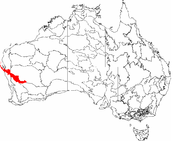
Interim Biogeographic Regionalisation for Australia
The Interim Biogeographic Regionalisation for Australia is a biogeographic regionalisation of Australia developed by the Australian Government's Department of the Environment, Water, Heritage and the Arts...
(IBRA) region in Western Australia
Western Australia
Western Australia is a state of Australia, occupying the entire western third of the Australian continent. It is bounded by the Indian Ocean to the north and west, the Great Australian Bight and Indian Ocean to the south, the Northern Territory to the north-east and South Australia to the south-east...
and part of the larger Southwest Australia savanna
Southwest Australia savanna
Southwest Australia savanna is an ecoregion in Western Australia.-Location and description:This dry region is a belt between the Mediterranean climate of the southwest corner and the semi-arid sandplains inland and to the north...
ecoregion
Ecoregion
An ecoregion , sometimes called a bioregion, is an ecologically and geographically defined area that is smaller than an ecozone and larger than an ecosystem. Ecoregions cover relatively large areas of land or water, and contain characteristic, geographically distinct assemblages of natural...
.
In the IBRA system it has the code of (YAL), and it has two sub-regions:
- Tallering sub-region (YAL2)
- Edel sub region (YAL1) which is a significant component of the Shark Bay, Western AustraliaShark Bay, Western AustraliaShark Bay is a World Heritage Site in the Gascoyne region of Western Australia. It is an area centred approximately on , 800 kilometres north of Perth, on the westernmost point of Australia. An expedition led by Dirk Hartog happened upon the area in 1616, becoming the second group of Europeans...
World Heritage area.
Further reading
- Thackway, R and I D Cresswell (1995) An interim biogeographic regionalisation for Australia : a framework for setting priorities in the National Reserves System Cooperative Program Version 4.0 Canberra : Australian Nature Conservation Agency, Reserve Systems Unit, 1995. ISBN 0642213712