


Xmonad

Encyclopedia
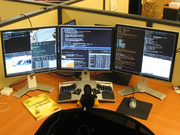
xmonad is a tiling window manager
for the X Window System
, written in the functional programming language
Haskell
.
Begun in March 2007, it is similar to dwm
, larswm
, StumpWM and other members of the tiling window manager
family, in that it arranges windows in a nonoverlapping tiled pattern and strives to make it possible for the user to productively manage windows without the use of the mouse
. Xmonad is packaged
and distributed on a wide range of Unix-like
operating systems, such as Arch Linux
, Debian
, Ubuntu
, Gentoo
, Source Mage, NixOS, FreeBSD
, NetBSD
, OpenBSD
, and Mac OS X
.
While originally a clone
of dwm (derivative in areas such as default keybindings), xmonad now supports features not available to dwm users such as per-workspace layout, tiling reflection, state preservation, layout mirroring, GNOME
support and per-screen status bars; it can be customised by modifying an external configuration file and 'reloaded' while running. XMonad features have begun to influence other tiling window managers - dwm has borrowed "urgency hooks" from XMonad, has also included Xinerama
support (for multihead displays) with release 4.8, and patches exist to reimplement XMonad's Fibonacci layout.
Extensions to the core system, including emulation of other window managers and unusual layout algorithms, such as window tiling
based on the Fibonacci spiral
, have been implemented by the active community and are available as a library.
In addition to obviating the need for the mouse, the xmonad developers make heavy use of semi-formal methods
and program derivation
for improving reliability and enabling a total line of code
count less than 1200, as of version 0.7; window manager properties (such as the behavior of window focus) are checked through use of QuickCheck
. This emphasis makes xmonad unusual in a number of ways; besides being the first window manager written in Haskell, it is also the first to use the zipper
data structure
for automatically managing focus
, and its core has been proven to be safe with respect to pattern matches
, contributing further to reliability. The developers write:
It makes use of Haskell features and tools such as: QuickCheck, GHC
extensions like pattern guards
, monads
, monad transformer
s, zippers, and the Cabal
packaging system, in addition to Haskell bindings to Xlib
and xft
fonts (with rebinding to XCB
planned when the Haskell bindings are released).
Tiling window manager
In computing, a tiling window manager is a window manager with an organization of the screen into mutually non-overlapping frames, as opposed to the more popular approach of coordinate-based stacking of overlapping objects that tries to fully emulate the desktop metaphor.-Xerox PARC:Although the...
for the X Window System
X Window System
The X window system is a computer software system and network protocol that provides a basis for graphical user interfaces and rich input device capability for networked computers...
, written in the functional programming language
Functional programming
In computer science, functional programming is a programming paradigm that treats computation as the evaluation of mathematical functions and avoids state and mutable data. It emphasizes the application of functions, in contrast to the imperative programming style, which emphasizes changes in state...
Haskell
Haskell (programming language)
Haskell is a standardized, general-purpose purely functional programming language, with non-strict semantics and strong static typing. It is named after logician Haskell Curry. In Haskell, "a function is a first-class citizen" of the programming language. As a functional programming language, the...
.
Begun in March 2007, it is similar to dwm
Dwm
dwm is a dynamic tiling window manager for X11 exhibiting the principles of minimalism which is known for having influenced the development of other window managers, including xmonad and awesome. It is externally similar to wmii, but internally much simpler. dwm is written purely in C and, for...
, larswm
Larswm
larswm is a window manager for the X window system that follows the tiling window manager paradigm. Using ideas from the older 9wm window manager, it features automatic tiling and virtual desktops. It also borrows other ideas, for example a limited form of plumbing, from the Acme development...
, StumpWM and other members of the tiling window manager
Tiling window manager
In computing, a tiling window manager is a window manager with an organization of the screen into mutually non-overlapping frames, as opposed to the more popular approach of coordinate-based stacking of overlapping objects that tries to fully emulate the desktop metaphor.-Xerox PARC:Although the...
family, in that it arranges windows in a nonoverlapping tiled pattern and strives to make it possible for the user to productively manage windows without the use of the mouse
Mouse (computing)
In computing, a mouse is a pointing device that functions by detecting two-dimensional motion relative to its supporting surface. Physically, a mouse consists of an object held under one of the user's hands, with one or more buttons...
. Xmonad is packaged
Package management system
In software, a package management system, also called package manager, is a collection of software tools to automate the process of installing, upgrading, configuring, and removing software packages for a computer's operating system in a consistent manner...
and distributed on a wide range of Unix-like
Unix-like
A Unix-like operating system is one that behaves in a manner similar to a Unix system, while not necessarily conforming to or being certified to any version of the Single UNIX Specification....
operating systems, such as Arch Linux
Arch Linux
Arch Linux is an independently developed, Linux-based operating system for i686 and x86-64 computers. It is composed predominantly of free and open source software, and supports community involvement....
, Debian
Debian
Debian is a computer operating system composed of software packages released as free and open source software primarily under the GNU General Public License along with other free software licenses. Debian GNU/Linux, which includes the GNU OS tools and Linux kernel, is a popular and influential...
, Ubuntu
Ubuntu (operating system)
Ubuntu is a computer operating system based on the Debian Linux distribution and distributed as free and open source software. It is named after the Southern African philosophy of Ubuntu...
, Gentoo
Gentoo Linux
Gentoo Linux is a computer operating system built on top of the Linux kernel and based on the Portage package management system. It is distributed as free and open source software. Unlike a conventional software distribution, the user compiles the source code locally according to their chosen...
, Source Mage, NixOS, FreeBSD
FreeBSD
FreeBSD is a free Unix-like operating system descended from AT&T UNIX via BSD UNIX. Although for legal reasons FreeBSD cannot be called “UNIX”, as the direct descendant of BSD UNIX , FreeBSD’s internals and system APIs are UNIX-compliant...
, NetBSD
NetBSD
NetBSD is a freely available open source version of the Berkeley Software Distribution Unix operating system. It was the second open source BSD descendant to be formally released, after 386BSD, and continues to be actively developed. The NetBSD project is primarily focused on high quality design,...
, OpenBSD
OpenBSD
OpenBSD is a Unix-like computer operating system descended from Berkeley Software Distribution , a Unix derivative developed at the University of California, Berkeley. It was forked from NetBSD by project leader Theo de Raadt in late 1995...
, and Mac OS X
Mac OS X
Mac OS X is a series of Unix-based operating systems and graphical user interfaces developed, marketed, and sold by Apple Inc. Since 2002, has been included with all new Macintosh computer systems...
.
While originally a clone
Clone (computer science)
In computing, a clone is a hardware or software system that is designed to mimic another system. Compatibility with the original system is usually the explicit purpose of cloning hardware or low-level software such as operating systems...
of dwm (derivative in areas such as default keybindings), xmonad now supports features not available to dwm users such as per-workspace layout, tiling reflection, state preservation, layout mirroring, GNOME
GNOME
GNOME is a desktop environment and graphical user interface that runs on top of a computer operating system. It is composed entirely of free and open source software...
support and per-screen status bars; it can be customised by modifying an external configuration file and 'reloaded' while running. XMonad features have begun to influence other tiling window managers - dwm has borrowed "urgency hooks" from XMonad, has also included Xinerama
Xinerama
Xinerama is an extension to the X Window System which enables multi-headed X applications and window managers to use two or more physical displays as one large virtual display.It was originally developed by Madeline T...
support (for multihead displays) with release 4.8, and patches exist to reimplement XMonad's Fibonacci layout.
Extensions to the core system, including emulation of other window managers and unusual layout algorithms, such as window tiling
Tessellation
A tessellation or tiling of the plane is a pattern of plane figures that fills the plane with no overlaps and no gaps. One may also speak of tessellations of parts of the plane or of other surfaces. Generalizations to higher dimensions are also possible. Tessellations frequently appeared in the art...
based on the Fibonacci spiral
Fibonacci number
In mathematics, the Fibonacci numbers are the numbers in the following integer sequence:0,\;1,\;1,\;2,\;3,\;5,\;8,\;13,\;21,\;34,\;55,\;89,\;144,\; \ldots\; ....
, have been implemented by the active community and are available as a library.
In addition to obviating the need for the mouse, the xmonad developers make heavy use of semi-formal methods
Formal methods
In computer science and software engineering, formal methods are a particular kind of mathematically-based techniques for the specification, development and verification of software and hardware systems...
and program derivation
Program derivation
In computer science, program derivation is the derivation of a program from its specification, by mathematical means.To derive a program means to write a formal specification, which is usually non-executable, and then apply mathematically correct rules in order to obtain an executable program...
for improving reliability and enabling a total line of code
Source lines of code
Source lines of code is a software metric used to measure the size of a software program by counting the number of lines in the text of the program's source code...
count less than 1200, as of version 0.7; window manager properties (such as the behavior of window focus) are checked through use of QuickCheck
QuickCheck
QuickCheck is a combinator library written in Haskell, designed to assist in software testing by generating test cases for test suites. It is compatible with the GHC compiler and the Hugs interpreter....
. This emphasis makes xmonad unusual in a number of ways; besides being the first window manager written in Haskell, it is also the first to use the zipper
Zipper (data structure)
A zipper is a technique of representing an aggregate data structure so that it is convenient for writing programs that traverse the structure arbitrarily and update its contents, especially in purely functional programming languages. The zipper was described by Gérard Huet in 1997...
data structure
Data structure
In computer science, a data structure is a particular way of storing and organizing data in a computer so that it can be used efficiently.Different kinds of data structures are suited to different kinds of applications, and some are highly specialized to specific tasks...
for automatically managing focus
Focus (computing)
In computing, the focus indicates the component of the graphical user interface which is currently selected to receive input. Text entered at the keyboard or pasted from a clipboard is sent to the component which currently has the focus. Moving the focus away from a specific user interface element...
, and its core has been proven to be safe with respect to pattern matches
Pattern matching
In computer science, pattern matching is the act of checking some sequence of tokens for the presence of the constituents of some pattern. In contrast to pattern recognition, the match usually has to be exact. The patterns generally have the form of either sequences or tree structures...
, contributing further to reliability. The developers write:
"xmonad is a tiling window manager for the X Window system, implemented, configured and dynamically extensible in Haskell. This demonstration presents the case that software dominated by side effects can be developed with the precision and efficiency we expect from Haskell by utilising purely functional data structures, an expressive type system, extended static checking and property-
based testing. In addition, we describe the use of Haskell as an application configuration and extension language."
It makes use of Haskell features and tools such as: QuickCheck, GHC
Glasgow Haskell Compiler
The Glorious Glasgow Haskell Compilation System, more commonly known as the Glasgow Haskell Compiler or GHC, is an open source native code compiler for the functional programming language Haskell. The lead developers are Simon Peyton Jones and Simon Marlow...
extensions like pattern guards
Guard (computing)
In computer programming, a guard is a boolean expression that must evaluate to true if the program execution is to continue in the branch in question. The term is used at least in Haskell, Clean, Erlang, occam, Promela, OCaml and Scala programming languages. In Mathematica, guards are called...
, monads
Monads in functional programming
In functional programming, a monad is a programming structure that represents computations. Monads are a kind of abstract data type constructor that encapsulate program logic instead of data in the domain model...
, monad transformer
Monad transformer
In functional programming, a monad transformer is a type constructor which takes a monad as an argument and returns a monad as a result.Monad transformers can be used to compose features encapsulated by monads - such as state, exception handling, and I/O - in a modular way...
s, zippers, and the Cabal
Cabal (software)
The Haskell Cabal is the Common Architecture for Building Applications and Libraries; it aids in the packaging and distribution of software packages...
packaging system, in addition to Haskell bindings to Xlib
Xlib
Xlib is an X Window System protocol client library written in the C programming language. It contains functions for interacting with an X server. These functions allow programmers to write programs without knowing the details of the protocol...
and xft
Xft
Xft, the X FreeType interface library, is a free computer program library written by Keith Packard. As of version 2.1, it is licensed under a quasi-BSD license....
fonts (with rebinding to XCB
XCB
In computing, XCB is a C language binding for the X Window System. It is implemented as free software and aims to replace Xlib. The project was started in 2001 by Bart Massey....
planned when the Haskell bindings are released).
External links
- xmonad.org - Official Site
- "xmonad - tiling window manager" - Using xmonad on Ubuntu.
- "Taste of Haskell" - OSCONO'Reilly Open Source ConventionThe O'Reilly Open Source Convention is an annual convention for the discussion of free and open source software. It is organized by the publisher O'Reilly Media and is held each summer in the United States.-Notable events:...
presentation by Simon Peyton JonesSimon Peyton JonesSimon Peyton Jones is a British computer scientist who researches the implementation and applications of functional programming languages, particularly lazy functional languages...
on Haskell, using xmonad as an example- First half of talk (video)
- Second half of talk (video)
- Bits and Bytes: xmonad
- "Roll Your Own Haskell Window Manager: Part 1: Defining a Model"
- "Roll Your Own Window Manager: Tracking Focus with a Zipper"
- Haskell Communities and Activities Report - 13th edition; XMonad
- Don Stewart demo