

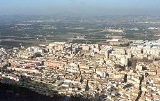
Xàtiva

Encyclopedia
Xàtiva (ˈʃativa) is a town in eastern Spain
, in the province of Valencia, on the right (western) bank of the river Albaida and at the junction of the Valencia–Murcia
and Valencia Albacete
railways.
There is a brisk local trade in grain, fruit, wine, olive oil and rice.
The leading local football club is CD Olimpic Xàtiva
.
 Xàtiva (Saetabis in Latin) was famous in Roman times for its silk fabrics, mentioned by the Latin poets Ovid and Catullus. Xàtiva is also known as an early European center of paper manufacture
. In the 12th century, Arabs
brought the technology to manufacture paper
to Xàtiva.
It is the birthplace of two popes, Callixtus III and Alexander VI, and also the painter José Ribera
Spagnoletto. it suffered a dark moment in its history at the hands of Philip V of Spain
, who, after his victory in the Battle of Almansa
in the War of the Spanish Succession
, ordered the city to be burned. The name was changed to San Felipe. In memory of the insult, the portrait of the monarch hangs upside down in the local museum of L'Almodí.
Xàtiva was briefly a provincial capital under the shortlived 1822 territorial division of Spain
, during the Trienio Liberal. The Province of Játiva
was revoked with the return to absolutism
in 1823.
Its collegiate church, dating from 1414, but rebuilt about a century later in the Renaissance style, was formerly a cathedral, and is the chief among many churches and convents. The town-hall and a church on the castle hill are partly constructed of inscribed Roman masonry, and several houses date from the Moorish period.
Other sights include:
Spain
Spain , officially the Kingdom of Spain languages]] under the European Charter for Regional or Minority Languages. In each of these, Spain's official name is as follows:;;;;;;), is a country and member state of the European Union located in southwestern Europe on the Iberian Peninsula...
, in the province of Valencia, on the right (western) bank of the river Albaida and at the junction of the Valencia–Murcia
Murcia
-History:It is widely believed that Murcia's name is derived from the Latin words of Myrtea or Murtea, meaning land of Myrtle , although it may also be a derivation of the word Murtia, which would mean Murtius Village...
and Valencia Albacete
Albacete
Albacete is a city and municipality in southeastern Spain, 258 km southeast of Madrid, the capital of the province of Albacete in the autonomous community of Castile-La Mancha. The municipality had a population of c. 169,700 in 2009....
railways.
There is a brisk local trade in grain, fruit, wine, olive oil and rice.
The leading local football club is CD Olimpic Xàtiva
CD Olimpic Xativa
Club Deportivo Olímpic de Xàtiva is a Spanish football team based in Xàtiva, in the Valencian Community. Founded in 1932, it currently plays in Segunda División B – Group 3, holding home games at Campo de Futbol La Murta.-History:...
.
History
Papermaking
Papermaking is the process of making paper, a substance which is used universally today for writing and packaging.In papermaking a dilute suspension of fibres in water is drained through a screen, so that a mat of randomly interwoven fibres is laid down. Water is removed from this mat of fibres by...
. In the 12th century, Arabs
Al-Andalus
Al-Andalus was the Arabic name given to a nation and territorial region also commonly referred to as Moorish Iberia. The name describes parts of the Iberian Peninsula and Septimania governed by Muslims , at various times in the period between 711 and 1492, although the territorial boundaries...
brought the technology to manufacture paper
Paper
Paper is a thin material mainly used for writing upon, printing upon, drawing or for packaging. It is produced by pressing together moist fibers, typically cellulose pulp derived from wood, rags or grasses, and drying them into flexible sheets....
to Xàtiva.
It is the birthplace of two popes, Callixtus III and Alexander VI, and also the painter José Ribera
José Ribera
Jusepe de Ribera, probably an italianization of Josep de Ribera was a Spanish Tenebrist painter and printmaker, also known as José de Ribera in Spanish and as Giuseppe Ribera in Italian. He was also called by his contemporaries and early writers Lo Spagnoletto, or "the Little Spaniard"...
Spagnoletto. it suffered a dark moment in its history at the hands of Philip V of Spain
Philip V of Spain
Philip V was King of Spain from 15 November 1700 to 15 January 1724, when he abdicated in favor of his son Louis, and from 6 September 1724, when he assumed the throne again upon his son's death, to his death.Before his reign, Philip occupied an exalted place in the royal family of France as a...
, who, after his victory in the Battle of Almansa
Battle of Almansa
The Battle of Almansa, fought on 25 April 1707, was one of the most decisive engagements of the War of the Spanish Succession. At Almansa, the Franco–Spanish army under Berwick soundly defeated the allied forces of Portugal, England, and the United Provinces led by the Earl of Galway,...
in the War of the Spanish Succession
War of the Spanish Succession
The War of the Spanish Succession was fought among several European powers, including a divided Spain, over the possible unification of the Kingdoms of Spain and France under one Bourbon monarch. As France and Spain were among the most powerful states of Europe, such a unification would have...
, ordered the city to be burned. The name was changed to San Felipe. In memory of the insult, the portrait of the monarch hangs upside down in the local museum of L'Almodí.
Xàtiva was briefly a provincial capital under the shortlived 1822 territorial division of Spain
1822 territorial division of Spain
The 1822 territorial division of Spain was a rearrangement of the territory of Spain into various provinces, enacted briefly during the Trienio Liberal of 1820–1823...
, during the Trienio Liberal. The Province of Játiva
Province of Játiva
The Province of Játiva was a province of Spain created in the 1822 territorial division of Spain , during the Trienio Liberal of 1820–1823. Its population of 164,795 represented 1.41% of the total Spanish population of the time. Its capital was Játiva...
was revoked with the return to absolutism
Absolute monarchy
Absolute monarchy is a monarchical form of government in which the monarch exercises ultimate governing authority as head of state and head of government, his or her power not being limited by a constitution or by the law. An absolute monarch thus wields unrestricted political power over the...
in 1823.
Main sights
Xàtiva is built on the margin of a fertile plain, and on the southern slopes of the Monte Bernisa, a hill with two peaks, each surmounted by a Castle of Xàtiva.Its collegiate church, dating from 1414, but rebuilt about a century later in the Renaissance style, was formerly a cathedral, and is the chief among many churches and convents. The town-hall and a church on the castle hill are partly constructed of inscribed Roman masonry, and several houses date from the Moorish period.
Other sights include:
- the Royal Monastery of the Assumption, Gothic and Baroque style, built during the 14th century and renovated in the 16th–18th centuries.
- Church of St. Felix (13th century)
- Church of St. Peter (14th century). The interior has a cofferCofferA coffer in architecture, is a sunken panel in the shape of a square, rectangle, or octagon in a ceiling, soffit or vault...
decorated in Gothic-Mudéjar style. - Hermitage of St. Anne (14th century), in Gothic style
- Almodí, a 14th century Gothic edifice (1530–1548) now housing a Museum