


Workover

Encyclopedia
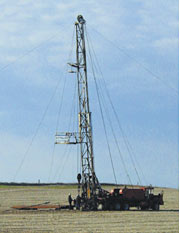
Oil well
An oil well is a general term for any boring through the earth's surface that is designed to find and acquire petroleum oil hydrocarbons. Usually some natural gas is produced along with the oil. A well that is designed to produce mainly or only gas may be termed a gas well.-History:The earliest...
intervention
Well intervention
A well intervention, or 'well work', is any operation carried out on an oil or gas well during, or at the end of its productive life, that alters the state of the well and or well geometry, provides well diagnostics or manages the production of the well....
involving invasive techniques, such as wireline
Wireline
In the oil and gas industry, the term wireline usually refers to a cabling technology used by operators of oil and gas wells to lower equipment or measurement devices into the well for the purposes of well intervention and reservoir evaluation....
, coiled tubing
Coiled tubing
In the oil and gas industries, coiled tubing refers to metal piping, normally 1" to 3.25" in diameter, used for interventions in oil and gas wells and sometimes as production tubing in depleted gas wells, which comes spooled on a large reel. Coiled tubing is often used to carry out operations...
or snubbing
Snubbing
See snubber for a device used to suppress voltage transients in electrical systemsSnubbing is a type of heavy well intervention performed on oil and gas wells. It involves running the BHA on a pipe string using a hydraulic workover rig...
. More specifically though, it will refer to the expensive process of pulling and replacing a completion
Completion (oil and gas wells)
In petroleum production, completion is the process of making a well ready for production . This principally involves preparing the bottom of the hole to the required specifications, running in the production tubing and its associated down hole tools as well as perforating and stimulating as...
.
Reason to perform a workover
Workovers rank among the most complex, difficult and expensive types of wellwork there is. They are only performed if the completion of a well is terminally unsuitable for the job at hand. The production tubingProduction tubing
Production tubing is a tube used in a wellbore through which production fluids are produced .Production tubing is run into the drilled well after the casing is run and cemented in place. Production tubing protects wellbore casing from wear, tear, corrosion, and deposition of by-products, such as...
may have become damaged due to operational factors like corrosion to the point where well integrity is threatened. Downhole components such as tubing retrievable downhole safety valve
Downhole safety valve
A downhole safety valve refers to a component on an oil and gas well, which acts as a failsafe to prevent the uncontrolled release of reservoir fluids in the event of a worst case scenario surface disaster...
s or electrical submersible pumps may have malfunctioned, needing replacement.
In other circumstances, the reason for a workover may not be that the completion itself is in a bad condition, but that changing reservoir
Oil reservoir
A petroleum reservoir, or oil and gas reservoir, is a subsurface pool of hydrocarbons contained in porous or fractured rock formations. The naturally occurring hydrocarbons, such as crude oil or natural gas, are trapped by overlying rock formations with lower permeability...
conditions make it unsuitable. For example, a high productivity well may have been completed with 5½" tubing to allow high flow rates (a narrower tubing would have unnecessarily choked the flow). Some years on, declining productivity means the reservoir can no longer support stable flow through this wide bore. This may lead to a workover to replace the 5½" tubing with 4½" tubing. The narrower bore makes for a more stable flow.
Operation
Before any workover, the well must first be killedWell kill
A well kill is the operation of placing a column of heavy fluid into a well bore in order to prevent the flow of reservoir fluids without the need for pressure control equipment at the surface. It works on the principle that the weight of the "kill fluid" or "kill mud" will be enough to suppress...
. Since workovers are long planned in advance, there would be much time to plan the well kill
Well kill
A well kill is the operation of placing a column of heavy fluid into a well bore in order to prevent the flow of reservoir fluids without the need for pressure control equipment at the surface. It works on the principle that the weight of the "kill fluid" or "kill mud" will be enough to suppress...
and so the reverse circulation would be common. The intense nature of this operation often requires no less than the capabilities of a drilling rig
Drilling rig
A drilling rig is a machine which creates holes or shafts in the ground. Drilling rigs can be massive structures housing equipment used to drill water wells, oil wells, or natural gas extraction wells, or they can be small enough to be moved manually by one person...
.
The workover begins by removing the wellhead and possibly the flow line then lifting the tubing hanger
Tubing hanger
A tubing hanger is a component used in the completion of oil and gas production wells. It is set in the tree or the wellhead and suspends the production tubing and/or casing. Sometimes it provides porting to allow the communication of hydraulic, electric and other downhole functions, as well as...
from the casing head and thus beginning to pull the completion out of the well. The string will almost always be fixed in place by at least one production packer
Production packer
A production packer is a standard component of the completion hardware of oil or gas wells used to provide a seal between the outside of the production tubing and the inside of the casing, liner, or wellbore wall....
. If the packer is retrievable it can be released easily enough and pulled out with the completion string. If it is permanent, then it is common to cut the tubing just above it and pull out the upper portion of the string. If necessary, the packer and the tubing left in hole can be milled out, though more commonly, the new completion will make use of it by setting a new packer just above it and running new tubing down to the top of the old.
Workovers on casing
Although less exposed to wellbore fluids, casing stringsCasing (oil well)
Casing is large diameter pipe that is assembled and inserted into a recently drilled section of a borehole and typically held into place with cement.-Purpose:Casing that is cemented in place aids the drilling process in several ways:...
too have been known to lose integrity. On occasion, it may be deemed economical to pull and replace it. Because casing strings are cemented in place, this is significantly more difficult and expensive than replacing the completion string. If in some instances the casing cannot be removed from the well, it may be necessary to sidetrack the offending area and recomplete, also an expensive process. For all but the most productive well, replacing casing would never be economical.