
All Topics  
Woodworking joints


   Email Print
   Bookmark   Link


Woodworking joints


Joinery is that part of woodworking
Woodworking

Woodworking is the process of building, making or carving something using wood....
 that involves joining together pieces of wood, to create furniture, structures, toys, and other items. Some wood joints employ fasteners, bindings, or adhesives, while others use only wood elements. The characteristics of wooden joints - strength, flexibility, toughness, etc. - derive from the properties of the joining materials and from how they are used in the joints.


Discussion
Ask a question about 'Woodworking joints'
Start a new discussion about 'Woodworking joints'
Answer questions from other users
Full Discussion Forum


Recent Posts


Encyclopedia


Joinery is that part of woodworking
Woodworking

Woodworking is the process of building, making or carving something using wood....
 that involves joining together pieces of wood, to create furniture, structures, toys, and other items. Some wood joints employ fasteners, bindings, or adhesives, while others use only wood elements. The characteristics of wooden joints - strength, flexibility, toughness, etc. - derive from the properties of the joining materials and from how they are used in the joints. Therefore, different joinery techniques are used to meet differing requirements. For example, the joinery used to build a house
House

A house generally refers to a or building that is a dwelling or place for habitation by humans. The term includes many kinds of dwellings ranging from rudimentary huts of nomadic tribes to high-rise apartment buildings....
 is different from that used to make puzzle
Puzzle

A puzzle is a problem or enigma that tests the ingenuity of the solver. In a basic puzzle one is intended to piece together objects in a logical way in order to come up with the desired shape, picture or solution....
 toys, although some concepts overlap.

Traditional Joinery

Many traditional wood joinery techniques use the distinctive material properties of wood
Wood

Wood is an organic material; in the strict sense wood is produced as secondary xylem in the stems of woody plants, notably trees but also shrubs, etc....
, often without resorting to mechanical fasteners or adhesives. While every culture in which pieces of wood are joined together to make furniture or structures has a joinery tradition, wood joinery techniques have been especially well documented and celebrated in the Chinese
Ancient Chinese wooden architecture

Ancient Chinese wooden architecture is the least studied of any of the world's great architectural traditions from the western point of view, and its study is relatively new....
, Europe
Europe

Europe is, conventionally, one of the world's seven continents. Comprising the westernmost peninsula of Eurasia, Europe is generally divided from Asia to its east by the water divide of the Ural Mountains, the Ural , the Caspian Sea, and by the Caucasus Mountains to the southeast....
an, and Japanese traditions. The Japanese and Chinese traditions in particular include hundreds of types of joints, many of which do not use glue
Adhesive

Adhesive or glue is a compound in a liquid or semi-liquid state that adhesion or bonds items together. Adhesives may come from either natural or Chemical synthesis sources....
 or nails
Nail (engineering)

In engineering, woodworking and construction, a nail is a Pin -shaped, sharp object of hard metal, typically steel, used as a fastener. Nails for specialized purposes may also be made of stainless steel, brass or aluminium....
. The Chinese have been using this method for the last seven thousand years.

Properties of wood

Many wood joinery techniques either depend upon or compensate for the fact that wood is anisotropic: its material properties are different along different dimensions.

Joining wood parts together must take this into account, otherwise the joint is destined to fail. Gluing boards with the grain running perpendicular to each other is often the reason for split boards, or broken joints. Furniture from the 18th century, while made by master craftsmen, did not take this into account. The result is this masterful work suffers from broken bracket feet, which was often attached with a glue block which ran perpendicular to the base pieces. The glue blocks were fastened with both glue and nails, resulting in unequal expansion and contraction between the pieces. This was also the cause of splitting of wide boards, which were commonly used during that period.

In modern woodworking it is even more critical, as heating and air conditioning cause major changes in the moisture content of the wood. All woodworking joints must take these changes into account, and allow for the resulting movement.

Strength

Wood is stronger when stressed along the grain
Wood grain

In speaking of wood the term grain is used, in several ways. Perhaps most important is that in woodworking techniques . In describing the application of a woodworking technique to a given piece of wood, the direction of the technique may be:...
 (longitudinally) than it is when stressed across the grain (radially and tangentially).

Dimensional Stability

Timber expands and contracts in response to humidity, usually much less so longitudinally than in the radial and tangential directions. As tracheophytes
Vascular plant

Vascular plants are those plants that have lignin tissue for conducting water, minerals, and photosynthetic products through the plant. Vascular plants include the ferns, clubmosses, flowering plants, conifers and other gymnosperms....
, trees have lignified tissues which transport resources such as water, minerals and photosynthetic products up and down the plant. While lumber from a harvested tree is no longer alive, these tissue still absorp and expel water causing swelling and shrinkage of the wood in kind with change in humidity. When the dimensional stability of the wood is paramount, quartersawn lumber is preferred because its grain pattern is consistent and thus reacts less to humidity.

Materials used for joining

  • Joints can be designed to hold without the use of glue or fasteners.
  • Glue
    Glue

    This is a list of various types of adhesive. Historically, the term "glue" only referred to protein colloids prepared from animal flesh. The meaning has been extended to refer to any fluid adhesive....
     is highly effective for joining wood when both surfaces of the joint are edge grain. A properly glued joint may be as strong as a single piece of wood. However, glue is ineffective on end-grain
    Wood grain

    In speaking of wood the term grain is used, in several ways. Perhaps most important is that in woodworking techniques . In describing the application of a woodworking technique to a given piece of wood, the direction of the technique may be:...
     surfaces. Compared to a mortise and tenon
    Mortise and tenon

    Simple and strong, the mortise and tenon Woodworking joints has been used for millennia by woodworkers around the world to join pieces of wood, usually when the pieces are at an angle close to 90?....
    , a dowel joint is a poor joint because it does not address these properties. Much of the surface of the hole of a dowel joint is end-grain, to which glue adheres poorly. In a mortise and tenon, most of the surface of the joint is longitudinal-grain. Animal glue
    Animal glue

    An animal glue is an adhesive that is created by prolonged boiling of animal connective tissue.These protein colloid glues are formed through hydrolysis of the collagen from skins, bones, tendons, and other tissues, similar to gelatin....
     is soluble in water, producing joints that can be disassembled using steam
    Steam

    In physical chemistry, and in engineering, steam refers to vaporized water. It is a pure, completely invisible gaseous phase . At standard temperature and pressure, pure steam occupies about 1,600 times the volume of an equal mass of liquid water....
     to soften the glue.
  • Various mechanical fastener
    Fastener

    A fastener is a hardware device that mechanically joins or affixes two or more objects together.Fasteners can also be used to close a container such as a bag, a box, or an envelope; or they may involve keeping together the sides of an opening of flexible material, attaching a Lid to a container, etc....
    s are used, the simplest being nails and screw
    Screw

    A screw is a shaft with a helix groove or screw thread formed on its surface and provision at one end to turn the screw. Its main uses are as a threaded fastener used to hold objects together, and as a simple machine used to translate torque into linear force....
    s. Glue and fasteners can be added together.


Types of joints

Some types of joints used include:
  • Biscuit joint
    Butt joint

    A butt joint is a Woodworking joints technique in which two members are joined by simply butting them together. The butt joint is the simplest joint to make since it merely involves cutting the members to the appropriate length and butting them together....
  • Bridle
    Bridle joint

    A bridle joint is a woodworking joint, similar to a mortise and tenon, in that a tenon is cut on the end of one member and a mortise is cut into the other to accept it....
  • Butt
    Butt joint

    A butt joint is a Woodworking joints technique in which two members are joined by simply butting them together. The butt joint is the simplest joint to make since it merely involves cutting the members to the appropriate length and butting them together....
  • Butterfly
    Butterfly joint

    A Butterfly joint is a type of Woodworking joints used either to hold two or more wooden boards together or to keep two halves of a board that have already started to split from splitting further....
  • Dowel
    Butt joint

    A butt joint is a Woodworking joints technique in which two members are joined by simply butting them together. The butt joint is the simplest joint to make since it merely involves cutting the members to the appropriate length and butting them together....
  • Coping
  • Cope and stick
    Cope and stick

    Cope and stick construction is a frame and panel technique often used in the making of doors, wainscoting, and other decorative features for Cabinet makings, furniture, and homes....
  • Dado
    Dado (joinery)

    A dado , housing or trench is a slot or trench cut into the surface of a piece of machinable material, usually wood. When viewed in cross-section, a dado has three sides....
     (US) or Housing Joint (UK)
  • Dougong
    Dougong

    Dougong is a unique structural element of interlocking wooden bracket , one of the most important elements in traditional Chinese architecture, Japanese architecture, and Korean architecture....
  • Dovetail
    Dovetail joint

    A dovetail joint or simply dovetail is a joint technique most commonly used in woodworking joints. Noted for its resistance to being pulled apart , the dovetail joint is commonly used to join for example the sides of a Drawer to the front....
  • Finger
    Finger joint

    The finger joint / is made by cutting a set of complementary rectangular cuts in two pieces of wood, which are then glued. To visualize a finger joint simply interlock the fingers of your hands at a ninety degree angle; hence the name "finger joint." It is stronger than a butt or lap joint, and often forms part of the overall look of the...
     (US) or box combing (UK)
  • Lap
    Lap joint

    In woodworking or metal fitting, a lap joint describes a technique for joining two pieces of material by overlapping them. A lap may be a full lap or half lap....
     (halving joint)
    • Cross-lap
      Lap joint

      In woodworking or metal fitting, a lap joint describes a technique for joining two pieces of material by overlapping them. A lap may be a full lap or half lap....
    • Halved joint
      Halved joint

      A halved joint is a woodworking joint in which the two members are joined by removing material from each at the point of intersection so that they overlap....
    • Dovetail-lap
      Lap joint

      In woodworking or metal fitting, a lap joint describes a technique for joining two pieces of material by overlapping them. A lap may be a full lap or half lap....
    • End-lap
      Lap joint

      In woodworking or metal fitting, a lap joint describes a technique for joining two pieces of material by overlapping them. A lap may be a full lap or half lap....
       (corner halving joint)
    • Middle-lap
      Lap joint

      In woodworking or metal fitting, a lap joint describes a technique for joining two pieces of material by overlapping them. A lap may be a full lap or half lap....
       (Tee halving joint)
  • Miter
    Miter joint

    A mitre or miter joint is a joint made by beveling each of two parts to be joined, usually at a 45? angle, to form a corner, usually a 90? angle....
     (mitre)
  • Mortise and tenon
    Mortise and tenon

    Simple and strong, the mortise and tenon Woodworking joints has been used for millennia by woodworkers around the world to join pieces of wood, usually when the pieces are at an angle close to 90?....
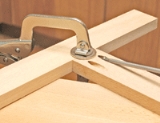
  • Pocket-Hole Joinery
  • Rabbet
    Rabbet

    A rabbet is a recess or groove cut into the edge of a piece of machineable material, usually wood. When viewed in cross-section, a rabbet is two-sided and open to the edge or end of the surface into which it is cut....
     (rebate)
  • Scarf
    Scarf joint

    A scarf joint is a method of joining two members end to end in woodworking or metalworking. The scarf joint is used when the material being joined is not available in the length required....
     (scarph)
  • Splice joint
    Splice joint

    A splice joint is a method of joining two members end to end in woodworking. The splice joint is used when the material being joined is not available in the length required....
  • Tongue and groove
    Tongue and groove

    Tongue and groove or T&G is a method of fitting similar objects together, edge to edge, used mainly with wood: flooring, parquetry, panelling, and similar constructions....
  • Frame and Panel
    Frame and panel

    Frame and panel construction is a woodworking technique often used in the making of doors, panelling, and other decorative features for Cabinet makings, furniture, and homes....
     (rail and stile)


Images of different types of joints


See also

  • Woodworking
    Woodworking

    Woodworking is the process of building, making or carving something using wood....
  • Cabinet making
    Cabinet making

    Cabinet making is the practice of utilizing various woodworking skills to create cabinets, shelving and furniture.Cabinet making involves techniques such as creating appropriate Woodworking joints, dado_, bevel, chamfer and shelving systems, the use of finishing tools such as Wood routers to create decorative edgings, and so on....
  • Building construction
  • Chinese Wooden Architecture
    Ancient Chinese wooden architecture

    Ancient Chinese wooden architecture is the least studied of any of the world's great architectural traditions from the western point of view, and its study is relatively new....
  • Timber framing
    Timber framing

    Timber framing , or Half-timbering, is the method of creating framed structures of heavy timber jointed together with pegged mortise and tenon joints....


Footnotes


External links

  • Pro Woodworking Tips - Woodworking Terms and Joints
  • - Practical information on creating various wood-working joints