
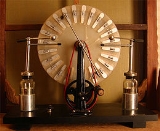
The
Wimshurst influence machine is an
electrostatic generatorAn electrostatic generator, or electrostatic machine, is a mechanical device that produces static electricity, or electricity at high voltage and low continuous current...
, a machine for generating high
voltageVoltage, otherwise known as electrical potential difference or electric tension is the difference in electric potential between two points — or the difference in electric potential energy per unit charge between two points...
s developed between 1880 and 1883 by
BritishThe United Kingdom of Great Britain and Northern IrelandIn the United Kingdom and Dependencies, other languages have been officially recognised as legitimate autochthonous languages under the European Charter for Regional or Minority Languages...
inventor
James WimshurstJames Wimshurst was an English inventor, engineer and shipwright. Though Wimshurst did not patent his machines and the various improvements that he made to them, his refinements to the electrostatic generator led to its becoming widely known as the Wimshurst machine.-Biography:Wimshurst was born...
(1832 – 1903).
It has a distinctive appearance with two large contra-rotating discs mounted in a vertical plane, two cross bars with metallic brushes, and a
spark gapA spark gap consists of an arrangement of two conducting electrodes separated by a gap usually filled with a gas such as air, designed to allow an electric spark to pass between the conductors. When the voltage difference between the conductors exceeds the gap's breakdown voltage, a spark forms,...
formed by two metal spheres.
Description
These machines belong to a class of generators called influence machines, which separate
electric chargeElectric charge is a physical property of matter that causes it to experience a force when near other electrically charged matter. Electric charge comes in two types, called positive and negative. Two positively charged substances, or objects, experience a mutual repulsive force, as do two...
s through
electrostatic inductionElectrostatic induction is a redistribution of electrical charge in an object, caused by the influence of nearby charges. Induction was discovered by British scientist John Canton in 1753 and Swedish professor Johan Carl Wilcke in 1762. Electrostatic generators, such as the Wimshurst machine, the...
, or
influence. Earlier machines in this class were developed by
Wilhelm HoltzWilhelm Holtz was a German physicist who was a native of Saatel bei Barth, Mecklenburg. Between 1857 and 1862 he studied physics and natural sciences in Berlin, Dijon and Edinburgh...
(1865 and 1867),
August ToeplerAugust Joseph Ignaz Toepler was a German physicist known for his experiments in electrostatics. In 1864 he applied Foucault's knife-edge test for telescope mirrors to the analysis of fluid flow and the shock wave. He named this new method schlieren photography, for which he is justifiably famous...
(1865), and J. Robert Voss (1880). The older machines were less efficient and exhibited an unpredictable tendency to switch their polarity. The Wimshurst did not have this defect.
In a Wimshurst machine, the two insulated discs and their metal sectors rotate in opposite directions passing the crossed metal neutralizer bars and their brushes. An imbalance of charges is induced, amplified, and collected by two pairs of metal combs with points placed near the surfaces of each disk. These collectors are mounted on insulating supports and connected to the output terminals. The positive feedback increases the accumulating charges exponentially until the dielectric breakdown voltage of the air is reached and an
electric sparkAn electric spark is a type of electrostatic discharge that occurs when an electric field creates an ionized electrically conductive channel in air producing a brief emission of light and sound. A spark is formed when the electric field strength exceeds the dielectric field strength of air...
jumps across the gap.
The machine is theoretically not self-starting, meaning that if none of the sectors on the discs has any electrical charge there is nothing to induce charges on other sectors. In practice, even a small residual charge on any sector is enough to start the process going once the discs start to rotate. The machine will only work satisfactorily in a dry atmosphere. It does require mechanical
powerIn physics, power is the rate at which energy is transferred, used, or transformed. For example, the rate at which a light bulb transforms electrical energy into heat and light is measured in watts—the more wattage, the more power, or equivalently the more electrical energy is used per unit...
to turn the disks against the electric field, and it is this energy that the machine converts into electric power. The output of the Wimshurst machine is essentially a constant current that is proportional to the area covered by the metal sectors and to the rotation speed. The insulation and the size of the machine determine the maximum output voltage that can be reached. The accumulated spark energy can be increased by adding a pair of
Leyden jarA Leyden jar, or Leiden jar, is a device that "stores" static electricity between two electrodes on the inside and outside of a jar. It was invented independently by German cleric Ewald Georg von Kleist on 11 October 1745 and by Dutch scientist Pieter van Musschenbroek of Leiden in 1745–1746. The...
s, an early type of
capacitorA capacitor is a passive two-terminal electrical component used to store energy in an electric field. The forms of practical capacitors vary widely, but all contain at least two electrical conductors separated by a dielectric ; for example, one common construction consists of metal foils separated...
suitable for high voltages, with the jars’ inner plates independently connected to each of the output terminals and the jars’ outer plates interconnected. A typical Wimshurst machine can produce sparks that are about a third of the disc's diameter in length and several tens of microamperes.
Operation
The two contra-rotating insulating discs (usually made of glass) have a number of metal sectors stuck onto them. The machine is provided with 4 small earthed brushes (2 on each side of the machine on conducting shafts at 90 degrees to each other), plus a pair of charge-collection combs. The conducting shafts that hold the brushes on a typical Wimshurst machine would form an 'X' on an x-ray photograph; the charge-collection combs are typically mounted along the horizontal and equally contact the outer edges of both front and back discs. The collection combs on each side are usually connected to respective Leyden jars.
Any small charge on either of the two discs suffices to begin the charging process. Suppose, therefore, that the back disc has a small, net electrostatic charge. For concreteness, assume this charge is positive and that A rotates counter-clockwise. As the charged sector rotates to the position of the brush next to disc B, it induces a polarization of charge on the conducting shaft holding the brush, attracting negative charge to the near side, so that positive charge accumulates on the far side (across the disc, 180 degrees away). The shaft's polarized charges attach to the nearest sectors on disc B, resulting in negative charge on B closest the original positive charge on A, and positive charge on the opposite side of B. As A continues to rotate, its charge is accumulated by the first charge-collection comb it encounters (after an additional 45-degree rotation).
As B rotates 90 degrees clockwise, the charges that have been induced on it line up with the brushes next to disc A. Naturally the charges on B induce the opposite polarization of the A-brushes' shaft (viz., negative next to positive and positive next to negative), and the shaft's polarization is transferred to its disc. Disc B keeps rotating and its charges are accumulated by the nearest charge-collection combs.
Disc A rotates 90 degrees so that its charges line up with the brush of disc B, where an opposite charge-polarization is induced on the B conducting shaft and the nearest sectors of B, similar to the description two paragraphs above.
The process repeats, with each charge polarization on A inducing polarization on B, inducing polarization on A, etc. All of these induced positive and negative charges are collected by combs to charge the Leyden jars, electrical charge-storage devices similar to capacitors. It is the mechanical energy required to separate the opposing charges on the adjacent sectors that provides the energy source for the electrical output.
External links