
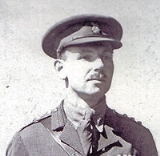
William Howard Livens DSOThe Distinguished Service Order is a military decoration of the United Kingdom, and formerly of other Commonwealth countries, awarded for meritorious or distinguished service by officers of the armed forces during wartime, typically in actual combat.The DSO was instituted on 6 September 1886 by...
MCThe Military Cross is the third level military decoration awarded to officers and other ranks of the British Armed Forces and formerly also to officers of other Commonwealth countries....
(28 March 1889 – 1 February 1964) was an engineer, a soldier in the
British ArmyThe British Army is the land armed forces branch of the British Armed Forces. It came into being with the unification of the Kingdoms of England and Scotland into the Kingdom of Great Britain in 1707. The new British Army incorporated Regiments that had already existed in England and Scotland and...
and an inventor particularly known for the design of
chemical warfareChemical warfare involves using the toxic properties of chemical substances as weapons to kill, injure, or incapacitate an enemy....
and flame warfare weapons. Resourceful and ingenious, Livens’ successful creations were characterised by being very practical and easy to produce in large numbers. In an obituary,
Sir Harold HartleySir Harold Brewer Hartley was a British physical chemist. He moved from academia to important positions in business and industry.He was educated at Mortimer College, Dulwich College, and Balliol College, Oxford...
said "Livens combined great energy and enterprise with a flair for seeing simple solutions and inventive genius."
Livens is best known for inventing the
Livens ProjectorThe Livens Projector was a simple mortar-like weapon that could throw large drums filled with inflammable or toxic chemicals. In World War One, the Livens Projector became the standard means of delivering gas attacks and it remained in the arsenal of the British army until the early years of the...
a simple mortar-like weapon that could throw large drums filled with inflammable or toxic chemicals. In World War One, the Livens Projector became the standard means of delivering gas attacks and it remained in the arsenal of the British army until the early years of the Second World War.
Early life
Livens' parents were Frederick Howard Livens (1854-1948) and Priscilla Abbott. They married on 9 October 1886 at the Upton Congregational Church. Frederick Howard Livens was Chief Engineer and later Chairman of
Ruston and HornsbyRuston was an industrial equipment manufacturer in Lincoln, England, the company's history going back to 1840. The company is best known as a manufacturer of narrow and standard gauge diesel locomotives and also of steam shovels. Other products included cars, steam locomotives and a range of...
in
LincolnLincoln is a cathedral city and county town of Lincolnshire, England.The non-metropolitan district of Lincoln has a population of around 101,000 - the 2001 census gave the entire urban area of Lincoln a population of 120,779...
. Frederick and Priscilla had three children, William Howard and two younger daughters.
In 1903, Livens was sent to
Oundle SchoolOundle School is a co-educational English public school located in the ancient market town of Oundle in Northamptonshire, England. The school has been maintained by the Worshipful Company of Grocers of the City of London since its foundation in 1556, making it one of the oldest surviving public...
, a famous
public schoolAn independent school in the United Kingdom is a school that is not financed by taxpayers or through the taxation system by local or national government, and is instead funded by private sources, predominantly in the form of tuition charges, gifts and long-term charitable endowments, and so not...
located in the ancient market town of
OundleOundle is an ancient market town on the River Nene in Northamptonshire, England, with a population of 5,345 or 5,674 . It is 80 miles north of London and 12 miles southwest of Peterborough.-History:...
in
NorthamptonshireNorthamptonshire is a landlocked county in the English East Midlands, with a population of 629,676 as at the 2001 census...
,
EnglandEngland is a country that is part of the United Kingdom. It shares land borders with Scotland to the north and Wales to the west; the Irish Sea is to the north west, the Celtic Sea to the south west and the North Sea to the east, with the English Channel to the south separating it from continental...
. While there, he enrolled in the Officer Training Corps (OTC) wherein he served with the rank of
sergeantSergeant is a rank used in some form by most militaries, police forces, and other uniformed organizations around the world. Its origins are the Latin serviens, "one who serves", through the French term Sergent....
.
On leaving school in 1908, Livens went to
Christ's CollegeChrist's College is a constituent college of the University of Cambridge.With a reputation for high academic standards, Christ's College has consistently finished in the top ten colleges in the Tompkins Table in recent years.-College history:...
at the
University of CambridgeThe University of Cambridge , located in the City of Cambridge, Cambridgeshire, United Kingdom, is the second oldest university in the English-speaking world and the fourth oldest in Europe...
from 1908 to October 1911. There he enrolled in the college OTC and served with the rank of
privateA Private is a soldier of the lowest military rank . The term dates from the Middle Ages, where privates were known as "private soldiers" who were either hired, conscripted, or feudalized into service by a nobleman forming an army...
and he was captain of the Cambridge rifle team. He was a
crack shotA marksman is a person who is skilled in precision shooting, using projectile weapons, such as with a rifle but most commonly with a sniper rifle, to shoot at small long-range targets. In the military, marksmen are sometimes attached to an infantry squad where they take accurate long-range shots at...
with a rifle, making a record score in a competition with a team from Oxford University and also an excellent shot with a pistol.
Livens trained as civil engineer, and was for a while an assistant editor for
Country LifeCountry Life is a British weekly magazine, based in London at 110 Southwark Street, and owned by media company IPC Media, a Time Warner subsidiary.- Topics :...
magazine. But, when the First World War started, he joined the British Army.
World War One
On 4 August 1914, on graduating from the Officer Training Corps, Livens applied for a commission in the
Royal EngineersThe Corps of Royal Engineers, usually just called the Royal Engineers , and commonly known as the Sappers, is one of the corps of the British Army. It provides combat engineering and other technical support to the British Armed Forces...
. He was enrolled as a
Second LieutenantSecond Lieutenant is the lowest commissioned officer military rank in many armed forces.In British English the rank is pronounced second /lɛf'tɛnənt/ , while in American English it is pronounced second /lu'tɛnənt/ ....
on 30 September 1914 and he was given a clerical post in the Motorcycle signalling section at
ChathamChatham Dockyard, located on the River Medway and of which two-thirds is in Gillingham and one third in Chatham, Kent, England, came into existence at the time when, following the Reformation, relations with the Catholic countries of Europe had worsened, leading to a requirement for additional...
. Livens experience of the OTC and his enthusiasm for target shooting prepared him well for at least some aspects of Army life:
Army life did not suppress Livens' creativity and he turned his mind to the problem of making better weapons. He fitted out makeshift laboratories at his Chatham barracks bedroom and in the officers' garage. For a firing rage he used vacant land near one of the old forts which overlooked the Thames estuary. Here he worked on developing flame throwers and small mortars to throw oil and gas.
Livens' inventive work was prompted by thoughts of revenge for perceived German atrocities. According to
Simon JonesSimon Jones may refer to:*Simon Jones , British actor *Simon Jones , Welsh cricketer who plays for England...
' book
World War I Gas Warfare Tactics and Equipment, on learning that, apparently, his wife had been killed when the luxury liner
RMS LusitaniaRMS Lusitania was an ocean liner owned by the Cunard Line and built by John Brown and Company of Clydebank, Scotland, torpedoed by a German U-boat on 7 May 1915. The ship sank in 18 minutes, eight miles off the Old Head of Kinsale, Ireland, killing 1,198 of the 1,959 people aboard...
had been sunk by a German torpedo with the loss of 1,100 passengers and crew, he vowed to kill an equal number of Germans. It was to this end he began experimenting with gas and flame projectors of various types and continued in his work even after hearing that his wife had not, after all, been on board the Lusitania. Although this version of events is consistent with family tradition, the story about Livens' wife cannot be literally true because he did not get married until 1916; however, Charles Foulkes who became Livens' commanding officer and later wrote
Gas! The Story of the Special Brigade mentions "a strong personal feeling" connected with the sinking of the Lusitania without being more specific. According to
Who's Who in World War One by
John BourneJohn Bourne is a British artist and painter, living and working in Wales, and a member of the Stuckists art movement. He founded the Wrexham Stuckists group in 2001 and has been exhibited in the group's shows since then, including The Stuckists Punk Victorian. He has also taken part in Stuckist...
, it was the first use of
poison gasThe use of poison gas in World War I was a major military innovation. The gases ranged from disabling chemicals, such as tear gas and the severe mustard gas, to lethal agents like phosgene and chlorine. This chemical warfare was a major component of the first global war and first total war of the...
by the Germans at the
Second Battle of YpresThe Second Battle of Ypres was the first time Germany used poison gas on a large scale on the Western Front in World War I and the first time a former colonial force pushed back a major European power on European soil, which occurred in the battle of St...
on 22 April 1915 that prompted Livens' vengeful ambitions. This alternative account is consistent with Livens' later statement that he began his experimental work at the end of April 1915 whereas the Lusitania was sunk in May 1915.
Late in August 1915, Livens left Chatham to join one of the newly formed Royal Engineer Special Gas Companies where he was one of very few officers to have a background in engineering rather than chemistry. At the time, gas warfare was very primitive: heavy
cylindersA gas cylinder or tank is a pressure vessel used to store gases at high pressure. Gases stored this way are called bottled gases.-Regulations and testing:...
of poison gas were manhandled to the front trenches and their contents simply vented out through metal pipes relying on a breeze to carry the toxic cloud over the enemy trenches. But the wind could be fickle and a change in its direction at the first British gas attack at
LoosThe Battle of Loos was one of the major British offensives mounted on the Western Front in 1915 during World War I. It marked the first time the British used poison gas during the war, and is also famous for the fact that it witnessed the first large-scale use of new army or "Kitchener's Army"...
was a disaster. Livens developed the use of long rubber hoses to carry the gas to an optimum location for release and of a
manifoldA manifold, in systems for moving fluids or gases is a junction of pipes or channels, typically bringing one into many or many into one.-Applications:*Heated-manifold direct-injection die casting for zinc die casting....
that reduced the number of parapet pipes by connecting four cylinders to a single pipe, these improvements helped make the system more reliable. Major-General Foulkes described him as a "go getter", but also as unfamiliar with military protocol. Foulkes later recalled Livens' part in the preparation of a gas attack on the
Hohenzollern RedoubtThe Hohenzollern Redoubt, near to Auchy-les-Mines in France, was a German fortification on the Western Front in World War I.- Introduction :...
:
Livens was soon put in charge of Z company, a special unit that was given the responsibility of developing a British version of the German flamethrower that had recently been deployed on the Western Front. Livens' massive fixed flame projector was used on 1 July 1916 at the start of the Battle of the Somme. Impressive as it was, the limited range and the immobility of the weapon severely limited its usefulness and the project was abandoned.
One day, during an attack on the Somme, Z company encountered a party of Germans who were well dug in. Grenades did not succeed in shifting them, so Livens threw in two five gallon oil drums; the burning oil was so effective that Livens' comrade, Harry Strange, wondered whether it would be better to use containers to carry the flame to the enemy rather than relying on a complex flame thrower. Reflecting on the incident, Livens and Strange considered how a really large shell filled with fuel might be thrown. Although the key idea of throwing a large container of oil was due to Strange, it was Livens who went on to develop a large, but simple, mortar that could throw a three gallon drum of oil which would burst when it landed...
Livens' new weapon was used for the first time on the morning of 23 July 1916: twenty oil projectors were fired just before an attack in the battle of the Somme at
PozièresThe Battle of Pozières was a two week struggle for the French village of Pozières and the ridge on which it stands, during the middle stages of the 1916 Battle of the Somme. Though British divisions were involved in most phases of the fighting, Pozières is primarily remembered as an Australian battle...
– the effect was limited. Next, thirty projectors were fired at the eastern corner of
High WoodHigh Wood is a small forest near Bazentin le Petit in the Somme département of northern France which was the scene of intense fighting for two months from 14 July to 15 September, 1916 during the Battle of the Somme.-Background:...
on the 18 August with more encouraging results and another attack on 3 September was highly successful.
Following these attacks, Livens came to the attention of
General GoughGeneral Sir Hubert de la Poer Gough GCB, GCMG, KCVO was a senior officer in the British Army, who commanded the British Fifth Army from 1916 to 1918 during the First World War.-Background:...
who was impressed by his ideas and "wangled" everything that he needed. The new weapon was developed into the
Livens ProjectorThe Livens Projector was a simple mortar-like weapon that could throw large drums filled with inflammable or toxic chemicals. In World War One, the Livens Projector became the standard means of delivering gas attacks and it remained in the arsenal of the British army until the early years of the...
which consisted of a simple tube closed by a hemisphere at one end. It was half buried in the ground at an angle of 45 degrees and pointing in the required direction. It was then loaded with a single shot with an amount of propellant calculated to effect the desired range. Preparing a battery of projectors for an attack required a lot of preparation, this was not a serious problem in the conditions of static trench warfare and the weapon was so simple and inexpensive that hundreds – and on occasions thousands – of projectors could be fired simultaneously catching the enemy by surprise. Z Company rapidly developed the Livens Projector, increasing its range from the original , first to and they eventually produced an electrically triggered version with a range of .
The Livens Projector was modified to fire canisters of poison gas rather than oil. This system was tried in secret, at
ThiepvalThe Thiepval Memorial to the Missing of the Somme is a major war memorial to 72,090 missing British and Commonwealth men who died in the Battle of the Somme of the First World War and who have no known grave...
in September 1916 and
Beaumont-HamelBeaumont-Hamel is a commune in the Somme department in Picardie in northern France.-Population:-Beaumont-Hamel Newfoundland Memorial:The Beaumont-Hamel Newfoundland Memorial is a memorial site dedicated to the commemoration of Dominion of Newfoundland forces members who were killed during World War I...
in November. The Livens Projector was able to deliver a high concentration of gas a considerable distance and each canister delivered as much gas as several chemical warfare artillery shells.
The Livens Projector was used in a series of gas attacks during October 1916 and a number of officers took a close interest in the results. Livens had witnessed some projector firings from the vantage of an aircraft and in his report he estimated that "...if the projectors were used on a large scale the cost of killing Germans could be reduced to sixteen shillings each." This report was sent to the Ministry of Munitions and Livens was returned to England soon afterwards to help develop a standard projector and drum. The Livens Projector became a preferred means by which the British Army delivered a chemical attack and its production was given a high priority, the total for the Allies of the Great War eventually exceeded 150,000 units. Livens, "who was always full of ideas" gave up the command of Z company and became a liaison officer between Foulkes' Special Brigade and the Ministry of Munitions in which role he remained for the last two years of the war.
Livens also experimented with attempts to cut
barbed wireBarbed wire, also known as barb wire , is a type of fencing wire constructed with sharp edges or points arranged at intervals along the strand. It is used to construct inexpensive fences and is used atop walls surrounding secured property...
using large quantities of explosives. A witness to one trial described
orange boxA wooden box is a container made of wood for storage or as a shipping container.Construction may include several types of wood; lumber , plywood, engineered woods, etc...
es filled with explosives and fired from a hole in the ground in the manner of a
shell fougasseA fougasse is an improvised mine constructed by making a hollow in the ground or rock and filling this with explosives and projectiles. Fougasse was well known to military engineers by the mid-eighteenth century but was also referred to by Vauban in the seventeenth century and was used by...
. This system failed because the explosives tended to detonate ineffectually in mid-air – a sight that was described as being: "A most impressive picture of the Day of Judgement". A variation of the Livens Projector prototype was also tested with a view to cutting wire; Major-General Foulkes later recalled:
Livens' wire-cutting ideas, were characteristically simple but ultimately unsuccessful.
Livens' work was dangerous and he showed no lack of physical courage. On one occasion, while testing a service gas mask against
Hydrogen sulfideHydrogen sulfide is the chemical compound with the formula H
2S. This colorless, toxic and flammable gas is partially responsible for the foul odor of rotten eggs and flatulence....
(
HHydrogen is the chemical element with atomic number 1. It is represented by the symbol H. At standard temperature and pressure, hydrogen is a colorless, odorless, nonmetallic, tasteless, highly flammable diatomic gas with the molecular formula H
2...
2SSulfur or sulphur is the chemical element that has the atomic number 16. It is denoted with the symbol S. It is an abundant, multivalent non-metal. Sulfur, in its native form, is a yellow crystalline solid. In nature, it can be found as the pure element and as sulfide and sulfate minerals...
); the gas penetrated almost immediately and Livens fell unconscious though he recovered quickly. During the war, Livens was awarded the Military Cross on 14 January 1916 and the Distinguished Service Order on 1 January 1918. There are no published citations for his decorations, this may be due to the sensitive nature of his work.
Livens was demobilised from the army on 11 April 1919.
Personal life
At some time during 1916 Livens married Elizabeth Price. They had three daughters.
Between the wars
Just before the end of the First World War, Livens wrote a patent for an improved version of his projector and in mid-June 1919, Livens and his father jointly wrote a patent for an improved projectile – the principal enhancement being the construction of strong but light-weight casing by using drawn manufacturing technique.
In 1920, Livens applied to the Royal Commission on awards for inventors in respect of his wartime work on flamethrowers and the Livens Projector. He had to wait for a hearing, which was complicated by the fact that his old comrade Harry Strange also made a claim in connection with the invention. The hearing was delayed until 27 May 1922 by which time Livens had agreed that Strange should have a share of the "plunder" from any award that might be obtained. The hearing was detailed and a number of witnesses were called including the recently retired General Gough and Charles Howard Foulkes who was then a colonel. Livens was awarded £500 for his work on flamethrowers and £4,500 for the Livens projector and its ammunition. (A considerable sum: £5,000 in 1922 is equivalent to £ today.)
In 1924, Livens invented a small
dishwasherA dishwasher is a mechanical device for cleaning dishes and eating utensils. Dishwashers can be found in restaurants and private homes.-How dishwashers work:...
suitable for use in a domestic setting. It had all the features of a modern dishwasher, including a front door for loading, a wire rack to hold crockery and a rotating sprayer. According to family tradition, Livens built a prototype for the benefit of the family; but when it was tried out by their maidservant, she was later found in tears with water flooding across the floor. At that point the experiment was abandoned!
Livens became interest in
SpiritualismSpiritualism is a monotheistic belief system or religion, postulating a belief in God, but the distinguishing feature is belief that spirits of the dead can be contacted, either by individuals or by gifted or trained "mediums", who can provide information about the afterlife.Spiritualism developed...
. He attended a number of
séanceA séance is an attempt to communicate with spirits. The word "séance" comes from the French word for "seat," "session" or "sitting," from the Old French "seoir," "to sit." In French, the word's meaning is quite general: one may, for example, speak of "une séance de cinéma"...
s, including on 15 November 1932 witnessing a séance with the famous medium
Rudi SchneiderRudi Schneider , son of Josef Schneider and brother of Willi Schneider, was an Austrian spiritualist and Physical Medium. His career was covered extensively by the journal of the American Society for Psychical Research, and he took part in a number of notable experiments conducted by paranormal...
, although in this case it was a null result — nothing happened. Livens was an honorary vice-president of the
Spiritualist Association of Great BritainThe Spiritualist Association of Great Britain was established in 1872. The Association moved to Belgrave Square in London in the 1940s, where it is still located, serving the principles of the Spiritualist movement. The SAGB is open to members and non-members....
and later he was a great friend of
Lord DowdingAir Chief Marshal Hugh Caswell Tremenheere Dowding, 1st Baron Dowding GCB, GCVO, CMG was a British officer in the Royal Air Force. He was the commander of RAF Fighter Command during the Battle of Britain....
who had similar interests.
World War Two
At the outbreak of war, Livens was offered the RAF rank of
Air CommodoreAir Commodore is an air officer rank which originated in and continues to be used by the Royal Air Force...
. However, he did not enlist, preferring to make his contribution to the war effort as a civilian - in which role he was free to disagree with his seniors.
In 1940, as a
German invasion of Britain threatenedBritish anti-invasion preparations of World War II entailed a large-scale division of military and civilian mobilization in response to the threat of invasion by German armed forces in 1940 and 1941. The army needed to recover from the defeat of the British Expeditionary Force in France, and 1.5...
, the British developed a number of innovative flame warfare weapons. Livens joined the team of developers working at the newly formed Petroleum Warfare Department under the directorship of Sir Donald Banks. Banks described Livens thus:
The Petroleum Warfare Department experimented with several proposed systems, including a number suggested by Livens. These included a system resembling his projector to send "flaming comets" onto the landing beaches, but the suggestion with the most promise was the flame fougasse and it was widely adopted.
A flame fougasse comprised a 40 gallon light steel drum filled with petroleum mixture and a small, electrically detonated explosive as a propellant charge. The barrel was dug into the roadside with a substantial overburden and camouflaged. When the
AmmonalAmmonal is an explosive made up of ammonium nitrate, trinitrotoluene, and aluminium powder.The ammonium nitrate functions as an oxidizer and aluminium as a power enhancer. To some extent the aluminium makes it more sensitive to detonation...
-based propellant charge was detonated, it caused the barrel to rupture and shoot a flame wide and long.
Tens of thousands of flame fougasse barrels were deployed. Almost all were removed before the end of the war, although, incredibly, a few were missed and their remains have lasted to the present day.
The flame fougasse has remained in army field manuals as a battlefield expedient ever since.
Livens' wife, Elizabeth, died on 18 July 1945 after a long illness.
After World War Two
On 22 July 1947, Livens married Arron Perry at St Paul's Church, Winchmore Hill.
Livens was briefly interested in photography. In the 1950s, Livens patented inventions relating to photography.
Livens enjoyed sailing small boats and was a member of the
Royal Thames Yacht ClubThe Royal Thames Yacht Club is the oldest sailing club in the United Kingdom. Its headquarters are located at 60 Knightsbridge, London, England, overlooking Hyde Park....
.
Livens died at a London hospital on 1 February 1964.
Livens' army rank
A number of authors credit Livens with the rank of
MajorIn many European languages, the term Major is a military rank, implying seniority at one of usually various levels of rank. For example:*"General-Major" or "Major-General", denoting a senior ranking general officer....
or
ColonelColonel is a military rank of a commissioned officer, with corresponding ranks existing in almost every country in the world. It is also used in some police forces and other paramilitary rank structures...
. However, there is no evidence that he ever attained a rank higher than
CaptainCaptain is a junior officer rank of the British Army and Royal Marines. It ranks above Lieutenant and below Major and has a NATO ranking code of OF-2. The rank is equivalent to a Lieutenant in the Royal Navy and to a Flight Lieutenant in the Royal Air Force...
. According to a family tradition, he was the youngest Staff Officer in the British Army and wore the appropriate collar tabs; because these were later only worn by Colonels and above, it seems possible that this distinction in uniform caused some confusion.
External links