

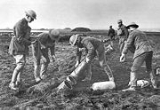
Livens Projector

Encyclopedia
-
- For the large flamethrower see Livens Large Gallery Flame Projectors
The Livens Projector was a simple mortar-like weapon that could throw large drums filled with flammable or toxic
Chemical warfare
Chemical warfare involves using the toxic properties of chemical substances as weapons. This type of warfare is distinct from Nuclear warfare and Biological warfare, which together make up NBC, the military acronym for Nuclear, Biological, and Chemical...
chemicals. In the First World War
World War I
World War I , which was predominantly called the World War or the Great War from its occurrence until 1939, and the First World War or World War I thereafter, was a major war centred in Europe that began on 28 July 1914 and lasted until 11 November 1918...
, the Livens Projector became the standard means of delivering gas attacks and it remained in the arsenal of the British Army
British Army
The British Army is the land warfare branch of Her Majesty's Armed Forces in the United Kingdom. It came into being with the unification of the Kingdom of England and Scotland into the Kingdom of Great Britain in 1707. The new British Army incorporated Regiments that had already existed in England...
until the early years of the Second World War
World War II
World War II, or the Second World War , was a global conflict lasting from 1939 to 1945, involving most of the world's nations—including all of the great powers—eventually forming two opposing military alliances: the Allies and the Axis...
.
History
It was created by the BritishUnited Kingdom
The United Kingdom of Great Britain and Northern IrelandIn the United Kingdom and Dependencies, other languages have been officially recognised as legitimate autochthonous languages under the European Charter for Regional or Minority Languages...
army officer Captain William H. Livens
William Howard Livens
William Howard Livens DSO MC was an engineer, a soldier in the British Army and an inventor particularly known for the design of chemical warfare and flame warfare weapons. Resourceful and clever, Livens’ successful creations were characterised by being very practical and easy to produce in large...
of the Royal Engineers
Royal Engineers
The Corps of Royal Engineers, usually just called the Royal Engineers , and commonly known as the Sappers, is one of the corps of the British Army....
. Later, in World War II
World War II
World War II, or the Second World War , was a global conflict lasting from 1939 to 1945, involving most of the world's nations—including all of the great powers—eventually forming two opposing military alliances: the Allies and the Axis...
he worked on petroleum warfare weapons such as the flame fougasse
Flame fougasse
A flame fougasse is a weapon. It is a type of mine which uses an explosive charge to project burning liquid onto a target. The flame fougasse was developed by the Petroleum Warfare Department in Britain as an anti-tank weapon during the invasion crisis of 1940...
and various other flame throwing weapons.
Prior to the invention of the Livens Projector, chemical weapons had been delivered either by "cloud attacks" or chemical-filled shells fired from howitzers. Cloud attacks were made by burying gas-filled cylinder tanks just beyond the parapet of the attacker's trenches and then opening valves on the tanks when the wind was right. This allowed a useful amount of gas to be released but there was danger that the wind would change and the gas would drift back over the attacking troops. Chemical shells were much easier to direct at the enemy but could not deliver nearly as much gas as a cylinder tank.
Livens was in command of Z company, the unit charged with developing and using flame and chemical weapons. Flame throwers and various means of dispensing chemicals had proven frustratingly limited in effect. One day, during an attack on the Somme, Z company encountered a party of Germans who were well dug in. Grenades did not succeed in shifting them, so Livens improvised a sort of giant Molotov cocktail
Molotov cocktail
The Molotov cocktail, also known as the petrol bomb, gasoline bomb, Molotov bomb, fire bottle, fire bomb, or simply Molotov, is a generic name used for a variety of improvised incendiary weapons...
using two 5 gallon oil drums. When these were thrown into the German positions they were so effective that Livens's comrade Harry Strange wondered whether it would be better to use containers to carry the flame to the enemy rather than relying on a complex flame thrower.
Reflecting on the incident, Livens and Strange considered how a really large shell filled with fuel might be thrown by a mortar. Livens went on to develop a large, simple mortar that could throw a three gallon drum of oil which would burst when it landed, spreading burning oil over the target. Livens came to the attention of General Hubert Gough
Hubert Gough
General Sir Hubert de la Poer Gough GCB, GCMG, KCVO was a senior officer in the British Army, who commanded the British Fifth Army from 1916 to 1918 during the First World War.-Family background:...
who was impressed by his ideas and "wangled" everything that Livens needed for his large projector.
On 25 July 1916 at Ovillers-la-Boisselle
Ovillers-la-Boisselle
Ovillers-la-Boisselle is a commune in the Somme department in Picardie in northern France.-Geography:The commune is situated on the D929 road, some northeast of Amiens.-Population:-History:...
during the Battle of the Somme, Z Company used 80 projectors when the Australians were due to attack Pozières
Pozières
Pozières is a commune in the Somme department in Picardie in northern France.-Geography:The commune is situated on the D929 road, some northeast of Amiens between Albert and Bapaume, on the Pozières ridge.-Population:-History:...
. The early versions had a short range and it was necessary to place the projectors 200 yards out in no-man's-land
No man's land
No man's land is a term for land that is unoccupied or is under dispute between parties that leave it unoccupied due to fear or uncertainty. The term was originally used to define a contested territory or a dumping ground for refuse between fiefdoms...
. The resulting barrage was highly successful in neutralising the German machine-gun posts.
Z Company rapidly developed the Livens Projector, increasing its range to 350 yards and eventually an electrically triggered version with a range of 1,300 yards. This version was successfully used at Messines Ridge
Battle of Messines
The Battle of Messines was a battle of the Western front of the First World War. It began on 7 June 1917 when the British Second Army under the command of General Herbert Plumer launched an offensive near the village of Mesen in West Flanders, Belgium...
in June 1917.
The Livens Projector was then modified to fire canisters of poison gas rather than oil. This system was tested in secret, at Thiepval
Thiepval
The Thiepval Memorial to the Missing of the Somme is a major war memorial to 72,191 missing British and South African men who died in the Battles of the Somme of the First World War between 1915 and 1918 who have no known grave...
in September 1916 and Beaumont-Hamel
Beaumont-Hamel
Beaumont-Hamel is a commune in the Somme department in Picardy in northern France.During the First World War, Beaumont-Hamel was very close to the front lines and saw heavy combat, especially during the Battle of the Somme which was the largest Allied offensive of the entire war. By 1918 the...
in November. The Livens Projector was able to deliver a high concentration of gas a considerable distance. Each canister delivered as much gas as several chemical warfare artillery shells. Without the need to reload a barrage could be launched quickly, catching the enemy by surprise. Although each projector could be fired just once during an attack, the weapon was sufficiently inexpensive to be deployed in hundreds or even thousands.
The Livens Projector was also used to fire other substances. At one time or another the drums contained high explosive, oil and cotton-waste pellets, thermite
Thermite
Thermite is a pyrotechnic composition of a metal powder and a metal oxide that produces an exothermic oxidation-reduction reaction known as a thermite reaction. If aluminium is the reducing agent it is called an aluminothermic reaction...
, white phosphorus and "stinks". Used as giant stink bomb
Stink bomb
A stink bomb or stinkbomb is a device designed to create an unpleasant smell. They range in effectiveness from simple pranks to military grade or riot control chemical agents.The Guinness Book of Records lists two smelliest substances...
s to trick the enemy, "stinks" were malodorous but harmless substances such as bone oil
Dippel's oil
Dippel's Oil is a nitrogenous by-product of the destructive distillation manufacture of bone char . This liquid is dark colored and highly viscous with an unpleasant smell. The oil contains the organic base pyrrole. It is named after its inventor, Johann Conrad Dippel,Dippel's oil had a number...
and amyl acetate
Amyl acetate
Amyl acetate is an organic compound and an ester with the chemical formula CH3COO[CH2]4CH3 and the molecular weight 130.19 g/mol. It has a scent similar to bananas and apples which is not detectable by all people. The compound is the condensation product of acetic acid and 1-pentanol...
used to simulate a poison gas attack, thereby compelling the enemy to put on their cumbersome masks (which reduced the efficiency of German troops) on occasions when gas could not be safely employed. Alternatively, "stinks" could be used to artificially prolong the scale, discomfort and duration of genuine gas-attacks i.e. alternating projectiles containing "stinks" with phosgene
Phosgene
Phosgene is the chemical compound with the formula COCl2. This colorless gas gained infamy as a chemical weapon during World War I. It is also a valued industrial reagent and building block in synthesis of pharmaceuticals and other organic compounds. In low concentrations, its odor resembles...
, adamsite
Adamsite
Adamsite or DM is an organic compound; technically, an arsenical diphenylaminechlorarsine, that can be used as a riot control agent. DM belongs to the group of chemical warfare agents known as vomiting agents or sneeze gases...
or chloropicrin
Chloropicrin
Chloropicrin, also known as PS, is a chemical compound with the structural formula Cl3CNO2. This colourless highly toxic liquid was once used in chemical warfare and is currently used as a fumigant and nematocide.-History:...
. There was even a design for ammunition containing a dozen Mills bomb
Mills bomb
Mills bomb is the popular name for a series of prominent British hand grenades. They were the first modern fragmentation grenades in the world.-Overview:...
s in the manner of a cluster bomb
Cluster bomb
A cluster munition is a form of air-dropped or ground-launched explosive weapon that releases or ejects smaller sub-munitions. Commonly, this is a cluster bomb that ejects explosive bomblets that are designed to kill enemy personnel and destroy vehicles...
.
The Livens Projector remained in the arsenal of the British Army until the early years of the Second World War
World War II
World War II, or the Second World War , was a global conflict lasting from 1939 to 1945, involving most of the world's nations—including all of the great powers—eventually forming two opposing military alliances: the Allies and the Axis...
.
Description
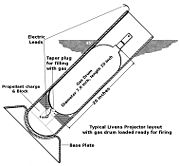
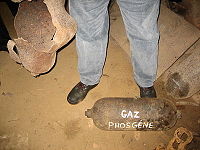
Specifications varied during the war. The early field improvisations in July 1916 near La Boselle based the barrel on 12 inches (304.8 mm) oil drums, the projectile was an oil can. The production model was decided on in December 1916 after further successful field trials on the Somme. It was based on spare 8 inches (203.2 mm) oxy-acetylene welded
Oxy-fuel welding and cutting
Oxy-fuel welding and oxy-fuel cutting are processes that use fuel gases and oxygen to weld and cut metals, respectively. French engineers Edmond Fouché and Charles Picard became the first to develop oxygen-acetylene welding in 1903...
tubing.
The 8-inch barrel became standard and was first used in numbers when 2,000 fired a salvo in the Battle of Vimy Ridge
Battle of Vimy Ridge
The Battle of Vimy Ridge was a military engagement fought primarily as part of the Battle of Arras, in the Nord-Pas-de-Calais region of France, during the First World War. The main combatants were the Canadian Corps, of four divisions, against three divisions of the German Sixth Army...
in April 1917. Barrels were supplied in three lengths depending on required range: 2 in 9 in (0.8382 m) for short range, 3 ft (0.9144 m) for medium range, 4 in 3 in (1.3 m) for maximum range.
A drum 7.6 in (193 mm) in diameter and 20 in (508 mm) long containing 30 lb (13.6 kg) of gas was shot out by an electrically initiated charge, giving it a range of about 1500 m (1,640.4 yd). On impact with the target, a burster charge would disperse the chemical filling over the area.
It was also used to project flammable oil, as with 1,500 drums fired before the Battle of Messines
Battle of Messines
The Battle of Messines was a battle of the Western front of the First World War. It began on 7 June 1917 when the British Second Army under the command of General Herbert Plumer launched an offensive near the village of Mesen in West Flanders, Belgium...
in June 1917. Oil was also tried on 20 September 1917 during the Battle of Menin Road with 290 projectors used in support of an attempt to capture Eagle Trench east of Langemarck. This included concrete bunkers and machine gun nests but the drums did not land in the trenches and failed to suppress the German defenders there.
Combat use
As a rule, the projectors were sited out in the open some little way behind the front line so that digging, aiming (either by direct line of sight or by compass)and wiring up the electrical leads were easier. When camouflaged the positions would be unknown to the enemy so that although the enemy was able to recognise the direction of the location by the discharge flash he would be uncertain of the range. As such these installations could only be carried out at night. The digging of the narrow trenches did not involve much labour and later in the war the projectors were only buried to a depth of about a foot, instead of up to their muzzles.The projector was somewhat unreliable. In order to safeguard friendly forces from 'shorts' an area immediately ahead of the projector battery was cleared of troops before firing. This area allowed for the possibility of drums reaching only 60% of the estimated range and veering 20 degrees from the central line of fire by the wind or from some other cause.
The projectors were also inaccurate:
- "It was distinctly laid down as a principle that, owing to the inaccuracy of the weapon, the most suitable targets were areas which were either strongly held or which contained underground shelters in which the occupants were safe against artillery fire."
A British training manual of 1940 described it as:
- "a simple weapon which does not aspire to great accuracy. Its range is limited to about 1,800 yards; the noise of firing is very loud, and at night is accompanied by a vivid flash.
- Projectors are the principal armament of C.W. companies, RE."
The projector's unreliability and inaccuracy were more than made up for by the weapon's principal advantages: it was a cheap, simple and extremely effective method of delivering chemical weapons. Typically, hundreds, or even thousands, of Livens projectors would be fired in unison during an attack in order to saturate the enemy lines with poison gas.
Surviving examples
- Several barrels with bases are displayed at Sanctuary Wood Museum Hill 62 Zillebeke, BelgiumSanctuary Wood Museum Hill 62The Sanctuary Wood Museum Hill 62, east of Ypres, Belgium is located in the neighborhood of the Canadian Hill 62 Memorial and the Sanctuary Wood Cemetery...
- Memorial Museum Passchendaele in Zonnebeke
- Several barrels in the ground at the Yorkshire Trench & Dug-out in Ypres
- In Flanders Fields Museum in Ypres
There are a number of surviving examples in private collections and other museums.