

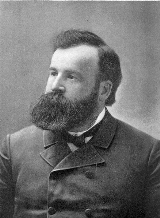
William Hamilton Gibson

Encyclopedia
William Hamilton Gibson (October 5, 1850 - July 16, 1896) was an American
illustrator, author and naturalist.
The financial failure and in 1868 the death of Gibson's father, a New York broker, put an end to his studies in the Brooklyn Polytechnic Institute and made it necessary for him to earn his own living. From the life insurance
business, in Brooklyn
, he soon turned to the study of natural history
and illustration, he had sketched flowers and insects when he was only eight years old, had long been interested in botany and entomology, and had acquired great skill in making faux flowers. His first drawings, of a technical character, were published in 1870.
He rapidly became an expert illustrator and a remarkably able wood-engraver, while he also drew on stone with great success. He drew for The American Agriculturist, Hearth and Home, and Appletons American Cyclopaedia
; for The Youth's Companion and St Nicholas
; and then for various Harper publications, especially Harper's Monthly magazine, where his illustrations first gained popularity. He died of apoplexy
, brought on by overwork at Washington, Connecticut
, where he had had a summer studio, and where in a great boulder is inset a relief portrait of him by H. K. Bush-Brown
. He was an expert photographer, and his drawings had a nearly photographic and almost microscopic accuracy of detail which slightly lessened their artistic value, as a poetic and sometimes humorous quality somewhat detracted from their scientific worth. Gibson was perfectly at home in black-and-white, but rarely (and feebly) used colors. He was a popular writer and lecturer on natural history.
's New South, and E. P. Roe
's Nature's Serial Story; and his own books, The Complete American Trapper (1876; revised, 1880, as Camp Life in the Woods); Pastoral Days: or, Memories of a New England Year (1880); Highways and Byways (1882); Happy Hunting Grounds (1886); Strolls by Starlight and Sunshine (1890); Sharp Eyes: a Rambler's Calendar (1891); Our Edible Mushrooms and Toadstools (1895); Eye Spy: Afield with Nature among Flowers and Animate Things (1897); and My Studio Neighbours (1898).
United States
The United States of America is a federal constitutional republic comprising fifty states and a federal district...
illustrator, author and naturalist.
Biography
Gibson was born in Sandy Hook, Connecticut, of an old, distinguished New England family; one of his great-great-grandfathers was the jurist Richard Dana (1699–1772), who was the great-grandfather of the famous author Richard Henry Dana, Jr.Richard Henry Dana, Jr.
Richard Henry Dana Jr. was an American lawyer and politician from Massachusetts, a descendant of an eminent colonial family who gained renown as the author of the American classic, the memoir Two Years Before the Mast...
The financial failure and in 1868 the death of Gibson's father, a New York broker, put an end to his studies in the Brooklyn Polytechnic Institute and made it necessary for him to earn his own living. From the life insurance
Life insurance
Life insurance is a contract between an insurance policy holder and an insurer, where the insurer promises to pay a designated beneficiary a sum of money upon the death of the insured person. Depending on the contract, other events such as terminal illness or critical illness may also trigger...
business, in Brooklyn
Brooklyn
Brooklyn is the most populous of New York City's five boroughs, with nearly 2.6 million residents, and the second-largest in area. Since 1896, Brooklyn has had the same boundaries as Kings County, which is now the most populous county in New York State and the second-most densely populated...
, he soon turned to the study of natural history
Natural history
Natural history is the scientific research of plants or animals, leaning more towards observational rather than experimental methods of study, and encompasses more research published in magazines than in academic journals. Grouped among the natural sciences, natural history is the systematic study...
and illustration, he had sketched flowers and insects when he was only eight years old, had long been interested in botany and entomology, and had acquired great skill in making faux flowers. His first drawings, of a technical character, were published in 1870.
He rapidly became an expert illustrator and a remarkably able wood-engraver, while he also drew on stone with great success. He drew for The American Agriculturist, Hearth and Home, and Appletons American Cyclopaedia
New American Cyclopedia
The New American Cyclopedia was a 16-volume encyclopedia created and published by D. Appleton & Company of New York over the years 1857 to 1866. Its primary editors were George Ripley and Charles A. Dana....
; for The Youth's Companion and St Nicholas
St. Nicholas Magazine
St. Nicholas Magazine was a popular children's magazine, founded by Scribner's in 1873. The first editor was Mary Mapes Dodge, who continued her association with the magazine until her death in 1905. Dodge published work by the country's best writers, including Louisa May Alcott, Francis Hodgson...
; and then for various Harper publications, especially Harper's Monthly magazine, where his illustrations first gained popularity. He died of apoplexy
Apoplexy
Apoplexy is a medical term, which can be used to describe 'bleeding' in a stroke . Without further specification, it is rather outdated in use. Today it is used only for specific conditions, such as pituitary apoplexy and ovarian apoplexy. In common speech, it is used non-medically to mean a state...
, brought on by overwork at Washington, Connecticut
Washington, Connecticut
Washington is a rural town in Litchfield County, Connecticut, in the New England region of the United States. The population was 3,596 at the 2000 census. Washington is known for its picturesque countryside, historic architecture, and active civic and cultural life...
, where he had had a summer studio, and where in a great boulder is inset a relief portrait of him by H. K. Bush-Brown
Henry Kirke Bush-Brown
Henry Kirke Bush-Brown was an American sculptor and the adopted nephew of sculptor Henry Kirke Brown. He was raised in Newburgh, New York and attended the National Academy of Design in New York City....
. He was an expert photographer, and his drawings had a nearly photographic and almost microscopic accuracy of detail which slightly lessened their artistic value, as a poetic and sometimes humorous quality somewhat detracted from their scientific worth. Gibson was perfectly at home in black-and-white, but rarely (and feebly) used colors. He was a popular writer and lecturer on natural history.
Works
Gibson illustrated S. A. Drake's In the Heart of the White Mountains, C. D. WarnerCharles Dudley Warner
Charles Dudley Warner was an American essayist, novelist, and friend of Mark Twain, with whom he co-authored the novel The Gilded Age: A Tale of Today.-Biography:...
's New South, and E. P. Roe
Edward Payson Roe
-Biography:Edward Payson Roe was born in Moodna, Orange County, New York. He studied at Williams College and at Auburn Theological Seminary. In 1862 He became chaplain of the Second New York Cavalry, U.S.V., and in 1864 chaplain of Hampton Hospital, in Virginia. In 1866-74 he was pastor of the...
's Nature's Serial Story; and his own books, The Complete American Trapper (1876; revised, 1880, as Camp Life in the Woods); Pastoral Days: or, Memories of a New England Year (1880); Highways and Byways (1882); Happy Hunting Grounds (1886); Strolls by Starlight and Sunshine (1890); Sharp Eyes: a Rambler's Calendar (1891); Our Edible Mushrooms and Toadstools (1895); Eye Spy: Afield with Nature among Flowers and Animate Things (1897); and My Studio Neighbours (1898).
External links
(plain text and HTML)- http://www.archive.org/search.php?query=mediatype%3A%28texts%29%20-contributor%3Agutenberg%20AND%20%28subject%3A%22Gibson%2C%20William%20Hamilton%2C%201850-1896%22%20OR%20subject%3A%22Gibson%2C%20W.%20Hamilton%20%28William%20Hamilton%29%2C%201850-1896%22%20OR%20subject%3A%22William%20Hamilton%20Gibson%22%20OR%20creator%3A%22Gibson%2C%20William%20Hamilton%2C%201850-1896%22%20OR%20creator%3A%22Gibson%2C%20W.%20Hamilton%20%28William%20Hamilton%29%2C%201850-1896%22%20OR%20creator%3A%22William%20Hamilton%20Gibson%22%20OR%20description%3A%22Gibson%2C%20W.%20Hamilton%20%28William%20Hamilton%29%2C%201850-1896%22%20OR%20description%3A%22Gibson%2C%20William%20Hamilton%2C%201850-1896%22%20OR%20description%3A%22William%20Hamilton%20Gibson%22%20OR%20title%3A%22William%20Hamilton%20Gibson%22%29Works by William Hamilton Gibson] at Internet ArchiveInternet ArchiveThe Internet Archive is a non-profit digital library with the stated mission of "universal access to all knowledge". It offers permanent storage and access to collections of digitized materials, including websites, music, moving images, and nearly 3 million public domain books. The Internet Archive...
(scanned books original editions illustrated)