
All Topics  
William Gilbert

 
William Gilbert

   Email Print
   Bookmark   Link


William Gilbert


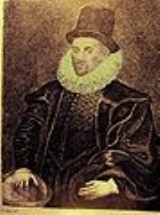
William Gilbert, also known as Gilbard, (Colchester, England
England

native_name =|conventional_long_name = England|common_name = England|image_flag = Flag of England.svg|image_coat = England COA.svg|symbol_type = Royal Coat of Arms...
, May 24, 1544 – London
London

London is the capital of both England and the United Kingdom, and the most populous municipality in the European Union. An important settlement for two millennia, History of London goes back to its founding by the Roman Empire....
, England
England

native_name =|conventional_long_name = England|common_name = England|image_flag = Flag of England.svg|image_coat = England COA.svg|symbol_type = Royal Coat of Arms...
, November 30, 1603) was an English physicist and a natural philosopher. He was an early Copernican
Copernican principle

In cosmology, the Copernican principle, named after Nicolaus Copernicus, states the Earth is not in a central, specially favoured position. More recently, the principle is generalised to the Theory of relativity concept that humans are not privileged observers of the universe....
, and passionately rejected both the prevailing Aristotelian philosophy and the Scholastic method of university teaching. Gilbert was educated at St John's College, Cambridge
St John's College, Cambridge

St John's College, an institution known formally as The Master, Fellows and Scholars of the College of St John the Evangelist in the University of Cambridge is a constituent college of the University of Cambridge founded by Lady Margaret Beaufort in 1511....
; after gaining his MD from Cambridge in 1569, and a short spell as bursar of St John's College, he left for practice in London and in 1600 was elected President of the College of Physicians (not by that point granted a royal charter).


Discussion
Ask a question about 'William Gilbert'
Start a new discussion about 'William Gilbert'
Answer questions from other users
Full Discussion Forum


Recent Posts


Encyclopedia


William Gilbert, also known as Gilbard, (Colchester, England
England

native_name =|conventional_long_name = England|common_name = England|image_flag = Flag of England.svg|image_coat = England COA.svg|symbol_type = Royal Coat of Arms...
, May 24, 1544 – London
London

London is the capital of both England and the United Kingdom, and the most populous municipality in the European Union. An important settlement for two millennia, History of London goes back to its founding by the Roman Empire....
, England
England

native_name =|conventional_long_name = England|common_name = England|image_flag = Flag of England.svg|image_coat = England COA.svg|symbol_type = Royal Coat of Arms...
, November 30, 1603) was an English physicist and a natural philosopher. He was an early Copernican
Copernican principle

In cosmology, the Copernican principle, named after Nicolaus Copernicus, states the Earth is not in a central, specially favoured position. More recently, the principle is generalised to the Theory of relativity concept that humans are not privileged observers of the universe....
, and passionately rejected both the prevailing Aristotelian philosophy and the Scholastic method of university teaching. Gilbert was educated at St John's College, Cambridge
St John's College, Cambridge

St John's College, an institution known formally as The Master, Fellows and Scholars of the College of St John the Evangelist in the University of Cambridge is a constituent college of the University of Cambridge founded by Lady Margaret Beaufort in 1511....
; after gaining his MD from Cambridge in 1569, and a short spell as bursar of St John's College, he left for practice in London and in 1600 was elected President of the College of Physicians (not by that point granted a royal charter). From 1601 until his death in 1603, he was Elizabeth I
Elizabeth I of England

Elizabeth I was List of English monarchs and Queen of Ireland from 17 November 1558 until her death. Sometimes called The Virgin Queen, Gloriana, or Good Queen Bess, Elizabeth was the fifth and last monarch of the House of Tudor....
's own physician, and James VI and I
James I of England

James VI and I was List of monarchs of Scotland as James VI, and List of English monarchs and King of Ireland as James I. He ruled in Kingdom of Scotland as James VI from 24 July 1567, when he was only one year old, succeeding his mother Mary I of Scotland....
 renewed his appointment.

Gilbert is known for his investigations of magnetism
Magnetism

In physics, magnetism is one of the phenomena by which materials exert attractive or repulsive forces on other materials. Some well-known materials that exhibit easily detectable magnetic properties are nickel, iron, cobalt, and their alloys; however, all materials are influenced to greater or lesser degree by the presence of a magnetic fiel...
 and electricity
Electricity

Electricity is a general term that encompasses a variety of phenomena resulting from the presence and flow of electric charge. These include many easily recognizable phenomena such as lightning and static electricity, but in addition, less familiar concepts such as the electromagnetic field and electromagnetic induction....
. He is credited as one of the originators of the term electricity and many regard him as the father of electrical engineering
Electrical engineering

Electrical engineering, sometimes referred to as electrical and electronic engineering, is a field of engineering that deals with the study and application of electricity, electronics and electromagnetism....
 or electricity
Electricity

Electricity is a general term that encompasses a variety of phenomena resulting from the presence and flow of electric charge. These include many easily recognizable phenomena such as lightning and static electricity, but in addition, less familiar concepts such as the electromagnetic field and electromagnetic induction....
 and magnetism
Magnetism

In physics, magnetism is one of the phenomena by which materials exert attractive or repulsive forces on other materials. Some well-known materials that exhibit easily detectable magnetic properties are nickel, iron, cobalt, and their alloys; however, all materials are influenced to greater or lesser degree by the presence of a magnetic fiel...
.

His primary work was De Magnete, Magneticisque Corporibus, et de Magno Magnete Tellure
De Magnete

De Magnete, Magneticisque Corporibus, et de Magno Magnete Tellure is a scientific work published in 1600 by the English physician and scientist William Gilbert and also by his partner Christopher Clews....
 (On the Magnet and Magnetic Bodies, and on the Great Magnet the Earth) published in 1600. In this work, he describes many of his experiments with his model earth called the terrella
Terrella

A terrella is a small magnet model ball representing the Earth, that is thought to have been invented by England physician William Gilbert while investigating magnetism, and further developed 300 years later by the Norway scientist and explorer Kristian Birkeland, while investigating the polar aurora....
. From these experiments, he concluded that the Earth
Earth's magnetic field

Earth's magnetic field is approximately a magnetic dipole, with one magnetic pole near the north pole and the other near the geographic south pole ....
 was itself magnetic and that this was the reason compass
Compass

A compass, magnetic compass or mariner's compass is a navigational instrument for determining direction relative to the earth's magnetic poles....
es point north (previously, some believed that it was the pole star (Polaris
Polaris

Polaris is the brightest star in the constellation Ursa Minor. It is very close to the north celestial pole , making it the current northern pole star....
) or a large magnetic island on the north pole that attracted the compass). He was the first to argue, correctly, that the centre of the Earth was iron, and he considered an important and related property of magnets was that they can be cut, each forming a new magnet with north and south poles.

The English word electricity was first used in 1646 by Sir Thomas Browne, derived from Gilbert's 1600 New Latin
New Latin

The term New Latin or Neo-Latin is used to describe a form the Latin language used after the end of the Medieval Latin period to c. 1900, and in a very limited fashion, down to the present day....
 electricus, meaning "like amber". The term had been in use since the 1200s, but Gilbert was the first to use it to mean "like amber in its attractive properties". He recognized that friction with these objects removed a so-called effluvium, which would cause the attraction effect in returning to the object, though he did not realize that this substance (electric charge
Electric charge

Electric charge is a fundamental conserved property of some subatomic particles, which determines their electromagnetic interaction. Electrically charged matter is influenced by, and produces, electromagnetic fields....
) was universal to all materials.

In his book, he also studied static electricity
Static electricity

Static electricity refers to the buildup of electric charge on the surface of objects. The static charges remains on an object until they either bleed off to ground or are quickly neutralized by a discharge....
 using amber
Amber

Amber is fossil tree resin, which is appreciated for its color and beauty. Good quality amber is used for the manufacture of ornamental objects and jewelry....
; amber is called elektron in Greek, so Gilbert decided to call its effect the electric force. He invented the first electrical measuring instrument
Measuring instrument

In the physical sciences, quality assurance, and engineering, measurement is the activity of obtaining and comparing physical quantity of real-world object and phenomenon....
, the electroscope
Electroscope

An electroscope is an early scientific instrument that is used to detect the presence and magnitude of electric charge on a body. It was the first electrical measuring instrument....
, in the form of a pivoted needle he called the versorium.

Like others of his day, he believed that "crystal" (quartz
Quartz

Quartz is the most abundant mineral in the Earth's continental crust . It is made up of a Crystal structure of silica tetrahedra. Quartz has a hardness of 7 on the Mohs scale and a density of 2.65 g/cm?....
) was an especially hard form of water
Water

Water is a common chemical substance that is essential for the survival of all known forms of life. In typical usage, water refers only to its liquid form or States of matter, but the substance also has a solid state, ice, and a gaseous state, water vapor or steam....
, formed from compressed ice
Ice

Ice is a solid phases of matter, usually crystalline solid, of a non-metallic substance that is liquid or gas at room temperature, such as ammonia ice or methane ice....
:

Gilbert argued that electricity and magnetism were not the same thing. For evidence, he (incorrectly) pointed out that, while electrical attraction disappeared with heat, magnetic attraction did not (although it is proven that magnetism does in fact become damaged and weakened with heat). It took James Clerk Maxwell
James Clerk Maxwell

James Clerk Maxwell was a Scotland Mathematical physics. His most significant achievement was the development of the classical electromagnetic theory, synthesizing all previous unrelated observations, experiments and equations of electricity, magnetism and even optics into a consistent theory....
 to show that both effects were aspects of a single force: electromagnetism. Even then, Maxwell simply surmised this in his A Treatise on Electricity and Magnetism
A Treatise on Electricity and Magnetism

A Treatise on Electricity and Magnetism is an 1873 textbook on electromagnetism written by James Clerk Maxwell.These equations are compiled to two sets....
 after much analysis. By keeping clarity, Gilbert's strong distinction advanced science for nearly 250 years.

Gilbert's magnetism
Magnetism

In physics, magnetism is one of the phenomena by which materials exert attractive or repulsive forces on other materials. Some well-known materials that exhibit easily detectable magnetic properties are nickel, iron, cobalt, and their alloys; however, all materials are influenced to greater or lesser degree by the presence of a magnetic fiel...
 was the invisible force that many other natural philosophers, such as Kepler
Johannes Kepler

Johannes Kepler was a Germans mathematician, astronomer and astrologer, and key figure in the 17th century Scientific revolution. He is best known for his eponymous Kepler's laws of planetary motion, codified by later astronomers based on his works Astronomia nova, Harmonices Mundi, and Epitome of Copernican Astrononomy....
, seized upon, incorrectly, as governing the motions that they observed. While not attributing magnetism to attraction among the stars, Gilbert pointed out the motion of the skies were due to earth's rotation, and not the rotation of the spheres, 20 years before Galileo (see external reference below).

A unit of magnetomotive force
Magnetomotive force

Magnetomotive force is any physical cause that produces magnetic flux, i.e. lines of forces emitted from a magnetic material. If a magnetic field passes through a cross sectional area A , it produces a flux given by the equation MMF?A = flux ....
, also known as magnetic potential
Magnetic potential

The magnetic potential provides a mathematical way to define a magnetic field in classical electromagnetism. It is analogous to the electric potential which defines the electric field in electrostatics....
, was named the gilbert
Gilbert

Gilbert is a masculine given name, surname and placename. It is from the Germanic gisel "promise, pledge" or "noble youth" and beraht "bright" or "famous"....
 in his honor.

Gilbert died on November 30, 1603. His cause of death is thought to have been the bubonic plague
Bubonic plague

Plague is a deadly infectious disease caused by the Enterobacteriaceae Yersinia pestis . Plague is a zoonotic, primarily carried by rodents and spread to humans via fleas....
.

Whilst today he is generally referred to as William Gilbert, he also went under the name of William Gilberd. The latter was used in his and his father's epitaph, the records of the town of Colchester, the Biographical Memoir in De Magnete, and the name of The Gilberd School
Gilberd School

The Gilberd School is a comprehensive school in Colchester, England.Since their opening on 12 July 1912 the buildings on North Hill, Colchester, have seen many changes, although the exterior structure is almost unaltered....
 in Colchester, named after Gilbert.

Further reading

  • Gilbert, William. (1600), De Magnete (About the Magnet). Translated 1893 from Latin to English by Paul Fleury Mottelay, Dover Books, paperback.
  • Leary, Warren E. (2000), Celebrating the Book That Ushered In thee Age of Sciences, The New York Times, June 13, 2000.
  • Pumfrey, Stephen & Tilley, David. (2003). William Gilbert: forgotten genius, Physics World
    Physics World

    Physics World is the membership magazine of the Institute of Physics, one of the largest physical societies in the world. It is an international monthly magazine covering all areas of physics, both pure and applied, and is aimed at physicists in research, industry and education worldwide....
    , November;
  • Pumfrey, Stephen. (2002). Latitude & the Magnetic Earth, Icon Books, paperback.

External links

  • — biography of William Gilbert.
  • — Translation of De Magnete by Silvanus Thompson for the Gilbert Club, London 1900. Full text, free to read and search. Go to page 9 and read Gilbert saying the earth revolves leading to the motion of the skies.
  • — website hosted by NASA — Commemorating the 400th anniversary of "De Magnete" by William Gilbert of Colchester.