


Web browser

Encyclopedia
A web browser is a software application for retrieving, presenting, and traversing information resources on the World Wide Web
. An information resource is identified by a Uniform Resource Identifier
(URI) and may be a web page
, image, video, or other piece of content. Hyperlinks present in resources enable users easily to navigate their browsers to related resources.
A web browser can also be defined as an application software
or program designed to enable users to access, retrieve and view documents and other resources on the Internet
.
Although browsers are primarily intended to access the World Wide Web, they can also be used to access information provided by web servers in private networks or files in file systems.
The major web browsers are Internet Explorer
, Firefox, Google Chrome
, Safari
, and Opera
.
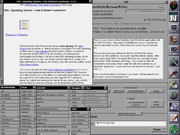 The first web browser was invented in 1990 by Tim Berners-Lee
. It was called WorldWideWeb
(no spaces) and was later renamed Nexus.
In 1993, browser software was further innovated by Marc Andreesen with the release of Mosaic
(later Netscape
), "the world's first popular browser", which made the World Wide Web system easy to use and more accessible to the average person. Andreesen's browser sparked the internet boom of the 1990s. These are the two major milestones in the history of the Web.
The introduction of the NCSA Mosaic web browser in 1993 – one of the first graphical web browsers – led to an explosion in web use. Marc Andreessen
, the leader of the Mosaic team at NCSA, soon started his own company, named Netscape
, and released the Mosaic-influenced Netscape Navigator
in 1994, which quickly became the world's most popular browser, accounting for 90% of all web use at its peak (see usage share of web browsers
).
Microsoft
responded with its Internet Explorer
in 1995 (also heavily influenced by Mosaic), initiating the industry's first browser war. Bundled with Windows
, Internet Explorer gained dominance in the web browser market; Internet Explorer usage share peaked at over 95% by 2002.
Opera
debuted in 1996; although it has never achieved widespread use, having less than 1% browser usage share as of February 2009 according to Net Applications, having grown to 2.14 in April 2011 its Opera-mini version has an additive share, in April 2011 amounting to 1.11 % of overall browser use, but focused on the fast-growing mobile phone
web browser market, being preinstalled on over 40 million phones. It is also available on several other embedded system
s, including Nintendo
's Wii
video game console.
In 1998, Netscape launched what was to become the Mozilla Foundation
in an attempt to produce a competitive browser using the open source
software model. That browser would eventually evolve into Firefox, which developed a respectable following while still in the beta stage of development; shortly after the release of Firefox 1.0 in late 2004, Firefox (all versions) accounted for 7.4% of browser use. As of August 2011, Firefox has a 27.7% usage share.
Apple's Safari
had its first beta release in January 2003; as of April 2011, it has a dominant share of Apple-based web browsing, accounting for just over 7.15% of the entire browser market.
The most recent major entrant to the browser market is Google
's Chrome
, first released in September 2008. Chrome's take-up has increased significantly year on year, by doubling its usage share from 7.7 percent to 15.5 percent by August 2011. This increase seems largely to be at the expense of Internet Explorer, whose share has tended to decrease from month to month.
(URL), for examplehttp://en.wikipedia.org/ , into the browser. The prefix of the URL determines how the URL will be interpreted. The most commonly used kind of URI starts with http: and identifies a resource to be retrieved over the Hypertext Transfer Protocol
(HTTP). Many browsers also support a variety of other prefixes, such as https: for HTTPS
, ftp: for the File Transfer Protocol
, and file: for local files. Prefixes that the web browser cannot directly handle are often handed off to another application entirely. For example, mailto: URIs are usually passed to the user's default e-mail application, and news: URIs are passed to the user's default newsgroup reader.
In the case of http, https, file, and others, once the resource has been retrieved the web browser will display it. HTML
is passed to the browser's layout engine
to be transformed from markup
to an interactive document. Aside from HTML, web browsers can generally display any kind of content that can be part of a web page. Most browsers can display images, audio, video, and XML
files, and often have plug-ins to support Flash
applications and Java applets. Upon encountering a file of an unsupported type or a file that is set up to be downloaded rather than displayed, the browser prompts the user to save the file to disk.
Information resources may contain hyperlinks to other information resources. Each link contains the URI of a resource to go to. When a link is clicked, the browser navigates to the resource indicated by the link's target URI, and the process of bringing content to the user begins again.
, Usenet
news, and Internet Relay Chat
(IRC), are sometimes referred to as "Internet suites" rather than merely "web browsers".
All major web browsers allow the user to open multiple information resources at the same time, either in different browser windows or in different tabs of the same window. Major browsers also include pop-up blockers to prevent unwanted windows from "popping up" without the user's consent.
Most web browsers can display a list of web pages that the user has bookmarked so that the user can quickly return to them. Bookmarks are also called "Favorites" in Internet Explorer
. In addition, all major web browsers have some form of built-in web feed
aggregator. In Firefox, web feeds are formatted as "live bookmarks" and behave like a folder of bookmarks corresponding to recent entries in the feed. In Opera
, a more traditional feed reader is included which stores and displays the contents of the feed.
Furthermore, most browsers can be extended via plug-ins
, downloadable components that provide additional features.
Major browsers also possess incremental find
features to search within a web page.
, and browsing history. For a comparison of the current security vulnerabilities of browsers, see comparison of web browsers.
HTML and XHTML
, which should be rendered in the same way by all browsers.
is a computer program
that extends the functionality of a web browser. Every major web browser supports the development of browser extension
s.
World Wide Web
The World Wide Web is a system of interlinked hypertext documents accessed via the Internet...
. An information resource is identified by a Uniform Resource Identifier
Uniform Resource Identifier
In computing, a uniform resource identifier is a string of characters used to identify a name or a resource on the Internet. Such identification enables interaction with representations of the resource over a network using specific protocols...
(URI) and may be a web page
Web page
A web page or webpage is a document or information resource that is suitable for the World Wide Web and can be accessed through a web browser and displayed on a monitor or mobile device. This information is usually in HTML or XHTML format, and may provide navigation to other web pages via hypertext...
, image, video, or other piece of content. Hyperlinks present in resources enable users easily to navigate their browsers to related resources.
A web browser can also be defined as an application software
Application software
Application software, also known as an application or an "app", is computer software designed to help the user to perform specific tasks. Examples include enterprise software, accounting software, office suites, graphics software and media players. Many application programs deal principally with...
or program designed to enable users to access, retrieve and view documents and other resources on the Internet
Internet
The Internet is a global system of interconnected computer networks that use the standard Internet protocol suite to serve billions of users worldwide...
.
Although browsers are primarily intended to access the World Wide Web, they can also be used to access information provided by web servers in private networks or files in file systems.
The major web browsers are Internet Explorer
Internet Explorer
Windows Internet Explorer is a series of graphical web browsers developed by Microsoft and included as part of the Microsoft Windows line of operating systems, starting in 1995. It was first released as part of the add-on package Plus! for Windows 95 that year...
, Firefox, Google Chrome
Google Chrome
Google Chrome is a web browser developed by Google that uses the WebKit layout engine. It was first released as a beta version for Microsoft Windows on September 2, 2008, and the public stable release was on December 11, 2008. The name is derived from the graphical user interface frame, or...
, Safari
Safari (web browser)
Safari is a web browser developed by Apple Inc. and included with the Mac OS X and iOS operating systems. First released as a public beta on January 7, 2003 on the company's Mac OS X operating system, it became Apple's default browser beginning with Mac OS X v10.3 "Panther". Safari is also the...
, and Opera
Opera (web browser)
Opera is a web browser and Internet suite developed by Opera Software with over 200 million users worldwide. The browser handles common Internet-related tasks such as displaying web sites, sending and receiving e-mail messages, managing contacts, chatting on IRC, downloading files via BitTorrent,...
.
History
Tim Berners-Lee
Sir Timothy John "Tim" Berners-Lee, , also known as "TimBL", is a British computer scientist, MIT professor and the inventor of the World Wide Web...
. It was called WorldWideWeb
WorldWideWeb
WorldWideWeb, later renamed to Nexus to avoid confusion between the software and the World Wide Web, was the first web browser and editor. When it was written, WorldWideWeb was the only way to view the Web....
(no spaces) and was later renamed Nexus.
In 1993, browser software was further innovated by Marc Andreesen with the release of Mosaic
Mosaic (web browser)
Mosaic is the web browser credited with popularizing the World Wide Web. It was also a client for earlier protocols such as FTP, NNTP, and gopher. Its clean, easily understood user interface, reliability, Windows port and simple installation all contributed to making it the application that opened...
(later Netscape
Netscape
Netscape Communications is a US computer services company, best known for Netscape Navigator, its web browser. When it was an independent company, its headquarters were in Mountain View, California...
), "the world's first popular browser", which made the World Wide Web system easy to use and more accessible to the average person. Andreesen's browser sparked the internet boom of the 1990s. These are the two major milestones in the history of the Web.
The introduction of the NCSA Mosaic web browser in 1993 – one of the first graphical web browsers – led to an explosion in web use. Marc Andreessen
Marc Andreessen
Marc Andreessen is an American entrepreneur, investor, software engineer, and multi-millionaire best known as co-author of Mosaic, the first widely-used web browser, and co-founder of Netscape Communications Corporation. He founded and later sold the software company Opsware to Hewlett-Packard...
, the leader of the Mosaic team at NCSA, soon started his own company, named Netscape
Netscape
Netscape Communications is a US computer services company, best known for Netscape Navigator, its web browser. When it was an independent company, its headquarters were in Mountain View, California...
, and released the Mosaic-influenced Netscape Navigator
Netscape Navigator
Netscape Navigator was a proprietary web browser that was popular in the 1990s. It was the flagship product of the Netscape Communications Corporation and the dominant web browser in terms of usage share, although by 2002 its usage had almost disappeared...
in 1994, which quickly became the world's most popular browser, accounting for 90% of all web use at its peak (see usage share of web browsers
Usage share of web browsers
The usage share of a web browser is the proportion, often expressed as a percentage, of users of all web browsers who use that particular browser. This figure can only be estimated, typically by determining the proportion of visitors to a group of websites that use a particular web browser...
).
Microsoft
Microsoft
Microsoft Corporation is an American public multinational corporation headquartered in Redmond, Washington, USA that develops, manufactures, licenses, and supports a wide range of products and services predominantly related to computing through its various product divisions...
responded with its Internet Explorer
Internet Explorer
Windows Internet Explorer is a series of graphical web browsers developed by Microsoft and included as part of the Microsoft Windows line of operating systems, starting in 1995. It was first released as part of the add-on package Plus! for Windows 95 that year...
in 1995 (also heavily influenced by Mosaic), initiating the industry's first browser war. Bundled with Windows
Microsoft Windows
Microsoft Windows is a series of operating systems produced by Microsoft.Microsoft introduced an operating environment named Windows on November 20, 1985 as an add-on to MS-DOS in response to the growing interest in graphical user interfaces . Microsoft Windows came to dominate the world's personal...
, Internet Explorer gained dominance in the web browser market; Internet Explorer usage share peaked at over 95% by 2002.
Opera
Opera (web browser)
Opera is a web browser and Internet suite developed by Opera Software with over 200 million users worldwide. The browser handles common Internet-related tasks such as displaying web sites, sending and receiving e-mail messages, managing contacts, chatting on IRC, downloading files via BitTorrent,...
debuted in 1996; although it has never achieved widespread use, having less than 1% browser usage share as of February 2009 according to Net Applications, having grown to 2.14 in April 2011 its Opera-mini version has an additive share, in April 2011 amounting to 1.11 % of overall browser use, but focused on the fast-growing mobile phone
Mobile phone
A mobile phone is a device which can make and receive telephone calls over a radio link whilst moving around a wide geographic area. It does so by connecting to a cellular network provided by a mobile network operator...
web browser market, being preinstalled on over 40 million phones. It is also available on several other embedded system
Embedded system
An embedded system is a computer system designed for specific control functions within a larger system. often with real-time computing constraints. It is embedded as part of a complete device often including hardware and mechanical parts. By contrast, a general-purpose computer, such as a personal...
s, including Nintendo
Nintendo
is a multinational corporation located in Kyoto, Japan. Founded on September 23, 1889 by Fusajiro Yamauchi, it produced handmade hanafuda cards. By 1963, the company had tried several small niche businesses, such as a cab company and a love hotel....
's Wii
Wii
The Wii is a home video game console released by Nintendo on November 19, 2006. As a seventh-generation console, the Wii primarily competes with Microsoft's Xbox 360 and Sony's PlayStation 3. Nintendo states that its console targets a broader demographic than that of the two others...
video game console.
In 1998, Netscape launched what was to become the Mozilla Foundation
Mozilla Foundation
The Mozilla Foundation is a non-profit organization that exists to support and provide leadership for the open source Mozilla project. The organization sets the policies that govern development, operates key infrastructure and controls trademarks and other intellectual property...
in an attempt to produce a competitive browser using the open source
Open source
The term open source describes practices in production and development that promote access to the end product's source materials. Some consider open source a philosophy, others consider it a pragmatic methodology...
software model. That browser would eventually evolve into Firefox, which developed a respectable following while still in the beta stage of development; shortly after the release of Firefox 1.0 in late 2004, Firefox (all versions) accounted for 7.4% of browser use. As of August 2011, Firefox has a 27.7% usage share.
Apple's Safari
Safari (web browser)
Safari is a web browser developed by Apple Inc. and included with the Mac OS X and iOS operating systems. First released as a public beta on January 7, 2003 on the company's Mac OS X operating system, it became Apple's default browser beginning with Mac OS X v10.3 "Panther". Safari is also the...
had its first beta release in January 2003; as of April 2011, it has a dominant share of Apple-based web browsing, accounting for just over 7.15% of the entire browser market.
The most recent major entrant to the browser market is Google
Google
Google Inc. is an American multinational public corporation invested in Internet search, cloud computing, and advertising technologies. Google hosts and develops a number of Internet-based services and products, and generates profit primarily from advertising through its AdWords program...
's Chrome
Google Chrome
Google Chrome is a web browser developed by Google that uses the WebKit layout engine. It was first released as a beta version for Microsoft Windows on September 2, 2008, and the public stable release was on December 11, 2008. The name is derived from the graphical user interface frame, or...
, first released in September 2008. Chrome's take-up has increased significantly year on year, by doubling its usage share from 7.7 percent to 15.5 percent by August 2011. This increase seems largely to be at the expense of Internet Explorer, whose share has tended to decrease from month to month.
Function
The primary purpose of a web browser is to bring information resources to the user. This process begins when the user inputs a Uniform Resource LocatorUniform Resource Locator
In computing, a uniform resource locator or universal resource locator is a specific character string that constitutes a reference to an Internet resource....
(URL), for example
Hypertext Transfer Protocol
The Hypertext Transfer Protocol is a networking protocol for distributed, collaborative, hypermedia information systems. HTTP is the foundation of data communication for the World Wide Web....
(HTTP). Many browsers also support a variety of other prefixes, such as https: for HTTPS
Https
Hypertext Transfer Protocol Secure is a combination of the Hypertext Transfer Protocol with SSL/TLS protocol to provide encrypted communication and secure identification of a network web server...
, ftp: for the File Transfer Protocol
File Transfer Protocol
File Transfer Protocol is a standard network protocol used to transfer files from one host to another host over a TCP-based network, such as the Internet. FTP is built on a client-server architecture and utilizes separate control and data connections between the client and server...
, and file: for local files. Prefixes that the web browser cannot directly handle are often handed off to another application entirely. For example, mailto: URIs are usually passed to the user's default e-mail application, and news: URIs are passed to the user's default newsgroup reader.
In the case of http, https, file, and others, once the resource has been retrieved the web browser will display it. HTML
HTML
HyperText Markup Language is the predominant markup language for web pages. HTML elements are the basic building-blocks of webpages....
is passed to the browser's layout engine
Layout engine
A web browser engine, , is a software component that takes marked up content and formatting information and displays the formatted content on the screen. It "paints" on the content area of a window, which is displayed on a monitor or a printer...
to be transformed from markup
Markup language
A markup language is a modern system for annotating a text in a way that is syntactically distinguishable from that text. The idea and terminology evolved from the "marking up" of manuscripts, i.e. the revision instructions by editors, traditionally written with a blue pencil on authors' manuscripts...
to an interactive document. Aside from HTML, web browsers can generally display any kind of content that can be part of a web page. Most browsers can display images, audio, video, and XML
XML
Extensible Markup Language is a set of rules for encoding documents in machine-readable form. It is defined in the XML 1.0 Specification produced by the W3C, and several other related specifications, all gratis open standards....
files, and often have plug-ins to support Flash
Adobe Flash
Adobe Flash is a multimedia platform used to add animation, video, and interactivity to web pages. Flash is frequently used for advertisements, games and flash animations for broadcast...
applications and Java applets. Upon encountering a file of an unsupported type or a file that is set up to be downloaded rather than displayed, the browser prompts the user to save the file to disk.
Information resources may contain hyperlinks to other information resources. Each link contains the URI of a resource to go to. When a link is clicked, the browser navigates to the resource indicated by the link's target URI, and the process of bringing content to the user begins again.
Features
Available web browsers range in features from minimal, text-based user interfaces with bare-bones support for HTML to rich user interfaces supporting a wide variety of file formats and protocols. Browsers which include additional components to support e-mailE-mail
Electronic mail, commonly known as email or e-mail, is a method of exchanging digital messages from an author to one or more recipients. Modern email operates across the Internet or other computer networks. Some early email systems required that the author and the recipient both be online at the...
, Usenet
Usenet
Usenet is a worldwide distributed Internet discussion system. It developed from the general purpose UUCP architecture of the same name.Duke University graduate students Tom Truscott and Jim Ellis conceived the idea in 1979 and it was established in 1980...
news, and Internet Relay Chat
Internet Relay Chat
Internet Relay Chat is a protocol for real-time Internet text messaging or synchronous conferencing. It is mainly designed for group communication in discussion forums, called channels, but also allows one-to-one communication via private message as well as chat and data transfer, including file...
(IRC), are sometimes referred to as "Internet suites" rather than merely "web browsers".
All major web browsers allow the user to open multiple information resources at the same time, either in different browser windows or in different tabs of the same window. Major browsers also include pop-up blockers to prevent unwanted windows from "popping up" without the user's consent.
Most web browsers can display a list of web pages that the user has bookmarked so that the user can quickly return to them. Bookmarks are also called "Favorites" in Internet Explorer
Internet Explorer
Windows Internet Explorer is a series of graphical web browsers developed by Microsoft and included as part of the Microsoft Windows line of operating systems, starting in 1995. It was first released as part of the add-on package Plus! for Windows 95 that year...
. In addition, all major web browsers have some form of built-in web feed
Web feed
A web feed is a data format used for providing users with frequently updated content. Content distributors syndicate a web feed, thereby allowing users to subscribe to it. Making a collection of web feeds accessible in one spot is known as aggregation, which is performed by an aggregator...
aggregator. In Firefox, web feeds are formatted as "live bookmarks" and behave like a folder of bookmarks corresponding to recent entries in the feed. In Opera
Opera (web browser)
Opera is a web browser and Internet suite developed by Opera Software with over 200 million users worldwide. The browser handles common Internet-related tasks such as displaying web sites, sending and receiving e-mail messages, managing contacts, chatting on IRC, downloading files via BitTorrent,...
, a more traditional feed reader is included which stores and displays the contents of the feed.
Furthermore, most browsers can be extended via plug-ins
Browser extension
A browser extension is a computer program that extends the functionality of a web browser in some way. Depending on the browser and the version, the term may be distinct from similar terms such as plug-in or add-on. Mozilla Firefox was designed with the idea of being a small and simple web browser,...
, downloadable components that provide additional features.
User interface
Most major web browsers have these user interface elements in common:- Back and forward buttons to go back to the previous resource and forward respectively.
- A refresh or reload button to reload the current resource.
- A stop button to cancel loading the resource. In some browsers, the stop button is merged with the reload button.
- A home button to return to the user's home page.
- An address bar to input the Uniform Resource IdentifierUniform Resource IdentifierIn computing, a uniform resource identifier is a string of characters used to identify a name or a resource on the Internet. Such identification enables interaction with representations of the resource over a network using specific protocols...
(URI) of the desired resource and display it. - A search bar to input terms into a search engineSearch engineA search engine is an information retrieval system designed to help find information stored on a computer system. The search results are usually presented in a list and are commonly called hits. Search engines help to minimize the time required to find information and the amount of information...
. In some browsers, the search bar is merged with the address bar. - A status barStatus barA status bar, similar to a status line, is an information area typically found at the bottom of windows in a graphical user interface.A status bar is sometimes divided into sections, each of which shows different information. Its job is primarily to display information about the current state of...
to display progress in loading the resource and also the URI of links when the cursor hovers over them, and page zoomingPage zoomingIn computing, page zooming is the ability to zoom in and out a document or image at page level. It is usually found in applications related to document layout and publishing, e.g...
capability.
Major browsers also possess incremental find
Incremental find
In computing, incremental search, incremental find or real-time suggestions is a user interface interaction method to progressively search for and filter through text. As the user types text, one or more possible matches for the text are found and immediately presented to the user...
features to search within a web page.
Privacy and security
Most browsers support HTTP Secure and offer quick and easy ways to delete the web cache, cookiesHTTP cookie
A cookie, also known as an HTTP cookie, web cookie, or browser cookie, is used for an origin website to send state information to a user's browser and for the browser to return the state information to the origin site...
, and browsing history. For a comparison of the current security vulnerabilities of browsers, see comparison of web browsers.
Standards support
Early web browsers supported only a very simple version of HTML. The rapid development of proprietary web browsers led to the development of non-standard dialects of HTML, leading to problems with interoperability. Modern web browsers support a combination of standards-based and de factoDe facto
De facto is a Latin expression that means "concerning fact." In law, it often means "in practice but not necessarily ordained by law" or "in practice or actuality, but not officially established." It is commonly used in contrast to de jure when referring to matters of law, governance, or...
HTML and XHTML
XHTML
XHTML is a family of XML markup languages that mirror or extend versions of the widely-used Hypertext Markup Language , the language in which web pages are written....
, which should be rendered in the same way by all browsers.
Extensibility
A browser extensionBrowser extension
A browser extension is a computer program that extends the functionality of a web browser in some way. Depending on the browser and the version, the term may be distinct from similar terms such as plug-in or add-on. Mozilla Firefox was designed with the idea of being a small and simple web browser,...
is a computer program
Computer program
A computer program is a sequence of instructions written to perform a specified task with a computer. A computer requires programs to function, typically executing the program's instructions in a central processor. The program has an executable form that the computer can use directly to execute...
that extends the functionality of a web browser. Every major web browser supports the development of browser extension
Browser extension
A browser extension is a computer program that extends the functionality of a web browser in some way. Depending on the browser and the version, the term may be distinct from similar terms such as plug-in or add-on. Mozilla Firefox was designed with the idea of being a small and simple web browser,...
s.
See also
- BrowseBrowseTo browse is a kind or orienting strategy used by animals or human beings. It is supposed to identify something of relevance for the browsing organism. When used about human beings it is a metaphor taken from the animal kingdom. It is used, for example, about people browsing open shelves in...
- Browser warsBrowser warsBrowser wars is a metaphorical term that refers to competitions for dominance in usage share in the web browser marketplace. The term is often used to denote two specific rivalries: the competition that saw Microsoft's Internet Explorer replace Netscape's Navigator as the dominant browser during...
- GeobrowsingGeobrowsingGeobrowsing is a term used to describe the act of seeking and accessing information on the Internet via a method that is reverse of the traditional Web navigational path...
- Internet suiteInternet suiteAn Internet suite is an Internet-related software suite. Internet suites usually include a web browser, e-mail client , download manager, HTML editor, and an IRC client....
- Layout engineLayout engineA web browser engine, , is a software component that takes marked up content and formatting information and displays the formatted content on the screen. It "paints" on the content area of a window, which is displayed on a monitor or a printer...
- List of web browsers
- Mobile browser
- Timeline of web browsers
- Usage share of web browsersUsage share of web browsersThe usage share of a web browser is the proportion, often expressed as a percentage, of users of all web browsers who use that particular browser. This figure can only be estimated, typically by determining the proportion of visitors to a group of websites that use a particular web browser...
- Web browser comparison