
All Topics  
Wampanoag


   Email Print
   Bookmark   Link


Wampanoag


The Wampanoag (Wôpanâak in the Wampanoag language
Massachusett language

The Massachusett language was a Native American languages, a member of the Algonquian language family. It is also known as the Wampanoag, Natick, or Pokanoket language....
; alternate spellings Wompanoag or Wampanig) are a Native American
Native Americans in the United States

Native Americans in the United States are the Indigenous peoples of the Americas from the regions of North America now encompassed by the continental United States United States, including parts of Alaska and the island state of Hawaii....
 nation which currently consists of five tribes.

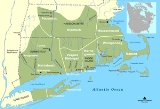
In 1600 the Wampanoag lived in southeastern Massachusetts
Massachusetts

The Commonwealth of Massachusetts is a U.S. state located in the New England region of the Northeastern United States United States. It borders Rhode Island and Connecticut to the south, New York to the west, and Vermont and New Hampshire to the north....
 and Rhode Island
Rhode Island

Rhode Island and Providence Plantations, more commonly referred to as Rhode Island , is a U.S. state in the New England region of the United States....
, as well as within a territory that encompassed current day Martha's Vineyard
Martha's Vineyard

Martha's Vineyard is an island off the United States east coast, to the south of Cape Cod, both forming a part of the Outer Lands region. It is often called just "the Vineyard"....
, Nantucket and the Elizabeth Islands
Elizabeth Islands

The Elizabeth Islands are a chain of small islands extending southwest from the southern coast of Cape Cod, Massachusetts in the United States....
. Their population numbered about 12,000.

Historical Wampanoag leaders included:


Name
In 1616, John Smith
John Smith of Jamestown

File:Captain John Smith.JPGCaptain John Smith Admiral of New England was an England soldier, sailor, and author. He is remembered for his role in establishing the first permanent English settlement in North America at Jamestown, Virginia, and his brief association with the Native Americans in the United States girl Pocahontas during an alte...
 erroneously referred to the entire Wampanoag confederacy as the Pakanoket
Pokanoket

The Pokanoket, or Pocasset, were one of the tribes that made up the Wampanoag peoples.Massasoit, and his sons Wamsutta and Metacomet, were successively the sachem of the Pokanoket in the 17th century when they first treatied with, and then King Philip's War, the British colonizers of what is now Massachusetts....
.
Pakanoket
Pokanoket

The Pokanoket, or Pocasset, were one of the tribes that made up the Wampanoag peoples.Massasoit, and his sons Wamsutta and Metacomet, were successively the sachem of the Pokanoket in the 17th century when they first treatied with, and then King Philip's War, the British colonizers of what is now Massachusetts....
 continued to be used in the earliest colonial records and reports.


Discussion
Ask a question about 'Wampanoag'
Start a new discussion about 'Wampanoag'
Answer questions from other users
Full Discussion Forum


Encyclopedia


The Wampanoag (Wôpanâak in the Wampanoag language
Massachusett language

The Massachusett language was a Native American languages, a member of the Algonquian language family. It is also known as the Wampanoag, Natick, or Pokanoket language....
; alternate spellings Wompanoag or Wampanig) are a Native American
Native Americans in the United States

Native Americans in the United States are the Indigenous peoples of the Americas from the regions of North America now encompassed by the continental United States United States, including parts of Alaska and the island state of Hawaii....
 nation which currently consists of five tribes.

In 1600 the Wampanoag lived in southeastern Massachusetts
Massachusetts

The Commonwealth of Massachusetts is a U.S. state located in the New England region of the Northeastern United States United States. It borders Rhode Island and Connecticut to the south, New York to the west, and Vermont and New Hampshire to the north....
 and Rhode Island
Rhode Island

Rhode Island and Providence Plantations, more commonly referred to as Rhode Island , is a U.S. state in the New England region of the United States....
, as well as within a territory that encompassed current day Martha's Vineyard
Martha's Vineyard

Martha's Vineyard is an island off the United States east coast, to the south of Cape Cod, both forming a part of the Outer Lands region. It is often called just "the Vineyard"....
, Nantucket and the Elizabeth Islands
Elizabeth Islands

The Elizabeth Islands are a chain of small islands extending southwest from the southern coast of Cape Cod, Massachusetts in the United States....
. Their population numbered about 12,000.

Historical Wampanoag leaders included:
  • Massasoit
    Massasoit

    Massasoit Sachem or Ousamequin ,was the sachem, or leader, of the Pokanoket, and "Massasoit" of the Wampanoag Confederacy. The term Massasoit actually means Great Sachem....
    , who met the English;


  • Massasoit's
    Massasoit

    Massasoit Sachem or Ousamequin ,was the sachem, or leader, of the Pokanoket, and "Massasoit" of the Wampanoag Confederacy. The term Massasoit actually means Great Sachem....
     oldest son Wamsutta
    Wamsutta

    Wamsutta , also Alexander Pokanoket as he was called by New England colonists, was a leader of the Wampanoag Native Americans in the United States tribe....
     (known by the English as King Alexander) who died under mysterious circumstances after visiting with English colonial administrators in Plymouth;
  • His second son Metacom or Metacomet (King Philip), who initiated the war against the English known as King Philip's War
    King Philip's War

    King Philip's War, sometimes called Metacomet's War or Metacom's Rebellion, was an armed conflict between indigenous peoples of the Americas inhabitants of present-day southern New England and English colonists and their Native American allies from 1675–1676....
     in retaliation for the death of his brother at the hands of the English;
  • Sachem
    Sachem

    Sachem may refer to:* Sachem, a Native American leader* A leader of Tammany Hall* The Sachem award, which replaced the Sagamore of the Wabash as Indiana's highest civilian honor...
     Weetamoo
    Weetamoo

    Weetamoo , also referred to as Weetamoe, was a Pocasset Wampanoag Native Americans in the United States woman who was born c. 1635 in Mettapoiset, village of the Pokanoket, and died at Taunton River in 1676....
     of the Pocasset
    Pocasset

    Pocasset may refer to:* Pocasset, Massachusetts* Pocasset, OklahomaExcess long comment to prevent listing on...
    , a woman who supported Metacom and drowned crossing the Taunton River
    Taunton River

    The Taunton River , is a river in southeastern Massachusetts in the United States. It arises from the confluence of the Town River and Matfield River, in the town of Bridgewater, Massachusetts....
     while fleeing the English;
  • Sachem Awashonks
    Awashonks

    Awashonks was a female sachem of the Sakonnet Native Americans in the United States tribe in Seconet, Rhode Island. She signed the Plymouth Agreement of 1671....
     of the Sakonnet, a woman who at first fought the English but then changed sides; and
  • Annawan
    Annawan

    Annawan could refer to*Annawan , an Indian chief and historical figure in southeastern Massachusetts *Annawan, Illinois, a town located in the United States...
    , a war leader.


Name


In 1616, John Smith
John Smith of Jamestown

File:Captain John Smith.JPGCaptain John Smith Admiral of New England was an England soldier, sailor, and author. He is remembered for his role in establishing the first permanent English settlement in North America at Jamestown, Virginia, and his brief association with the Native Americans in the United States girl Pocahontas during an alte...
 erroneously referred to the entire Wampanoag confederacy as the Pakanoket
Pokanoket

The Pokanoket, or Pocasset, were one of the tribes that made up the Wampanoag peoples.Massasoit, and his sons Wamsutta and Metacomet, were successively the sachem of the Pokanoket in the 17th century when they first treatied with, and then King Philip's War, the British colonizers of what is now Massachusetts....
.
Pakanoket
Pokanoket

The Pokanoket, or Pocasset, were one of the tribes that made up the Wampanoag peoples.Massasoit, and his sons Wamsutta and Metacomet, were successively the sachem of the Pokanoket in the 17th century when they first treatied with, and then King Philip's War, the British colonizers of what is now Massachusetts....
 continued to be used in the earliest colonial records and reports. The Pakanoket
Pokanoket

The Pokanoket, or Pocasset, were one of the tribes that made up the Wampanoag peoples.Massasoit, and his sons Wamsutta and Metacomet, were successively the sachem of the Pokanoket in the 17th century when they first treatied with, and then King Philip's War, the British colonizers of what is now Massachusetts....
 tribal seat was located near present-day Bristol, Rhode Island
Bristol, Rhode Island

Bristol is a New England town in and the historic county seat of Bristol County, Rhode Island, Rhode Island, United States. The population was 22,469 at the United States Census, 2000....
. Wampanoag means ‘’People of the First Light.’’ The word Wapanoos was first seen on Adriaen Block
Adriaen Block

Adriaen Block was a Netherlands private trader and navigator who is best known for exploring the coastal and river valley areas between present-day New Jersey and Massachusetts during four voyages from 1611 to 1614, following the 1609 expedition by Henry Hudson....
's 1614 map and was the earliest European representation of Wampanoag territory. Other synonyms include ‘’Wapenock, Massasoit’’ and ‘’Philip's Indians’’.

Groups of the Wampanoag

groupArea inhabited
Gay Head or Aquinnahwestern point of Martha's Vineyard
ChappaquiddickChappaquiddick Island
NantucketNantucket Island
NausetCape Cod
MashpeeCape Cod
Patuxeteastern Massachusetts, on Plymouth Bay
Pokanoketeastern Massachusetts, near present-day Bristol
Pocassetpresent day north Fall River,Massachusetts
Herring PondPlymouth & Cape Cod
and approximately 50 more groups 


Culture

See also: Massachusett
Massachusett

The Massachusett were a tribe of Native Americans in the United States who lived in areas surrounding Massachusetts Bay in what is now the state of Massachusetts....
.

The Wampanoag were semi-sedentary, with seasonal movements between fixed sites in present-day southern New England
New England

New England is a region of the United States located in the northeastern corner of the country, bounded by the Atlantic Ocean, Canada and New York State, and consisting of the modern U.S....
. The "three sisters," corn (maize
Maize

Maize , known as corn in some countries, is a cereal domesticated in Mesoamerica and subsequently spread throughout the American continents....
), bean
Bean

Bean is a common name for large plant seeds of several genus of the Family Fabaceae used for human food or animal feed.The whole young pods of bean plants, if picked before the pods ripen and dry, can be tender enough to eat whole, whether cooked or raw....
s and squash
Squash (fruit)

Squashes generally refer to four species of the genus Cucurbita native to Mexico and Central America, also called marrows depending on variety or the nationality of the speaker....
 were the staples of their diet, supplemented by fish
Fish

A fish is any marine biology vertebrate animal that is typically ectothermic , covered with scale , and equipped with two sets of paired fins and several unpaired fins....
 and game
Game (food)

Game is any animal hunting for food or not normally Domestication . Game animals are also hunted for sport.The type and range of animals hunted for food varies in different parts of the world....
. More specifically, each community had authority over a well-defined territory from which the people derived their livelihood through a seasonal round of fishing, planting, harvesting and hunting. Because southern New England
New England

New England is a region of the United States located in the northeastern corner of the country, bounded by the Atlantic Ocean, Canada and New York State, and consisting of the modern U.S....
 was thickly populated, hunting grounds had strictly defined boundaries. Land was hereditary and descent was reckoned matrilineally, wherein both hereditary status and claims to land were passed down through women. Mothers with claims to specific plots of land used for farming or hunting passed those claims to their female descendants, irrespective of their marital status.

The work of making a living was organized on a family level. Families gathered together in the spring to fish, in early winter to hunt and in the summer they separated to cultivate individual planting fields. Boys were schooled in the way of the woods, where a man's skill at hunting and ability to survive under all conditions were vital to his family's well being. Women were trained from their earliest years to work diligently in the fields and around the family wetu, a round or oval house that was designed to be easily dismantled and moved in just a few hours.

The production of food among the Wampanoag was similar to that of many Native American societies. Food habits were divided along gendered lines. Men and women had specific tasks and Native women played an active role in many of the stages of food production. Since the Wampanoag relied primarily on goods garnered from this kind of work, women had important socio-political, economic, and spiritual roles in their communities. Wampanoag men were mainly responsible for hunting and fishing, while women took care of farming and the gathering of wild fruits, nuts, berries, shellfish, etc. Women were responsible for up to seventy-five percent of all food production in Wampanoag societies.

The Wampanoag were organized into a confederation
Confederation

Usually created by treaty but often later adopting a common constitution, confederations tend to be established for dealing with critical issues such as defense , foreign affairs, or a common currency, with the central government being required to provide support for all members....
, where a head sachem
Sachem

Sachem may refer to:* Sachem, a Native American leader* A leader of Tammany Hall* The Sachem award, which replaced the Sagamore of the Wabash as Indiana's highest civilian honor...
, or political leader, presided over a number of other sachems. The English often referred to the sachem as “king,” a title that misled more than it clarified since the position of a sachem differed in many ways from that of a king. Sachems were bound to consult not only their own councilors within their tribe but also any of the “petty sachems,” or people of influence, in the region. They were also responsible for arranging trade privileges as well as protecting their allies in exchange for material tribute. Both women and men could hold the position of sachem, and women were sometimes chosen over close male relatives. Two Martha's Vineyard
Martha's Vineyard

Martha's Vineyard is an island off the United States east coast, to the south of Cape Cod, both forming a part of the Outer Lands region. It is often called just "the Vineyard"....
 and Nantucket Wampanoag female sachems, Wunnatuckquannumou and Askamaboo, presided despite the competition of male contenders, including near relatives, for their power. These women gained power because their matrilineal clans held sway over large plots of land and they themselves had accrued enough status and power—not because they were the widows of former sachems.

Pre-marital sexual experimentation was accepted, although once couples opted to marry, the Wampanoag expected fidelity within unions. Roger Williams
Roger Williams (theologian)

Roger Williams was an England theology, a notable proponent of religious toleration and the separation of church and state and an advocate for fair dealings with Native Americans in the United States....
 (1603-1683), stated that “single fornication they count no sin, but after Marriage, (which they solemnize by consent of Parents and publique approbation…) then they count it heinous for either of them to be false.” In addition, polygamy
Polygamy

The term polygamy is used in related ways in social anthropology, sociobiology, and sociology. Polygamy can be defined as any "Types of marriages in which a person [has] more than one spouse."...
 was practiced among the Wampanoag, although monogamy was the norm. Even within Wampanoag society where status was constituted within a matrilineal, matrifocal society, some elite men could take several wives for political or social reasons. Multiple wives were also a path to and symbol of wealth because women were the producers and distributors of corn and other food products. However, as within most Native American societies, marriage and conjugal unions were not as important as ties of clan and kinship. Marriages could be and were dissolved relatively easily, but family and clan relations were of extreme and lasting importance, constituting the ties that bound individuals to one another and their tribal territories as a whole.

Language


The Wampanoag originally spoke a dialect of the Massachusett-Wampanoag language
Massachusett language

The Massachusett language was a Native American languages, a member of the Algonquian language family. It is also known as the Wampanoag, Natick, or Pokanoket language....
, which belongs to the Algonquian languages
Algonquian languages

The Algonquian languages are a subfamily of Native American languages that includes most of the languages in the Algic languages language family ....
 family. Currently English speaking, the Wampanoag are spearheading a language revival under the direction of the "Wampanoag Language Reclamation Project."

The decline of the Wampanoag language began to accelerate rapidly after the American Revolution
American Revolution

The American Revolution refers to the political upheaval during the last half of the 18th century in which the Thirteen Colonies of North America overthrew the governance of the British Empire and then rejected the British monarchy to become the sovereign United States of America....
. At this time, New England Native American communities suffered from huge gender imbalances due to premature male deaths, especially due to military and maritime activity. Consequently, many Wampanoag women were forced to marry outside of their linguistic groups, making it extremely difficult to maintain the various Wampanoag dialects.

In 1993, Jessie Little Doe Baird (Mashpee Wampanoag), instituted the "Wampanoag Language Reclamation Project", along with Helen Manning, (Aquinnah Wampanoag). Baird's stated purpose was the revival of the Wampanoag language; that Wampanoag tribal members should once again become fluent in Wampanoag and speak Wampanoag within their tribal territories. Seventeenth century printed texts provide a basis, including the translation of the 1663 Eliot Bible (a Bible translated into Wampanoag by Wampanoag converts under the direction of missionary John Eliot
John Eliot

John Eliot may refer to:*Sir John Eliot , English politician*John Eliot , English Puritan minister and missionary*John Eliot, 1st Earl of St Germans , British politician....
), as well as examples from related neighboring Algonquian languages. Today Baird's teaches classes in Mashpee
Mashpee, Massachusetts

Mashpee is a New England town in Barnstable County, Massachusetts, Massachusetts, United States. The population was 12,946 at the 2000 census....
 and Aquinnah. Only Wampanoag is spoken during the lessons, and only Wampanoag people are permitted to attend classes. Baird is also compiling a Wampanoag dictionary which currently contains roughly 8,600 words, and through the initiative of the Mashantucket Pequot Tribe
Mashantucket Pequot Tribe

The Mashantucket Pequot are a small Native Americans in the United States tribal nation in Connecticut. The Mashantucket Pequot operate Foxwoods Resort Casino, the world's second largest resort casino, which is currently undergoing a $700 million expansion, to be completed in summer 2008....
, has begun to implement a language reclamation project there.

History


European incursions


In 1524, King Francis I of France
Francis I of France

Francis I , was crowned King of France in 1515 in the cathedral at Reims and reigned until 1547.Francis I is considered to be France's first Renaissance monarch....
 commissioned Giovanni Da Verrazzano to lead an expedition to the "New World". Verrazzano likely reached present-day North Carolina
North Carolina

North Carolina is a U.S. state located on the Atlantic Seaboard in the southeastern United States. The state borders South Carolina and Georgia to the south, Tennessee to the west and Virginia to the north....
 one point south of present-day Cape Fear
Cape Fear

Cape Fear is a prominent Headlands and bays jutting into the Atlantic Ocean Ocean from Bald Head Island on the coast of North Carolina in the southeastern United States....
. He first traveled south but turned north for fear of encountering the Spanish who had established outposts in present-day Florida
Florida

Florida is a U.S. state located in the Southeastern United States of the United States, bordering Alabama to the northwest and Georgia to the northeast....
. When Verrazzano reached Newport Harbor, he attempted to contact the Wampanoag Indians and initiate trade relations

Squanto (or Tisquantum)

One of the earlier contacts between the Wampanoag and Europeans dates from the 16th century, when merchant vessels and fishing boats traveled along the coast of present-day New England
New England

New England is a region of the United States located in the northeastern corner of the country, bounded by the Atlantic Ocean, Canada and New York State, and consisting of the modern U.S....
. Captains of merchant vessels captured Native Americans
Indigenous peoples of the Americas

The indigenous peoples of the Americas are the pre-Columbian inhabitants of the Americas, their descendants, and many ethnic groups who identify with those peoples....
 and sold them as slaves in order to increase their earnings. For example, Captain Thomas Hunt
Thomas Hunt

Thomas Hunt may refer to:* Thomas Hunt formerly with Norwich City F.C.* Thomas Hunt , Englishman martyred with Thomas Sprott in 1600* Thomas Hunt , English slaver, most notable for taking Squanto to Europe from his home in modern-day Massachusetts...
 captured several Wampanoag after enticing them aboard his vessel in 1614. He later sold them in Spain as slaves. One of his victims, a Patuxet
Patuxet

The Patuxet are an extinct subtribe of the Wampanoag Indian tribal confederation. They lived primarily in and around the area of what has since been settled as Plymouth, Massachusetts....
 named Squanto
Squanto

Tisquantum was one of two Native American Indians that assisted the Pilgrims after their first winter in the New World. He was a member of the Patuxet tribe, a subtribe of the Wampanoag....
 (or Tisquantum), was bought by Spanish monks, who attempted to convert him. Eventually he was set free, and despite his prior experiences he boarded an English ship again in order to accompany an expedition to Newfoundland as a translator. From Newfoundland he made his way back to his homeland in 1619, only to discover that the entire Patuxet tribe, and with them, his family, had fallen victim to an epidemic.

In 1620, religious separatists and others from England who are known today as "Pilgrims
Pilgrims

Pilgrims, or Pilgrim Fathers , is a name commonly applied to the early settlers of the Plymouth Colony in present-day Plymouth, Massachusetts....
" arrived in present-day Plymouth, where Squanto, along with other Wampanoags, taught the starving Pilgrims how to cultivate corn, farm squash and beans, catch fish, and collect seafood.

Massasoit


Squanto lived with the colonists and acted as a middleman between the Pilgrims and Massasoit, the Wampanoag sachem. For the Wampanoag, the ten years before the arrival of the Pilgrims was the worst time in their history. They were attacked by Micmac
Mi'kmaq

The M?kmaq , traditionally spelled Micmac in English, but Mi?kmaq by the M?kmaq of Nova Scotia, Miigmaq by the M?kmaq of New Brunswick, Mi?gmaq by the Listuguj Council in Quebec, or M?gmaq in some native literature, are a First Nations people, indigenous to northeastern New England, Canada's Atlantic Provin...
 warriors from the north, who took over the coast after their victory over the Penobscot
Penobscot

The Penobscot are a sovereign people indigenous to what is now Maritime Canada and the northeastern United States, particularly Maine. They were and are significant participants in the historical and present Wabanaki Confederacy, along with the Passamaquoddy, Maliseet and Mi'kmaq nations....
 in the Tarrantine
Tarrantine

The Tarrantines were an alliance of seafaring Indigenous peoples of the Americas bands in coastal Northeast America, consisting of what are now known as Mi'kmaq, Maliseet, and Passamaquoddy....
 War (1607-1615). At the same time, the Pequot
Pequot

See Main articles:*Mashantucket Pequots*Eastern Pequot Tribal Nation.The 'Pequot' are a tribal nation of Native Americans in the United Statess who, in the 17th century, inhabited much of what is now Connecticut....
 came from the west, and occupied portions of eastern Connecticut
Connecticut

Connecticut is a U.S. state located in the New England region of the northeastern United States. The state borders New York to the west and south , Massachusetts to the north, and Rhode Island to the east....
.

Additionally, between 1616 and 1618, the Wampanoag suffered from an epidemic or series of epidemics, most probably a strain of plague. The groups most devastated by the illness were those that traded heavily with the French
France

France , officially the French Republic , is a country whose Metropolitan France is located in Western Europe and that also comprises various Overseas departments and territories of France....
 or were allied with those that did, leading to speculation that the disease was a “virgin soil” epidemic to which Europeans had some immunity but were able to act as carriers. Alfred Cosby, a medical historian, has suggested that among the Massachusett
Massachusett

The Massachusett were a tribe of Native Americans in the United States who lived in areas surrounding Massachusetts Bay in what is now the state of Massachusetts....
 and mainland Pokanoket
Pokanoket

The Pokanoket, or Pocasset, were one of the tribes that made up the Wampanoag peoples.Massasoit, and his sons Wamsutta and Metacomet, were successively the sachem of the Pokanoket in the 17th century when they first treatied with, and then King Philip's War, the British colonizers of what is now Massachusetts....
, the decline in population was as high as ninety percent. The disease caused a complete restructuring of Wampanoag political systems, with many sachems gathering together previously strong villages to form new alliances. For example, the Pokanoket
Pokanoket

The Pokanoket, or Pocasset, were one of the tribes that made up the Wampanoag peoples.Massasoit, and his sons Wamsutta and Metacomet, were successively the sachem of the Pokanoket in the 17th century when they first treatied with, and then King Philip's War, the British colonizers of what is now Massachusetts....
 sachem Massasoit
Massasoit

Massasoit Sachem or Ousamequin ,was the sachem, or leader, of the Pokanoket, and "Massasoit" of the Wampanoag Confederacy. The term Massasoit actually means Great Sachem....
 and ten followers representing the remainder of the band were forced to submit to the Narragansett
Narragansett

Narragansett may refer to:*Narragansett *Narragansett, Rhode Island, a town*Narragansett Bay*Narragansett *Narragansett Turkey*Narragansett, a dialect of the Massachusett language...
, their inland rivals, and agreed to give up valuable territory at the head of the Narragansett Bay
Narragansett Bay

Narragansett Bay is a bay and estuary on the north side of Rhode Island Sound. Covering 147 mi? , the Bay forms New England's largest estuary, which functions as an expansive natural harbor, and includes a small archipelago....
. The Narragansett
Narragansett

Narragansett may refer to:*Narragansett *Narragansett, Rhode Island, a town*Narragansett Bay*Narragansett *Narragansett Turkey*Narragansett, a dialect of the Massachusett language...
, an isolated island group, had little contact with early European traders and were thus not nearly as devastated by the epidemic as the Wampanoag. As a result, their power in the region increased greatly in the mid-seventeenth century. They began to demand that the weakened Wampanoag pay them tribute, and Massasoit
Massasoit

Massasoit Sachem or Ousamequin ,was the sachem, or leader, of the Pokanoket, and "Massasoit" of the Wampanoag Confederacy. The term Massasoit actually means Great Sachem....
 began to hope that the English would help his people fight the oppression by the Narragansett
Narragansett

Narragansett may refer to:*Narragansett *Narragansett, Rhode Island, a town*Narragansett Bay*Narragansett *Narragansett Turkey*Narragansett, a dialect of the Massachusett language...
.

In March 1621 Massasoit visited Plymouth, accompanied by Squanto. He signed an alliance which gave the English permission to take about 12,000 acres (49 km²) of land for Plymouth Plantation. However, it is very doubtful that Massasoit understood the differences between land ownership in the European sense, compared with the native people's manner of using the land. At the moment, this was not particularly significant, because so many of Massasoit's people had died that their traditional lands were significantly depopulated. Furthermore, it was impossible for the Wampanoag to suspect that the few English, who had barely lived through the winter, could ever be a danger to them.

The veracity and significance of the first Thanksgiving
Thanksgiving (United States)

Thanksgiving, or Thanksgiving Day, celebrated on the fourth Thursday in November, at the end of the harvest season, is an annual United States Federal holiday to express Gratitude for one's material possessions....
 is debated in the United States. Many Native Americans
Native Americans in the United States

Native Americans in the United States are the Indigenous peoples of the Americas from the regions of North America now encompassed by the continental United States United States, including parts of Alaska and the island state of Hawaii....
 in particular argue against the romanticized idea of the Wampanoag celebrating together with the colonists, for at that time the Indians had already recognized violent and greedy tendencies in the Pilgrims. Moreover, colonial documents fail to document that any such event actually took place. The first "thanksgiving" that appears in the documentary record occurred two decades later and shortly after the Pequot War
Pequot War

The Pequot War was an armed conflict in 1636-1637 between an alliance of Massachusetts Bay Colony and Plymouth Colony colonies, with Indigenous peoples of the Americas allies , against the Pequot tribe....
 in 1637, when Connecticut Colony
Connecticut Colony

The Colony of Connecticut was an English colony that became the U.S. state of Connecticut. Originally known as the River Colony, it was organized on March 3, 1636 as a haven for Puritan noblemen....
 set aside a day of thanksgiving to celebrate the near annihilation of the Pequot. Thus in 1970, several Native American activist organizations declared Thanksgiving the "National Day of Mourning
National Day of Mourning (United States)

The National Day of Mourning is an annual protest held on the fourth Thursday of November, the same day as Thanksgiving , in the United States of America since 1970....
."

The Narragansett
Narragansett

Narragansett may refer to:*Narragansett *Narragansett, Rhode Island, a town*Narragansett Bay*Narragansett *Narragansett Turkey*Narragansett, a dialect of the Massachusett language...
 were suspicious of the alliance between the Wampanoag and the English, fearing that the two would unite to attack them. Before they could wage war on the English, however, the Narragansett were attacked by the Pequot
Pequot

See Main articles:*Mashantucket Pequots*Eastern Pequot Tribal Nation.The 'Pequot' are a tribal nation of Native Americans in the United Statess who, in the 17th century, inhabited much of what is now Connecticut....
. The good relationship between the Wampanoag and the Pilgrims lasted, and when Massasoit became gravely ill in the winter of 1623, he was nursed back to health by the English. In the meantime, Plymouth Colony continued to grow, and a number of English Puritans settled on Massachusetts Bay
Massachusetts Bay

Massachusetts Bay is one of the large headlands and bays of the Atlantic Ocean that form the distinctive shape of the coastline of the U.S. state of Massachusetts....
. In 1632 the Narragansett ended their wars with the Pequot
Pequot

See Main articles:*Mashantucket Pequots*Eastern Pequot Tribal Nation.The 'Pequot' are a tribal nation of Native Americans in the United Statess who, in the 17th century, inhabited much of what is now Connecticut....
 and the Mohawk
Mohawk nation

Mohawk are an Indigenous peoples of the Americas of North America originally from the Mohawk Valley in upstate New York to southern Quebec and eastern Ontario....
 and turned against the Wampanoag again. They attacked Massasoit's village, Sowam, but with help from the English, the Wampanoag drove the Narragansett back.

Expansion of the Colonists

Plymouthkolonie
After 1630, the members of Plymouth Colony found themselves becoming a minority, due to the growing number of Puritan
Puritan

A Puritan of 16th and 17th century England was an associate of any number of religious groups advocating for more "purity" of worship and doctrine, as well as personal and group pietism....
s arriving and settling near present-day Boston. Barely tolerant of other Christians denominations, the Puritans largely viewed the native peoples as savages and heathens. They were also soldiers and traders, who had little interest in friendship or cooperation with the Indians. Under this new leadership, the English expanded westwards into the Connecticut River Valley
Connecticut River Valley

The Connecticut River Valley stretches from the New Hampshire and Quebec border to Long Island Sound on the Connecticut coast. Orography, the Connecticut River Valley stretches beyond the floodplain to encompass some wiktionary:inland towns....
, and in 1637 they destroyed the powerful Pequot Confederation. In 1643 the Mohegans defeated the Narragansett in a war, and with support from the English, they became the dominant tribe in southern New England.

Between 1640 and 1675 new waves of settlers arrived, and they continued to force the native peoples westward. While the Pilgrims had normally paid for the land, or had at least asked for permission, most Puritans simply took the land for themselves. In 1665 the Indians of southern New England were simply in the way of the English. They did not desire the ability to survive in the wilderness. Catching fish and the trading of commodities had replaced the colonists’ trading of furs and wampum from previous years. The population of the native peoples continued to decline, due to recurring epidemics in 1633, 1635, 1654, 1661 and 1667.

Conversion to Christianity

After 1640, John Eliot and other Puritan missionaries proposed a "humane" solution to the Indian “problem:” converting native peoples to Christianity. The converted Indians were resettled in fourteen "praying towns." The system of organization into sedentary townships was especially important because it demanded the renunciation of Wampanoag practices such as migratory hunting patterns and their adoption of a more traditionally English way of life. By settling them into established towns, Eliot and his colleagues hoped that under the tutelage of Christian ministers, Native Americans would adopt English – and therefore “civilized” – practices like monogamous marriage, agriculture, patriarchal households, and jurisprudence.

The motivations of Wampanoags, and members of other New England Native American societies, to convert to Christianity were numerous and varied. The high levels of epidemics among the Native Americans after the arrival of the Europeans certainly contributed. In addition to bringing about a dramatic restructuring of Wampanoag political hierarchies, the massive death toll caused a certain level of disillusionment in Native American societies. It has been suggested that the survivors experienced a type of spiritual crisis because their medical and religious leaders could not prevent the epidemic. Conversely, the English settlers were often unaffected by the sickness, which contributed to the belief that the English god was more powerful than their own. In addition, by the latter half of the seventeenth century, alcoholism
Alcoholism

Alcoholism is a term with multiple and sometimes conflicting definitions to describe the detrimental effects of alcohol intake.In common and historic usage, alcoholism refers to any condition that results in the continued consumption of alcoholic beverages despite health problems and negative social consequences....
 had become rampant among males in some southern New England ethnic groups and inspired many to turn to Christianity and Christian discipline systems for help. Thus Christianity became a refuge of Wampanoag women from male drunkenness. With its insistence upon temperance and systems of earthy and heavenly retribution for drunkenness, Christianity held great appeal to Wampanoag attempting to fight alcoholism, especially to those women whose close male relatives were affected.

The level of conversion, not only to Christianity but to English cultural and societal norms, that was demanded of the Native Americans depended on the town and region. In most of Eliot's mainland “praying towns,” Wampanoag converts were expected to follow English laws, manners, and gender roles in addition to adopting the material trappings of English life. Rather than a system in which those who did not conform were punished, however, Eliot and other ministers relied on praise and rewards for those who did.

The Christian Indian settlements of Martha's Vineyard
Martha's Vineyard

Martha's Vineyard is an island off the United States east coast, to the south of Cape Cod, both forming a part of the Outer Lands region. It is often called just "the Vineyard"....
 were noted for a great deal of sharing and mixing between Wampanoag and English ways of life. Wampanoag converts often carried over cultural attributes such as dress, hairstyle, and governance. These Martha's Vineyard converts were not required to scrupulously attend church and often maintained traditional cultural practices such as mourning rituals. The Martha's Vineyard Christian Indian settlements were much more a mixture of Wampanoag and English cultures than a forced acceptance of English Puritan values.

In addition to religious conversion, Eliot's “praying Indians” experienced a high degree of cultural assimilation, especially in the area of law and justice systems. In pre-colonial Wampanoag societies, the sachem and his or her council were responsible for administering justice among their people. However, converts increasingly turned to religious authorities for help in resolving their legal quarrels as the seventeenth and eighteenth centuries progressed. Christian ministers and missionaries supplanted traditional leaders as the legal authorities among Wampanoag Christians.

The conversion of Native Americans to Christianity had an especially great effect on female converts. As previously discussed, many Wampanoag women were attracted to Christianity because it offered a chance to free themselves and especially their male relatives from alcohol abuse, Christianity also altered the gender power structure. English ministers such as John Eliot attempted to introduce a patriarchal society to their Wampanoag converts, both inside and outside of the home. In many cases, however, these attempts failed because Wampanoag women, especially Wampanoag wives, were, in the majority of cases on the Vineyard, the spiritual leaders of their households. Additionally, they were also more likely to convert than Indian males. Experience Mayhew, a Puritan minister, observed that there were “a greater number of their women appearing pious than of the men among them.” However, this tendency towards female conversion created a problem for missionaries intent on establishing traditional patriarchal family and societal structures among the Native Americans: in order to convert the men, these Puritans often had to place power in the hands of the women. In general, English ministers agreed that it was preferable for women to subvert the patriarchal model and assume a dominant spiritual role than it was for their husbands to remain unconverted. Experience Mayhew asked “[How] can those Wives answer it unto God who do not Use their utmost Endeavors to Perswade and oblige their husbands to maintain Prayer in their families [?]” Thus, the lives of some Wampanoag women changed greatly after their conversion to Christianity because the gender roles prescribed by pre-colonial society were often altered or replaced by English customs, while others remained practitioners of traditional Christianity.

Metacomet (King Philip)

King Philip C By Revere
Even Massasoit took on English customs. Before his death in 1661, he asked the legislators in Plymouth to give both of his sons English names. Wamsutta
Wamsutta

Wamsutta , also Alexander Pokanoket as he was called by New England colonists, was a leader of the Wampanoag Native Americans in the United States tribe....
, the older son, was given the name Alexander, and his younger brother, Metacomet
Metacomet

Metacomet , also known as King Philip or Metacom, was a war chief or sachem of the Wampanoag Indians and their leader in King Philip's War....
, was named Philip. After his father's death, Alexander became the sachem of the Wampanoag. The English were not happy about this, because they felt he was too self-confident, and so they invited him to Plymouth to talk. On the way home Wamsutta became seriously ill and died. The Wampanoag were told he died of fever, but many Indians thought he had been poisoned. The following year Metacomet became sachem of the Wampanoag. He was later named "King Philip" by the English.

To all appearances, Philip was not a radical sachem, but under his rule the relationship between the Wampanoag and the colonists changed dramatically. Philip understood that the English would eventually take over everything, not only native land, but also their culture, their way of life and their religion. Philip decided to impede the further expansion of English settlements. For the Wampanoag alone, this was impossible, because at that time their tribe numbered less than 1,000. Philip began to visit other tribes, to talk them into his plan. This too was a nearly hopeless undertaking, because at that time the number of colonists in southern New England was more than double that of the Indians – 35,000 colonists in the face of 15,000 natives. In 1671 Philip was called to Taunton
Taunton, Massachusetts

Taunton is a city in Bristol County, Massachusetts, Massachusetts, United States. It is the county seat of Bristol County and the hub of the Greater Taunton Area....
, where he listened to the accusations of the English and signed an agreement that required the Wampanoag to give up their firearm
Firearm

A firearm is a tool that projects either single or multiple projectiles at high velocity through a controlled explosion. The firing is achieved by the gases produced through rapid, confined combustion of a propellant....
s. To be on the safe side however, he did not take part in the subsequent dinner, and the weapons were not delivered later either.

The seizures of land by the English continued, and little by little, Philip gained the Nipmuck
Nipmuck

The Nipmuc are a group of Algonquian peoples Native Americans in the United States native to Worcester County, Massachusetts....
, Pocomtuc
Pocomtuc

The Pocomtuc, also Pocumtuck or Deerfield Indians, were a Native Americans in the United States tribe formerly inhabiting Western Massachusetts, especially around the confluence of the Deerfield River and Connecticut Rivers in Franklin County, Massachusetts, but also found in parts of Hampden and Hampshire County, Massachusetts, a...
 and Narragansett as allies. The beginning of the uprising was first scheduled for the spring of 1676. In March 1675 the body of John Sassamon
John Sassamon

Early Biography John Sassamon, the shortened and Anglicized version of his actual name, Wassausmon, was born circa 1620 in Punkapog, current Canton MA....
 was found. Sassamon was a Christian Indian raised in one of John Eliot's “praying towns,” Natick, and educated at Harvard College
Harvard College

Harvard College is the undergraduate section and oldest school of Harvard University, a private university in the United States founded in 1636 by the Massachusetts legislature....
. Sassamon had served as a scribe, interpreter and counselor to Metacom and the Wampanoags. However, a week before his death, Sassamon reported to Josiah Winslow
Josiah Winslow

Josiah Winslow was an American Pilgrim leader. He served as governor of Plymouth Colony from 1673 to 1680.Born in Plymouth Colony , he was son of Edward Winslow and Susanna White....
, governor of Plymouth, that Metacom was planning a war against the English. It is unclear whether Sassamon was telling the truth or whether he was lying in an attempt to win back English trust and respect. When Sassamon was found dead underneath the ice of Assawompsett Pond a week later, three Wampanoag warriors were accused of his murder by a Christian Indian and taken captive. After a trial by a jury of twelve Englishmen and six Christian Indians – an attempt by the government of Plymouth to give the appearance of justice – the Wampanoag men were hanged in June 1675. This provocation, combined with the rumors that the English wanted to capture Philip, was enough to start a war. Philip called together a council of war on Mount Hope; most Wampanoags wanted to follow him, with the exception of the Nauset
Nauset

The Nauset tribe, sometimes referred to as the Cape Cod Indians lived in what is present-day Cape Cod, Massachusetts, living east of Bass River and lands occupied by their closely related neighbours, the Wampanoag....
 on Cape Cod
Cape Cod

Cape Cod, often referred to as simply the Cape, is a peninsula in the easternmost portion of the state of Massachusetts, in the Northeastern United States....
 and the small groups on the offshore islands. Further allies were the Nipmucks, Pocomtucs and some Pennacook
Pennacook

The Pennacook, or Merrimack, tribe were a people that formerly inhabited the Merrimack River Valley of Massachusetts, New Hampshire, and portions of southern Maine....
s and Eastern Abenakis from further north. The Narragansett remained neutral at the beginning of the war.

King Philip's War

On July 20, 1675 some young Wampanoags trekked to Swansea
Swansea, Massachusetts

Swansea is a New England town in Bristol County, Massachusetts in southeastern Massachusetts.It is located at the mouth of the Taunton River, just west of Fall River, Massachusetts, 47 miles south of Boston, Massachusetts; and 12 miles southeast of Providence, Rhode Island, Rhode Island....
, killed some cattle, and scared the white settlers. The next day King Philip's War
King Philip's War

King Philip's War, sometimes called Metacomet's War or Metacom's Rebellion, was an armed conflict between indigenous peoples of the Americas inhabitants of present-day southern New England and English colonists and their Native American allies from 1675–1676....
 broke out, and the Indians attacked a number of white settlements and burned them to the ground. The unexpected attacks caused great panic among the English. The united tribes in southern New England were successful as well: of 90 English settlements, 52 were attacked and partially burned down.

At the outbreak of the war, many pro-English Native Americans had offered to fight against King Philip and his allies, serving as warriors, scouts, advisers and spies. However, mistrust and hostility caused the English to eventually discontinue Native American services, even though they were invaluable in the war. English sentiment was particularly ugly toward Christian Indians because they considered it the worst treachery that coreligionists and people that had supposedly been “civilized” by God's word would fight against them. It was popularly believed that all Christian Indians were spies for King Philip and his allies, even though many were either pro-English or neutral in the war. Thus, many Christian Indians were collectively moved by the Massachusetts government to Deer Island
Deer Island (Massachusetts)

Deer Island is part of the Boston Harbor Islands National Recreation Area. Although still an island by name, Deer Island has in fact been connected to the mainland since the former Shirley Gut channel, which once separated the island from the town of Winthrop, Massachusetts, was filled in by the New England Hurricane of 1938....
 in Boston Harbor
Boston Harbor

Boston Harbor is a natural harbor located adjacent ot the city of Boston, Massachusetts. It is home to the Port of Boston, a major shipping facility in the northeast....
. This was partially done to protect the “praying Indians” from English vigilante
Vigilante

A vigilante is a person who violates the law in order to exact what they believe to be justice from criminals, because they think that the criminal will not be caught or will not be sufficiently punished by the legal system....
s, but it was also a precautionary measure to prevent rebellion and sedition. English prejudice against Christian Indians can be clearly seen in Mary Rowlandson
Mary Rowlandson

'Mary White Rowlandson' was a colonial United States woman who was captured by Native Americans in the United States during King Philip's War. After her release, she wrote a book about her experience, The Sovereignty and Goodness of God: Being a Narrative of the Captivity and Restoration of Mrs....
's The Sovereignty and Goodness of God, an account of her months of captivity by the Wampanoag during King Philip's War. Rowlandson rails against “praying Indians” and their cruelties towards fellow Christians, singling Christian converts out for especially vitriolic tirades.

From Massachusetts outwards, the war spread to more parts of New England. Some tribes from Maine
Maine

The State of Maine is a U.S. state in the New England region of the northeastern United States of America, bordering the Atlantic Ocean to the southeast, New Hampshire to the southwest, the Canadian provinces of Quebec to the northwest and New Brunswick to the northeast....
, the Kennebecs, Pigwackets (Pequawkets) and Arosaguntacooks joined in the war against the English. Even the former enemies of the Wampanoags, the Narragansetts of Rhode Island, relinquished their neutrality after the colonists attacked a fortified village. In that battle, which became known as the “Great Swamp Massacre,” the Narragansett lost more than 600 people and 20 sachems. However, their leader, Canonchet, was able to flee and led a large group of Narragansett warriors west to join King Philip's warriors.

In the spring of 1676, after a winter of hunger and deprivation, the tide turned against Philip. The English troops set out on a relentless chase after him, and his best ally, Sachem Canonchet of the Narragansett, was taken captive and executed by a firing squad. His corpse was quartered, and his head was sent to Hartford, Connecticut
Hartford, Connecticut

Hartford is the Capital of the Connecticut. It is located in Hartford County, Connecticut on the Connecticut River, north of the center of the state, south of Springfield, Massachusetts....
, and put on public display.

During the summer months, Philip escaped from his pursuers and to a hideout on Mount Hope. But in August it was discovered by Indian scouts working for the English, and 173 Wampanoags were killed or taken prisoner. Philip only barely escaped capture, but among the prisoners taken were his wife and their nine-year-old son. They were taken onto a ship in Plymouth and sold as slaves in the West Indies. On August 12, 1676, English troops surrounded Philip's camp, and shortly thereafter he was shot and killed. His head was cut off and for 20 years it was displayed on a pike in Plymouth.

Consequences of the War


With the death of Philip and most of their leaders, the Wampanoags were nearly exterminated; only about 400 of them survived the war. The Narragansetts and Nipmuck
Nipmuck

The Nipmuc are a group of Algonquian peoples Native Americans in the United States native to Worcester County, Massachusetts....
s suffered similar losses, and many small tribes in southern New England were, for all intents and purposes, gone. In addition, many Wampanoags were sold into slavery. Male captives were generally sold to slave traders and transported to the West Indies, Bermuda
Bermuda

Bermuda is a British overseas territory in the Atlantic Ocean. Located off the east coast of the United States, it is situated around 1770 kilometres northeast of Miami, Florida, and 1350 kilometres south of Halifax Regional Municipality, Canada....
, Virginia
Virginia

The Commonwealth of Virginia is an United States U.S. state on the East Coast of the United States of the Southern United States. The state is known as the "Old Dominion" and sometimes as "Mother of Presidents", because it is the birthplace of Lists of United States Presidents by place of birth#By state....
, or the Iberian Peninsula
Iberian Peninsula

The Iberian Peninsula, or Iberia, is located in the extreme southwest of Europe and includes modern-day Spain, Portugal, Andorra and Gibraltar and a very small area of France....
. The families of these captives, including women and children, were usually used as slaves in the New England colonies. Of those Indians that were not sold into slavery, many were forced to move into Natick, Wamesit, Punkapoag, and Hassanamesit, four of the John Eliot's original fourteen praying towns and the only ones to be reopened after the war. Overall, approximately five thousand Native Americans (forty percent of their population) and two and a half thousand English men and women (five percent) were killed in King Philip's War.

18th to 20th century


Mashpee
With the exception of the Wampanoag groups on the coastal islands, who had stayed neutral through the war, the Wampanoag of the mainland were resettled with the Saconnet, or brought, together with the Nauset, into the praying towns in Barnstable County
Barnstable County, Massachusetts

Barnstable County is a county located in the U.S. state of Massachusetts, consisting of Cape Cod and associated islands. As of 2000, the population was 222,230....
. In Massachusetts, Mashpee
Mashpee, Massachusetts

Mashpee is a New England town in Barnstable County, Massachusetts, Massachusetts, United States. The population was 12,946 at the 2000 census....
, on Cape Cod, was the biggest reservation
Indian reservation

An Indian reservation is an area of land managed by a Native Americans of the United States tribe under the United States Department of the Interior Bureau of Indian Affairs....
. In 1660 the Indians were allotted about there, and beginning in 1665 they governed themselves with a court of law and trials. The area was integrated into the district of Mashpee in 1763, but in 1788 the state revoked their ability to self-govern, which it considered a failure. It then appointed a committee to supervise, consisting of five white-only members. A certain degree of self-government was returned to the Indians in 1834, and although the Indians were far from completely autonomous, one could say that this time the experiment was successful. Their land was divided up in 1842, with 2,000 acres (8 km²) of their 13,000 acres (53 km²) distributed in 60 acre parcels to each family. Many laws attest to constant problems of encroachments by whites, who stole wood from the reservation. It was a large region, once rich in wood, fish and game, and therefore desirable for the whites. Some had trouble ignoring the constantly growing community of non-whites, and so the Mashpee Indians had more conflicts with their white neighbors than the other Indian settlements in the state.

Wampanoag on Martha's Vineyard
On Martha's Vineyard there were three reservations in the 18th and 19th centuries – Chappaquiddick, Christiantown and Gay Head. The Chappaquiddick Reservation was part of a small island with the same name, and was located on the eastern point of that island. As the result of the sale of land in 1789, the Indians lost valuable areas, and the remaining land was distributed between the Indians residents in 1810. In 1823 the laws were changed, in order to hinder those trying to get rid of the Indians and to implement a visible beginning of a civic organization. Around 1849, they owned 692 acres (2.8 km²) of infertile land, and many of the residents moved to nearby Edgartown
Edgartown, Massachusetts

Edgartown is a New England town located on Martha's Vineyard in Dukes County, Massachusetts, Massachusetts, United States. The population was 3,779 at the 2000 census....
, so that they could practice a trade and obtain some civil rights.

Christiantown was originally a "praying town" on the northwest side of Martha's Vineyard, northwest of Tisbury
Tisbury, Massachusetts

Tisbury is a New England town located on Martha's Vineyard in Dukes County, Massachusetts, Massachusetts, United States. The population was 3,755 at the 2000 census....
. In 1849 the reservation still consisted of 390 acres (1.6 km²), of which all but 10 were distributed among the residents. The land which was kept under community ownership yielded very few crops, and the tribe members left it behind to get paying jobs in the cities. It is known, through oral tradition, that Christiantown was wiped out in 1888 by a smallpox
Smallpox

Smallpox is an infectious disease unique to humans, caused by either of two virus variants, Variola major and Variola minor. The disease is also known by the Latin names Variola or Variola vera, which is a derivative of the Latin varius, meaning spotted, or varus, meaning "pimple"....
 epidemic. The third reservation on Martha's Vineyard was constructed in 1711 by the New England Company (founded in 1649) to Christianize the Indians. They bought land for the Gay Head Indians, who had lived there since before 1642. Unfortunately there was a fierce dispute over how the land should be cultivated, because the better sections of the land had been leased to the whites at low interest. The original goal of creating an undisturbed center for missionary work was quickly forgotten. The state finally created a reservation on a peninsula on the western point of Martha's Vineyard and named it Gay Head. This region was connected to the main island by an isthmus and created the isolation that the Indians wanted to have. In 1849 they had 2,400 acres (9.7 km²) there, of which 500 were distributed among the tribe members. The rest was communal property. In contrast to the other groups on Massachusetts reservations, the tribe had no guardian or headman. When they needed advice on legal questions, they asked the guardian of the Chappaquiddick Reservation, but other matters they handled themselves. They had no legal claim to their land and allowed the tribal members free rein over their choice of land, as well as over cultivation and building, in order to make their ownership clear. They did not allow whites to settle on their land, and the laws regulating tribe membership were strict. As a result they were able to strengthen the groups' ties to each other, and they did not lose their tribal identity until long after the other groups.

The Wampanoag on Nantucket Island were almost completely destroyed by an unknown plague
Pestilence

A pestilence is any virulent and highly infectious disease that can cause an epidemic or even a pandemic. The word can also be used about parasites causing large scale sickness and death, such as Guinea worm....
 in 1763; the last Nantucket died in 1855.

Current status

A little over 2,000 Wampanoag survive (many of whose ancestry includes other tribes), and many live on the reservation
Indian reservation

An Indian reservation is an area of land managed by a Native Americans of the United States tribe under the United States Department of the Interior Bureau of Indian Affairs....
 (Watuppa Wampanoag Reservation) on Martha's Vineyard, in Dukes County
Dukes County, Massachusetts

The County of Dukes County is a county located in the U.S. state of Massachusetts. As of 2000, the population was 14,987. Its county seat is Edgartown, Massachusetts....
. It is located in the town of Aquinnah
Aquinnah, Massachusetts

Aquinnah is a New England town located on the island of Martha's Vineyard in Massachusetts. Prior to 1998 the town was known as Gay Head. The population was 344 at the 2000 U.S....
 (formerly known as Gay Head), at the extreme western part of the island. It has a land area of 1.952 km² (482.35 acre
Acre

The acre is a Units of measurement of area in a number of different systems, including the Imperial unit#Measures of area and United States customary units#Units of area systems....
s), and a 2000 census
United States Census, 2000

File:US-Census-2000Logo.svgThe Twenty-Second United States Census, known as Census 2000 and conducted by the United States Census Bureau, determined the resident population of the United States on April 1, 2000, to be 281,421,906, an increase of 13.2% over the 248,709,873 persons Enumeration during the United States Census, 1990....
 resident population of 91 persons.

There are currently five organized groups of the Wampanoag: Assonet, Gay Head, Herring Pond, Mashpee and Namasket. All have applied for recognition by the government, but only the Gay Head Wampanoag still have a reservation on Martha's Vineyard. They received government recognition in 1987 from the Bureau of Indian Affairs
Bureau of Indian Affairs

The Bureau of Indian Affairs is an agency of the federal government of the United States within the United States Department of the Interior charged with the administration and management of 55.7 million acres of land held in trust by the United States for Native Americans in the United States, List of Native American Tribal Entities and A...
. They currently have 1,000 registered members. Their reservation consists of 485 acres (approx. 2 km²) and is located on the outermost southwest part of the island. The official registered name is "Wampanoag Tribe of Gay Head". The "Mashpee Wampanoag Tribe" consists of 1,200 registered members and owns many stores and museums. Since 1924 there has been a powwow every year at the beginning of July. The reservation is located near Mashpee on Cape Cod. After decades of legal disputes, the Mashpee Wampanoag obtained provisional recognition as an Indian tribe from the Bureau of Indian Affairs in April 2006, and then received official Federal recognition in February 2007. There is also still land which is owned separately by families and in common by Wampanoag descendants at both Chapaquddick and Christiantown, and they have also purchased land in Middleborough, Massachusetts
Middleborough, Massachusetts

Middleborough is a town in Plymouth County, Massachusetts, Massachusetts, United States. The population was 19,941 at the 2000 census.For geographic and demographic information on the village of Middleborough Center, please see the article Middleborough Center, Massachusetts....
 upon which to build a casino
Casino

A casino is, in the modern sense of the word, a facility that houses and accommodates certain types of gambling activities. Casinos are most commonly built near or combined with hotels, restaurants, retail shopping, cruise ships and other tourist attractions....
.

In February 2009 Glenn A. Marshall, chairman of the Mashpee Wampanoag Tribe, pleaded guilty to federal charges of violations of campaign finance law, tax fraud, wire fraud, and Social Security fraud, all in connection with the effort to secure federal recognition for the tribe.

A remnant of the Wampanoag reside on St. David's Island, Bermuda
St. David's Island, Bermuda

St. David's Island is one of the main islands of Bermuda. It is located in the far north of the territory, one of the two similarly sized islands that makeup the majority of St....
. They are descendants of those sold overseas in the aftermath of King Philip's War by the Puritans.

Demographics

YearNumberNoteSource
16106,600mainland 3,600; islands 3,000James Mooney
James Mooney

James Mooney was an American anthropologist who lived for several years among the Cherokee. He was born at Richmond, Indiana, Indiana. In 1885 he became connected with the Bureau of American Ethnology at Washington, D.C....
16205,000mainland 2,000 (after the epidemics); islands 3,000unknown
1677400mainland (after King Philip's War)general estimate
20002,336Wampanoag (total)US Census
United States Census

File:Census Bureau seal.svgThe United States Census is a decennial census mandated by the United States United States Constitution. The population is enumerated every 10 years and the results are used to allocate List of United States Congressional districts , U.S....


Notable Wampanoag

  • Caleb Cheeshahteaumuck
    Caleb Cheeshahteaumuck

    In 1665, Caleb Cheeshahteaumuck became the first Native Americans in the United States to graduate from Harvard University.Cheeshahteaumuck, of the Wampanoag tribe, came from Martha's Vineyard....
  • Jamaal Branch
    Jamaal Branch

    Jamaal Branch is an American football running back who is currently a free agent. He was originally signed by the Saints as an Undrafted sportsperson in 2006....
  • Corbitant
    Corbitant

    Corbitant: An Wampanoag Indian sachem or Sagamore under Massasoit. Corbitant was sachem of the Pocasset tribe in present day North Tiverton, RI....
  • Amos Haskins
  • Lloyd Sonny Dove
    Sonny Dove

    Lloyd "Sonny" Dove was an United States professional basketball player. He was born in Brooklyn, New York City. His family were of Native American Niantic/Narragansett and Mashpee Wampanoag descent....
  • Melvin Coombs
    Melvin Coombs

    Melvin Coombs was a Wampanoag dancer, cultural educator, and Heritage interpretation....
  • Manitonquat (Medicine Story)
    Manitonquat (Medicine Story)

    Manitonquat, also known as Medicine Story is a storyteller and keeper of native lore of the Wampanoag Nation of Massachusetts and ceremonial medicine man of the Assonet Band....


See also

  • List of Native American Tribal Entities
    List of Native American Tribal Entities

    Federally recognized tribes are those Indian tribes recognized by the United States Bureau of Indian Affairs for certain Government of the United States purposes....
  • The City of Columbus
    City of Columbus

    The passenger steamer City of Columbus ran aground on Devil?s Bridge off the Gay Head Cliffs in Aquinnah, Massachusetts in January 1884. She was owned by Boston & Savannah Steamship Co....
     was a shipwreck where a group of Wampanoag Indians risked their lives to save passengers
  • Crispus Attucks
    Crispus Attucks

    Crispus Attucks was one of five people killed in the Boston Massacre in Boston, Massachusetts. He has been frequently named as the first martyr of the American Revolution and is the only Boston Massacre victim whose name is commonly remembered....
  • Cuttyhunk
    Cuttyhunk

    Cuttyhunk Island is the outermost of the Elizabeth Islands in Massachusetts, located between Buzzards Bay to the north and Vineyard Sound to the south....
  • Old Indian Meeting House
    Old Indian Meeting House

    Old Indian Meeting House or "Old Indian Church" is a historic meeting house at 410 Meetinghouse Road in Mashpee, Massachusetts. The meetinghouse is the oldest extant Native Americans in the United States church in the United States and the oldest church on Cape Cod....
    , 1684 church


Online

  • United States Census Bureau
  • Cape Cod Times
  • Cape Cod Times
  • Cape Cod Times
  • Cape Cod Times
  • Cape Cod Times
  • Roots Web
  • The Royal Gazette


In print

Culture:
  • Bragdon, Kathleen. Gender as a Social Category in Native Southern New England. (American Society for Ethnohistory, Ethnohistory 43:4). 1996.
  • Moondancer and Strong Woman. A Cultural History of the Native Peoples of Southern New England: Voices from Past and Present. (Boulder, CO: Bauu Press), 2007.
  • Plane, Anne Marie. Colonial Intimacies: Indian Marriage in Early New England. (Ithaca, NY: Cornell University Press), 2000.
  • Salisbury, Neal. Introduction to The Sovereignty and Goodness of God by Mary Rowlandson. (Boston, MA: Bedford Books), 1997.
  • Salisbury, Neal and Colin G. Calloway, eds. Reinterpreting New England Indians and the Colonial Experience. Vol. 71 of Publications of the Colonial Society of Massachusetts. (Boston, MA: University of Virginia Press), 1993.
  • Waters, Kate, and Kendall, Russ. Tapenum's Day - A Wampanoag Indian Boy in Pilgrim Times. (New York, Scholastic), 1996. ISBN 0590202375
  • Williams, Roger. “Narrangansett Women.” (1643).


History:
  • Lepore, Jill. The Name of War. (New York: Alfred A. Knopf), 1998.
  • Rowlandson, Mary. The Sovereignty and Goodness of God. (Boston, MA: Bedford Books), 1997.
  • Salisbury, Neal. Introduction to The Sovereignty and Goodness of God by Mary Rowlandson. (Boston, MA: Bedford Books), 1997.
  • Salisbury, Neal. Manitou and Providence. (Oxford: Oxford University Press), 1982.
  • Leach, Douglas Edward. Flintlock and Tomahawk. (Norton: The Norton Library ISBN 0 393 00340 4), 1958.
Conversion and Christianity:
  • Mayhew, Experience. “Family Religion Excited and Assisted.” (1714-1728).
  • Mayhew, Experience. “Indian Converts.”
  • Ronda, James P. Generations of Faith: The Christian Indians of Martha's Vineyard. (William and Mary Quarterly 38), 1981.
  • Salisbury, Neal. Manitou and Providence. (Oxford: Oxford University Press), 1982.


External links