


Volkswagen Karmann Ghia

Encyclopedia
The Volkswagen Karmann Ghia is a 2+2 coupe and convertible marketed from 1955 to 1974 by Volkswagen
– combining the chassis and mechanicals of the Type 1 (Beetle)
, styling by Luigi Segre
of the Italian carrozzeria Ghia
, and hand-built bodywork by German coach-builder Karmann
.
The Karmann Ghia was internally designated the Type 14. Volkswagen later introduced a variant in 1961, the Type 34 – featuring angular bodywork and based on the newly introduced Type 3
platform.
Production doubled soon after its introduction, becoming the car most-imported into the U.S. American industrial designer Walter Dorwin Teague
selected the Type 14 for his list of the world's most beautifully designed products.
Over 445,000 Karmann Ghias were produced in Germany over the car's production life – not including the Type 34 variant. Karmann Brazil produced 41,600 cars locally for South America between 1962 and 1975.
.
In the early 1950s, Volkswagen was producing its economy car, the Type 1 (Beetle). With an increase in post-war standards of living, executives at Volkswagen proposed adding a halo car to its model range, contracting with German coachbuilder Karmann for its manufacture. Karmann in turn contracted the Italian firm Ghia, who adapted styling themes previously explored for Chrysler
and Studebaker
to a Beetle floorpan
widened by 12 in (304.8 mm).
In contrast to the Beetle's machine welded-body with bolt-on fenders, the Karmann Ghia's body panels were butt-welded
, hand-shaped and smoothed with English pewter
in a time-consuming process commensurate with higher-end manufacturers – and resulting in the Karmann Ghia's higher price.
The design and prototype were well-received by Volkswagen executives, and in August 1955 the first Type 14 was manufactured in Osnabrück
, Germany. Public reaction to the Type 14 exceeded expectations, with over 10,000 sold in the first year.
The Type 14 was marketed as a practical and stylish 2+2 rather than as a true sports car
. As they shared engines, the Type 14's engine displacement grew concurrently with the Type 1 (Beetle), ultimately arriving at a displacement of 1584 cc, producing 60 hp.
In August 1957, Volkswagen introduced a convertible
version of the Karmann Ghia. Exterior changes in 1961 included wider and finned front grilles, taller and more rounded rear taillights and headlights relocated to a higher position – with previous models and their lower headlight placement called lowlights. The Italian designer Sergio Sartorelli
, designer of Type 34, oversaw the various restylings of Type 14.
The 1967 Type 14 Karmann Ghia convertible gained notoriety on American television as being the car driven by CONTROL Agent 86 Maxwell Smart in the opening credits of the third and fourth seasons of Get Smart
. Like the Sunbeam Tiger
before it, (which remained the car driven by Smart in the episodes themseleves), the character would be seen in the opening credits screeching to a halt outside of his headquarters. The Karmann Ghia was replaced in the final season credits of the show however, by the Opel GT
. In the 2008 film of the same name
, a Karmann Ghia once again made an appearance driven by Smart, along with its two sister cars, though the car in the film was a model from 1970. The Karmann Ghia is also the subject of a secret pass phrase in the 2011 movie Cars 2
.
In 1970, larger taillights integrated the reversing lights and larger wrap-around turn signals. Still larger and wider taillights increased side visibility and at the same time large square-section bumpers replaced the smooth round originals. For the USA model only, 1973 modifications mandated by the National Highway Traffic Safety Administration
(NHTSA) included energy-absorbing bumpers. A carpeted package shelf replaced the rear seat.
In late 1974 the car was superseded by the Golf ("Rabbit" in USA)-based Volkswagen Scirocco
.
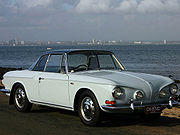
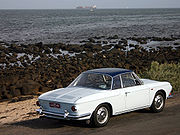 In September 1961, Volkswagen introduced the VW 1500 Karmann Ghia, or Type 34, based on its new Type 3
platform, featuring Volkswagen's new flat 1500cc engine design, and styling by Italian engineer Sergio Sartorelli
. Due to model confusion with the Type 14 1500 introduced in 1967, the Type 34 was known variously as the "Der Große Karmann" ("the big Karmann") in Germany, "Razor Edge Ghia" in the United Kingdom, or "European Ghia" (or "Type 3 Ghia" among enthusiasts) in the United States. Today the name Type 34 is recognized as the worldwide naming convention.
The second automobile model in the world to have this option, an electrically operated sliding steel sunroof was optional in 1962. The styling offered more interior and cargo room than the original Karmann Ghia. It featured an electric clock, three luggage spaces, built-in fog lights, round tail lights, upper & lower dash pads, door pads, & long padded armrests. It was the fastest production VW model of its day.
Until it was replaced by the VW-Porsche 914
, it was the most expensive and luxurious passenger car VW manufactured in the 1960s — back then you could have purchased two basic Beetles for the price of one Type 34 in many markets. The comparatively high price meant it never generated high demand, and only 42,505 (plus 17 prototype convertibles ) were built over the car's entire production life between 1962 and 1969 (roughly 5,000 a year). Today, the Type 34 is considered a semi-rare collectible with values ranging from US$25K (nice original or restored) to $8K (driving project) to $3K (non-driving parts car). Values in Europe are the highest with an unrestored original Pearl White 1962 Coupe selling for US$34,000 in late-2010 in Germany.
Although the Type 34 was available in most countries, it was not offered officially in the U.S. — VW's largest and most important export market — another reason for its low sales numbers. Many still made their way to the USA (most via Canada), and the USA has the largest number of known Type 34s left in the world (400 of the total 1,500 to 2,000 or so remaining).
Like its Type 14 brother, the Type 34 was styled by the Italian design studio Ghia. There are some similar styling influences, but the Type 14 Ghia looks very different from the Type 34. The chassis is also a major difference between the cars: the Type 14 shares its chassis with a Beetle, whereas the Type 34 body is mounted on the Type 3 chassis and drive train (the same as in a 1500/1600 Notchback, Variant (squareback) & Fastback) — all distinguished by a flattened "pancake" engine that provides a front and rear boot. The Type 34 is consequently mechanically the same as other Type 3s. All bodywork, interior, glass, bumpers, and most of the lenses are unique to the Type 34.
The Wilhelm Karmann factory assembly line which assembled the Type 34 also produced the VW-Porsche 914 (known as Porsche 914 in the USA) — the Type 34's replacement.
 As an alternative to the Type 34 Karmann-Ghia coupé, which Volkswagen had introduced to Europe in 1961, Karmann-Ghia do Brasil looked to Ghia in Turin for a reworked version of the Type 14 at the end of the 1960s. At the time Ghia employed Giorgetto Giugiaro
, the famous Italian designer and he was set to work on the new Brazilian Karmann Ghia. The result was the Volkswagen Karmann Ghia TC (Touring Coupé), internally known as the Type 145, which was introduced in 1970.
This model looked much like an Italian impression of a Porsche 911
and was a roomy 2+2 coupe with a modern and comfortable interior. Underneath it was similar to the Type 14 though actually the platform of the Volkswagen Variant was used rather than that of the Volkswagen Beetle
. The main difference was the engine: the Type 145 TC was fitted with the 1584 cc flat-four air-cooled boxer unit from the Type 3
instead of the 1192 cc unit of the Type 14. The car had 65 hp @ 4600 rpm and a top speed of 86 mph (138.4 km/h), compared to the 34 hp and 72 mph (115.9 km/h) of the Type 14.
18,119 TC models were produced during its production run from 1970 till 1976. It was only offered in South America and wasn't exported off the continent. There is a prototype which is part of the factory museum collection of Karmann
in Osnabrück
, Germany.
Volkswagen
Volkswagen is a German automobile manufacturer and is the original and biggest-selling marque of the Volkswagen Group, which now also owns the Audi, Bentley, Bugatti, Lamborghini, SEAT, and Škoda marques and the truck manufacturer Scania.Volkswagen means "people's car" in German, where it is...
– combining the chassis and mechanicals of the Type 1 (Beetle)
Volkswagen Beetle
The Volkswagen Type 1, widely known as the Volkswagen Beetle or Volkswagen Bug, is an economy car produced by the German auto maker Volkswagen from 1938 until 2003...
, styling by Luigi Segre
Luigi Segre
Luigi "Gigi" Segre was an Italian automotive designer and engineer, leading the Carrozzeria Ghia from 1953, when Mario Boano left, until his death in 1963, from complications during surgery....
of the Italian carrozzeria Ghia
Carrozzeria Ghia
Carrozzeria Ghia SpA is one of the most famous Italian automobile design and coachbuilding firms, established by Giacinto Ghia and Gariglio as Carrozzeria Ghia & Gariglio, located at 4 Corso Valentino in Turin....
, and hand-built bodywork by German coach-builder Karmann
Karmann
Wilhelm Karmann GmbH, commonly known simply as Karmann, in Osnabrück, Germany was until 2009 the largest independent motor vehicle manufacturing company in Germany...
.
The Karmann Ghia was internally designated the Type 14. Volkswagen later introduced a variant in 1961, the Type 34 – featuring angular bodywork and based on the newly introduced Type 3
Volkswagen Type 3
The Volkswagen Type 3 was a range of small cars from German manufacturer Volkswagen , introduced at the 1961 Frankfurt Motor Show, Internationale Automobil-Ausstellung ....
platform.
Production doubled soon after its introduction, becoming the car most-imported into the U.S. American industrial designer Walter Dorwin Teague
Walter Dorwin Teague
Walter Dorwin Teague was an American architect, designer and one of the most prolific American industrial designers in terms of volume of completed work. Teague's name and vision lives on through the legacy of his company....
selected the Type 14 for his list of the world's most beautifully designed products.
Over 445,000 Karmann Ghias were produced in Germany over the car's production life – not including the Type 34 variant. Karmann Brazil produced 41,600 cars locally for South America between 1962 and 1975.
History
The Type 14 debuted at the October 1953 Paris Auto Show as a styling concept created for Ghia by Luigi SegreLuigi Segre
Luigi "Gigi" Segre was an Italian automotive designer and engineer, leading the Carrozzeria Ghia from 1953, when Mario Boano left, until his death in 1963, from complications during surgery....
.
In the early 1950s, Volkswagen was producing its economy car, the Type 1 (Beetle). With an increase in post-war standards of living, executives at Volkswagen proposed adding a halo car to its model range, contracting with German coachbuilder Karmann for its manufacture. Karmann in turn contracted the Italian firm Ghia, who adapted styling themes previously explored for Chrysler
Chrysler
Chrysler Group LLC is a multinational automaker headquartered in Auburn Hills, Michigan, USA. Chrysler was first organized as the Chrysler Corporation in 1925....
and Studebaker
Studebaker
Studebaker Corporation was a United States wagon and automobile manufacturer based in South Bend, Indiana. Founded in 1852 and incorporated in 1868 under the name of the Studebaker Brothers Manufacturing Company, the company was originally a producer of wagons for farmers, miners, and the...
to a Beetle floorpan
Floorpan
The floorpan is a large sheet metal stamping that often incorporates several smaller welded stampings to form the floor of a large vehicle and the position of its external and structural panels....
widened by 12 in (304.8 mm).
In contrast to the Beetle's machine welded-body with bolt-on fenders, the Karmann Ghia's body panels were butt-welded
Buttwelding
Butt welding can be used to run a processing machine continuously, as opposed to having to restart such machine with a new supply of metals.Usually, the seams are cleaned and prepared, and set on an automated piece of equipment which then welds the two materials together...
, hand-shaped and smoothed with English pewter
English pewter
While the term pewter covers a range of tin-based alloys, the term English pewter has come to represent a strictly-controlled alloy, specified by BSEN611-1 and British Standard 5140, consisting mainly of tin , with the balance made up of antimony and copper. Significantly, it is free of lead and...
in a time-consuming process commensurate with higher-end manufacturers – and resulting in the Karmann Ghia's higher price.
The design and prototype were well-received by Volkswagen executives, and in August 1955 the first Type 14 was manufactured in Osnabrück
Osnabrück
Osnabrück is a city in Lower Saxony, Germany, some 80 km NNE of Dortmund, 45 km NE of Münster, and some 100 km due west of Hanover. It lies in a valley penned between the Wiehen Hills and the northern tip of the Teutoburg Forest...
, Germany. Public reaction to the Type 14 exceeded expectations, with over 10,000 sold in the first year.
The Type 14 was marketed as a practical and stylish 2+2 rather than as a true sports car
Sports car
A sports car is a small, usually two seat, two door automobile designed for high speed driving and maneuverability....
. As they shared engines, the Type 14's engine displacement grew concurrently with the Type 1 (Beetle), ultimately arriving at a displacement of 1584 cc, producing 60 hp.
In August 1957, Volkswagen introduced a convertible
Convertible
A convertible is a type of automobile in which the roof can retract and fold away having windows which wind-down inside the doors, converting it from an enclosed to an open-air vehicle...
version of the Karmann Ghia. Exterior changes in 1961 included wider and finned front grilles, taller and more rounded rear taillights and headlights relocated to a higher position – with previous models and their lower headlight placement called lowlights. The Italian designer Sergio Sartorelli
Sergio Sartorelli
Sergio Sartorelli was an Italian automotive designer and engineer who worked for Carrozzeria Ghia and FIAT. He designed the Karmann Ghia Type 34....
, designer of Type 34, oversaw the various restylings of Type 14.
The 1967 Type 14 Karmann Ghia convertible gained notoriety on American television as being the car driven by CONTROL Agent 86 Maxwell Smart in the opening credits of the third and fourth seasons of Get Smart
Get Smart
Get Smart is an American comedy television series that satirizes the secret agent genre. Created by Mel Brooks with Buck Henry, the show starred Don Adams , Barbara Feldon , and Edward Platt...
. Like the Sunbeam Tiger
Sunbeam Tiger
The Sunbeam Tiger was a muscle car version of the British Rootes Group's Sunbeam Alpine roadster.-Development:The West Coast Sales Manager of Rootes American Motors Inc., Ian Garrad, realized that the Alpine's image was that of a touring car rather than a sports car, and he set about changing its...
before it, (which remained the car driven by Smart in the episodes themseleves), the character would be seen in the opening credits screeching to a halt outside of his headquarters. The Karmann Ghia was replaced in the final season credits of the show however, by the Opel GT
Opel GT
The Opel GT is a two-seat sports car first presented as a styling exercise in 1965 at the Paris and Frankfurt motor shows, and introduced as a production model late in 1968 by Opel, a German subsidiary of General Motors...
. In the 2008 film of the same name
Get Smart (film)
Get Smart is a 2008 American spy-fi comedy film based on Mel Brooks and Buck Henry's 1960s spy parody television series of the same name. The film stars Steve Carell as Maxwell Smart and Anne Hathaway as Agent 99...
, a Karmann Ghia once again made an appearance driven by Smart, along with its two sister cars, though the car in the film was a model from 1970. The Karmann Ghia is also the subject of a secret pass phrase in the 2011 movie Cars 2
Cars 2
Cars 2 is a 2011 American computer-animated action film produced by Pixar, and it is the sequel to the 2006 film, Cars. In the film, race car Lightning McQueen and tow truck Mater head to Japan and Europe to compete in the World Grand Prix, but Mater becomes sidetracked with international espionage...
.
In 1970, larger taillights integrated the reversing lights and larger wrap-around turn signals. Still larger and wider taillights increased side visibility and at the same time large square-section bumpers replaced the smooth round originals. For the USA model only, 1973 modifications mandated by the National Highway Traffic Safety Administration
National Highway Traffic Safety Administration
The National Highway Traffic Safety Administration is an agency of the Executive Branch of the U.S. government, part of the Department of Transportation...
(NHTSA) included energy-absorbing bumpers. A carpeted package shelf replaced the rear seat.
In late 1974 the car was superseded by the Golf ("Rabbit" in USA)-based Volkswagen Scirocco
Volkswagen Scirocco
The Scirocco is a 3-door Coupe manufactured by German automaker Volkswagen, undergoing two generations of development between 1974 and 1992 and reintroduced in a third generation in August 2008.-Etymology:...
.
| Karmann Ghia (1963) | |||||||||
|---|---|---|---|---|---|---|---|---|---|
| Engine | Displacement | Power | Torque | Wheelbase | L × W × H (mm) | Weight | Top speed | 0→100 km/h | Fuel cap. |
| OHV four-stroke air-cooled flat 4 "Volkswagen Volkswagen Volkswagen is a German automobile manufacturer and is the original and biggest-selling marque of the Volkswagen Group, which now also owns the Audi, Bentley, Bugatti, Lamborghini, SEAT, and Škoda marques and the truck manufacturer Scania.Volkswagen means "people's car" in German, where it is... ", 1 single Solex 28 PICT carburettor |
1,192 cc (77 x 64 mm) | 34 PS at 3,600 rpm | 8.4 kgm at 2,000 rpm | 2,40 m | 4,14×1,63×1,33 | 820 kg | 120 km/h (75 mph) | ||
| OHV four-stroke air-cooled flat 4 "Volkswagen Volkswagen Volkswagen is a German automobile manufacturer and is the original and biggest-selling marque of the Volkswagen Group, which now also owns the Audi, Bentley, Bugatti, Lamborghini, SEAT, and Škoda marques and the truck manufacturer Scania.Volkswagen means "people's car" in German, where it is... ", Modified with double Solex 32 PBIC carburettor and OKRASA long-stroke crankshaft. |
1,295 cc (77 x 69.5 mm) | 50 PS at 4,200 rpm | 9.6 kgm at 2,800 rpm | 150 km/h (93 mph) |
Type 34 Karmann Ghia
Volkswagen Type 3
The Volkswagen Type 3 was a range of small cars from German manufacturer Volkswagen , introduced at the 1961 Frankfurt Motor Show, Internationale Automobil-Ausstellung ....
platform, featuring Volkswagen's new flat 1500cc engine design, and styling by Italian engineer Sergio Sartorelli
Sergio Sartorelli
Sergio Sartorelli was an Italian automotive designer and engineer who worked for Carrozzeria Ghia and FIAT. He designed the Karmann Ghia Type 34....
. Due to model confusion with the Type 14 1500 introduced in 1967, the Type 34 was known variously as the "Der Große Karmann" ("the big Karmann") in Germany, "Razor Edge Ghia" in the United Kingdom, or "European Ghia" (or "Type 3 Ghia" among enthusiasts) in the United States. Today the name Type 34 is recognized as the worldwide naming convention.
The second automobile model in the world to have this option, an electrically operated sliding steel sunroof was optional in 1962. The styling offered more interior and cargo room than the original Karmann Ghia. It featured an electric clock, three luggage spaces, built-in fog lights, round tail lights, upper & lower dash pads, door pads, & long padded armrests. It was the fastest production VW model of its day.
Until it was replaced by the VW-Porsche 914
Porsche 914
The Porsche 914 or VW-Porsche 914 is a mid-engined, targa-topped two-seat roadster designed, manufactured and marketed collaboratively by Volkswagen and Porsche from 1969 to 1976.- Development :...
, it was the most expensive and luxurious passenger car VW manufactured in the 1960s — back then you could have purchased two basic Beetles for the price of one Type 34 in many markets. The comparatively high price meant it never generated high demand, and only 42,505 (plus 17 prototype convertibles ) were built over the car's entire production life between 1962 and 1969 (roughly 5,000 a year). Today, the Type 34 is considered a semi-rare collectible with values ranging from US$25K (nice original or restored) to $8K (driving project) to $3K (non-driving parts car). Values in Europe are the highest with an unrestored original Pearl White 1962 Coupe selling for US$34,000 in late-2010 in Germany.
Although the Type 34 was available in most countries, it was not offered officially in the U.S. — VW's largest and most important export market — another reason for its low sales numbers. Many still made their way to the USA (most via Canada), and the USA has the largest number of known Type 34s left in the world (400 of the total 1,500 to 2,000 or so remaining).
Like its Type 14 brother, the Type 34 was styled by the Italian design studio Ghia. There are some similar styling influences, but the Type 14 Ghia looks very different from the Type 34. The chassis is also a major difference between the cars: the Type 14 shares its chassis with a Beetle, whereas the Type 34 body is mounted on the Type 3 chassis and drive train (the same as in a 1500/1600 Notchback, Variant (squareback) & Fastback) — all distinguished by a flattened "pancake" engine that provides a front and rear boot. The Type 34 is consequently mechanically the same as other Type 3s. All bodywork, interior, glass, bumpers, and most of the lenses are unique to the Type 34.
The Wilhelm Karmann factory assembly line which assembled the Type 34 also produced the VW-Porsche 914 (known as Porsche 914 in the USA) — the Type 34's replacement.
Karmann Ghia TC
Giorgetto Giugiaro
Giorgetto Giugiaro is an Italian automobile designer responsible equally for a stable of supercars and several of the most popular everyday vehicles driven today...
, the famous Italian designer and he was set to work on the new Brazilian Karmann Ghia. The result was the Volkswagen Karmann Ghia TC (Touring Coupé), internally known as the Type 145, which was introduced in 1970.
This model looked much like an Italian impression of a Porsche 911
Porsche 911
The Porsche 911 is a luxury 2-door sports coupe made by Porsche AG of Stuttgart, Germany. It has a distinctive design, rear-engined and with independent rear suspension, an evolution of the swing axle on the Porsche 356. The engine was also air-cooled until the introduction of the Type 996 in 1998...
and was a roomy 2+2 coupe with a modern and comfortable interior. Underneath it was similar to the Type 14 though actually the platform of the Volkswagen Variant was used rather than that of the Volkswagen Beetle
Volkswagen Beetle
The Volkswagen Type 1, widely known as the Volkswagen Beetle or Volkswagen Bug, is an economy car produced by the German auto maker Volkswagen from 1938 until 2003...
. The main difference was the engine: the Type 145 TC was fitted with the 1584 cc flat-four air-cooled boxer unit from the Type 3
Volkswagen Type 3
The Volkswagen Type 3 was a range of small cars from German manufacturer Volkswagen , introduced at the 1961 Frankfurt Motor Show, Internationale Automobil-Ausstellung ....
instead of the 1192 cc unit of the Type 14. The car had 65 hp @ 4600 rpm and a top speed of 86 mph (138.4 km/h), compared to the 34 hp and 72 mph (115.9 km/h) of the Type 14.
18,119 TC models were produced during its production run from 1970 till 1976. It was only offered in South America and wasn't exported off the continent. There is a prototype which is part of the factory museum collection of Karmann
Karmann
Wilhelm Karmann GmbH, commonly known simply as Karmann, in Osnabrück, Germany was until 2009 the largest independent motor vehicle manufacturing company in Germany...
in Osnabrück
Osnabrück
Osnabrück is a city in Lower Saxony, Germany, some 80 km NNE of Dortmund, 45 km NE of Münster, and some 100 km due west of Hanover. It lies in a valley penned between the Wiehen Hills and the northern tip of the Teutoburg Forest...
, Germany.