

Visions of the Daughters of Albion

Encyclopedia
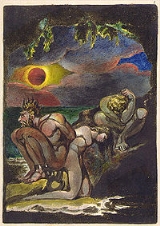
Visions of the Daughters of Albion is a 1793 poem by William Blake
, produced as a book with his own illustrations. It is a short and early example of his prophetic books
, and a sequel of sorts to The Book of Thel
.
The central narrative is of the female character Oothoon, called the "soft soul of America", and of her sexual experience. S. Foster Damon
(A Blake Dictionary) suggested that Blake had been influenced by Mary Wollstonecraft
's A Vindication of the Rights of Women, published in 1792.
Oothoon is in love with Theotormon, who represents the chaste man, filled with a false sense of righteousness. Oothoon desires Theotormon but is suddenly, violently raped by Bromion. After Oothoon is raped neither Bromion nor Theotormon want anything to do with her.
As is usual in Blake, the names of the characters represent their symbolic roles. Theotormon's name is derived from the Greek "theos", which means god, and the Latin "tormentum", which means twist or torment. The name of his rival Bromion is Greek meaning "roarer".
Bromion represents the passionate man, filled with lustful fire. Oothoon is the representation of a woman in Blake's society, who had no charge over her own sexuality. Blake has the Daughters of Albion look to the West, to America, because he believed that there was a promise in America that would one day end all forms of discrimination. It was to be in America, that races would live in harmony, and women would be able to claim their own sexuality. At the same time, Blake recognizes that though America has freed itself from British rule, it continues to practice slavery.
Blake used Plato's Allegory of the cave
in Visions of the Daughters of Albion as a theme for the three characters not being able to understand the true nature of reality, without being hindered by convention
. It has been argued that Theotormon is a mythicised version of John Stedman, whose book about his experience of slavery and brutality in Suriname
on the coast of South America was being illustrated by Blake at the time.
William Blake
William Blake was an English poet, painter, and printmaker. Largely unrecognised during his lifetime, Blake is now considered a seminal figure in the history of both the poetry and visual arts of the Romantic Age...
, produced as a book with his own illustrations. It is a short and early example of his prophetic books
William Blake's prophetic books
The prophetic books of the English poet and artist William Blake are a series of difficult and obscure poetic works. While Blake worked as a commercial illustrator, these books were ones that he produced, with his own engravings, as an extended and largely private project...
, and a sequel of sorts to The Book of Thel
The Book of Thel
The Book of Thel is a poem by William Blake, dated 1789 and probably worked on in the period 1788 to 1790.It is illustrated by his own plates, and is relatively short and easy to understand, compared to his later prophetic books. The metre is a fourteen-syllable line. It was preceded by Tiriel,...
.
The central narrative is of the female character Oothoon, called the "soft soul of America", and of her sexual experience. S. Foster Damon
S. Foster Damon
S Foster Damon was an American academic, a specialist in William Blake, a critic and a poet. He was born in Newton, Massachusetts. He was one of the Harvard Aesthetes, and married Louise Wheelwright, sister of John Wheelwright who was another poet identified with that grouping...
(A Blake Dictionary) suggested that Blake had been influenced by Mary Wollstonecraft
Mary Wollstonecraft
Mary Wollstonecraft was an eighteenth-century British writer, philosopher, and advocate of women's rights. During her brief career, she wrote novels, treatises, a travel narrative, a history of the French Revolution, a conduct book, and a children's book...
's A Vindication of the Rights of Women, published in 1792.
Oothoon is in love with Theotormon, who represents the chaste man, filled with a false sense of righteousness. Oothoon desires Theotormon but is suddenly, violently raped by Bromion. After Oothoon is raped neither Bromion nor Theotormon want anything to do with her.
As is usual in Blake, the names of the characters represent their symbolic roles. Theotormon's name is derived from the Greek "theos", which means god, and the Latin "tormentum", which means twist or torment. The name of his rival Bromion is Greek meaning "roarer".
Bromion represents the passionate man, filled with lustful fire. Oothoon is the representation of a woman in Blake's society, who had no charge over her own sexuality. Blake has the Daughters of Albion look to the West, to America, because he believed that there was a promise in America that would one day end all forms of discrimination. It was to be in America, that races would live in harmony, and women would be able to claim their own sexuality. At the same time, Blake recognizes that though America has freed itself from British rule, it continues to practice slavery.
Blake used Plato's Allegory of the cave
Allegory of the cave
The Allegory of the Cave—also known as the Analogy of the Cave, Plato's Cave, or the Parable of the Cave—is an allegory used by the Greek philosopher Plato in his work The Republic to illustrate "our nature in its education and want of education"...
in Visions of the Daughters of Albion as a theme for the three characters not being able to understand the true nature of reality, without being hindered by convention
Convention (norm)
A convention is a set of agreed, stipulated or generally accepted standards, norms, social norms or criteria, often taking the form of a custom....
. It has been argued that Theotormon is a mythicised version of John Stedman, whose book about his experience of slavery and brutality in Suriname
Suriname
Suriname , officially the Republic of Suriname , is a country in northern South America. It borders French Guiana to the east, Guyana to the west, Brazil to the south, and on the north by the Atlantic Ocean. Suriname was a former colony of the British and of the Dutch, and was previously known as...
on the coast of South America was being illustrated by Blake at the time.
Trivia
- BromionBromionBromion is a character in the mythology of William Blake. According to S. Foster Damon he represents Reason, from the side of the poet's mind.-Incidence:* Visions of the Daughters of Albion, in which he plays a major role...
is a title used for Dionysos; it means the "loud-roarer". - The edition was very small, and copies have been individually traced.
External links
- Blake Archive page
- Text of Visions of the Daughters of Albion
- Digital Facsimile of Visions of the daughters of Albion bound with Book of Thel, Lowell *EC75.B5815.793va. Houghton Library at Harvard University.