
All Topics  
Virtual ground


   Email Print
   Bookmark   Link


Virtual ground


In the theory of electrical network
Electrical network

An electrical network is an interconnection of electrical elements such as resistors, inductors, capacitors, transmission lines, voltage sources, current sources, and switches....
s, a virtual ground (or virtual earth) is a node of the circuit that is maintained at a steady reference potential, without being connected directly to the reference potential. In some cases the reference potential is considered to be that of the surface of the earth, and the reference node is called "ground" or "earth" as a consequence.

The virtual ground concept aids circuit analysis in operational amplifier and other circuits and provides useful practical circuit effects that would be difficult to achieve in other ways.

In circuit theory, a node may have any value of current or voltage but physical implementations of a virtual ground will have limitations of current handling ability and a non-zero impedance
Impedance

Impedance may refer to:*the ratio of the voltage phasor to the electric current phasor, as in**Electrical impedance, a measure of opposition to time-varying electric current in an electric circuit....
 which may have practical side effects.

Creating a simple virtual ground
In electronics, virtual ground is usually created by summing two opposite voltages.


Discussion
Ask a question about 'Virtual ground'
Start a new discussion about 'Virtual ground'
Answer questions from other users
Full Discussion Forum


Encyclopedia


In the theory of electrical network
Electrical network

An electrical network is an interconnection of electrical elements such as resistors, inductors, capacitors, transmission lines, voltage sources, current sources, and switches....
s, a virtual ground (or virtual earth) is a node of the circuit that is maintained at a steady reference potential, without being connected directly to the reference potential. In some cases the reference potential is considered to be that of the surface of the earth, and the reference node is called "ground" or "earth" as a consequence.

The virtual ground concept aids circuit analysis in operational amplifier and other circuits and provides useful practical circuit effects that would be difficult to achieve in other ways.

In circuit theory, a node may have any value of current or voltage but physical implementations of a virtual ground will have limitations of current handling ability and a non-zero impedance
Impedance

Impedance may refer to:*the ratio of the voltage phasor to the electric current phasor, as in**Electrical impedance, a measure of opposition to time-varying electric current in an electric circuit....
 which may have practical side effects.

Creating a simple virtual ground


In electronics, virtual ground is usually created by summing two opposite voltages. Since direct parallel connection of voltage sources will cause excessive current flow (a voltage "conflict") resistors must be included. For example, in the simple virtual ground circuit (Fig. 2), two opposite voltage sources (+V1 and -V2) are connected through respective resistors (R1 and R2) to the virtual ground point A.

You can think of the circuit as two parallel connected current sources: I1 (comprising V1 and R1) and I2 (comprising V2 and R2). The parallel connection of the two sources has given the name of circuits with parallel negative feedback. From another viewpoint, the two resistors constitute an extremely useful resistive circuit of a parallel voltage summer, which is frequently used in circuits with parallel feedback (op-amp inverting amplifier, op-amp inverting summer, op-amp non-inverting Schmitt trigger
Schmitt trigger

In electronics, a Schmitt trigger is a comparator electrical network that incorporates positive feedback.When the input is higher than a certain chosen threshold, the output is high; when the input is below another chosen threshold, the output is low; when the input is between the two, the output retains its value....
, etc.)

Figuratively speaking, the circuit may be considered as an electrical "tug of war", where two voltage sources "fight" each other - V1 "pulls" the point A up while V2 "pulls" it down. In this "game", the pull-up resistor
Pull-up resistor

Pull-up resistors are used in electronic logic circuits to ensure that inputs to logic systems settle at expected logic levels if external devices are disconnected....
 R1 and the pull-down resistor R2 serve as electrical "ropes". If V1/V2 = -R1/R2, zero voltage appears in the point A; it is a virtual ground. In this arrangement, a current I = V1/R1 = V2/R2 passes continuously through the circuit; as a result, the resistors dissipate power continuously.


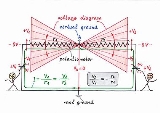
The requirements needed for appearance a virtual ground in the common point between two series connected resistors can be seen directly as geometrical relations in the similar triangles constituting the voltage diagram of a linear potentiometer (Fig. 1):

  • two voltages have to be applied to the other ends of the resistors,
  • the voltages have to have opposite polarities regarding to the ground,
  • the voltages have to bear the same proportion as between the respective resistors.


Obtaining a perfect virtual ground


Once the virtual ground is created, it has to be kept steady since the input sources and the loads connected to this point affect it by "injecting" or "sinking" a current. This is the well-known problem of keeping up a constant voltage (zero voltage is also a voltage).

The most popular way of keeping up a virtual ground is a negative feedback
Negative feedback

Negative feedback feeds part of a system's output, inverted, into the system's input; generally with the result that fluctuations are attenuated....
. In this case (Fig. 2), the varying voltage source B2 "observes" continuously the voltage VA of the virtual ground point and changes its voltage V2 so that the voltage VA is always zero.
Opampinverting
An op-amp inverting amplifier (Fig. 3a) is a typical circuit where the virtual ground point is kept up by a negative feedback. Since an operational amplifier
Operational amplifier

An operational amplifier, which is often called an op-amp, is a direct current-Direct coupling high-gain electronic voltage electronic amplifier with differential inputs and, usually, a single output....
 has very high open loop gain, the amplifier acts automatically to make the potential difference between its inputs tend to zero when a feedback network is implemented; to achieve a reasonable voltage at the output (and thus equilibrium in the system), the output supplies the non-inverting input (via the feedback network) with enough voltage to reduce the potential difference between the inputs to microvolts. The non-inverting (+) input of the operational amplifier is grounded; therefore, its inverting (-) input, although not connected to ground, will assume a similar potential, becoming a virtual ground. The circuit operation is illustrated more attractively on Fig. 3b by means of a voltage diagram; for this purpose, the two resistors are replaced by one linear potentiometer.


It seems strange but, in order to understand how an op-amp sustains the virtual ground, it is useful to think of it as an integrator rather than an amplifier.

According to this viewpoint, if the input voltage source changes its voltage -VIN towards the negative supply voltage -V, a negative voltage VA = -VR2/(VR1 + VR2) tries to appear in the point A. However, the op-amp "observes" that and immediately reacts: it changes its output voltage VOA toward the positive supply voltage +V until it manages to zero again the potential VA (to restore the virtual ground).

On the graphical presentation, the two sources "pull" the virtual ground point A in opposite directions; as a result, the voltage diagram rotates around the point A. The op-amp serves here as the varying voltage source V2 from Fig. 1.


Applications


Virtual ground serving as a power ground


Real ground. Voltage
Voltage

Electrical tension is the potential difference between two points of an electrical or electronic circuit, expressed in volts. It is the measurement of the potential for an electric field to cause an electric current in an electrical conductor....
 is a differential quantity, which appears between two points. In order to deal only with a voltage (an electrical potential) of a single point, the second point has to be connected to a reference point (ground
Ground

Ground may refer to:* The surface of the Earth* Soil, a mixture of clay, sand and organic matter present on the surface of the Earth and serving as substrate for plants growth and micro-organisms development...
). Usually, the power supply terminals serve as steady grounds; when the internal points of compound power sources are accessible, they can also serve as real grounds (Fig. 4a).

Real ground is a point with a steady voltage belonging to the supply voltage source.


Virtual ground. If there are not accessible source internal points, external circuit points having steady voltage towards the source terminals can serve as artificial virtual grounds (Fig. 4b). Such a point has to have steady potential, which does not vary when the electrical sources "attack" the virtual ground by "injecting" or "sucking" a current to/from it.

Virtual ground is a circuit point with a steady voltage outside the supply voltage source.


Virtual ground serving as a circuit point:


Circuit input

Op Amp I To V Pos 300
In all the circuits with parallel negative feedback (e.g., the inverting op-amp circuits), the main duty of the (op-amp) amplifier is to "look after" the virtual ground, in order to keep an almost zero voltage in this point. However, the input sources affect the virtual ground by "injecting" or "sucking" a current to/from this point. In the simplest case, the input current sources do this directly (examples: transimpedance amplifier - Fig. 5, current integrator
Current integrator

A current integrator is an electronic device performing a time integration of an electric current, thus measuring a total electric charge.One application of current integration is in ion beam deposition, where the measured charge directly corresponds to the number of ions deposited on a substrate, assuming the charge state of the ions is kn...
 and charge amplifier
Charge amplifier

A charge amplifier is a circuit whose equivalent input impedance is a capacitance that provides a very high value of impedance at low frequencies....
).

A virtual ground presents a very low impedance
Electrical impedance

Electrical impedance, or simply impedance, describes a measure of opposition to a sinusoidal alternating current . Electrical impedance extends the concept of Electrical resistance to AC circuits, describing not only the relative amplitudes of the voltage and Electric current, but also the relative Phase ....
 to any signal connected to it and it therefore provides the perfect type of input for current type signal sources (piezoelectric sensor
Piezoelectric sensor

A piezoelectric sensor is a device that uses the piezoelectric effect to measure pressure, acceleration, Strain or force by converting them to an electricity signal....
s, photodiode
Photodiode

A photodiode is a type of photodetector capable of converting light into either electric current or voltage, depending upon the mode of operation....
s etc.) For example, in the circuit of a charge amplifier, stray capacitance at the input to the amplifier is not detrimental to operation because this capacitance is always at a virtual ground.


Internal circuit node

"Conflict point" in differential circuits. If a differential input signal is applied to a transistor differential amplifier, a virtual ground appears in the common "conflict" point between the emitters of the two "fighting" transistors. Similarly, a virtual ground appears in the internal middle point of the common resistor Rgain connecting the outputs of the input op-amp followers of an instrumentation amplifier
Instrumentation amplifier

An instrumentation amplifier is a type of differential amplifier that has been outfitted with input buffers, which eliminate the need for input impedance matching and thus make the amplifier particularly suitable for use in measurement and test equipment....
. Also, two virtual grounds appear simultaneously at the inverting and the non-inverting inputs of a fully differential amplifier
Fully differential amplifier

A fully differential amplifier, usually referred to as an 'FDA' for brevity, is a direct current-Direct coupling high-gain electronic voltage electronic amplifier with differential inputs and differential outputs....
.

"Intervention" point in negative feedback circuits. The input voltage sources affect the virtual ground existing in the op-amp circuits with parallel negative feedback through a circuit component acting as a voltage-to-current converter
Voltage-to-current converter

For a variety of reasons, in low-voltage electronics, voltage is a more frequently used data carrier. Thus electronic devices tend to be labeled with voltage inputs and outputs....
. It can be a resistor (in an inverting amplifier, integrator
Integrator

An integrator is a device to perform the mathematical operation known as integral, a fundamental operation in calculus.The integration function is often part of engineering, physics, machine, chemical and science calculations....
, logarithmic amplifier), a capacitor (in a differentiator
Differentiator

A Differentiator is a circuit that is designed such that the output of the circuit is proportional to the time derivative of the input. There are two types of differentiator circuits, active differentiator and passive differentiator circuit....
), a diode (in an antilogarithmic amplifier), etc. In some circuits, for example, a summing amplifier (Fig. 6), a few input sources "attack" simultaneously the virtual ground. The op-amp reacts to the input intervention, in order to restore the normal virtual ground state (VA = 0). For this purpose, it changes its output voltage, in order to "suck" or "push" a current through another circuit component (a capacitor, a diode, a resistor, etc.) from/to this point.

In this way, the op-amp's output voltage in circuits with parallel negative feedback actually represents the op-amp's reaction to the input intervention and serves as an output. Actually, the virtual ground point is the "true" output but it is non-used.

Purposely worsened virtual ground. In some single-supplied circuits with positive feedback (for example, an op-amp inverting comparator with hysteresis
Hysteresis

A system with hysteresis can be summarized as a system that may be in any number of states, independent of the inputs to the system. To be exact, a system with hysteresis exhibits path-dependence, or "rate-independent memory"....
 named also op-amp Schmitt trigger), the virtual ground is preliminarily worsened. In this arrangements, this point has significant internal resistance, in order to be easily influenced by the op-amp output. The same trick of a "soft" virtual ground is frequently used in the single supply op-amp circuits with negative feedback.

Circuit output

It seems strange but, in some odd circuits, the virtual ground point serves as a circuit signal output.

Clipping indicator. In the circuits with parallel negative feedback, the voltage of the virtual ground point indicates the system's state. When the system works properly, its output quantity (usually voltage) manages to "neutralize" the input influence in the virtual ground; there is approximately a zero voltage in this point. If the system runs out of output voltage, it saturates and a voltage appears in the virtual ground. Actually, this voltage is a part of the input voltage. For example, in the circuit of an inverting amplifier (Fig. 3a), the resistors Rin and Rf act as a voltage divider; therefore, Rf/(Rf + Rin) part of the input voltage begins crossing over to the op-amp's inverting input when the op amp saturates. This voltage may be used (for example, in audio amplifiers) as an output signal indicating the onset of clipping.

Diode limiter. In the clever circuit of an op-amp parallel diode limiter (Fig. 7), the op-amp's output is non-used as a conventional circuit output (as it is in a logarithmic converter); instead, the inverting op-amp's input serves as an output. At a positive input voltage (when the circuit limits), the op-amp adds a compensating voltage VOA = VF in series with the forward voltage drop VF across the diode. As a result, the imperfect diode becomes an almost ideal one having zero forward voltage drop VF ˜ 0. Respectively, the imperfect passive diode limiter (the resistor R and diode D) that clips the input positive voltage at approximately 0.7V becomes an almost ideal limiter that clips the voltage at ˜ 0V.


Virtual ground problems


Static error. Negative feedback seems to be a perfect technique for keeping up a virtual ground as it compensates various disturbances. However, it can't keep up exactly zero voltage in this point; this voltage is VA = VOA/A (where A is the op-amp gain without a negative feedback applied). Typically, A > 105; therefore, VA is almost zero.

Sensitivity. Virtual ground is a sensitive point, especially if the circuit components are highly resistive. The op-amp reacts to any influence at this point (e.g., due to leakage on the PCB) by changing its output voltage.

Inertness. In response to an input voltage or current step, the op-amp output voltage does not change instantaneously; the finite circuit bandwidth results in a ramp-like initial response as with an integrator. As a result, the virtual ground moves from zero until the op-amp responds. For example, in the circuit of an inverting amplifier - Fig. 3a, Rf/(Rf + Rin) part of the input voltage appears at the virtual ground point.

Instability. In an inverting amplifier adding a capacitor between ground and the virtual ground at the (-) op-amp input can make the amplifier unstable. Stray capacitance from a probe is often sufficient.

See also


  • Voltage-to-current converter
    Voltage-to-current converter

    For a variety of reasons, in low-voltage electronics, voltage is a more frequently used data carrier. Thus electronic devices tend to be labeled with voltage inputs and outputs....
     and Current-to-voltage converter
    Current-to-voltage converter

    Three kinds of devices are used in electronics: Electrical generators , converters and Electrical loads . Most frequently, they use voltage as input/output quantity....
     show some typical virtual ground applications


External links

  • RF Virtual ground node and antenna engineering by Francesco Errante
  • shows how to build various op-amp inverting circuits keeping virtual ground (an animated flash movie)
  • shows the application of the virtual ground concept in an inverting amplifier
  • - a funny story about op-amp amplifying circuits and virtual ground manifestations
  • Application note on creating an artificial virtual ground as a reference voltage.