

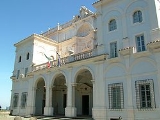
Villa Falconieri

Encyclopedia
Frascati
Frascati is a town and comune in the province of Rome in the Lazio region of central Italy. It is located south-east of Rome, on the Alban Hills close to the ancient city of Tusculum. Frascati is closely associated with science, being the location of several international scientific...
, Italy
Italy
Italy , officially the Italian Republic languages]] under the European Charter for Regional or Minority Languages. In each of these, Italy's official name is as follows:;;;;;;;;), is a unitary parliamentary republic in South-Central Europe. To the north it borders France, Switzerland, Austria and...
.
History
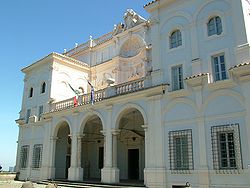
The villa was originally called Villa Rufina, having been was initially built by Monsignor Alessandro Rufini. Later it was enlarged thanks to Pope Paul III, dates back to 1546. In 1628 Orazio Falconieri purchased the villa and commissioned Francesco BorrominiFrancesco Borromini
Francesco Borromini, byname of Francesco Castelli was an architect from Ticino who, with his contemporaries, Gian Lorenzo Bernini and Pietro da Cortona, was a leading figure in the emergence of Roman Baroque architecture.A keen student of the architecture of Michelangelo and the ruins of...
to oversee its renovation. His aim was for he and his brother, Cardinal Lelio Falconieri
Lelio Falconieri
Lelio Falconieri was an Italian Catholic Cardinal.-Family and early life:Falconieri was born in 1585 in Florence, the tenth of the thirteen children of Paolo Falconieri and his second wife Maddalena degli Albizzi. He was the brother of Don Orazio Falconieri who purchased the Villa Falconieri and...
, to be buried there
Important architects worked on the design such as Antonio da Sangallo the Younger
Antonio da Sangallo the Younger
thumb|250px|The church of Santa Maria di Loreto near the [[Trajan's Market]] in [[Rome]], considered Sangallo's masterwork.thumb|250px|View of St. Patrick's Well in [[Orvieto]]....
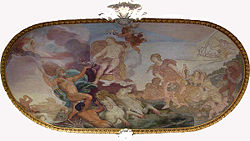
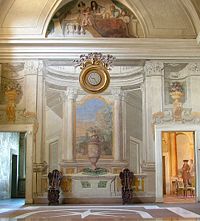
and Borromini. The interior houses frescoes by Pier Leone Ghezzi
Pier Leone Ghezzi
Pier Leone Ghezzi was an Italian Rococo painter and caricaturist active in Rome.Ghezzi was born in Rome. His father, Giuseppe Ghezzi, , also trained Antonio Amorosi, and was a secretary to the Roman Accademia di San Luca...
, Giacinto Calandrucci
Giacinto Calandrucci
Giacinto Calandrucci was an Italian painter of the Baroque period.Originally from Palermo, he moved to Rome with the fellow Palermitaan painter and engraver Pietro del Pò. Like many painters in Rome in his day, then entered the large and prolific studio of Carlo Maratta...
, Ciro Ferri
Ciro Ferri
Ciro Ferri was an Italian Baroque sculptor and painter, the chief pupil and successor of Pietro da Cortona.He was born in Rome, where he began working under Cortona and with a team of artists in the extensive fresco decorations of the Quirinal Palace...
, Niccolò Berrettoni
Niccolò Berrettoni
Niccolò Berrettoni was an Italian painter of the Baroque period. He trained with Simone Cantarini then worked with Carlo Maratta. Among his paintings in Rome was a Madonna with St...
, and others. The park is a splendid Italian gardens enlarged in the 17th century, with small lake bordered by cypresses created in the 18th century.
Modern history
Later, on May 1907, the Villa was bought by the German baron Ernest Mendelsshon-Bartholdy of Berlin, who gave it as a gift to Kaiser Wilhelm II. On April 6, 1911 the Crown Prince William and Princess Cecilie visited the villa and decided on some restorations. Here the German writer Richard Voss lived (25 years) and wrote several novels as Villa Falconieri, Roman Fever, The Son of Volsca and others; he called the Villa as "my shining house". For these reasons Villa Falconieri was always dear to the German community of Rome.At the end of the First World War, the Villa was confiscated by Italian State. Villa Falconieri was damaged by bombing during World War II
World War II
World War II, or the Second World War , was a global conflict lasting from 1939 to 1945, involving most of the world's nations—including all of the great powers—eventually forming two opposing military alliances: the Allies and the Axis...
but masterly work restored its previous splendor.
Modern use
Villa Falconieri is now the headquarters of the Centro Europeo dell' Educazione (CEDE) and INVALSI.