
All Topics  
Vibrio cholerae

 
Vibrio Cholerae

   Email Print
   Bookmark   Link


Vibrio cholerae


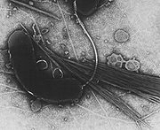
Vibrio cholerae (also Kommabacillus) is a motile gram negative curved-rod shaped bacterium with a polar flagellum
Flagellum

A flagellum is a tail-like structure that projects from the cell body of certain prokaryotic and eukaryotic cells, and it functions in locomotion....
 that causes cholera
Cholera

Cholera, sometimes known as Asiatic or epidemic cholera, is an infectious gastroenteritis caused by enterotoxin-producing strains of the bacterium Vibrio cholerae....
 in human
Human

A human being, also human or man, is a member of a species of bipedalism primates in the family Hominidae . Mitochondrial DNA evidence indicates that modern humans originated in east Africa about 200,000 years ago....
s. V. cholerae and other species of the genus
Genus

A genus is a low-level taxonomic rank used in the classification of living and fossil organisms. The taxonomic ranks are domain , kingdom , phylum, class , order , family , genus, and species....
 Vibrio
Vibrio

Vibrio is a genus of Gram-negative bacteria possessing a curved rod shape. Typically found in Seawater, Vibrio are Facultative anaerobic organism that test positive for oxidase and do not form spores....
 belong to the gamma subdivision of the Proteobacteria
Proteobacteria

The Proteobacteria are a major group of bacteria. They include a wide variety of pathogens, such as Escherichia, Salmonella, Vibrio, Helicobacter, and many other notable genera....
.  

There are two major strains of V. cholerae, classic and El Tor
El Tor

El Tor is the name given to a particular strain of the bacterium Vibrio cholerae, the causative agent of cholera. Also known as V. cholera biotype eltor, it has been the dominant strain in the seventh global pandemic....
, and numerous other serogroups.

V. cholerae was first isolated as the cause of cholera by Italian anatomist Filippo Pacini
Filippo Pacini

Filippo Pacini was an Italy anatomist, posthumously famous for isolating the cholera bacillus Vibrio cholerae in 1854, well before Robert Koch's more widely accepted discoveries thirty years later....
 in 1854, but his discovery was not widely known until Robert Koch
Robert Koch

Heinrich Hermann Robert Koch was a German physician. He became famous for isolating Bacillus anthracis , the Mycobacterium tuberculosis and the Vibrio cholerae and for his development of Koch's postulates....
, working independently thirty years later, publicized the knowledge and the means of fighting the disease.

Habitat
V. cholerae occurs naturally in the plankton
Plankton

Plankton consist of any drifting organisms that inhabit the pelagic zone of oceans, seas, or bodies of fresh water. Plankton are defined by their ecological niche rather than their Phylogenetics or taxonomy classification....
 of fresh
Fresh Water

Fresh Water is the debut album by Australian rock and blues singer Alison McCallum, released in 1972. Rare for an Australian artist at the time, it came in a gatefold sleeve....
, brackish
Brackish water

Brackish water is water that has more salinity than fresh water, but not as much as seawater. It may result from mixing of seawater with fresh water, as in estuary, or it may occur in brackish fossil aquifers....
, and salt water
Seawater

Seawater is water from a sea or ocean. On average, seawater in the world's oceans has a salinity of about 3.5%, or 35 parts per thousand . This means that every 1 kg of seawater has approximately 35 grams of sea salt ....
, attached primarily to copepod
Copepod

Copepods are a group of small crustaceans found in the sea and nearly every fresh water habitat . Many species are planktonic , but more are benthos , and some continental species may live in limno-terrestrial habitats and other wet terrestrial places, such as swamps, under leaf fall in wet forests, bogs, springs, ephemeral ponds and puddle...
s in the zooplankton
Zooplankton

Zooplankton are the heterotrophic type of plankton. Plankton are organisms drifting in the Pelagic zone of oceans, seas, and bodies of fresh water....
.


Discussion
Ask a question about 'Vibrio cholerae'
Start a new discussion about 'Vibrio cholerae'
Answer questions from other users
Full Discussion Forum


Encyclopedia


Vibrio cholerae (also Kommabacillus) is a motile gram negative curved-rod shaped bacterium with a polar flagellum
Flagellum

A flagellum is a tail-like structure that projects from the cell body of certain prokaryotic and eukaryotic cells, and it functions in locomotion....
 that causes cholera
Cholera

Cholera, sometimes known as Asiatic or epidemic cholera, is an infectious gastroenteritis caused by enterotoxin-producing strains of the bacterium Vibrio cholerae....
 in human
Human

A human being, also human or man, is a member of a species of bipedalism primates in the family Hominidae . Mitochondrial DNA evidence indicates that modern humans originated in east Africa about 200,000 years ago....
s. V. cholerae and other species of the genus
Genus

A genus is a low-level taxonomic rank used in the classification of living and fossil organisms. The taxonomic ranks are domain , kingdom , phylum, class , order , family , genus, and species....
 Vibrio
Vibrio

Vibrio is a genus of Gram-negative bacteria possessing a curved rod shape. Typically found in Seawater, Vibrio are Facultative anaerobic organism that test positive for oxidase and do not form spores....
 belong to the gamma subdivision of the Proteobacteria
Proteobacteria

The Proteobacteria are a major group of bacteria. They include a wide variety of pathogens, such as Escherichia, Salmonella, Vibrio, Helicobacter, and many other notable genera....
.  

There are two major strains of V. cholerae, classic and El Tor
El Tor

El Tor is the name given to a particular strain of the bacterium Vibrio cholerae, the causative agent of cholera. Also known as V. cholera biotype eltor, it has been the dominant strain in the seventh global pandemic....
, and numerous other serogroups.

V. cholerae was first isolated as the cause of cholera by Italian anatomist Filippo Pacini
Filippo Pacini

Filippo Pacini was an Italy anatomist, posthumously famous for isolating the cholera bacillus Vibrio cholerae in 1854, well before Robert Koch's more widely accepted discoveries thirty years later....
 in 1854, but his discovery was not widely known until Robert Koch
Robert Koch

Heinrich Hermann Robert Koch was a German physician. He became famous for isolating Bacillus anthracis , the Mycobacterium tuberculosis and the Vibrio cholerae and for his development of Koch's postulates....
, working independently thirty years later, publicized the knowledge and the means of fighting the disease.

Habitat


V. cholerae occurs naturally in the plankton
Plankton

Plankton consist of any drifting organisms that inhabit the pelagic zone of oceans, seas, or bodies of fresh water. Plankton are defined by their ecological niche rather than their Phylogenetics or taxonomy classification....
 of fresh
Fresh Water

Fresh Water is the debut album by Australian rock and blues singer Alison McCallum, released in 1972. Rare for an Australian artist at the time, it came in a gatefold sleeve....
, brackish
Brackish water

Brackish water is water that has more salinity than fresh water, but not as much as seawater. It may result from mixing of seawater with fresh water, as in estuary, or it may occur in brackish fossil aquifers....
, and salt water
Seawater

Seawater is water from a sea or ocean. On average, seawater in the world's oceans has a salinity of about 3.5%, or 35 parts per thousand . This means that every 1 kg of seawater has approximately 35 grams of sea salt ....
, attached primarily to copepod
Copepod

Copepods are a group of small crustaceans found in the sea and nearly every fresh water habitat . Many species are planktonic , but more are benthos , and some continental species may live in limno-terrestrial habitats and other wet terrestrial places, such as swamps, under leaf fall in wet forests, bogs, springs, ephemeral ponds and puddle...
s in the zooplankton
Zooplankton

Zooplankton are the heterotrophic type of plankton. Plankton are organisms drifting in the Pelagic zone of oceans, seas, and bodies of fresh water....
. Coastal cholera outbreaks typically follow zooplankton blooms
Algal bloom

An algal bloom is a rapid increase in the population of algae in an aquatic system. Algal blooms may occur in freshwater as well as marine environments....
. This makes cholera a typical zoonosis
Zoonosis

A zoonosis or zoonose is any infectious disease that is able to be transmitted from other animals, both wild and domestic, to humans or from humans to animals ....
.

Pathogenesis

V. cholerae colonizes the gastrointestinal tract, where it adheres to villi. Additionally, it produces two different proteases called chitinase and mucinase. Chitinase
Chitinase

Chitinases are digestive enzymes that break down glycosidic bonds in chitin. Because chitin composes the cell walls of fungi and exoskeleton elements of some animals , chitinases are generally found in organisms that either need to reshape their own chitin or to dissolve and digest the chitin of fungi or animals....
 is responsible for the ability of Vibrio cholerae to enter copepods. Mucinase is a non-specific protease that assists entry into the human gastro-intestinal tract.

Vibrio cholerae produces what is called a ZOT, termed as "Zona Occludens Toxin". This toxin specifically attacks the zona occludans or "tight" junctions joining epithelial cells.

Passage of the bacterium through the gastrointestinal tract is believed to be a major contributor to its enhanced pathogenicity as compared to colonies cultured in vitro. This enhanced virulence affords a competitive advantage in nature, this competitive advantage is lost once virulent bacteria are transferred to in vitro cultures. . V. cholerae strains possessing this higher virulence were found to possess an increase in transcription of genes coding for biosynthesis of amino acids, iron uptake systems, ribosomal proteins, and formation of a periplasmic nitrate reductase complex that may allow for respiration under low oxygen tension, all of which enhance proliferation in the rice water stool that is characteristic of cholera infection

Genomics and Evolution

The 4.0 Mbp genome
Genome

In classical genetics, the genome of a diploid organism including eukarya refers to a full set of chromosomes or genes in a gamete; thereby, a regular somatic cell contains two full sets of genomes....
 of N16961, an O1 serogroup, El Tor biotype, 7th pandemic strain of V. cholerae, is comprised of two circular chromosome
Chromosome

A chromosome is an organized structure of DNA and protein that is found in Cell . A chromosome is a single piece of DNA that contains many genes, regulatory sequence and other genetic sequence....
s of unequal size that are predicted to encode a total of 3,885 gene
Gene

A gene is the basic unit of heredity in a living organism. All living things depend on genes. Genes hold the information to build and maintain their cell and pass genetic trait to offspring....
s. The genomic sequence
DNA sequence

A DNA sequence or genetic sequence is a succession of letters representing the primary structure of a real or hypothetical DNA molecule or strand, with the capacity to carry information as described by the central dogma of molecular biology....
 of this representative strain has furthered our understanding of the genetic and phenotypic diversity found within the species V. cholerae. Sequence data have been used to identify horizontally acquired sequences, dissect complex regulatory and signaling pathways, and develop computational approaches to predict patterns of gene expression
Gene expression

Gene expression is the process by which inheritable information from a gene, such as the DNA sequence, is made into a functional gene product, such as protein or RNA....
 and the presence of metabolic pathway
Metabolic pathway

In biochemistry, a metabolic pathway is a series of chemistry reactions occurring within a cell . In each pathway, a principal chemical is modified by chemical reactions....
 components. Microarray
Microarray

Different kinds of biological assays are called microarrays:*DNA microarrays, such as cDNA microarrays and oligonucleotide microarrays*MMChips, for surveillance of microRNA populations...
s are being used to study the evolution of the organism. Genomic sequencing of additional strains, subtractive hybridization studies and the introduction of new model systems have also contributed to the identification of novel sequences and pathogenic mechanisms associated with other strains.

See also

  • Cholera
    Cholera

    Cholera, sometimes known as Asiatic or epidemic cholera, is an infectious gastroenteritis caused by enterotoxin-producing strains of the bacterium Vibrio cholerae....


External links