


Veiled Chameleon

Encyclopedia
The veiled chameleon, Chamaeleo calyptratus, is a large species
of chameleon
found in the mountain
regions of Yemen
, United Arab Emirates
and Saudi Arabia
. It is also sometimes referred to as the Yemen Chameleon.
The male
veiled chameleon
is green in color and, depending on the animal's emotional state, this green will range from a bright lime
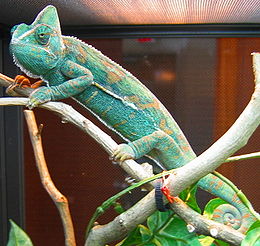
green to a red olive drab. Surroundings only partly contribute to a chameleon's "decision" to change color. The green base color is marked with stripes and spots of yellow, brown, and blue. Non-breeding female
s and juvenile chameleons are generally a uniform green color with some white markings. Breeding and gravid females are a very dark green with blue and yellow spots. The prominence of these markings is dependent on several factors including health, mood, and temperature of the lizard.
Male chameleons of the species have small spurs or heels on the back their rear feet; while females do not. This spur is present on males from hatching, and can grow larger with maturity. Adult male Veiled chameleons are relatively large for reptiles. It is possible for them to reach an overall length of 24 inches (60 cm). Most specimens usually reach between 14 to 18 inches (35–45 cm). Females are smaller with the average overall length being just under 12 inches (30 cm). Males and females both have a decorative growth called a "casque" on their heads. The casque of a male chameleon is much taller than the female's.
Like most chameleons, veiled chameleons are specialized tree
dwellers. They have a flattened body meant to mimic a leaf and feet specially designed for grasping limbs and branches. They have a prehensile tail that acts as a fifth appendage and aids in climbing. Their eye
s work independently of one another allowing the chameleon to look in front of and behind itself at the same time. They have a long sticky tongue
that they use to capture their insect
prey. Veiled chameleons are ambush predators and are capable of lying still for very long periods of time waiting for an unsuspecting locust
to wander by.
 Veiled chameleons are omnivore
s. While their main diet consists of insects, they will occasionally consume the leaves, blossoms, and fruit of various plants. This is especially true in times of drought
when water is scarce. Like all chameleons, veiled chameleons prefer to drink water that is in drops or on leaves. They do not always recognize standing water and may dehydrate if that is their only source.
Female veiled chameleons can produce up to three clutches of eggs
a year, as early from 4–6 months of age. Each clutch may contain 20–70 eggs. The eggs dissimilar to chickens. They retain sperm, which is why they lay so many clutches. Egg-laying sand must be provided for mature females in an incubated bucket or etc. with approximately 8-10 inches of organic garden soil, or they can die of egg binding.
Veiled chameleons are often kept in captivity because they are hearty when compared to other chameleon species often offered for sale. Like most old-world chameleons, they must be kept individually in a screened enclosure, and provided with a basking light, and a source of UVB/UVA light. As with all exotic pets, a qualified herpetologist veterinarian should be consulted when getting a new animal, and when any health or behavior problems are observed.
Species
In biology, a species is one of the basic units of biological classification and a taxonomic rank. A species is often defined as a group of organisms capable of interbreeding and producing fertile offspring. While in many cases this definition is adequate, more precise or differing measures are...
of chameleon
Chameleon
Chameleons are a distinctive and highly specialized clade of lizards. They are distinguished by their parrot-like zygodactylous feet, their separately mobile and stereoscopic eyes, their very long, highly modified, and rapidly extrudable tongues, their swaying gait, the possession by many of a...
found in the mountain
Mountain
Image:Himalaya_annotated.jpg|thumb|right|The Himalayan mountain range with Mount Everestrect 58 14 160 49 Chomo Lonzorect 200 28 335 52 Makalurect 378 24 566 45 Mount Everestrect 188 581 920 656 Tibetan Plateaurect 250 406 340 427 Rong River...
regions of Yemen
Yemen
The Republic of Yemen , commonly known as Yemen , is a country located in the Middle East, occupying the southwestern to southern end of the Arabian Peninsula. It is bordered by Saudi Arabia to the north, the Red Sea to the west, and Oman to the east....
, United Arab Emirates
United Arab Emirates
The United Arab Emirates, abbreviated as the UAE, or shortened to "the Emirates", is a state situated in the southeast of the Arabian Peninsula in Western Asia on the Persian Gulf, bordering Oman, and Saudi Arabia, and sharing sea borders with Iraq, Kuwait, Bahrain, Qatar, and Iran.The UAE is a...
and Saudi Arabia
Saudi Arabia
The Kingdom of Saudi Arabia , commonly known in British English as Saudi Arabia and in Arabic as as-Sa‘ūdiyyah , is the largest state in Western Asia by land area, constituting the bulk of the Arabian Peninsula, and the second-largest in the Arab World...
. It is also sometimes referred to as the Yemen Chameleon.
The male
Male
Male refers to the biological sex of an organism, or part of an organism, which produces small mobile gametes, called spermatozoa. Each spermatozoon can fuse with a larger female gamete or ovum, in the process of fertilization...
veiled chameleon
Chameleon
Chameleons are a distinctive and highly specialized clade of lizards. They are distinguished by their parrot-like zygodactylous feet, their separately mobile and stereoscopic eyes, their very long, highly modified, and rapidly extrudable tongues, their swaying gait, the possession by many of a...
is green in color and, depending on the animal's emotional state, this green will range from a bright lime
Lime (color)
Lime, also traditionally known as lime green or lime-green, is a color three-quarters of the way between yellow and green , so named because it is a representation of the color of the citrus fruit called limes...
green to a red olive drab. Surroundings only partly contribute to a chameleon's "decision" to change color. The green base color is marked with stripes and spots of yellow, brown, and blue. Non-breeding female
Female
Female is the sex of an organism, or a part of an organism, which produces non-mobile ova .- Defining characteristics :The ova are defined as the larger gametes in a heterogamous reproduction system, while the smaller, usually motile gamete, the spermatozoon, is produced by the male...
s and juvenile chameleons are generally a uniform green color with some white markings. Breeding and gravid females are a very dark green with blue and yellow spots. The prominence of these markings is dependent on several factors including health, mood, and temperature of the lizard.
Male chameleons of the species have small spurs or heels on the back their rear feet; while females do not. This spur is present on males from hatching, and can grow larger with maturity. Adult male Veiled chameleons are relatively large for reptiles. It is possible for them to reach an overall length of 24 inches (60 cm). Most specimens usually reach between 14 to 18 inches (35–45 cm). Females are smaller with the average overall length being just under 12 inches (30 cm). Males and females both have a decorative growth called a "casque" on their heads. The casque of a male chameleon is much taller than the female's.
Like most chameleons, veiled chameleons are specialized tree
Tree
A tree is a perennial woody plant. It is most often defined as a woody plant that has many secondary branches supported clear of the ground on a single main stem or trunk with clear apical dominance. A minimum height specification at maturity is cited by some authors, varying from 3 m to...
dwellers. They have a flattened body meant to mimic a leaf and feet specially designed for grasping limbs and branches. They have a prehensile tail that acts as a fifth appendage and aids in climbing. Their eye
Eye
Eyes are organs that detect light and convert it into electro-chemical impulses in neurons. The simplest photoreceptors in conscious vision connect light to movement...
s work independently of one another allowing the chameleon to look in front of and behind itself at the same time. They have a long sticky tongue
Tongue
The tongue is a muscular hydrostat on the floors of the mouths of most vertebrates which manipulates food for mastication. It is the primary organ of taste , as much of the upper surface of the tongue is covered in papillae and taste buds. It is sensitive and kept moist by saliva, and is richly...
that they use to capture their insect
Insect
Insects are a class of living creatures within the arthropods that have a chitinous exoskeleton, a three-part body , three pairs of jointed legs, compound eyes, and two antennae...
prey. Veiled chameleons are ambush predators and are capable of lying still for very long periods of time waiting for an unsuspecting locust
Locust
Locusts are the swarming phase of short-horned grasshoppers of the family Acrididae. These are species that can breed rapidly under suitable conditions and subsequently become gregarious and migratory...
to wander by.
Omnivore
Omnivores are species that eat both plants and animals as their primary food source...
s. While their main diet consists of insects, they will occasionally consume the leaves, blossoms, and fruit of various plants. This is especially true in times of drought
Drought
A drought is an extended period of months or years when a region notes a deficiency in its water supply. Generally, this occurs when a region receives consistently below average precipitation. It can have a substantial impact on the ecosystem and agriculture of the affected region...
when water is scarce. Like all chameleons, veiled chameleons prefer to drink water that is in drops or on leaves. They do not always recognize standing water and may dehydrate if that is their only source.
Female veiled chameleons can produce up to three clutches of eggs
Egg (biology)
An egg is an organic vessel in which an embryo first begins to develop. In most birds, reptiles, insects, molluscs, fish, and monotremes, an egg is the zygote, resulting from fertilization of the ovum, which is expelled from the body and permitted to develop outside the body until the developing...
a year, as early from 4–6 months of age. Each clutch may contain 20–70 eggs. The eggs dissimilar to chickens. They retain sperm, which is why they lay so many clutches. Egg-laying sand must be provided for mature females in an incubated bucket or etc. with approximately 8-10 inches of organic garden soil, or they can die of egg binding.
Veiled chameleons are often kept in captivity because they are hearty when compared to other chameleon species often offered for sale. Like most old-world chameleons, they must be kept individually in a screened enclosure, and provided with a basking light, and a source of UVB/UVA light. As with all exotic pets, a qualified herpetologist veterinarian should be consulted when getting a new animal, and when any health or behavior problems are observed.