
All Topics  
Vanity Fair

 
Vanity Fair

   Email Print
   Bookmark   Link


Vanity Fair


Vanity Fair: A Novel without a Hero is a novel
Novel

File:2009 stapelweise Neuerscheinungen im Buchladen.JPGA novel is today a long narrative in literary prose. The genre has historical roots both in the fields of the medieval and early modern Romance and in the tradition of the novella....
 by William Makepeace Thackeray
William Makepeace Thackeray

William Makepeace Thackeray was an England novelist of the 19th century. He was famous for his satire works, particularly Vanity Fair , a panoramic portrait of English society....
, first published in 1847-48, that satirizes
Satire

Satire is often strictly defined as a literary genre; although, in practice, it is also found in the graphic arts and performing arts. In satire, human or individual vices, follies, abuses, or shortcomings are held up to censure by means of ridicule, derision, burlesque, irony, or other methods, ideally with the intent to bring about improv...
 society in early 19th-century England
England

native_name =|conventional_long_name = England|common_name = England|image_flag = Flag of England.svg|image_coat = England COA.svg|symbol_type = Royal Coat of Arms...
. The book's title is a term originating in John Bunyan
John Bunyan

John Bunyan was an English Christianity writer and preacher, famous for writing The Pilgrim's Progress, arguably the most famous published Christian allegory....
's allegorical
Allegory

Allegory is generally treated as a figure of rhetoric, but an allegory does not have to be expressed in language: it may be addressed to the eye, and is often found in realistic painting, sculpture or some other form of Mimesis, or representative art....
 story The Pilgrim's Progress
The Pilgrim's Progress

The Pilgrim's Progress from This World to That Which Is to Come by John Bunyan is a Christian allegory. It is regarded as one of the most significant works of English literature, has been translated into more than 200 languages, and has never been out of print....
, which was first published in 1678, and still widely read at the time of Thackeray's novel. Vanity fair refers to a stop along the pilgrim's progress: a never-ending fair held in a town called Vanity, which is meant to be representational of man's sinful attachment to wordly things.


Discussion
Ask a question about 'Vanity Fair'
Start a new discussion about 'Vanity Fair'
Answer questions from other users
Full Discussion Forum


Encyclopedia


Vanity Fair: A Novel without a Hero is a novel
Novel

File:2009 stapelweise Neuerscheinungen im Buchladen.JPGA novel is today a long narrative in literary prose. The genre has historical roots both in the fields of the medieval and early modern Romance and in the tradition of the novella....
 by William Makepeace Thackeray
William Makepeace Thackeray

William Makepeace Thackeray was an England novelist of the 19th century. He was famous for his satire works, particularly Vanity Fair , a panoramic portrait of English society....
, first published in 1847-48, that satirizes
Satire

Satire is often strictly defined as a literary genre; although, in practice, it is also found in the graphic arts and performing arts. In satire, human or individual vices, follies, abuses, or shortcomings are held up to censure by means of ridicule, derision, burlesque, irony, or other methods, ideally with the intent to bring about improv...
 society in early 19th-century England
England

native_name =|conventional_long_name = England|common_name = England|image_flag = Flag of England.svg|image_coat = England COA.svg|symbol_type = Royal Coat of Arms...
. The book's title is a term originating in John Bunyan
John Bunyan

John Bunyan was an English Christianity writer and preacher, famous for writing The Pilgrim's Progress, arguably the most famous published Christian allegory....
's allegorical
Allegory

Allegory is generally treated as a figure of rhetoric, but an allegory does not have to be expressed in language: it may be addressed to the eye, and is often found in realistic painting, sculpture or some other form of Mimesis, or representative art....
 story The Pilgrim's Progress
The Pilgrim's Progress

The Pilgrim's Progress from This World to That Which Is to Come by John Bunyan is a Christian allegory. It is regarded as one of the most significant works of English literature, has been translated into more than 200 languages, and has never been out of print....
, which was first published in 1678, and still widely read at the time of Thackeray's novel. Vanity fair refers to a stop along the pilgrim's progress: a never-ending fair held in a town called Vanity, which is meant to be representational of man's sinful attachment to wordly things. The novel is now considered a classic, and has inspired several film adaptation
Film adaptation

Film adaptation is the transfer of a written work to a feature film. It is a type of derivative work.A common form of film adaptation is the use of a novel as the basis of a film, but film adaptation includes the use of non-fiction , autobiography, comic book, scripture, Play , and even other films....
s.

Plot summary

The story opens at Miss Pinkerton's Academy for Young Ladies, where the principal protagonist
Protagonist

A protagonist is the main Character of a drama or Narrative. The word "protagonist" derives from the Greek language p??ta????st?? , "one who plays the first part, chief actor." In the theatre of Ancient Greece, three actors played all of the main dramatic roles in a tragedy; the leading role was played by the protagonist, while the othe...
s Becky Sharp and Amelia Sedley have just completed their studies and are preparing to depart for Amelia's house in Russell Square
Russell Square

Russell Square is a large garden square in Bloomsbury, in the London Borough of Camden. It is near the University of London's main buildings and the British Museum....
. Becky is portrayed as a strong-willed and cunning young woman determined to make her way in society, and Amelia Sedley as a good-natured, loveable, though simple-minded young girl.

At Russell Square, Miss Sharp is introduced to the dashing and self-obsessed Captain George Osborne (to whom Amelia has been betrothed from a very young age) and to Amelia's brother Joseph Sedley, a clumsy and vainglorious but rich civil-servant fresh from the East India Company
East India Company

East India Company was a historical English company, founded in 1600, and chartered with the monopoly of trading with Southeast Asia, East Asia, and India....
. Becky entices Sedley, hoping to marry him, but she fails because of warnings from Captain Osborne, Sedley's own native shyness, and his embarrassment over some foolish drunken behavior of his that Becky had witnessed at Vauxhall.

With this, Becky Sharp says farewell to Sedley's family and enters the service of the crude and profligate baronet
Baronet

A baronet or the rare female equivalent, a baronetess , is the holder of a hereditary title awarded by the British Crown known as a baronetcy....
 Sir Pitt Crawley, who has engaged her as a governess
Governess

A governess is a female employee of a family who teaches children within their home. In contrast to a nanny or a babysitter, she concentrates on teaching children, not their physical needs....
 to his daughters. Her behaviour at Sir Pitt's house gains his favour, and after the premature death of his second wife, he proposes to her. However, he finds that she is already secretly married to his second son, Rawdon Crawley.

Sir Pitt's elder half sister, the spinster
Spinster

A spinster is a woman or girl of marriageable age who has been unwilling or unable to marry and, therefore, has no children. Socially, the term is usually applied only to women who are regarded as beyond the customary age for marriage, and is generally considered an insulting term, more degrading than the term "bachelor" for males....
 Miss Crawley, is very rich, having inherited her mother's fortune of £70,000. How she will bequeath her great wealth is a source of constant conflict between the branches of the Crawley family who vie shamelessly for her affections; initially her favorite is Sir Pitt's younger son, Captain Rawdon Crawley. For some time, Becky acts as Miss Crawley's companion, supplanting the loyal Miss Briggs in an attempt to establish herself in favor before breaking the news of her elopement with Miss Crawley's nephew. However, the misalliance so enrages Miss Crawley, that she disinherits her nephew in favour of his pompous and pedantic elder brother, who also bears the name Pitt Crawley. The married couple constantly attempt to reconcile with Miss Crawley, and she relents a little. However, she will only see her nephew and refuses to change her will.

While Becky Sharp is rising in the world, Amelia's father, John Sedley, is bankrupted. The Sedleys and Osbornes were once close allies, but the relationship between the two families disintegrates after the Sedleys are financially ruined, and the marriage of Amelia and George is forbidden. George ultimately decides to marry Amelia against his father's will, primarily due to the pressure of his friend Dobbin, and George is consequently disinherited. While these personal events take place, the Napoleonic Wars
Napoleonic Wars

The Napoleonic Wars were a series of conflicts involving Napoleon I of France First French Empire and changing sets of European allies and opposing coalitions that ran from 1803 to 1815....
 have been ramping up. George Osborne and William Dobbin are suddenly deployed to Brussels
Brussels

Brussels , officially the Brussels Capital-Region, is the de facto capital city of the European Union and the largest urban area in Belgium....
, but not before an encounter with Becky and Captain Crawley at Brighton. The holiday is interrupted by orders to march to Brussels. Already, the newly wedded Osborne is growing tired of Amelia, and he becomes increasingly attracted to Becky who encourages his advances.

At a ball in Brussels (based on the Duchess of Richmond's famous ball
Duchess of Richmond's ball

File:Henry-Nelson-O'Neil Before-Waterloo 1868.jpgThe Duchess of Richmond's ball was held in Brussels on 15 June 1815, the night before the Battle of Quatre Bras....
 on the eve of the battle of Waterloo
Battle of Waterloo

In the Battle of Waterloo forces of the First French Empire under Napoleon Bonaparte and Michel Ney were defeated by those of the Seventh Coalition, including a Prussian army under the command of Gebhard Leberecht von Bl?cher and an Anglo-Allied army under the command of the Arthur Wellesley, 1st Duke of Wellington....
) George gives Becky a note inviting her to run away with him. He regrets this shortly afterwards and reconciles with Amelia, who has been deeply hurt by his attentions towards her former friend. The morning after, he is sent to Waterloo with Captain Crawley and Dobbin, leaving Amelia distraught. Becky, on the other hand, is virtually indifferent to her husband's departure. She tries to console Amelia, but Amelia responds angrily, disgusted by Becky's flirtatious behavior with George and her lack of concern about Captain Crawley. Becky resents this snub and a rift develops between the two women that lasts for years. Becky is not very concerned for the outcome of the war, either. Should Napoleon win, she plans to become the mistress of one his marshals, and meanwhile she makes a profit selling her carriage and horses at inflated prices to panicking Britons seeking to flee the city, where the Belgian population is openly pro-Napoleonic.

Captain Crawley survives, but George dies in the battle. Amelia bears him a posthumous
Posthumous birth

A posthumous birth is the birth of a child after the death of a parent. A person born in these circumstances is called a posthumous child or a posthumously born person....
 son, who is also named George. She returns to live in genteel poverty with her parents. Meanwhile, since the death of George, Dobbin, who is young George's godfather, gradually begins to express his love for the widowed Amelia by small kindnesses toward her and her son. Most notable is the recovery of her old piano, which Dobbin picks up at an auction following the Sedleys' ruin. Amelia mistakenly assumes this was done by her late husband. She is too much in love with George's memory to return Dobbin's affections. Saddened, he goes to India for many years. Dobbin's infatuation with Amelia is a theme which unifies the novel and one which many have compared to Thackeray's unrequited love for a friend's wife.

Meanwhile, Becky also has a son, also named after his father, but unlike Amelia, who dotes on and even spoils her child, Becky is a cold, distant mother. She continues her ascent first in post-war Paris and then in London where she is patronised by the great Marquess of Steyne, who covertly subsidises her and introduces her to London
London

London is the capital of both England and the United Kingdom, and the most populous municipality in the European Union. An important settlement for two millennia, History of London goes back to its founding by the Roman Empire....
 society. Her success is unstoppable despite her humble origins, and she is eventually presented at court to the Prince Regent
George IV of the United Kingdom

George IV was the king of Kingdom of Hanover and the United Kingdom of Great Britain and Ireland from the death of his father, George III of the United Kingdom, on 29 January 1820 until his own death ten years later....
 himself.

Becky and Rawdon appear to be financially successful, but their wealth and high standard of living are mostly smoke and mirrors. Rawdon gambles heavily and earns money as a billiards shark. The book also suggests he cheats at cards. Becky accepts trinkets and money from her many admirers and sells some for cash. She also borrows heavily from the people around her and seldom pays bills. The couple lives mostly on credit, and while Rawdon seems to be too dim-witted to be aware of the effect of his borrowing on the people around him, Becky is fully aware that her heavy borrowing and her failure to pay bills bankrupts at least two innocent people: her servant Briggs, whose life savings Becky borrows and fritters away, and her landlord Raggles, who was formerly a butler to the Crawley family and who invested his life savings in the townhouse that Becky and Rawdon rent (and fail to pay for). She also cheats innkeepers, milliners, dress-makers, grocer
Grocer

Beginning as early as the 14th century, a grocer was a dealer in comestible dry goods such as spices, pepper, sugar, and cocoa, tea and coffee....
s, and others who do business on credit. She and Rawdon obtain credit by tricking everyone around them into believing they are receiving money from others. Sometimes, Becky and Rawdon buy time from their creditors by suggesting Rawdon received money in Miss Crawley's will or are being paid a stipend by Sir Pitt. Ultimately Becky is suspected of carrying on an extramarital affair with the Marquess of Steyne, apparently encouarged by Rawdon to prostitute herself in exchange for money and promotion.

At the summit of her success, Becky's pecuniary relationship with the rich and powerful Marquess of Steyne is discovered by Rawdon after Rawdon is arrested for debt. His brother's wife, Lady Jane, bails him out and he surprises Becky and Steyne in a compromising moment. Rawdon leaves his wife and through the offices of the Marquess of Steyne is made Governor
Governor

A governor is a governing official, usually the Executive of a non-sovereign level of government, ranking under the head of state. In federations, a governor may be the title of each appointed or elected politician who governs a constitutive state....
 of Coventry Island to get him out of the way, after Rawdon challenges the elderly marquess to a duel. Becky, having lost both husband and credibility, is warned by Steyne to quit England and wanders the continent. Rawdon and Becky's son is left in the care of Pitt Crawley and Lady Jane. However wherever Becky goes, she is followed by the shadow of the Marquess of Steyne. No sooner does she establish herself in polite society than someone turns up who knows her disreputable history and spreads rumours; Steyne himself hounds her out of Rome
Rome

Rome is the capital city of Italy and Lazio, and is Italy's largest and most populous city, with 2,724,347 residents in an urban area of some ....
.

As Amelia's adored son George grows up, his grandfather relents and takes him from poor Amelia, who knows the rich and bitter old man will give him a much better start in life than she or her family could ever manage. After twelve years abroad both Joseph Sedley and William Dobbin return to England. Dobbin professes his unchanged love to Amelia, but although Amelia is affectionate, she tells him she cannot forget the memory of her dead husband. Dobbin also becomes close to George, and his kind, firm manner are a good influence on the spoilt child.

While in England, Dobbin mediates a reconciliation between Amelia and her father-in-law. The death of Amelia's father prevents their meeting, but following Osborne's death soon after, it is revealed that he had amended his will and bequeathed young George half his large fortune and Amelia a generous annuity. The rest is divided between his daughters, Miss Osborne, and Mrs Bullock, who begrudges Amelia and her son for the decrease in her annuity.

After the death of old Mr. Osborne, Amelia, Joseph, George and Dobbin go on a trip to Germany
Germany

Germany , officially the Federal Republic of Germany , is a country in Central Europe. It is bordered to the north by the North Sea, Denmark, and the Baltic Sea; to the east by Poland and the Czech Republic; to the south by Austria and Switzerland; and to the west by France, Luxembourg, Belgium, and the Netherlands....
, where they encounter the destitute Becky. She meets the young George Osborne at a card table and then enchants Jos Sedley all over again. Becky has unfortunately deteriorated as a character. She is drinking heavily, has lost her singing voice and much of her looks, and spends time with card sharks and con artists. The book suggests that Becky has been involved in activities even more shady than her usual con games, but does not go into details. Since there have been earlier hints about Becky's early life with her father, some of which suggest that Becky was a child prostitute, the reader is tempted to draw the most unsavory conclusions.

Following Jos' entreaties, Amelia agrees to a reconciliation (when she hears that Becky's ties with her son have been severed), much to Dobbin's disapproval. Dobbin quarrels with Amelia and finally realizes that he is wasting his love on a woman too shallow to return it. However, Becky, in a moment of conscience, shows Amelia the note that George (Amelia's dead husband) had given her, asking her to run away with him. This destroys Amelia's idealized image of George, but not before Amelia has sent a note to Dobbin professing her love.

Becky resumes her seduction of Joseph Sedley and gains control over him. He eventually dies of a suspicious ailment after signing a portion of his money to Becky as life insurance. In the original illustrations, which were done by Thackeray, Becky is shown behind a curtain with a vial (presumably of poison) in her hand; the picture is labelled 'Becky's second appearance in the character of Clytemnestra
Clytemnestra

Clytemnestra was the wife of Agamemnon, king of the Ancient Greece kingdom of Mycenae or Argos. In the Oresteia by Aeschylus, she was a femme fatale who murdered her husband, Agamemnon—said by Euripides to be her second husband—and his concubine Cassandra....
.' (She had played Clytemnestra during charades at a party earlier in the book.) His death appears to have made her fortune.

By a twist of fate Rawdon Crawley dies weeks before his older brother, whose possibly retarded son has already died. Thus the baronetcy descends to Rawdon's son. Had he outlived his brother by even a day he would have become Sir Rawdon Crawley and Becky would have become Lady Crawley - the title she uses regardless in later life.

The reader is informed at the end of the novel that although Dobbin married Amelia, and although he always treated her with great kindness, he never fully regained the love that he once had for her. There is also a final appearance by Becky, as cocky as ever, selling trinkets at a fair, presumably having run through the fortune left to her by Jos.

Characters


Becky Sharp
Becky Sharp (character)

Becky Sharp is the anti-heroine of William Makepeace Thackeray's satirical novel Vanity Fair . A cynical social climber who uses her charms to fascinate and seduce upper-class men, Sharp is contrasted with the clinging, dependent heroine Amelia Sedley....
 

The heroine, or more correctly the anti-heroine, is an intelligent young woman with a gift for satire. She is described as a petite sandy haired girl who has green eyes and a great deal of wit. Fluent in both French and English, Becky has a beautiful singing voice, plays the piano, and shows great talent as an actress. She is also completely amoral and without conscience. She does not seem to have the ability to get attached to other people, and lies easily and intelligently to get her way. She is extremely manipulative and, after the first few chapters and her failure to attract Jos Sedley, is not shown as being particularly sincere.

Never having known financial or social security even as a child, Becky desires it above all things. Nearly everything she does is with the intention of securing a stable position for herself, or herself and her husband after she and Rawdon are married. She advances Rawdon's interests tirelessly, flirting with men such as General Tufto and the Marquess of Steyne in order to get him promoted. She also uses her feminine wiles to distract men at card parties while Rawdon cheats them blind.

Becky makes a few mistakes. Marrying Rawdon Crawley in secret was a mistake, as was running off instead of begging Miss Crawley's forgiveness. She also fails to manipulate Miss Crawley through Rawdon so as to obtain an inheritance. Although Becky manipulates men very easily, she does not even try to cultivate the friendship of most women. Lady Jane, the Dobbin sisters, and Lady Steyne see right through her. Amelia and (initially) Miss Crawley are exceptions to the rule.

Amelia Sedley

Amelia is Becky's opposite: pale, passive, and emotionally devoted to her husband and son. She marries George Osborne against the wishes of George's father, and when George dies at the battle of Waterloo she brings up little George alone while living with her parents. She is completely dominated by her spendthrift father (who steals and sells the annuity George's friends put together to try to support her) and her mother.

After George Osborne's death, Amelia is obsessed with her son and with the memory of her husband. She ignores William Dobbin, who courts her for years, and treats him shabbily until eventually he leaves. It is only after Becky shows her George's letter to her that Amelia realizes what a good man Dobbin is, although she has already written to him to ask him to come back. She eventually marries Dobbin.

Rawdon Crawley

Rawdon, the younger of the two Crawley sons, is an empty-headed brunette cavalry officer who is his wealthy aunt's favorite until he marries Becky Sharp, who is of a far lower class. He permanently alienates his aunt, who leaves her estate to Sir Pitt instead. Sir Pitt has by this time inherited their father's estate, leaving Rawdon quite poor.

The well-meaning Rawdon has a few talents in life, most of which have to do with gambling and dueling. He is very good at cards and pool, and although he does not always win he is able to earn cash by betting against less talented gamblers. He is heavily indebted throughout most of the book, not so much for his own expenses as for Becky's. Not particularly talented as a military officer, he is content to let Becky manage his career.

Although Rawdon knows Becky is attractive to men, he believes her reputation is spotless even though she is widely suspected of romantic intrigue with General Tufto and other powerful men. Nobody dares to suggest otherwise to Rawdon because of his temper and his reputation for dueling. Yet other people, particularly the Marquess of Steyne, find it impossible to believe that Crawley is unaware of Becky's tricks. Steyne in particular believes Rawdon is fully aware Becky is prostituting herself, and believes Rawdon is going along with the charade in the hope of financial gain.

After Rawdon finds out the truth and leaves Becky for an assignment overseas, he leaves his son to be brought up by Sir Pitt and Lady Jane.

Sir Pitt Crawley, Baronet

Rawdon Crawley's elder brother inherits the Crawley estate from his elderly father, and he also inherits from his wealthy aunt, Miss Crawley. Sir Pitt is very religious and has political aspirations, although not many people appreciate his intelligence or wisdom because there's not much there to appreciate. Somewhat pedantic and conservative, Sir Pitt does nothing to help Rawdon or Becky even when they fall on hard times. This is chiefly because Lady Jane cordially hates Becky.

Miss Crawley

The elderly Miss Crawley is everyone's favourite wealthy aunt. Sir Pitt and Rawdon both dote on her, although Rawdon is her favourite nephew and sole heir until he marries Becky. While Miss Crawley likes Becky and keeps her around to entertain her with sarcasm and wit, and while she loves scandal and particularly stories of unwise marriage, she does not want scandal or unwise marriage in her family.

A substantial part of the early section of the book deals with the efforts the Crawleys make to kowtow to Miss Crawley in the hope of receiving a big inheritance.

George Osborne

George Osborne, his father, and his two sisters are close to the Sedley family until Mr. Sedley (the father of Jos and Amelia) goes bankrupt following some ill-advised speculation. Since George and Amelia were raised in close company and were childhood sweethearts, George defies his father in order to marry Amelia. Before father and son can be reconciled, George is killed at the battle of Waterloo, leaving the pregnant Amelia to carry on as well as she can.

Raised to be a selfish, vain, profligate spender, George squanders the last of the money he receives from his father and sets nothing aside to help support Amelia. After marrying Amelia, he finds after a couple of weeks that he is bored. He flirts with Becky quite seriously and is reconciled to Amelia only a short time before he is killed in battle.

William Dobbin

The best friend of George Osborne, William Dobbin is tall, ungainly, and not particularly handsome. He is a few years older than George but has been friends with him since his school days even though Dobbin's father is a fig-merchant and the Osbornes belong to the genteel class and have become independently wealthy. He defends George and is blind to his faults in many ways although he tries to force George to do the right thing. He pushes George to keep his promise to marry Amelia even though Dobbin is in love with Amelia himself. After George is killed, Dobbin puts together an annuity to help support Amelia, ostensibly with the help of George's fellow officers.

Later, Dobbin discreetly does what he can to help support Amelia and also her son George. He allows Amelia to continue with her obsession over George and does not correct her erroneous beliefs about him. He hangs about for years, either pining away over her while serving in India or waiting on her in person, allowing her to take advantage of his good nature. After Amelia finally chooses Becky's friendship over his in Baden-Baden, Dobbin leaves in disgust. He returns when Amelia writes to him and admits her feelings for him, marries her, and has a daughter whom he loves deeply.

Jos Sedley

Amelia's older brother, Joseph "Jos" Sedley, is a minor government official who made a respectable fortune as a tax collector in India. Obese and self-important but very shy and insecure, he is attracted to Becky Sharp but circumstances prevent him from proposing. He never marries, but when he meets Becky again he is easily manipulated into falling in love with her. Jos is not a courageous or intelligent man, in fact he displays his cowardice at the Battle of Waterloo by trying to flee and purchasing both of Becky's overpriced horses. Becky ensnares him again near the end of the book.

Publishing history

Like many novels of the time, Vanity Fair was published as a serial
Serial (literature)

The term "serial" refers to the intrinsic property of a succession — namely, its sequence. In literature, the term is used as a noun to refer to a format by which a story is told in contiguous installments in sequential issues of a single periodical publication....
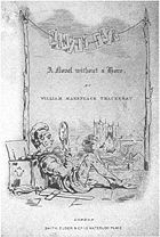
 before being sold in book form; it was printed in 20 monthly parts between January 1847 and July 1848. (As was standard practice, the last part was a "double number" containing parts 19 and 20.) The parts resembled pamphlets, and contained the text of several chapters between outer pages of steel-plate engravings and advertising. Woodcut engravings, which could be set along with normal moveable type, appeared within the text. The same engraved illustration appeared on the canary-yellow cover of each monthly part; this colour became Thackeray's signature (as a light blue-green was Dickens'), allowing passers-by to notice a new Thackeray number in a bookstall from a distance. Vanity Fair was the first work that Thackeray published under his own name, and was extremely well-received at the time. The original monthly numbers and later bound version featured Thackeray's own illustrations, which at times provided plot hints or symbolically freighted images (a major character shown as a man-eating mermaid, for instance) to which the text does not explicitly refer. Most modern editions either do not reproduce all the illustrations, or reproduce them so badly that much detail is lost.

Thackeray meant the book to be not only entertaining but also instructive, an intention demonstrated through the book's narration and through Thackeray's private correspondence. The novel is considered a classic of English literature, though some critics claim that it has structural problems; Thackeray sometimes lost track of the huge scope of his work, mixing up characters' names and minor plot details. The number of allusions and references it contains can make it difficult for modern readers to follow.

Literary significance and criticism


Contemporary critics

Even before the last part of the serial was published, critics hailed the work as a literary treasure. Although the critics were superlative in their praise, they expressed disappointment at the unremittingly dark portrayal of human nature, fearing Thackeray had taken his dismal metaphor too far. In response to his critics, Thackeray explained that he saw people for the most part "abominably foolish and selfish". The unhappy ending was intended to inspire readers to look inward at their own shortcomings.

Theorists

The subtitle, A Novel without a Hero, is apt because the characters are all flawed to a greater or lesser degree; even the most sympathetic have weaknesses, for example Captain Dobbin, who is prone to vanity
Vanity

In conventional parlance, vanity is the excessive belief in one's own abilities or attractiveness to others. In many religions vanity is considered a form of self-idolatry, in which one rejects God for the sake of one's own , and thereby becomes divorced from the Divine graces of God....
 and melancholy
Melancholia

Melancholia , in contemporary usage, is a mood disorder of non-specific depression , characterized by low levels of enthusiasm and eagerness for activity....
. The human weaknesses Thackeray illustrates are mostly to do with greed
Greed

Sorry, no overview for this topic
, idleness
Laziness

Laziness is a disinclination to activity or exertion despite having the ability to do so. It is often used as a pejorative. Chronic laziness may be an underlying psychological condition....
, and snob
Snob

A snob is someone who adopts the worldview of snobbery ? that some people are inherently inferior to him or her for any one of a variety of reasons, including real or supposed intellect, wealth, education, ancestry, etc....
bery, and the scheming, deceit
Lie

A lie , is a type of deception in the form of an untruthful statement, especially with the intention to deceive others, often with the further intention to maintain a secret or reputation, protect someone's feelings or to avoid a punishment....
 and hypocrisy
Hypocrisy

Hypocrisy , is acting in a manner contradictory to one's professed beliefs and feelings, or conversely, expressing false beliefs and opinions in order to conceal one's real feelings or motives....
 which mask them. None of the characters are wholly evil, though. Even Becky, who is amoral and cunning, is thrown on her own resources by poverty and its stigma. (She's the orphaned daughter of a poor artist.) Thackeray's tendency to highlight faults in all of his characters displays his desire for a greater level of realism
Literary realism

Literary realism most often refers to the trend, beginning with certain works of French literature of the 19th century and extending to late-nineteenth- and early-twentieth-century authors in various countries, towards depictions of contemporary life and society 'as they were'....
 in his fiction compared to the rather unlikely or idealised people in many contemporary novels.

The novel is a satire
Satire

Satire is often strictly defined as a literary genre; although, in practice, it is also found in the graphic arts and performing arts. In satire, human or individual vices, follies, abuses, or shortcomings are held up to censure by means of ridicule, derision, burlesque, irony, or other methods, ideally with the intent to bring about improv...
 of society as a whole, characterised by hypocrisy and opportunism
Opportunism

Opportunism is a term used in politics and political science. It forms an important rationale as well for transaction cost economics. It is interpreted in different ways, but usually refers to one or more of the following:...
, but it is not a reforming novel; there is no suggestion that social or political changes, or greater piety and moral reformism
Victorian morality

Victorian morality is a distillation of the morality views of people living at the time of Victoria of the United Kingdom in particular, and to the moral climate of Great Britain throughout the 19th century in general that were in stark contrast to the morality of the previous Georgian period....
 could improve the nature of society. It thus paints a fairly bleak view of the human condition. This bleak portrait is continued with Thackeray's own role as an omniscient narrator, one of the writers best known for using the technique. He continually offers asides about his characters and compares them to actors and puppets, but his scorn goes even as far as his readers; accusing all who may be interested in such "Vanity Fairs" as being either "of a lazy, or a benevolent, or a sarcastic mood".

The work is often compared to the other great historical novel
Historical novel

A historical novel is a novel in which the story is set among historical events, or more generally, in which the time of the action predates the lifetime of the author....
 which covered the Napoleonic wars
Napoleonic Wars

The Napoleonic Wars were a series of conflicts involving Napoleon I of France First French Empire and changing sets of European allies and opposing coalitions that ran from 1803 to 1815....
: Tolstoy
Tolstoy

Tolstoy, or Tolstoi is a prominent family of Russian nobility, descending from one Andrey Kharitonovich Tolstoy who served under Vasili II of Russia....
's War and Peace
War and Peace

War and Peace is a novel by Leo Tolstoy, first published from 1865 to 1869 in Russkiy Vestnik , which tells the story of Russian society during the Napoleonic Era....
. While Tolstoy's work has a greater emphasis on the historical detail and the effect the war has upon his protagonists, Thackeray instead uses the conflict as more of a backdrop to the lives of his characters. The momentous events on the continent do not always have an equally important influence on the behaviors of Thackeray's characters. Rather their faults tend to compound over time. This is in contrast to the redemptive power conflict has on the characters in War and Peace. For Thackeray, the Napoleonic wars as a whole can be thought of as one more of the vanities expressed in the title.

The suggestion, near the end of the work that Becky may have killed Jos is argued against by John Sutherland
John Sutherland

John Andrew Sutherland is an English literature lecturer, emeritus professor, newspaper columnist and author.Now Emeritus Lord Northcliffe Professor of Modern English Literature at University College London, John Sutherland began his academic career after graduating from the University of Leicester as an assistant lecturer in University of...
 in his book Is Heathcliff A Murderer? : Great Puzzles In Nineteenth-century Fiction. Although Becky is portrayed as having a highly dubious moral sense, the idea that she would commit premeditated murder
Premeditated murder

Premeditated murder is the crime of wrongfully causing the death of another human being after rationally considering the timing or method of doing so, in order to either increase the likelihood of success, or to evade detection or apprehension....
 is quite a step forward for the character. Thackeray was a fierce critic of the crime fiction popular at the time, particularly that of Edward Bulwer-Lytton. These lurid and sensationalist accounts—known as "Newgate novel
Newgate novel

The Newgate novels were novels published in England from the late 1820s until the 1840s that were thought to glamorise the lives of the criminals they portrayed....
s"—took their inspiration, and sometimes entire stories, from the pages of The Newgate Calendar
The Newgate Calendar

The Newgate Calendar, subtitled The Malefactors' Bloody Register, was a popular work of improving literature in the 18th and 19th centuries....
. What Thackeray principally objected to was the glorification of a criminal's deeds; it therefore seems strange that he would have depicted Becky as such a villainess. His intent may have been to entrap the Victorian reader with their own prejudices and make them think the worst of Becky Sharp even when they have no proof of her actions. This interpretation is not helped by the trio of lawyers she gets to defend her from the claims, Burke, Thurtell, and Hayes, named after prominent murders of the time (although this may have been further commentary aimed at the legal profession).

Though Thackeray does not settle definitively whether Becky murders Jos, such a development is in keeping with the overall trend of character development in the novel. The tone of Vanity Fair seems to darken as the book goes on. At the novel's beginning, Becky Sharp is a bright girl with an eye to improving her lot through marrying up the social scale; though she is thoroughly unsentimental, she is nonetheless portrayed as being a good friend to Amelia. By novel's end she is (implied to have become) an adulterer and a murderer. Amelia begins as a warm-hearted and friendly girl, though sentimental and naive, but by story's end she is portrayed as vacuous and shallow. Dobbin appears first as loyal and magnanimous, if unaware of his own worth; by the end of the story he is presented as a tragic fool, a prisoner of his own sense of duty who knows he is wasting his gifts on Amelia but is unable to live without her. Whether Thackeray intended this shift in tone when he began writing, or whether it developed over the course of the work's composition, is a question that cannot be settled. Regardless of its provenance, the novel's increasingly grim outlook can take readers aback, as characters whom Thackeray -- and the reader -- at first hold in sympathy are shown to be unworthy of such regard.

The character of Becky Sharp is based in part on Thackeray's maternal grandmother Harriet Becher. She abandoned her husband and children when she eloped with Captain Charles Christie. In 1806 shortly after the death of Christie and her husband she married Edward Butler, another army officer. Thackeray lived with his grandmother in Paris in the 1830s and again in the 1840s.

The image of Germany


Chapter LXII, where the characters go off to Germany, preserves an image of that country which was to change drastically a generation later, following the Unification of Germany
Unification of Germany

The unification of Germany took place on January 18, 1871, when Otto von Bismarck, the Prime Minister of Prussia, managed to unify a number of independent German people states into a nation-state, and thus create the German Empire, from which all of the states since that time bearing the name of Germany descend....
 in 1871. Thackeray's characters, and the writer himself, have a clear image of Germany as a collection of picturesque, old-fashioned, harmless and rather comic principalities:

(...) Those snug, unassuming dear old operas in the German towns, where the noblesse sits, cries and knits stockings on the one side over against the bourgeoisie on the other; and His Transparency the Duke and his Transparent family, all very fat and good natured, come and occupy the great box in the middle; and the pit is full of the most elegant slim-waisted officers with straw-coloured mustachios, and twopence a day on full pay.


Evidently, the very last thing which Thackeray and English people of his generation could have imagined was that Germany was fated to become a major world power and Britain's bitter foe in two wars of unprecedented destructiveness.

Film and television adaptations

The book has inspired a number of adaptations:

Silent film versions

  • 1911: Vanity Fair: directed by Charles Kent.
  • 1915: Vanity Fair: directed by Charles Brabin.
  • 1922: Vanity Fair: directed by W. Courtney Rowden.
  • 1923: Vanity Fair: directed by Hugo Ballin
    Hugo Ballin

    Hugo Ballin was born in New York City and studied at the Art Students League of New York. When the Wisconsin State Capital was built in the early 20th Century, Ballin created 26 murals for its interior....
    .


Sound film versions

  • 1932: Vanity Fair
    Vanity Fair (1932 film)

    Vanity Fair is a 1932 in film modernized adaptation of William Makepeace Thackeray's Vanity Fair that was directed by Chester M. Franklin and starred Myrna Loy....
    : directed by Chester M. Franklin and starring Myrna Loy
    Myrna Loy

    Myrna Loy was an American actress. Trained as a dancer, but after a few minor roles in silent films, she devoted herself fully to an acting career, and from 1925 gradually established herself as a film actress....
    .
  • 1935: Becky Sharp
    Becky Sharp (film)

    Becky Sharp is an Cinema of the United States film directed by Rouben Mamoulian and starring Miriam Hopkins, Frances Dee, Cedric Hardwicke, Billie Burke, Alison Skipworth, Nigel Bruce, and Alan Mowbray....
    : starring Miriam Hopkins
    Miriam Hopkins

    Ellen Miriam Hopkins was an Academy Award-nominated American actress....
     and Frances Dee
    Frances Dee

    Frances Marion Dee was an United States actress. She starred opposite Maurice Chevalier in the early talkie musical, The Playboy of Paris ....
    , the first film shot in Technicolor.
  • 2004: Vanity Fair
    Vanity Fair (2004 film)

    William Makepeace Thackeray's novel Vanity Fair has been the subject of Vanity Fair #Film, TV or theatrical_adaptations. Vanity Fair is a 2004 in film Drama film/romance film film, film director by Mira Nair....
    : directed by Mira Nair
    Mira Nair

    Mira Nair is an Indian-American film director and Film producer based in New York. Her production company is Mirabai Films.She was educated at Delhi University and Harvard University....
     and starring Reese Witherspoon
    Reese Witherspoon

    Laura Jeanne Reese Witherspoon , better known as Reese Witherspoon, is an American actress and film producer, who has established herself as a one of Hollywood top actresses in recent years....
    .


Television

  • 1967: Vanity Fair
    Vanity Fair (1967 TV serial)

    William Makepeace Thackeray's novel Vanity Fair has been the subject of Vanity Fair #Film, TV or theatrical adaptations. This BBC television drama Serial adaptation was broadcast in 1973....
    : BBC miniseries adapted by Rex Tucker
    Rex Tucker

    Rex Tucker was a United Kingdom television television director in the 1950s and 1960s.He was born in March, Cambridgeshire in the Isle of Ely....
     starring Susan Hampshire
    Susan Hampshire

    Susan Hampshire, Lady Kulukundis, Order of the British Empire is an England Actor best known for her many television and film roles. Her appeal has always been that of an "English rose"....
     as Becky Sharp, for which she received an Emmy Award
    Emmy Award

    The Emmy Award, also known as the 'Emmy', is a television production award, similar in nature to the Peabody Awards but more focused on entertainment, and is considered the television equivalent to the Academy Awards....
     in 1973. This version was also broadcast in 1972 in the US on PBS
    Public Broadcasting Service

    The Public Broadcasting Service is an United States non-profit public broadcasting television service with 354 member TV stations in the United States....
     television as part of Masterpiece Theatre
    Masterpiece Theatre

    Masterpiece is a drama anthology television series produced by WGBH-TV. It premiered on Public Broadcasting Service on January 10, 1971, making it America's longest-running weekly primetime drama series....
    .
  • 1987: Vanity Fair: BBC miniseries starring Eve Matheson as Becky Sharp, Rebecca Saire
    Rebecca Saire

    Rebecca Saire is a British actor....
     as Amelia Sedley, James Saxon
    James Saxon

    For the football player of the same name see James Saxon .James Saxon was a distinctive Great Britain character actor. He was born on 6 April 1954 in Swindon, Wiltshire, UK: and died on 2 July 2003 in Chichester, England, United Kingdom of a heart attack....
     as Jos Sedley and Simon Dormandy
    Simon Dormandy

    Simon Dormandy is an England actor and Film director, who as an actor has worked primarily with the Royal Shakespeare Company , perhaps best known on screen for his performances in Vanity Fair and Castaway ....
     as Dobbin.
  • 1998: Vanity Fair
    Vanity Fair (1998 TV serial)

    William Makepeace Thackeray's novel Vanity Fair has been the subject of Vanity Fair #Film, TV or theatrical adaptations. This BBC television drama Serial adaptation was broadcast in 1998....
    : BBC miniseries starring Natasha Little
    Natasha Little

    Natasha Little is a United Kingdom actor. She is best known for her work on British television, but has also starred in many film and theatre roles....
     as Becky Sharp.


Footnotes


External links

  • - Thackeray's Illustrations to Vanity Fair