
|
|
|
|
Vancouver Canucks
|
| |
|
| |
The Vancouver Canucks are a professional ice hockey team based in Vancouver, British Columbia, Canada. They are members of the Northwest Division of the Western Conference, of the National Hockey League (NHL). They play their home games at the 18,630 capacity General Motors Place.
The Canucks joined the league in 1970 as an expansion team along with the Buffalo Sabres. In its NHL history, the team has advanced twice to the Stanley Cup Finals, but was defeated both times by both New York teams after staging Cinderella runs: the Islanders in 1982, and the Rangers in 1994.
essional hockey has been played in the city almost continuously since 1911.

Discussion
Ask a question about 'Vancouver Canucks'
Start a new discussion about 'Vancouver Canucks'
Answer questions from other users
|
Encyclopedia
The Vancouver Canucks are a professional ice hockey team based in Vancouver, British Columbia, Canada. They are members of the Northwest Division of the Western Conference, of the National Hockey League (NHL). They play their home games at the 18,630 capacity General Motors Place.
The Canucks joined the league in 1970 as an expansion team along with the Buffalo Sabres. In its NHL history, the team has advanced twice to the Stanley Cup Finals, but was defeated both times by both New York teams after staging Cinderella runs: the Islanders in 1982, and the Rangers in 1994.
Franchise history
197082: Early years
Professional hockey has been played in the city almost continuously since 1911. The city's first professional team, the Vancouver Millionaires, played for the Stanley Cup five times, winning the trophy in 1915. It was also home to Denman Arena, the first artificial ice arenas in Canada and, at the time, the largest in the world. After the Millionaires disbanded in 1926, Vancouver was home to only minor league teams for many years, most notably the Vancouver Canucks, who played from 1945 to 1970 in the Pacific Coast Hockey League and minor professional Western Hockey League. In 2000, the Vancouver Giants joined the major junior Western Hockey League.
With the NHL's westward expansion, it was a foregone conclusion that big-league hockey would return to Vancouver. In fact, the city was so certain of success that it broke ground for a modern arena, the Pacific Coliseum, in 1967. However, when a Vancouver group led by WHL Canucks owner and former Vancouver mayor Fred Hume made a bid for one of the six teams due to join the league in 1967, the NHL claimed it was sloppily prepared and turned their application down. Speculation has long abounded that the bid was torpedoed by Toronto Maple Leafs owner Stafford Smythe, who after a failed Vancouver-based business deal was quoted as saying that the city would not get a NHL franchise in his lifetime, and with the Montreal Canadiens purportedly did not wish to split CBC hockey income three ways rather than two.
Three years later, another Vancouver group made a new presentation, and was awarded an expansion franchise for the price of six million dollars (four million dollars more than it would have cost in 1967). The new ownership group purchased the WHL Canucks, and joined the league along with the Buffalo Sabres for the 197071 season. Ex-Ranger centre Orland Kurtenbach was named the Canucks' first-ever captain, and the team played its inaugural game against the Los Angeles Kings on October 9, 1970, in which Barry Wilkins scored the first goal in franchise history. Two days later, the squad netted its first franchise win, with a score of 53 over the Toronto Maple Leafs.
Despite its location on the west coast, Vancouver was placed in the powerful East Division for its first four seasons. Although the team had a few capable players such as Kurtenbach, defencemen Dale Tallon and Jocelyn Guevremont, and winger Dennis Ververgaert, it failed to make the playoffs during these early years. Realignment for the 197475 season placed the Canucks in the new Smythe Division, and they responded with their first winning record, finishing first in the division. However, their first playoff series had them squaring off with the Montreal Canadiens, who quickly dispatched them in five games. The Canucks again posted a winning record and made the playoffs the next year, but went down to the New York Islanders in a two-game preliminary series.
The Canucks missed the playoffs the two seasons thereafter. These were not without their highlights, however. During these years, star players included Andre Boudrias, who finished first in team scoring four out of the franchise's first five seasons (and finished second by a single point in the other), forward Don Lever, and Dennis Kearns, who is to this day tied with Jyrki Lumme as the top-scoring defenceman in franchise history.
As it turned out, Vancouver would not have another winning team for sixteen seasons. For most of that time, however, they were much more competitive than their record indicated; they only missed the playoffs six times.
1982 Stanley Cup run
After a dozen years of unremarkable play, the Canucks finally made an impact in the post-season of 1982. After finishing three games under a .500 wins percentage over the course of the regular season, the Canucks would embark on an unexpected run to the Stanley Cup Finals, going 112 in series against the Calgary Flames, Los Angeles Kings, and Chicago Blackhawks. It should be noted that despite having a losing record, Vancouver had home ice advantage in the first series, having finished second in the Smythe Division that season behind only the Wayne Gretzky-led Edmonton Oilers. The Canucks also had home ice advantage during the second round series against the Kings, after the latter's upset of those same Oilers during the first round.
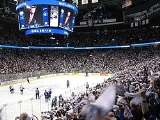
During the conference finals against the Chicago Blackhawks, Vancouver coach Roger Neilson, fed up with what he felt was the lousy performance of the officials in the game, placed a white towel on the end of a hockey stick and held it up in a gesture mocking surrender (waving the white flag). The players on the Canucks' bench followed suit, and although Vancouver lost the game, the team's fans appeared at the arena for the next game cheering their team on by waving white towels above their heads. The habit stuck, becoming an original Canuck fan tradition now seen across the league and in other sports, known as Towel Power. The Canucks proceeded to win that series, making it to the Stanley Cup finals for the first time in their history.
Entering the finals, the Canucks were the first team from Western Canada to play for the Stanley Cup in 56 years, since the Victoria Cougars reached the 1926 Stanley Cup Finals. However, they were unable to continue their Cinderella run as they were promptly swept in four games by the heavily-favoured defending champion New York Islanders, losing the final game on home ice. That season would prove to be the last one in which Vancouver won a playoff series until 1992.
Decline and resurgence (1982-1994) After their improbable Stanley Cup run, the Canucks slipped back into mediocrity for the rest of the 1980s, making the playoffs only four times for the rest of the decade. For most of the second half of the 1980s, they had to fight the Los Angeles Kings for the final playoff spot in the Smythe Division. Whenever they did make the playoffs, they were promptly ousted by the dominant Edmonton Oilers in 1986) and the Calgary Flames in 1983, 1984 and 1989). Due to the way the playoffs were structured, the Canucks faced the certainty of having to get past either the Oilers, Flames, or both to get to the Conference Finals.
Notable players during the 1980s included diminutive (though long-serving) team captain Stan Smyl, who retired the franchise leader in most scoring categories and remains one of only two players to have their jersey number retired by the Canucks; Swedish imports Thomas Gradin and Patrik Sundstrom; penalty minute king Tiger Williams (who led the NHL in penalty minutes during two of his seasons with the Canucks); hard-rock defenceman Harold Snepsts (one of the most popular players in franchise history); and high-scoring right winger Tony Tanti.
Following the acquisition of Pat Quinn as general manager in 1988, the Canucks rose to prominence in the early 1990s. This rise to success came roughly around the time the Oilers and Flames began to sink in the standings. Unlike the league's other Canadian teams, the Canucks thrived in the new environment created by the rise in player salaries. Paced by players such as new captain Trevor Linden, goalie Kirk McLean, and high-scoring sensation Pavel Bure (nicknamed the "Russian Rocket"), the Canucks won two consecutive regular-season division titles in 1992 and 1993, though they would be eliminated by the Oilers and Kings during the playoffs, in that order.
1994 Stanley Cup run
In 1994 the Canucks made their second trip to the Finals, entering the playoffs as the seventh seed in the newly renamed Western Conference. The club had what could be characterized as an off-year during the regular season, but resumed their form during the playoffs. Once again, like in 1982, the Canucks would embark on an unexpected run. Drawing a first-round matchup with the rival Calgary Flames, the Canucks were victorious in a close seven-game series. After trailing the series three games to one, Geoff Courtnall and Trevor Linden won games five and six for Vancouver in overtime. Again forcing overtime in game seven, goaltender Kirk McLean made "The Save," a defining moment in team history, stacking pads on the goal line to stop a near-perfect setup by Theoren Fleury and Robert Reichel, saving the Canucks from elimination. Pavel Bure scored the series-winning goal on a breakaway, after taking a stretch pass from Jeff Brown, in the second overtime.
Following their upset of the Flames, they then went on to defeat both the Dallas Stars and Toronto Maple Leafs in five games before meeting the Presidents' Trophy-winning New York Rangers in the Stanley Cup Finals. Vancouver achieved victory in game one by a score of 3-2 in overtime, largely in part to a 52-save performance by goaltender McLean. After losing games two, three and four, the Canucks won games five and six to force a seventh game at Madison Square Garden on June 14, 1994. Despite a two-goal effort (one on a shorthanded breakaway) from team captain Trevor Linden, Vancouver could not complete their Cinderella run, though they did far better than during the one of 1982, as the Rangers won their first Stanley Cup in 54 years with a score of 3-2, a loss made more disappointing due to Nathan LaFayette hitting the Ranger goalpost with under six minutes left in the third period. The loss was followed by a riot in downtown Vancouver. Mayhem ensued resulting in property damage, injuries, and arrests. Following the riots, the Canucks held a rally at BC Place attended by 40,000 fans, who congratulated the team for their effort.
1994-2001
After the 1994 playoff run, Vancouver played mediocre hockey, finishing .500 in the lockout shortened 199495 season and finishing two games below .500 in 199596. Despite playing poorly, they made the playoffs in both seasons but failed to replicate their success in the 1994 playoffs. Expectations were high and the team would soon move into its new arena, General Motors Place. Head coach Quinn stepped down to focus on his duties as a general manager, and was replaced by assistant Rick Ley, who was later succeeded by Tom Renney. Russ Courtnall and Alexander Mogilny were acquired via trade from the Dallas Stars and Buffalo Sabres, respectively, in an effort to further improve offence; Russ was reunited with his brother Geoff, and Mogilny was reunited with his former CSKA Moscow linemate, Pavel Bure. However, the team was swept in the second round by the Chicago Blackhawks in 1995 and defeated in the first round by the Stanley Cup-winning Colorado Avalanche in 1996, a season in which Bure suffered a season-ending injury early on. During the 1996-97 season, Bure suffered another season-ending injury, and despite strong performances by players such as Martin Gelinas and Mogilny, the Canucks missed the playoffs.
In the 1997 off-season, the Canucks made a big splash and signed free agent Mark Messier to a lucrative three-year deal. Also during the off-season was a change in management as general manager Pat Quinn was fired and replaced with a management committee. Renney was fired and Mike Keenan assumed coaching and general manager duties; when given the latter power, he split up the core of the 1994 team, most notably trading away fan-favourite and until then, career-Canuck, Trevor Linden to the New York Islanders. Although hugely unpopular, this trade would net the Canucks future impact player Todd Bertuzzi. Later on in the season, Brian Burke assumed the duty of general manager, after a stint as NHL vice-president.
Suffering their worst season of the decade in 1998-99, Keenan was fired midway through and replaced with Marc Crawford (who had won the Stanley Cup with the Colorado Avalanche in 1996). Pavel Bure, unhappy with playing in Vancouver, held out for the season, and was dealt to the Florida Panthers in a blockbuster deal which landed the Canucks blue-chip defenceman Ed Jovanovski. The Canucks missed the post-season again, but the payoff for the dreadful season was the chance to draft future stars Daniel and Henrik Sedin second and third overall in the 1999 NHL Entry Draft.
During the 1999-00 season, expectations were low for the Canucks. However, they surprised all by fighting for a playoff spot during the entire season, only dropping out of the hunt on the second to last game. Several players showed signs of the superstars they would become, notably, Todd Bertuzzi and Markus Naslund. Alexander Mogilny was traded to the New Jersey Devils for Denis Pederson and future offensive stalwart, Brendan Morrison. At season's end, Messier would leave to return to the Rangers, and Naslund was selected to be the new captain of the team.
"West Coast Express" years (2001-2005) Under new general manager Burke and new coach Crawford, the Canucks had once again become a playoff contender. The team held their training camp in Stockholm in 2000, and participated against Swedish and Finnish teams in the NHL Challenge. These years were the heyday of the "West Coast Express" line, which consisted of high-scoring left-winger Markus Naslund, centre Brendan Morrison and power-forward right wing Todd Bertuzzi.
The rebuilt Canucks team returned to the playoffs in 2001 (capturing the eighth and final position on the last day of the season), appearing in the playoffs for the first time since 1996. Being the eighth seed, the Canucks drew the first-seeded Colorado Avalanche in the first round and were swept in four games in the absence of Naslund, who had suffered a broken leg during the season.
The following season saw the return of the formerly-traded captain Trevor Linden, and another matchup with the top seed in the West, this time the Detroit Red Wings. This series was highlighted by a surprising 2-0 series lead taken by Vancouver, which was erased, following a weak goal allowed by goaltender Dan Cloutier from a centre-ice shot by Red Wings defenceman Nicklas Lidstrom. Detroit would win the next four games en route to a Stanley Cup championship.
2003 saw personal highs in the Canucks organization; Naslund finished the season with 104 points, enough for second-highest in the league. Bertuzzi finished fifth with 97. In goal, Cloutier posted a franchise record 7 shutouts. Winning a playoff series for the first time in eight years against the St. Louis Blues, a 3-1 series lead against the upstart Minnesota Wild would crumble away as the Wild won three straight, completing their second upset of the playoffs after defeating Colorado in Round one. In 2004, Bertuzzi would damage, some say irreparably, his reputation after his on-ice sucker punch from behind of Steve Moore of the Colorado Avalanche. He was suspended for the remainder of the regular season and playoffs. Despite winning the Northwest Division title in 2004 the Canucks would fall in the first round of the playoffs to their division rival, the Calgary Flames, who would go on to compete in the Stanley Cup Finals.
It was Tyler Machial who coined the phrase "Goalie Graveyard", when referring to the Canucks' long-standing history of having troubles between the pipes. Before the lockout of 2004-05, Burke did not have his contract renewed by the Canucks and was replaced by Dave Nonis, who had been assistant general manager and Director of Hockey Operations. Burke was then hired by the Mighty Ducks of Anaheim.
Post-Lockout (2005-2006)
The 2005-06 season began with much promise; some hockey analysts picked the Canucks as Stanley Cup favourites. Under new general manager Nonis, free agent activity in the summer prior to the 2005-06 season saw players such as Anson Carter and Richard Park arrive in Vancouver. However, the team failed to meet expectations and completed the regular season in a disappointing ninth place in their Conference — narrowly missing a playoff position to the Edmonton Oilers; this caused debate about the effect of the point awarded for an overtime or shootout loss, recently instituted by the NHL. The season was characterized by under-achieving play, most notably in the first line of Naslund, Bertuzzi, and Morrison, which was expected to produce higher point totals under the new league rules. Morrison had a career-high 84 penalty minutes. Meanwhile, his wingers, Bertuzzi and Naslund, had a combined -37 in Plus/Minus Rating. Vancouver's highest-scoring line was the second line of Carter and the Sedin twins.
Roberto Luongo era (2006–present)
On April 25, 2006, the Canucks fired Crawford; he was hired by the Los Angeles Kings. Alain Vigneault, who had just coached Vancouver's AHL affiliate, the Manitoba Moose, to a 102-point season, was hired as his replacement on June 20, 2006.
The re-building of the Canucks continued just three days after Vigneault's hiring, when Nonis completed a blockbuster trade with the Florida Panthers, trading Todd Bertuzzi, Bryan Allen and Alex Auld for Roberto Luongo, Lukas Krajicek and a sixth-round draft pick (Sergei Shirokov) in the 2006 NHL Entry Draft. Florida fan-favourite Luongo initially claimed to be "surprised" with being traded. He later signed a long-term 4-year, $27-million deal with the Canucks, which includes a no-trade clause after the first year, tying him with Chicago Blackhawks' Nikolai Khabibulin as the highest paid goaltender in the NHL and showing the Canucks' clear intention of making Luongo a franchise goalie. With the acquisition of Luongo, previous starting goaltender Dan Cloutier was dealt to the Los Angeles Kings on July 5, 2006.
On April 7, 2007, the Canucks won the Northwest Division title for the second time in three seasons with an overtime win over the San Jose Sharks. The win also gave Luongo his 47th win of the season, tying him for the previous single-season win record with Bernie Parent, which had been eclipsed during the same season by New Jersey Devils netminder Martin Brodeur.
The Canucks opened the 2007 playoffs with a quadruple-overtime win against their first-round opponents, the Dallas Stars. The game was the longest in club history and the sixth longest in league history. Also in this game, the Canucks set a record for shots against, allowing 76. In seven games, the Canucks prevailed despite a lack of goal-scoring; Stars goalie Marty Turco recorded three shutouts in the series, becoming the only goalie to earn three shutouts in a losing effort. Advancing to the second round, the team was defeated by the Stanley Cup-winning Anaheim Ducks in five games. Following the playoffs, coach Vigneault received the Jack Adams Award for his efforts in the Canucks' 49-win season.
The 2007-2008 season did not begin especially well, with key injuries beginning from training camp. Defencemen Sami Salo and Lukas Krajicek were both injured in October, while Kevin Bieksa was severely cut by the skate blade of Vernon Fiddler of the Nashville Predators on November 1. The trade deadline saw only one change for the team, with agitating left-winger Matt Cooke being traded to the Washington Capitals for left-winger Matt Pettinger. During the nine-game season-finale at the end of the season, the Canucks were again without Ohlund, who had suffered bone chips in his knee; as well, they lost promising rookie forward Mason Raymond to an MCL sprain and Morrison, again, to an ACL tear. Coming up short in these crucial games, the Canucks missed the playoffs for the second time in three years, coming up three points short. The final game of the season, played on home ice, saw the retiring Trevor Linden hailed as the first star of the game and given a standing ovation on a 7-1 loss to the Calgary Flames.
On April 14, 2008, the Canucks management fired general manager Dave Nonis. Nine days later, former player agent Mike Gillis was named as his replacement. In addition to Nonis' firing, the 2008 off-season saw several significant losses from the Canucks ranks. On May 29, 2008, the Vancouver Canucks tragically lost promising young prospect, Luc Bourdon, a defenseman picked 10th overall in the 2005 entry draft who died in a motorcycle crash near his hometown of Shippigan, New Brunswick. Shortly thereafter, long-time Canuck and fan favourite Trevor Linden officially retired on June 11, 2008. Then, as Gillis entered his first free agency period as general manager, he immediately made his mark on the team, letting team captain and all-time leading scorer Markus Naslund go to the New York Rangers and another long-time Canuck, Brendan Morrison sign with the Anaheim Ducks. In their place, Gillis signed unrestricted free agent Pavol Demitra, as well as traded for and signed restricted free agent Steve Bernier from the Buffalo Sabres in exchange for draft picks. Former Toronto Maple Leafs forward Kyle Wellwood was also added to the roster. Perhaps Gillis' most significant move was his two-year, $20 million contract offer to unrestricted free agent Mats Sundin. Although Sundin did not, at first, accept Gillis' offer, he later joined the Canucks in December 2008, signing a one-year, pro-rated, $6.5 million contract for the remainder of the 200809 season.
With the departure of Naslund to free agency, Gillis announced on September 30, 2008, that Roberto Luongo had been named team captain, marking the first time since Bill Durnan of the Montreal Canadiens in 1947 that a goaltender has been named the captain of their NHL team. On December 17, the Canucks retired the second jersey number in team history, hanging Trevor Linden's number 16 beside Smyl's number 12 in a pre-game ceremony.
Team information
Ownership
From 1988 to 1997, the Vancouver Canucks were owned by local businessman and philanthropist Arthur Griffiths, who had inherited the ownership from his father, Frank. However, he was forced to sell his majority interest in the Canucks after overextending his resources trying to build a new arena, General Motors Place. As a result, he sold his majority share to American billionaire John McCaw, Jr..
On November 17, 2004, the Aquilini Investment Group, headed by Francesco Aquilini, purchased a 50% share in Orca Bay Sports and Entertainment (the owners of both the Canucks franchise and General Motors Place) from John McCaw, Jr.. Prior to the sale, Aquilini and two business partners, Tom Gaglardi and Ryan Beedie, had negotiated with Orca Bay for several months without concluding an agreement. In January 2005, Gaglardi and Beedie filed a lawsuit against Aquilini and Orca Bay, alleging that Aquilini and Orca Bay had acted in bad faith in concluding a deal using information obtained from their joint offer.
On November 8, 2006, Aquilini, along with his brothers Roberto and Paolo, purchased the remaining 50% of the Vancouver Canucks and General Motors Place from McCaw.
In May 2007, Gaglardi and Beedie's civil lawsuit over Aquilini's purchase reached the Supreme Court of British Columbia. The court ruled for Aquilini, on January 10, 2008. The court held that there was no legal partnership between Aquilini, Beedie, and Gaglardi, and that McCaw was free to sell the team to anyone he wished.
Logos and jerseys
The team has gone through thirteen different logo and jersey changes in its history.
The team's first NHL jerseys, worn from the inaugural season of 1970-71 (modified for the 1972-73 season) until the end of the 1977-78 season, featured a blue rink-shaped rectangle with a hockey stick in it forming the letter "C", designed by North Vancouver artist, Joe Borovich. A modified version of this logo is still in use, as a shoulder patch on the team's current jerseys.
In 1978, aiming for a more aggressive image, the organization asked a San Francisco design agency, Beyl & Boyd, to design new uniforms. These consisted of a huge yellow, red-orange, and black striped "V" coming down from the shoulders (suggesting "victory", according to its designers). It is generally considered to be one of the worst uniforms in NHL history (hockey writer Stephen Cole referred to it looking like 'a punch in the eye').
The "Flying V" theme was abandoned in 1985, to feature the team's emblem on the front rather than the "V" (the emblem had previously been worn only on the arms). The logo consisted of the word "Canucks" in a diagonal slant as part the blade of a skate. The logo, with its laser-like design, was sometimes referred to as the "Star Wars" logo, the "waffle iron", the "plate of spaghetti", and most commonly, the "Flying Skate".
The yellow home jerseys were scrapped in 1989 in favour of more conventional white ones, and the triangular shoulder stripes which adorned the post-"V" jerseys were discarded as well. The new incarnation was worn from 1989-92, when a subtle change was made — and went largely unnoticed for the rest of the jersey's lifespan. The orange was changed to red, and the deep "gold" colour was changed to a much brighter yellow, reportedly because jersey-maker CCM no longer produced the required hues. In 1996, an alternate jersey was introduced, retaining the "Flying Skate" logo, but using a salmon colour graduating to black near the bottom.
In 1997 the Canucks unveiled a new logo, in which a Haida-style orca (killer whale) breaking out of a patch of ice forms a stylized "C". The logo has been much-maligned, accused of being a blatant reference to their parent company, Orca Bay (now Canucks Sports and Entertainment). At the time, general manager Pat Quinn discussed wanting to have a West Coast colour scheme, and overall West Coast themes in the logo; the colour scheme included blue, red, and silver. Beginning in 2001, an alternate jersey was utilized, with contrasting shoulder patches and a blue-to-maroon graduated colour in the body. In 2006 these gradient-coloured alternate jerseys were officially replaced with the popular, royal blue "Stick-in-Rink" uniforms from the 1970s.
Little more than halfway through the 2006-07 season, the Canucks announced that they would be changing their jerseys once again. While a report in February 2007 suggested the new scheme would be revealed on August 1, 2007, the new team jersey was actually unveiled prior to training camp, on August 29, 2007. It featured the same orca design present on their previous jerseys, but the colour scheme was updated to their "retro" colours of royal blue and kelly green. Additionally, the word "Vancouver" was added to the chest area above the orca. This move was seen as a way to connect the NHL Canucks team to that of the WHL team, whose members wore uniforms with the word "Canucks" along the top in a similar arched design. The actual jerseys themselves were changed to the Rbk Edge design, along with all other teams in the NHL. The introduction was largely greeted with disappointment from fans and sports commentators, who criticized the uniforms for looking like a "copy and paste" of those from the past. The Vancouver Sun described the new look as "decidedly unpopular."
On November 14, 2008, prior to their Sport Celebrities Festival, the Canucks released their new RBK Edge Third Jersey. While staying with the colours of Vancouver, and combining the old with the new, the jersey looks very similar to their home jersey. The modernized "Stick-in-Rink" logo unveiled the previous year on the shoulder of the main jerseys is used as the main crest. On the shoulder, a V with the head of Johnny Canuck on top is used. This is the first time in team history since joining the NHL that Johnny Canuck has appeared on a Vancouver uniform. The jersey so far has seen very mixed views. Some believe the jersey should have been released last year as their main jersey while others thought the jersey should be green with the Johnny Canuck logo as the main crest. People who have criticized the Johnny Canuck logo have compared it to the Vachon cakes logo (a V with the head of a chef on top). Sports Illustrated, rated it 13th overall out of the 19 third jerseys released for the 2008 season.
Media
After a relationship with CKNW stretching since the Canucks joined the NHL in 1970, the Canucks entered into a new radio broadcast deal in 2006 with The Team 1040 -- an AM sports/talk station. John Shorthouse continues to call the play-by-play, as he has since 1999. He is joined with colour commentary by Tom Larscheid, who has been with the broadcasts since 1977. The games air on 14 stations across British Columbia. In addition to national TV broadcasts on Hockey Night in Canada and on TSN, the Canucks also have arrangements with Rogers Sportsnet Pacific to air 47 games (as of 2007-08 season). These games are called by Shorthouse and former Canucks goaltender John Garrett. Additional games air on pay-per-view, which are radio simulcasts. On Friday, May 25, 2007, the Canucks and Sportsnet signed a multi-year contract that will keep the channel as the club's primary broadcaster. Under the agreement, Sportsnet Pacific will air 47 games in the 2007-08 NHL season and beginning this year select games will be broadcast in HD for the first time ever.
Seventh Canuck
On October 25, 2008, the Canucks retired the jersey number '7' in honour of the fans, the "seventh Canuck". Originally, the plan was to have a randomly selected season ticket holder unveil the banner before every home game and have it raised to the rafters, but after the first game it was abandoned. The banner now hangs permanently in the rafters of GM Place and its future is unknown.
Season-by-season record
This is a partial list of the last five seasons completed by the Canucks. For the full season-by-season history, see Vancouver Canucks seasons
Note: GP = Games played, W = Wins, L = Losses, T = Ties, OTL = Overtime Losses, Pts = Points, GF = Goals for, GA = Goals against, PIM = Penalties in minutes
Records as of April 6, 2008.
| Season | GP | W | L | T1 | OTL | Pts | GF | GA | PIM | Finish | Playoffs | 200304 | 82 | 43 | 24 | 10 | 5 | 101 | 235 | 194 | 1274 | 1st, Northwest | Lost in Conference Quarterfinals, 34 (Flames) | | 200405 | Season cancelled due to 200405 NHL lockout | 200506 | 82 | 42 | 32 | | 8 | 92 | 256 | 255 | 1477 | 4th, Northwest | Out of playoffs | | 200607 | 82 | 49 | 26 | | 7 | 105 | 222 | 201 | 1191 | 1st, Northwest | Lost in Conference Semifinals, 14 (Ducks) | | 200708 | 82 | 39 | 33 | | 10 | 88 | 213 | 215 | 1565 | 5th, Northwest | Out of playoffs |
- 1 As of the 200506 NHL season, all games will have a winner; the OTL column includes SOL (Shootout losses).
Players
Current roster
Team captains
Note: This list currently includes the NHL captains only.
Honoured members
Hall of Famers
Players
Builders
- Frank Griffiths, Owner, 1974-94, inducted 1993
- Jake Milford, General Manager, 1977-82, inducted 1984
- Roger Neilson, Assistant/Head coach, 1981-84, inducted 2002
- Bud Poile, General Manager, 1970-73, inducted 1990
Retired numbers
12 Stan Smyl, RW, 1978-91, number retired November 3, 199116 Trevor Linden, RW, 1988-1998/2001-2008, number retired December 17, 200899 Wayne Gretzky, number retired league-wide February 6, 2000
Notes: The number 11 of Wayne Maki (LW, 1970-73) was unofficially retired by the team following his untimely death in May 1974. Mark Messier (C, 1997-2000) is the only Canucks player to wear it since. The number 28 has been taken out of circulation due to the passing of Luc Bourdon.
First-round draft picks These are the last ten first-round draft picks for the Vancouver Canucks.
Franchise scoring leaders
These are the top-ten point-scorers in franchise history. Figures are updated after each completed NHL regular season.
Note: Pos = Position; GP = Games Played; G = Goals; A = Assists; Pts = Points; P/G = Points per game; * = current Canucks player
Awards and trophies
NHL
Franchise
Franchise individual records
- Most goals in a season: Pavel Bure, 60 (1992-93 & 1993-94)
- Most assists in a season: Henrik Sedin, 71 (2006-07)
- Most points in a season: Pavel Bure, 110 (1992-93)
- Most penalty minutes in a season: Donald Brashear, 372 (1997-98)
- Most points in a season, defenceman: Doug Lidster, 63 (1986-87)
- Most points in a season, rookie: Ivan Hlinka; Pavel Bure, 60 (1981-82; 1991-92)
- Most wins in a season: Roberto Luongo, 47 (2006-2007)
- Most shutouts in a season: Dan Cloutier, 7 (2002-03)
- Lowest GAA in a season (min. 30 GP): Dan Cloutier, 2.27 (2003-04)
- Best SVP% in a season (min. 30 GP): Roberto Luongo, .921 (2006-07)
External links
|
| |
|
|