All Topics  
Urvasi

 
Urvasi

   Email Print
   Bookmark   Link


Urvasi


Urvashi (, from "wide" + "to extend", "widely extending") is an Apsaras (nymph
Nymph

In Greek mythology, a nymph is any member of a large class of mythological entities in human form. They were typically associated with a particular location or landform....
) in Hindu mythology. She was a celestial maiden in Indra
Indra

Indra is the god of War and Weather, also the King of the gods or Deva and Lord of Heaven or Swarga in Hinduism. Mentioned first as the chief deity in the sacred Hindu text of Rig Veda, Indra is bestowed with a heroic and almost brash and amorous character....
's court and was considered the most beautiful of all the Apsarases.

She became the wife of king Pururavas
Pururavas

Pururavas , According to Vedas, is a Hindu mythology entity associated with the Surya and Usha , and is believed to resided in the middle region of the cosmos....
 (, from + "crying much or loudly"), an ancient chief of the lunar race
Lunar Dynasty

In Hindu mythology, the Lunar Dynasty is one of the two principal houses of the Kshatriya varna in Hinduism, or ruling caste. The Lunar Dynasty claims descent from the Moon , while the other principal house, the Suryavanshi claims descent from the Sun ....
. ShBr
Shatapatha Brahmana

The Shatapatha Brahmana is one of the prose texts describing the Historical Vedic religion ritual, associated with the Shukla Yajurveda. It survives in two recensions, Madhyandina and Kanva , with the former having the eponymous 100 brahmanas in 14 books, and the latter 104 brahmanas in 17 books....
 11.5.1, and treated in Kalidasa
Kalidasa

Kalidasa was a renowned Classical Sanskrit writer, widely regarded as the greatest poet and dramatist in the Sanskrit language. His floruit cannot be dated with precision, but most likely falls within the Gupta Empire, probably in the 4th century BC or 5th century or 6th century....
's drama Vikramorvasiyam
Vikramorvasiyam

Vikramorvasiyam is a Sanskrit play by medieval Indian poet Kalidasa, on the Vedic love story of king Pururavas and celestial nymph Urvashi....
.

Rashtrakavi Ramdhari Singh 'Dinkar'
Ramdhari Singh 'Dinkar'

Ramdhari Singh 'Dinkar' was an Indian Hindi poet, essayist and academician, who is considered as one of the most important modern Hindi poets....
 had written an Epic poetry
Epic poetry

An epic is a lengthy narrative poem, ordinarily concerning a serious subject containing details of heroic deeds and events significant to a culture or nation....
 with the title Urvashi for which he got the Jnanpith Award
Jnanpith Award

The Jnanpith Award is a literary award in India. Along with the Sahitya Akademi Fellowship, it is one of the two most prestigious literary honours in the country....
 in 1972.

e are many legends about the birth of Urvashi but the following one is most prevalent.

Once the revered sages Nara-narayana
Nara-Narayana

Nara-Narayana is a Hinduism deity. Nara-Narayana is the twin incarnation of god Vishnu on earth, working for the preservation of dharma or righteousness....
 was meditating in the holy shrine of Badrinath situated in the Himalayas.


Discussion
Ask a question about 'Urvasi'
Start a new discussion about 'Urvasi'
Answer questions from other users
Full Discussion Forum


Encyclopedia


Urvashi (, from "wide" + "to extend", "widely extending") is an Apsaras (nymph
Nymph

In Greek mythology, a nymph is any member of a large class of mythological entities in human form. They were typically associated with a particular location or landform....
) in Hindu mythology. She was a celestial maiden in Indra
Indra

Indra is the god of War and Weather, also the King of the gods or Deva and Lord of Heaven or Swarga in Hinduism. Mentioned first as the chief deity in the sacred Hindu text of Rig Veda, Indra is bestowed with a heroic and almost brash and amorous character....
's court and was considered the most beautiful of all the Apsarases.

She became the wife of king Pururavas
Pururavas

Pururavas , According to Vedas, is a Hindu mythology entity associated with the Surya and Usha , and is believed to resided in the middle region of the cosmos....
 (, from + "crying much or loudly"), an ancient chief of the lunar race
Lunar Dynasty

In Hindu mythology, the Lunar Dynasty is one of the two principal houses of the Kshatriya varna in Hinduism, or ruling caste. The Lunar Dynasty claims descent from the Moon , while the other principal house, the Suryavanshi claims descent from the Sun ....
. ShBr
Shatapatha Brahmana

The Shatapatha Brahmana is one of the prose texts describing the Historical Vedic religion ritual, associated with the Shukla Yajurveda. It survives in two recensions, Madhyandina and Kanva , with the former having the eponymous 100 brahmanas in 14 books, and the latter 104 brahmanas in 17 books....
 11.5.1, and treated in Kalidasa
Kalidasa

Kalidasa was a renowned Classical Sanskrit writer, widely regarded as the greatest poet and dramatist in the Sanskrit language. His floruit cannot be dated with precision, but most likely falls within the Gupta Empire, probably in the 4th century BC or 5th century or 6th century....
's drama Vikramorvasiyam
Vikramorvasiyam

Vikramorvasiyam is a Sanskrit play by medieval Indian poet Kalidasa, on the Vedic love story of king Pururavas and celestial nymph Urvashi....
.

Rashtrakavi Ramdhari Singh 'Dinkar'
Ramdhari Singh 'Dinkar'

Ramdhari Singh 'Dinkar' was an Indian Hindi poet, essayist and academician, who is considered as one of the most important modern Hindi poets....
 had written an Epic poetry
Epic poetry

An epic is a lengthy narrative poem, ordinarily concerning a serious subject containing details of heroic deeds and events significant to a culture or nation....
 with the title Urvashi for which he got the Jnanpith Award
Jnanpith Award

The Jnanpith Award is a literary award in India. Along with the Sahitya Akademi Fellowship, it is one of the two most prestigious literary honours in the country....
 in 1972.

Birth

There are many legends about the birth of Urvashi but the following one is most prevalent.

Once the revered sages Nara-narayana
Nara-Narayana

Nara-Narayana is a Hinduism deity. Nara-Narayana is the twin incarnation of god Vishnu on earth, working for the preservation of dharma or righteousness....
 was meditating in the holy shrine of Badrinath situated in the Himalayas. Indra
Indra

Indra is the god of War and Weather, also the King of the gods or Deva and Lord of Heaven or Swarga in Hinduism. Mentioned first as the chief deity in the sacred Hindu text of Rig Veda, Indra is bestowed with a heroic and almost brash and amorous character....
, the king of the Gods, did not want the sage to acquire divine powers through meditation and sent two apsara
Apsara

An Apsara , Acchara or A B? Sa La Tu , is a female spirit of the clouds and waters in Hindu mythology and Buddhist mythology. Frequently encountered English translations of the word "Apsara" are "nymph," "celestial nymph," and "celestial maiden."...
s to distract him. The sage struck his thigh and created a woman so beautiful that Indra’s apsaras were left matchless. This was Urvashi, named from ur, the Sanskrit word for thigh. After his meditation was complete the sage gifted Urvashi to Indra, and she occupied the pride of place in Indra’s court.

Urvashi and Pururavas

Urvashi found the atmosphere in heaven stifling. Everything was cold and synthetic including the colours and the fragrances of the flowers. Urvashi often stole to the Earth at night with her friends to feel the wet dew under her feet and the soft breeze against her body. On the other hand Pururava envied the Gods. He was a regular invitee to Indra's court and was haunted at night by the grandeur he saw there. He would then take his chariot above the clouds and hurtle through the skies at break-neck speed. It was on such an occasion that the two met.

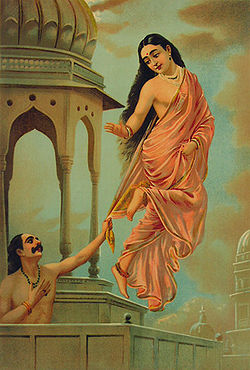
Urvashi was returning to heaven just before dawn with the other apsaras, when she was abducted by a demon. Pururava saw this and chased the demon on his chariot and freed Urvashi from his clutches. The brief period their bodies touched changed their lives forever. For the first time Urvasi experienced the warm flesh of a mortal, for the first time she heard blood pounding in veins and for the first time she heard the inhalation and exhalation of breath. Pururavas had seen Urvashi in Indra’s court before and to actually be close to the most beautiful woman in heaven exhilarated him. Pururava left Urvashi with her friends but when they parted each was madly in love with the other but unsure whether the love was being reciprocated.

Urvashi was a woman in a man’s world and in keeping with the tradition of the times expected the man to make the first move. Pururavas on the other hand feared rejection because he did not expect the pride of heaven to come and live with a mortal, and hence did not approach Urvashi. So both pined for each other. Urvashi was giving a dance performance in which she was portraying Vishnu’s consort, Lakshmi. Her concentration was with Pururavas and she called out her lover’s name instead of saying “Vishnu”. Her teacher, the sage Bharat, got offended and cursed Urvashi. “You will get to live with the person you are thinking about,” he said, “And you will also give birth to his son. But you will have to choose between the father and son, because the day they see each other you will have to leave them both and return to heaven.”

The curse actually emboldened Urvashi. She wasn’t even thinking about children, she was sure to get her love. She sent a friend to earth to find out about Pururava. The friend located the king in the garden of Gandhmadan (meaning intoxicating fragrance), whining away for his ladylove. The stage was set. Urvashi left heaven and went to the waiting arms of Pururava.

Pururavas was a married man. His wife was Aushiniri. They did not have any children and as was the custom of the time, the wife was blamed for this. So when Pururavas met Urvashi he was already distanced from his wife and hence was more easily drawn towards the apsara.

He decided to live with Urvashi in the forest of Gandhmadan. He arranged for all princely comforts there as also for running the affairs of state. They spent the time in love, in discourse; Urvashi sang and danced for Pururavas; the king was content to have her with him. For Urvashi this was a unique opportunity to live with mortals and to experience their joys and sufferings, while Pururavas reveled in the fact that the pride of heaven and Indra's favourite
Favourite

In historical writings, when used in reference to a person, favourite, also spelled favorite , means the intimate companion of a ruler or other important person....
 was his and his alone. In fact the only discordant note in their ethereal music was the argument whether the Gods are more fortunate or mortals.

An epic has been written on this debate by the famous Hindi poet, Dinkar, a passage from which bears translation. Urvashi is praising the fire that burns in the souls of mortals.

Till there is fire in the soul, the universe is your friend. Your chariot flies in the heavens and with the clouds does play. Till there is fire in the soul, the ocean looks up to you And its infinite wealth and treasure at your feet does lay. The fierce lion passes by; the dense forests give way, Even the towering mountain peaks bow down before you. Till there is fire in the soul, great Indra pays his respects And beautiful Urvashi descends to the earth for you.

But where there are givers there will be lovers' tiffs and Urvashi and Pururavas are said to have had their share. Once Urvashi and Pururava were walking along the bank of a stream in animated conversation. Pururavas noticed a maiden knee deep in water washing clothes and for a second his concentration faltered. Urvashi went into a fit of jealous rage and ran away. So maddened was she that she stepped into Kartikeya's grove. Kartikeya is the God of War and women were forbidden to enter his grove and if they did so they would be turned into a creeper. This was the fate Urvashi met. For many months Pururava searched for Urvashi. He prayed to the Gods for their favour. He recounted the numerous times he had fought shoulder to shoulder with them in their incessant war against the Demons. Kartikeya relented and gave Pururavas a crimson jewel and asked him to rub a particular creeper in his grove with it. When the king did so Urvashi was freed.

By now everyone, including Aushiniri had accepted Urvashi as the king's consort. There was no need for them to stay at Gandhmadan. The two went to the capital city of their kingdom and continued to enjoy each other's company as before. In all Urvashi and Pururava spent sixteen years together. The gem with which Pururava had freed Urvashi in Kartikeya's grove was Urvashi's favourite. One day a raven snatched it from the hands of Urvashi's maid. Pururava raised his bow but before he could fire an arrow someone else hit the bird and it fell into the palace courtyard. The arrow was retrieved and given to the king. It was the custom that each arrow bore the name of its owner and this arrow said Ayu the son of Pururavas and Urvashi.

It had so happened that Urvashi had desired to bear a child, so without Pururavas' knowledge she had conceived and given birth to his son. The incident at Kartikeya's grove was a ploy by the Gods to give Urvashi time for bearing the child. The reason for the secrecy lay in the curse sage Bharat had given Urvashi many years earlier. "You will have to choose between your son or your lover, for the day the two meet you will have to return to heaven." The lover in Urvashi had yet not been satisfied so she had left the newborn child in sage Chyavan's hermitage in the care of his wife Satyavati.

Sage Chyavan explained everything to the astounded king. The time had come for Ayu to meet Pururavas, but unfortunately the same time necessitated the departure of Urvashi. Pururava crowned Ayu as King and left for Gandhmadan, where he had spent memorable seasons with the apsara. But the story does not end here. The Demons attacked Heaven and with Pururava's help the Gods succeeded in driving them away. In return Indra allowed Urvashi to go back to Gandhmadan where she spent many more years with Pururava and bore him many more sons.

This story is captured by Sanskrit poet Kalidas in his play Vikramuurvashiiya