

Hydrate

Encyclopedia
Hydrate is a term used in inorganic chemistry
and organic chemistry
to indicate that a substance contains water
. The chemical state of the water varies widely between hydrates, some of which were so labeled before their chemical structure was understood.
or its elements to another molecule. For example, ethanol
, CH3–CH2–OH, can be considered as a hydrate of ethene, CH2=CH2, formed by the addition of H to one C and OH to the other C. A molecule of water may be eliminated, for example by the action of sulfuric acid
. Another example is chloral hydrate
, CCl3–CH(OH)2, which can be formed by reaction of water with chloral
, CCl3–CH=O.
Molecules have been labeled as hydrates for historical reasons. Glucose
, C6H12O6, was originally thought of as C6(H2O)6 and described as a carbohydrate
, but this is a very poor description of its structure as known today. And methanol
is often sold as “methyl hydrate”, implying the incorrect formula CH3OH2, while the correct formula is CH3–OH.
Many organic molecules, as with inorganic molecules, form crystals that incorporate water into the crystalline structure without chemical alteration of the organic molecule (water of crystallization
). The sugar trehalose
, for example, exists in both an anhydrous
form (melting point 203°C) and as a dihydrate (melting point 97°C). Protein crystals
commonly have as much as 50% water content.
" that are either bound to a metal center or that have crystallized with the metal complex. Such hydrates are also said to contain water of crystallization
or water of hydration. If the water is heavy water
, where the hydrogen involved is the isotope
deuterium
, then the term deuterate may be used in place of hydrate.
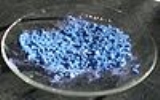
A colorful example is cobalt(II) chloride
, which turns from blue to magenta (red) upon hydration
, and can therefore be used as a water indicator.
The notation of hydrous compound, where n is the number of water molecules per formula unit of the salt, is commonly used to show that a salt is hydrated. The n is usually a low integer
, though it is possible for fractional values to exist. In a monohydrate n is one, in a hexahydrate n is 6 etc. (typical prefixes are mono, di, tri, tetra, penta, hexa, hepta, octa, nona, deca). Such water is also referred to as water of crystallization
. Examples include borax
decahydrate and chalcanthite
.
A hydrate which has lost water is referred to as an anhydride, and can normally lose further water only upon strong heating, if at all. A substance that does not contain any water is referred to as anhydrous
. Some anhydrous compounds are hydrated so easily that they are said to be hygroscopic and are used as drying agents or desiccant
s.
s (a class of solid hydrates of gases): water ice with gas molecules trapped within. When the gas is methane
it is called a methane hydrate.
Nonpolar molecules such as methane can form clathrate hydrate
s with water, especially under high pressure. Although there is no hydrogen bond
ing of water molecules when methane is the guest molecule of the clathrate, guest-host hydrogen bonding often forms with guest molecules in clathrates of many larger organic molecules, such as tetrahydrofuran
. In such cases the guest-host hydrogen bonds result in the formation of L-type Bjerrum defect
s in the clathrate lattice.
Inorganic chemistry
Inorganic chemistry is the branch of chemistry concerned with the properties and behavior of inorganic compounds. This field covers all chemical compounds except the myriad organic compounds , which are the subjects of organic chemistry...
and organic chemistry
Organic chemistry
Organic chemistry is a subdiscipline within chemistry involving the scientific study of the structure, properties, composition, reactions, and preparation of carbon-based compounds, hydrocarbons, and their derivatives...
to indicate that a substance contains water
Water
Water is a chemical substance with the chemical formula H2O. A water molecule contains one oxygen and two hydrogen atoms connected by covalent bonds. Water is a liquid at ambient conditions, but it often co-exists on Earth with its solid state, ice, and gaseous state . Water also exists in a...
. The chemical state of the water varies widely between hydrates, some of which were so labeled before their chemical structure was understood.
Organic chemistry
In organic chemistry, hydrate is a compound formed by the addition of waterWater
Water is a chemical substance with the chemical formula H2O. A water molecule contains one oxygen and two hydrogen atoms connected by covalent bonds. Water is a liquid at ambient conditions, but it often co-exists on Earth with its solid state, ice, and gaseous state . Water also exists in a...
or its elements to another molecule. For example, ethanol
Ethanol
Ethanol, also called ethyl alcohol, pure alcohol, grain alcohol, or drinking alcohol, is a volatile, flammable, colorless liquid. It is a psychoactive drug and one of the oldest recreational drugs. Best known as the type of alcohol found in alcoholic beverages, it is also used in thermometers, as a...
, CH3–CH2–OH, can be considered as a hydrate of ethene, CH2=CH2, formed by the addition of H to one C and OH to the other C. A molecule of water may be eliminated, for example by the action of sulfuric acid
Sulfuric acid
Sulfuric acid is a strong mineral acid with the molecular formula . Its historical name is oil of vitriol. Pure sulfuric acid is a highly corrosive, colorless, viscous liquid. The salts of sulfuric acid are called sulfates...
. Another example is chloral hydrate
Chloral hydrate
Chloral hydrate is a sedative and hypnotic drug as well as a chemical reagent and precursor. The name chloral hydrate indicates that it is formed from chloral by the addition of one molecule of water. Its chemical formula is C2H3Cl3O2....
, CCl3–CH(OH)2, which can be formed by reaction of water with chloral
Chloral
Chloral, also known as trichloroacetaldehyde, is the organic compound with the formula Cl3CCHO. This aldehyde is a colourless oily liquid that is soluble in a wide range of solvents...
, CCl3–CH=O.
Molecules have been labeled as hydrates for historical reasons. Glucose
Glucose
Glucose is a simple sugar and an important carbohydrate in biology. Cells use it as the primary source of energy and a metabolic intermediate...
, C6H12O6, was originally thought of as C6(H2O)6 and described as a carbohydrate
Carbohydrate
A carbohydrate is an organic compound with the empirical formula ; that is, consists only of carbon, hydrogen, and oxygen, with a hydrogen:oxygen atom ratio of 2:1 . However, there are exceptions to this. One common example would be deoxyribose, a component of DNA, which has the empirical...
, but this is a very poor description of its structure as known today. And methanol
Methanol
Methanol, also known as methyl alcohol, wood alcohol, wood naphtha or wood spirits, is a chemical with the formula CH3OH . It is the simplest alcohol, and is a light, volatile, colorless, flammable liquid with a distinctive odor very similar to, but slightly sweeter than, ethanol...
is often sold as “methyl hydrate”, implying the incorrect formula CH3OH2, while the correct formula is CH3–OH.
Many organic molecules, as with inorganic molecules, form crystals that incorporate water into the crystalline structure without chemical alteration of the organic molecule (water of crystallization
Water of crystallization
In crystallography, water of crystallization or water of hydration or crystallization water is water that occurs in crystals. Water of crystallization is necessary for the maintenance of crystalline properties, but capable of being removed by sufficient heat...
). The sugar trehalose
Trehalose
Trehalose, also known as mycose or tremalose, is a natural alpha-linked disaccharide formed by an α,α-1,1-glucoside bond between two α-glucose units. In 1832, H.A.L. Wiggers discovered trehalose in an ergot of rye, and in 1859 Marcellin Berthelot isolated it from trehala manna, a substance made...
, for example, exists in both an anhydrous
Anhydrous
As a general term, a substance is said to be anhydrous if it contains no water. The way of achieving the anhydrous form differs from one substance to another...
form (melting point 203°C) and as a dihydrate (melting point 97°C). Protein crystals
Protein crystallization
Most Proteins and many biological macromolecules differ from "small" molecules because the environment in which they function is aqueous. Therefore most biological macromolecules can be prompted to form crystals when the solution in which they are dissolved becomes supersaturated. The manner in...
commonly have as much as 50% water content.
Inorganic chemistry
Hydrates are inorganic salts "containing water molecules combined in a definite ratio as an integral part of the crystalCrystal
A crystal or crystalline solid is a solid material whose constituent atoms, molecules, or ions are arranged in an orderly repeating pattern extending in all three spatial dimensions. The scientific study of crystals and crystal formation is known as crystallography...
" that are either bound to a metal center or that have crystallized with the metal complex. Such hydrates are also said to contain water of crystallization
Water of crystallization
In crystallography, water of crystallization or water of hydration or crystallization water is water that occurs in crystals. Water of crystallization is necessary for the maintenance of crystalline properties, but capable of being removed by sufficient heat...
or water of hydration. If the water is heavy water
Heavy water
Heavy water is water highly enriched in the hydrogen isotope deuterium; e.g., heavy water used in CANDU reactors is 99.75% enriched by hydrogen atom-fraction...
, where the hydrogen involved is the isotope
Isotope
Isotopes are variants of atoms of a particular chemical element, which have differing numbers of neutrons. Atoms of a particular element by definition must contain the same number of protons but may have a distinct number of neutrons which differs from atom to atom, without changing the designation...
deuterium
Deuterium
Deuterium, also called heavy hydrogen, is one of two stable isotopes of hydrogen. It has a natural abundance in Earth's oceans of about one atom in of hydrogen . Deuterium accounts for approximately 0.0156% of all naturally occurring hydrogen in Earth's oceans, while the most common isotope ...
, then the term deuterate may be used in place of hydrate.
_chloride.jpg) |
-chloride-hexahydrate-sample.jpg) |
| Anhydrous Anhydrous As a general term, a substance is said to be anhydrous if it contains no water. The way of achieving the anhydrous form differs from one substance to another... cobalt(II) chloride CoCl2 |
Cobalt(II) chloride hexahydrate CoCl2·6H2O |
A colorful example is cobalt(II) chloride
Cobalt(II) chloride
Cobalt chloride is an inorganic compound of cobalt and chloride, with the formula CoCl2. It is usually supplied as the hexahydrate CoCl2·6H2O, which is one of the most commonly used cobalt compounds in the laboratory. The hexahydrate is deep purple in color, whereas the anhydrous form is sky blue...
, which turns from blue to magenta (red) upon hydration
Mineral hydration
Mineral hydration is an inorganic chemical reaction where water is added to the crystal structure of a mineral, usually creating a new mineral, usually called a hydrate....
, and can therefore be used as a water indicator.
The notation of hydrous compound, where n is the number of water molecules per formula unit of the salt, is commonly used to show that a salt is hydrated. The n is usually a low integer
Integer
The integers are formed by the natural numbers together with the negatives of the non-zero natural numbers .They are known as Positive and Negative Integers respectively...
, though it is possible for fractional values to exist. In a monohydrate n is one, in a hexahydrate n is 6 etc. (typical prefixes are mono, di, tri, tetra, penta, hexa, hepta, octa, nona, deca). Such water is also referred to as water of crystallization
Water of crystallization
In crystallography, water of crystallization or water of hydration or crystallization water is water that occurs in crystals. Water of crystallization is necessary for the maintenance of crystalline properties, but capable of being removed by sufficient heat...
. Examples include borax
Borax
Borax, also known as sodium borate, sodium tetraborate, or disodium tetraborate, is an important boron compound, a mineral, and a salt of boric acid. It is usually a white powder consisting of soft colorless crystals that dissolve easily in water.Borax has a wide variety of uses...
decahydrate and chalcanthite
Chalcanthite
Chalcanthite, whose name derives from the Greek, chalkos and anthos, meaning copper flower, is a richly-colored blue/green water-soluble sulfate mineral CuSO4·5H2O. It is commonly found in the late-stage oxidation zones of copper deposits...
.
A hydrate which has lost water is referred to as an anhydride, and can normally lose further water only upon strong heating, if at all. A substance that does not contain any water is referred to as anhydrous
Anhydrous
As a general term, a substance is said to be anhydrous if it contains no water. The way of achieving the anhydrous form differs from one substance to another...
. Some anhydrous compounds are hydrated so easily that they are said to be hygroscopic and are used as drying agents or desiccant
Desiccant
A desiccant is a hygroscopic substance that induces or sustains a state of dryness in its local vicinity in a moderately well-sealed container....
s.
Clathrate hydrates
Gas hydrates are clathrate hydrateClathrate hydrate
Clathrate hydrates are crystalline water-based solids physically resembling ice, in which small non-polar molecules or polar molecules with large hydrophobic moieties are trapped inside "cages" of hydrogen bonded water molecules...
s (a class of solid hydrates of gases): water ice with gas molecules trapped within. When the gas is methane
Methane
Methane is a chemical compound with the chemical formula . It is the simplest alkane, the principal component of natural gas, and probably the most abundant organic compound on earth. The relative abundance of methane makes it an attractive fuel...
it is called a methane hydrate.
Nonpolar molecules such as methane can form clathrate hydrate
Clathrate hydrate
Clathrate hydrates are crystalline water-based solids physically resembling ice, in which small non-polar molecules or polar molecules with large hydrophobic moieties are trapped inside "cages" of hydrogen bonded water molecules...
s with water, especially under high pressure. Although there is no hydrogen bond
Hydrogen bond
A hydrogen bond is the attractive interaction of a hydrogen atom with an electronegative atom, such as nitrogen, oxygen or fluorine, that comes from another molecule or chemical group. The hydrogen must be covalently bonded to another electronegative atom to create the bond...
ing of water molecules when methane is the guest molecule of the clathrate, guest-host hydrogen bonding often forms with guest molecules in clathrates of many larger organic molecules, such as tetrahydrofuran
Tetrahydrofuran
Tetrahydrofuran is a colorless, water-miscible organic liquid with low viscosity at standard temperature and pressure. This heterocyclic compound has the chemical formula 4O. As one of the most polar ethers with a wide liquid range, it is a useful solvent. Its main use, however, is as a precursor...
. In such cases the guest-host hydrogen bonds result in the formation of L-type Bjerrum defect
Bjerrum defect
A Bjerrum defect is a crystallographic defect which is specific to ice, and which is partly responsible for the electrical properties of ice. A hydrogen bond normally has one proton, but a hydrogen bond with a Bjerrum defect will have either two protons or no proton...
s in the clathrate lattice.
Stability
The stability of hydrates is generally determined by the nature of the compounds, their temperature, and the relative humidity (if they are exposed to air).See also
- Deliquescent
- Efflorescent
- Hydrated Ionic CompoundHydrated ionic compoundHydrated ionic compounds are those ionic compounds which contain water molecules inside their crystal lattice. The water is not chemically bonded to the crystal in any way, and may be driven off by heating the hydrated compound.- First system :...
- Hygroscopic
- Mineral hydrationMineral hydrationMineral hydration is an inorganic chemical reaction where water is added to the crystal structure of a mineral, usually creating a new mineral, usually called a hydrate....
- Water of crystallizationWater of crystallizationIn crystallography, water of crystallization or water of hydration or crystallization water is water that occurs in crystals. Water of crystallization is necessary for the maintenance of crystalline properties, but capable of being removed by sufficient heat...