

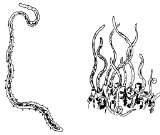
Tubificidae

Encyclopedia
The Naididae are a family
of clitellate oligochaete worm
s like the sludge worm, Tubifex tubifex
. They are key components of the benthic communities of many freshwater
and marine
ecosystem
s.
Analysis of 18S rDNA sequences has revealed that the family may not be monophyletic. However, the worst paraphyly
was corrected with uniting the Naidinae with the other families. This necessitated a change of names under the International Code of Zoological Nomenclature
rules, as Naididae was now the senior synonym of Tubificidae. It was proposed to the International Commission on Zoological Nomenclature
to suppress Naididae because the "tubificids" are the more well-known group of the two, but that was rejected.
Naididae is divided into six subfamilies, arranged here in the presumed phylogenetic sequence:
Family (biology)
In biological classification, family is* a taxonomic rank. Other well-known ranks are life, domain, kingdom, phylum, class, order, genus, and species, with family fitting between order and genus. As for the other well-known ranks, there is the option of an immediately lower rank, indicated by the...
of clitellate oligochaete worm
Worm
The term worm refers to an obsolete taxon used by Carolus Linnaeus and Jean-Baptiste Lamarck for all non-arthropod invertebrate animals, and stems from the Old English word wyrm. Currently it is used to describe many different distantly-related animals that typically have a long cylindrical...
s like the sludge worm, Tubifex tubifex
Tubifex tubifex
Tubifex tubifex, also called the sludge worm, or sewage worm, is a species of tubificid segmented worm that inhabits the sediments of lakes and rivers on several continents...
. They are key components of the benthic communities of many freshwater
Freshwater
Fresh water is naturally occurring water on the Earth's surface in ice sheets, ice caps, glaciers, bogs, ponds, lakes, rivers and streams, and underground as groundwater in aquifers and underground streams. Fresh water is generally characterized by having low concentrations of dissolved salts and...
and marine
Ocean
An ocean is a major body of saline water, and a principal component of the hydrosphere. Approximately 71% of the Earth's surface is covered by ocean, a continuous body of water that is customarily divided into several principal oceans and smaller seas.More than half of this area is over 3,000...
ecosystem
Ecosystem
An ecosystem is a biological environment consisting of all the organisms living in a particular area, as well as all the nonliving , physical components of the environment with which the organisms interact, such as air, soil, water and sunlight....
s.
Analysis of 18S rDNA sequences has revealed that the family may not be monophyletic. However, the worst paraphyly
Paraphyly
A group of taxa is said to be paraphyletic if the group consists of all the descendants of a hypothetical closest common ancestor minus one or more monophyletic groups of descendants...
was corrected with uniting the Naidinae with the other families. This necessitated a change of names under the International Code of Zoological Nomenclature
International Code of Zoological Nomenclature
The International Code of Zoological Nomenclature is a widely accepted convention in zoology that rules the formal scientific naming of organisms treated as animals...
rules, as Naididae was now the senior synonym of Tubificidae. It was proposed to the International Commission on Zoological Nomenclature
International Commission on Zoological Nomenclature
The International Commission on Zoological Nomenclature is an organization dedicated to "achieving stability and sense in the scientific naming of animals". Founded in 1895, it currently comprises 28 members from 20 countries, mainly practicing zoological taxonomists...
to suppress Naididae because the "tubificids" are the more well-known group of the two, but that was rejected.
Naididae is divided into six subfamilies, arranged here in the presumed phylogenetic sequence:
- Tubificinae, containing (among others) the genus TubifexTubifexTubifex is a cosmopolitan genus of tubificid Annelids that inhabit the sediments of lakes, rivers and occasionally sewer lines. There are over ten known species of Tubifex, but the number is not certain, as the species are not easily distinguishable from each other.-Food and feeding:Tubifex worms...
- Naidinae Ehrenberg, 1828
- Telmatodrilinae Eisen, 1879
- Limnodriloidinae Erséus, 1982
- Phallodrilinae Brinkhurst, 1971
- Pristininae Lastočkin, 1921, often included in Naidinae
- Rhyacodrilinae Hrabě, 1963