


Tsukiji fish market

Encyclopedia
Wholesale
Wholesaling, jobbing, or distributing is defined as the sale of goods or merchandise to retailers, to industrial, commercial, institutional, or other professional business users, or to other wholesalers and related subordinated services...
fish
Fish
Fish are a paraphyletic group of organisms that consist of all gill-bearing aquatic vertebrate animals that lack limbs with digits. Included in this definition are the living hagfish, lampreys, and cartilaginous and bony fish, as well as various extinct related groups...
and seafood
Seafood
Seafood is any form of marine life regarded as food by humans. Seafoods include fish, molluscs , crustaceans , echinoderms . Edible sea plants, such as some seaweeds and microalgae, are also seafood, and are widely eaten around the world, especially in Asia...
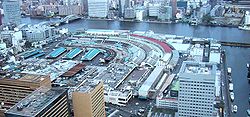
market in the world and also one of the largest wholesale food markets of any kind. The market is located in Tsukiji
Tsukiji
Tsukiji is a district of Chūō, Tokyo, Japan, the site of the Tsukiji fish market. Literally meaning "reclaimed land," it lies near the Sumida River on land reclaimed from Tokyo Bay in the 18th century, during the Edo period....
in central Tokyo
Tokyo
, ; officially , is one of the 47 prefectures of Japan. Tokyo is the capital of Japan, the center of the Greater Tokyo Area, and the largest metropolitan area of Japan. It is the seat of the Japanese government and the Imperial Palace, and the home of the Japanese Imperial Family...
, and is a major attraction for foreign visitors.
Location
Tsukijishijo Station
is a subway station in Chūō, Tokyo. It serves the lower part of the Tsukiji district, including the enormous Tokyo Metropolitan Central Wholesale Market, the Tokyo headquarters of the Asahi Shinbun newspaper, and Japan's National Cancer Center....
on the Toei Ōedo Line
Toei Oedo Line
The is a subway line in Tokyo, Japan operated by the Tokyo Metropolitan Bureau of Transportation . It commenced full operations on December 12, 2000; using the Japanese calendar this reads "12/12/12" as the year 2000 equals Heisei 12...
and Tsukiji Station
Tsukiji Station
is a subway station in Tsukiji, Chūō, Tokyo, Japan. It is operated by Tokyo Metro on the Hibiya Line, and has the station code H-10.-Location:The station is located in the Tsukiji neighbourhood of Chūō, Tokyo. Only a few blocks south of the station lies Tsukiji fish market, the largest seafood...
on the Tokyo Metro Hibiya Line
Tokyo Metro Hibiya Line
The is a metro line owned and operated by Tokyo Metro located in Tokyo, Japan. The line was named after the district of Hibiya, under which it passes.-Overview:The Hibiya Line runs between in Meguro and in Adachi...
. There are two distinct sections of the market as a whole. The "inner market" (jonai shijo) is the licensed wholesale market, where the auction
Auction
An auction is a process of buying and selling goods or services by offering them up for bid, taking bids, and then selling the item to the highest bidder...
s and most of the processing of the fish take place, and where licensed wholesale dealers (approximately 900 of them) operate small stalls. The "outer market" (jogai shijo) is a mixture of wholesale and retail shops that sell Japanese kitchen tools, restaurant supplies, groceries, and seafood, and many restaurants, especially sushi
Sushi
is a Japanese food consisting of cooked vinegared rice combined with other ingredients . Neta and forms of sushi presentation vary, but the ingredient which all sushi have in common is shari...
restaurants. Most of the shops in the outer market close by the early afternoon, and in the inner market even earlier.
Economics
The market handles more than 400 different types of seafood from cheap seaweedSeaweed
Seaweed is a loose, colloquial term encompassing macroscopic, multicellular, benthic marine algae. The term includes some members of the red, brown and green algae...
to the most expensive caviar
Caviar
Caviar, sometimes called black caviar, is a luxury delicacy, consisting of processed, salted, non-fertilized sturgeon roe. The roe can be "fresh" or pasteurized, the latter having much less culinary and economic value....
, and from tiny sardine
Sardine
Sardines, or pilchards, are several types of small, oily fish related to herrings, family Clupeidae. Sardines are named after the Mediterranean island of Sardinia, around which they were once abundant....
s to 300 kg tuna
Tuna
Tuna is a salt water fish from the family Scombridae, mostly in the genus Thunnus. Tuna are fast swimmers, and some species are capable of speeds of . Unlike most fish, which have white flesh, the muscle tissue of tuna ranges from pink to dark red. The red coloration derives from myoglobin, an...
and controversial whale species. Overall, more than 700,000 metric tons of seafood are handled every year at the three seafood markets in Tokyo, with a total value in excess of 600 billion yen (approximately 5.5 billion US dollars). The number of registered employees as of 25 January 2010 varies from 60,000 to 65,000, including wholesalers, accountants, auctioneers, company officials, and distributors.
Operations
The market opens most mornings (except Sundays, holidays and some Wednesdays) at 3:00 a.m. with the arrival of the products by ship, truck and plane from all over the world. Particularly impressive is the unloading of tons of frozen tuna. The auction houses (wholesalers known in Japanese as oroshi gyōsha) then estimate the value and prepare the incoming products for the auctions. The buyers (licensed to participate in the auctions) also inspect the fish to estimate which fish they would like to bid for and at which price.The auctions start around 5:20 a.m. Bidding can only be done by licensed participants. These bidders include intermediate wholesalers (nakaoroshi gyōsha) who operate stalls in the marketplace and other licensed buyers who are agents for restaurants, food processing companies, and large retailers.
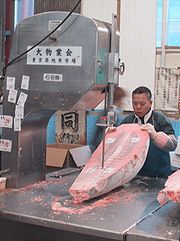
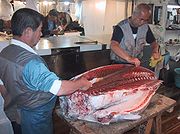
The auctions usually end around 7:00 a.m. Afterward, the purchased fish is either loaded onto trucks to be shipped to the next destination or on small carts and moved to the many shops inside the market. There the shop owners cut and prepare the products for retail. In case of large fish, for example tuna and swordfish, cutting and preparation is elaborate. Frozen tuna and swordfish are often cut with large band saws, and fresh tuna is carved with extremely long knives (some well over a meter in length) called oroshi hocho
Oroshi hocho
Maguro bōchō or Maguro kiri bōchō is an extremely long, highly specialized knife used in Japan to fillet tuna and other large fish....
, maguro-bocho, or hancho hocho.
The market is the busiest between 5:30 and 8:00 a.m., and the activity declines significantly afterward. Many shops start to close around 11:00 a.m., and the market closes for cleaning around 1:00 p.m. Tourists may visit the market daily between 5 a.m. and 6:15 a.m. and watch the proceedings from a designated area, except during periods when it is closed to the public.
Because of an increase in sightseers and the associated problems they cause, the market had banned all tourists from the tuna auctions on several occasions, including from 15 December 2008 through 17 January 2009, 10 December 2009 through 23 January 2010, and 8 April 2010 through 10 May 2010. After the latest ban that ended in May 2010, the tuna auctions have been re-opened to the public with a maximum limit of 140 visitors per day on a first-come, first-serve basis. Visitor entry into the interior wholesale markets is prohibited until after 9 AM. Due to the March 2011 earthquakes all tourists were banned from viewing the tuna auctions till 26 July 2011, from which date it was reopened.
Inspectors from the Tokyo Metropolitan Government supervise activities in the market to enforce the Food Hygiene Law.
History
Tokugawa Ieyasu
was the founder and first shogun of the Tokugawa shogunate of Japan , which ruled from the Battle of Sekigahara in 1600 until the Meiji Restoration in 1868. Ieyasu seized power in 1600, received appointment as shogun in 1603, abdicated from office in 1605, but...
during the Edo period
Edo period
The , or , is a division of Japanese history which was ruled by the shoguns of the Tokugawa family, running from 1603 to 1868. The political entity of this period was the Tokugawa shogunate....
to provide food for Edo
Edo
, also romanized as Yedo or Yeddo, is the former name of the Japanese capital Tokyo, and was the seat of power for the Tokugawa shogunate which ruled Japan from 1603 to 1868...
castle (nowadays Tokyo). Tokugawa Ieyasu invited fishermen from Tsukuda, Osaka
Osaka
is a city in the Kansai region of Japan's main island of Honshu, a designated city under the Local Autonomy Law, the capital city of Osaka Prefecture and also the biggest part of Keihanshin area, which is represented by three major cities of Japan, Kyoto, Osaka and Kobe...
to Edo to provide fish for the castle. Fish not bought by the castle was sold near the Nihonbashi
Nihonbashi
, or Nihombashi, is a business district of Chūō, Tokyo, Japan which grew up around the bridge of the same name which has linked two sides of the Nihonbashi River at this site since the 17th century. The first wooden bridge was completed in 1603, and the current bridge made of stone dates from 1911...
bridge, at a market called uogashi (literally, "fish quay") which was one of many specialized wholesale markets that lined the canals of Edo (as Tokyo was known until the 1870s).
In August 1918, following the so-called "Rice Riots
Rice Riots of 1918
The ' were a series of popular disturbances that erupted throughout Japan from July to September 1918, which brought about the collapse of the Terauchi Masatake administration.-Causes:...
" (Kome Soudou), which broke out in over 100 cities and towns in protest against food shortages and the speculative practices of wholesalers, the Japanese government was forced to create new institutions for the distribution of foodstuffs, especially in urban areas. A Central Wholesale Market Law was established in March 1923.
The Great Kantō earthquake on September 1, 1923, devastated much of central Tokyo, including the Nihonbashi
Nihonbashi
, or Nihombashi, is a business district of Chūō, Tokyo, Japan which grew up around the bridge of the same name which has linked two sides of the Nihonbashi River at this site since the 17th century. The first wooden bridge was completed in 1603, and the current bridge made of stone dates from 1911...
fish market. In the aftermath of the earthquake, the market was relocated to the Tsukiji
Tsukiji
Tsukiji is a district of Chūō, Tokyo, Japan, the site of the Tsukiji fish market. Literally meaning "reclaimed land," it lies near the Sumida River on land reclaimed from Tokyo Bay in the 18th century, during the Edo period....
district and, after the construction of a modern market facility was completed in 1935, the fish market began operations under the provisions of the 1923 Central Wholesale Market Law. Three major markets in Tsukiji, Kanda, and Koto began operating in 1935. Smaller branch markets were established in Ebara, Toshima, and Adachi, and elsewhere. At present, the Tokyo Metropolitan Government's system of wholesale markets includes more than a dozen major and branch markets, handling seafood, produce, meat, and cut flowers.