

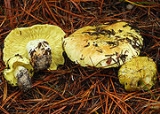
Tricholomataceae

Encyclopedia
The Tricholomataceae are a large family
of mushroom
s within the Agaricales
. A classic "wastebasket taxon", the Tricholomataceae is inclusive of any white-, yellow-, or pink-spored genera
in the Agaricales not already classified as belonging to the Amanitaceae
, Lepiotaceae, Hygrophoraceae
, Pluteaceae
, or Entolomataceae
.
The name derives from the Greek trichos (τριχος) meaning hair and loma (λωμα) meaning fringe or border although not all members display this feature.
Arnolds (1986) and Bas (1990) also place the genera of the Hygrophoraceae within this family, however, this classification is not accepted by the majority of fungal taxonomists. (Young, 2003)
Molecular phylogenetic analysis has greatly aided in the demarcation of clear monophyletic groups among the Tricholomataceae. So far, most of these groups have been defined cladistically rather than being defined as formal Linnean
taxa, though there have been several cases in which older proposed segregates from the Tricholomataceae have been validated by evidence coming from molecular phylogenetics
. As of 2006, validly published families segregated from the Tricholomataceae include the Hydnangiaceae
, Lyophyllaceae, Marasmiaceae
, Mycenaceae, Omphalotaceae, Physalacriaceae, and Pleurotaceae
.
The name "Tricholomataceae" is nevertheless seen as having validity in describing Tricholoma and its close relatives, and whatever other genera can at some future point be described as part of a monophyletic family including Tricholoma. To that end, the International Botanical Congress
has voted on two occasions (1988 and 2006) to conserve the name "Tricholomataceae" against competing names. (Redhead 2003, McNeill, et al. 2006) This decision does not invalidate the use of segregate families from the Tricholomataceae, but simply validates the continued use of Tricholomataceae. (Young, 2002)
The extinct genus Archaeomarasmius
, described from Turonian
age New Jersey
amber, is one of four known genera of Agaricales in the fossil record.
Family (biology)
In biological classification, family is* a taxonomic rank. Other well-known ranks are life, domain, kingdom, phylum, class, order, genus, and species, with family fitting between order and genus. As for the other well-known ranks, there is the option of an immediately lower rank, indicated by the...
of mushroom
Mushroom
A mushroom is the fleshy, spore-bearing fruiting body of a fungus, typically produced above ground on soil or on its food source. The standard for the name "mushroom" is the cultivated white button mushroom, Agaricus bisporus; hence the word "mushroom" is most often applied to those fungi that...
s within the Agaricales
Agaricales
The fungal order Agaricales, also known as gilled mushrooms , or euagarics, contains some of the most familiar types of mushrooms. The order has 33 extant families, 413 genera, and over 13000 described species, along with five extinct genera known only from the fossil record...
. A classic "wastebasket taxon", the Tricholomataceae is inclusive of any white-, yellow-, or pink-spored genera
Genera
Genera is a commercial operating system and development environment for Lisp machines developed by Symbolics. It is essentially a fork of an earlier operating system originating on the MIT AI Lab's Lisp machines which Symbolics had used in common with LMI and Texas Instruments...
in the Agaricales not already classified as belonging to the Amanitaceae
Amanitaceae
Amanitaceae are a family of fungi or mushrooms. The family, also commonly called the Amanita family, is in order Agaricales, gilled mushrooms...
, Lepiotaceae, Hygrophoraceae
Hygrophoraceae
The Hygrophoraceae are a family of fungi in the order Agaricales. Originally conceived as containing white-spored, thick-gilled agarics , including Hygrophorus and Hygrocybe species , DNA evidence has extended the limits of the family, so that it now contains not only agarics but also...
, Pluteaceae
Pluteaceae
The Pluteaceae are a family of small to medium-sized mushrooms which have free gill attachment and pink spores. Members of Pluteaceae can be mistaken for members of Entolomatacae but can be distinguished by their angled spores and attached gills...
, or Entolomataceae
Entolomataceae
The Entolomataceae, also known as Rhodophyllaceae are a large family of pink spored terrestrial gilled mushrooms which includes the genera Entoloma, Rhodocybe, and Clitopilus. The family collectively contains over 1500 species, the large majority of which are in Entoloma...
.
The name derives from the Greek trichos (τριχος) meaning hair and loma (λωμα) meaning fringe or border although not all members display this feature.
Arnolds (1986) and Bas (1990) also place the genera of the Hygrophoraceae within this family, however, this classification is not accepted by the majority of fungal taxonomists. (Young, 2003)
Molecular phylogenetic analysis has greatly aided in the demarcation of clear monophyletic groups among the Tricholomataceae. So far, most of these groups have been defined cladistically rather than being defined as formal Linnean
Linnean
Linnean is closely associated to the alternative spelling Linnaean, and can refer to any of the following all of which are related to the original system of scientific taxonomy of biological species or its author:-Linnaean:*Carolus Linnaeus...
taxa, though there have been several cases in which older proposed segregates from the Tricholomataceae have been validated by evidence coming from molecular phylogenetics
Phylogenetics
In biology, phylogenetics is the study of evolutionary relatedness among groups of organisms , which is discovered through molecular sequencing data and morphological data matrices...
. As of 2006, validly published families segregated from the Tricholomataceae include the Hydnangiaceae
Hydnangiaceae
The Hydnangiaceae are a family of fungi in the order of mushrooms known as the Agaricales. Widespread in temperate and tropical regions throughout the world, the family contains approximately 30 species amongst 4 genera...
, Lyophyllaceae, Marasmiaceae
Marasmiaceae
The Marasmiaceae are a family of basidiomycete fungi which have white spores. They mostly have a tough stem and the capability of shrivelling up during a dry period and later recovering. The widely consumed edible fungus Lentinula edodes, the Shiitake mushroom, is a member of this family...
, Mycenaceae, Omphalotaceae, Physalacriaceae, and Pleurotaceae
Pleurotaceae
Pleurotaceae are a family of small to medium sized mushrooms which have white spores. The family contains 6 genera and 94 species. Members of Pleurotaceae can be mistaken for members of Omphalotaceae...
.
The name "Tricholomataceae" is nevertheless seen as having validity in describing Tricholoma and its close relatives, and whatever other genera can at some future point be described as part of a monophyletic family including Tricholoma. To that end, the International Botanical Congress
International Botanical Congress
International Botanical Congress is a large-scale meeting of botanists in all scientific fields, from all over the world. Authorized by the International Association of Botanical and Mycological Societies , congresses are held every six years with the venue circulating around the world. The XVIII...
has voted on two occasions (1988 and 2006) to conserve the name "Tricholomataceae" against competing names. (Redhead 2003, McNeill, et al. 2006) This decision does not invalidate the use of segregate families from the Tricholomataceae, but simply validates the continued use of Tricholomataceae. (Young, 2002)
The extinct genus Archaeomarasmius
Archaeomarasmius
Archaeomarasmius is an extinct genus of gilled fungus in the Agaricales family Tricholomataceae, containing the single species Archaeomarasmius leggetti. It is known from two fruit bodies recovered from amber, one consisting of a complete cap with a broken stem, the other consisting of a fragment...
, described from Turonian
Turonian
The Turonian is, in the ICS' geologic timescale, the second age in the Late Cretaceous epoch, or a stage in the Upper Cretaceous series. It spans the time between 93.5 ± 0.8 Ma and 89.3 ± 1 Ma...
age New Jersey
New Jersey
New Jersey is a state in the Northeastern and Middle Atlantic regions of the United States. , its population was 8,791,894. It is bordered on the north and east by the state of New York, on the southeast and south by the Atlantic Ocean, on the west by Pennsylvania and on the southwest by Delaware...
amber, is one of four known genera of Agaricales in the fossil record.