
|
|
|
|
Toyota Sienna
|
| |
|
| |
Not to be confused with Toyota Sienta.
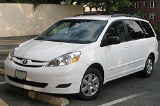
The Toyota Sienna is a family minivan currently manufactured in the United States by the Japanese automaker Toyota for the North American market only, and shares its platform with the Toyota Camry. It is rumored to be exported to emerging markets such as China by the year 2010. The Sienna replaced the first generation Toyota Previa van in 1998 befitting as a more conventional front wheel drive layout, and was last updated in 2004 as a larger model.

Discussion
Ask a question about 'Toyota Sienna'
Start a new discussion about 'Toyota Sienna'
Answer questions from other users
|
Recent Posts

Encyclopedia
Not to be confused with Toyota Sienta.
The Toyota Sienna is a family minivan currently manufactured in the United States by the Japanese automaker Toyota for the North American market only, and shares its platform with the Toyota Camry. It is rumored to be exported to emerging markets such as China by the year 2010. The Sienna replaced the first generation Toyota Previa van in 1998 befitting as a more conventional front wheel drive layout, and was last updated in 2004 as a larger model. They are often seen as taxis in New York City.
First generation (1998-2003) In late 1997, Toyota launched the smaller front wheel drive 1998 Toyota Sienna in the North American market as a replacement for the rather avant-garde mid-engined Toyota Previa The Toyota Sienna debuted with a 3.0-liter 1MZ-FE V6 engine rated at 145 kW and of torque. Built on an extended platform of the Toyota Camry, the Sienna was appropriately marketed as the "Camry of minivans". The Sienna also touted the best-in-class fuel economy (in miles per gallon) of any minivan which was rated at 18 city/24 highway. It was built in Georgetown, Kentucky.
A year after its release, the Sienna faced new competition from Honda's new Odyssey minivan.
For 2001 model year, the Sienna underwent a minor mid-cycle refresh. This update included a facelift to both front and rear fascias which added a redesigned front grille and bumper along with revised rear taillights sporting a more modern appearance (clear-lens turn-signals as opposed to amber-coloured). Toyota also revamped the center console area to add more usability to the HVAC controls along with new locations for the accessory switches (Rear Vent, Power Sliding Doors, Heated Seats). The engine now came equipped with a variable valve timing feature VVT-i boosting output to and torque.
This generation was noteworthy for its impressive safety content as one of the few minivans to offer competitive options including anti-lock brakes, Vehicle Stability Control (VSC), traction control and SRS Side-impact airbags.
The IIHS rated the Sienna Good in all six frontal crash test measures
1999 NHTSA scores:
Frontal Driver:
Frontal Passenger:
Side Driver:
Side Rear Passenger:
Second generation (2004-2009)
In January 2003, the second-generation Sienna was unveiled at the Detroit Auto Show. Production shifted to Princeton, Indiana, and the former Georgetown plant was retooled to build the second generation Camry Solara. In order to make the redesign more successful Toyota assigned Yuji Yokoya chief engineer on the new Sienna project. Yuji and his family drove the previous Sienna over 53,000 miles throughout North America to find weaknesses from the previous model.
The new redesign continued to be offered in CE, LE, and XLE trims along with the arrival of a new more luxurious, leather-trimmed XLE Limited model. All Siennas were now powered by an updated ULEV rated 3.3-liter 3MZ-FE engine paired with a new 5-speed automatic transmission (U151E in FWD models and U151F in AWD models). The gear-shift lever was also moved from the steering column to the lower-center dashboard area and worked in a zig-zag pattern much like that on the Lexus RX. New styling allowed for a drag coefficient figure of (0.30 Cd). Fuel economy remained commendable at 19 city/26 highway (17 city/23 highway for AWD).
Having grown larger in size than the first generation, the Sienna now offered a variety of new features, many of which were derived from other competition within segment. A prime example of this was the clever hide-away third-row seat that stowed away folding flat into a floorwell (FWD only), which was first revolutionized by the Honda Odyssey and followed by nearly every other minivan. However, while the Odyssey's "Magic Seat" was a one-piece folding bench, the Sienna's added a more versatile 60/40 split configuration. Power-retractable side-windows which rolled down completely into the second-row sliding-doors (introduced in the Mazda MPV) were also new along with available eight-passenger seating (CE and LE only), dual power sliding doors and power liftgate (standard on XLE and Limited, optional on LE).
Standard features include remote keyless entry, tilt-and-telescopic steering wheel, high solar energy-absorbing glass (HSEA) on the windshield and front windows, rear climate control, tire-pressure monitor, and run-flat tires that came standard with the available all wheel drive. All 2004-2007 Siennas also came standard with a factory tow package and a 3500lb towing capacity. Major options included HID Xenon headlamps (XLE Limited), Dynamic Laser Cruise Control, front and rear obstacle detection, "kid-view" mirror (similar to wide-angle mirrors found in a school bus), voice-activated navigation system which includes backup camera, 10-speaker JBL Synthesis audio and rear-seat DVD entertainment system w/flip down screen.
Safety
The Sienna comes standard with ABS. Side airbags were optional on certain 2004 and 2005 model trims, becoming standard on all 2006 trims. Vehicle Stability Control initially optional became standard on 2008 models.
The IIHS gives the Sienna an overall Good score in their frontal crash tests, the Sienna also receives Good marks in all six measured categories. Models equipped with side airbags also receive a Good overall score while models without side airbags receive an Acceptable score for side impacts.
2004 NHTSA crash test (no side airbags):
Frontal Driver:
Frontal Passenger:
Side Driver:
Side Rear Passenger:
2wd Rollover:
Model year changes
For 2006, mid-cycle refresher, the front fascia, side molding, and rear taillamps were restyled. Horsepower and torque ratings were changed to meet SAE's new standard to 215 hp and 222 ft·lbf (from 230 hp and 242 ft·lbf, Toyota also now rates engines on 87 octane). Blue-backlit electroluminescent Optitron gauges were added to LE, XLE, and Limited trims. The "XLE" prefix in "XLE Limited" was removed to lessen confusion, and newly added equipment exclusively for this trimline included an optional memory function for the power driver's seat and side-view mirrors (also available on XLE as an option) and power-folding exterior side-view mirrors with integrated in-glass LED turn-signal repeaters. Secondary options included Bluetooth capability and a power-folding third-row seat.
Front row side-torso airbags and side curtain airbags for all three rows became standard equipment on all models. The optional rear seat audio system was discontinued.
For 2007, a new ULEV-II certified 2GR-FE 3.5-liter V6 engine rated at replaced the old 3.3 L V6.
Fuel economy improved to 17/23 MPG for front-wheel-drive models and 16/21 MPG for AWD models. A new seven-spoke alloy wheel design was made exclusive to the Limited and AWD models.
For 2009, the Sienna remains largely unchanged save for a revision in pricing to become even more competitive through several available comprehensively-equipped "extra-value package" offerings. In the Canadian market, base prices are lowered by up to as much as $1,500.
Models
The 2008 Toyota Sienna is available in:
- CE ($24,340 USD MSRP)
- CE 8-Passenger (24,490 USD MSRP)
- LE ($25,865 USD MSRP)
- LE 8-Passenger ($26,015 USD MSRP)
- LE AWD (29,035 USD MSRP)
- XLE ($29,525 USD MSRP)
- XLE AWD ($32,285 USD MSRP)
- Limited ($35,465 USD MSRP)
- Limited AWD ($37,665 USD MSRP)
2008 specifications
- Engine: 3.5 L DOHC 24-valve Dual VVT-i V6 - 2GR-FE
- Output: 266 hp (200 kW) at 6200 RPM and 248 ft·lbf (336 N·m) at 4700 rpm (SAE Net)
- Transmission: 5-speed electronically controlled automatic transmission with Intelligent Grade-Logic Control (ECT-i)
- MPG: EPA Estimated 23 MPG Highway, 17 MPG City (2WD), and 21 Highway, 16 City (AWD).
- Drivetrain: Front wheel drive, all wheel drive available on LE, XLE, XLE Limited (CE in Canada)
- Turning Diameter: 36.8 ft (11.2 m)
- Brakes: Power-assisted ventilated front disc, rear disk with anti-lock braking system (ABS), and 4-channel disc brakes on XLE Limited, all wheel drive models or with available Vehicle Stability Control system and Braking Assist
US Sales
| US Calendar Year | Sales |
|---|
| 2000 | 103,137 | | 2001 | 88,469 | | 2002 | 80,915 | | 2003 | 105,499 | | 2004 | 159,119 | | 2005 | 161,380 | | 2006 | 163,269 | | 2007 | 138,162 | | 2008 | 115,944 |
Awards
2004:
In the media
- A yellow 04-05 Toyota Sienna taxi is driven as the primary vehicle in the game show Cash Cab.
- A light-blue 04-05 Toyota Sienna CE is the family minivan featured in the Disney movie The Pacifier.
- The YTV van used in the Long Day Weekend Trip is a Sienna painted with the YTV Logo.
External links
|
| |
|
|