


Tour Montparnasse

Encyclopedia
Tour Maine-Montparnasse (Maine-Montparnasse Tower), also commonly named Tour Montparnasse, is a 210 metres (689 ft) tall office skyscraper
located in Paris
, France
, in the area of Montparnasse
. Constructed from 1969 to 1972, it was the tallest skyscraper in France until 2011, when it was surpassed in height by the Tour First (231 metres (758 ft)). It is currently the eleventh tallest building in the European Union.
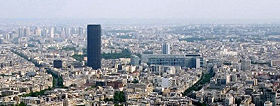 Built on top of the Montparnasse – Bienvenüe Paris Métro
station, the 59 floors of the tower
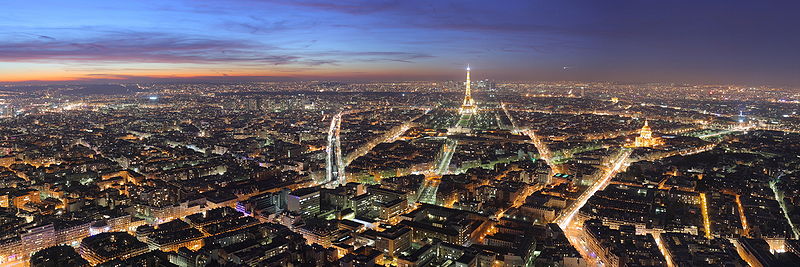
are mainly occupied by offices. The 56th floor, with a restaurant, and the terrace on the top floor, are open to the public for viewing the city. The view covers a radius of 40 kilometres (24.9 mi); aircraft can be seen taking off from Orly Airport. The guard rail, to which various antennae are attached, can be pneumatically lowered in just two minutes to allow helicopters to land. At the time of construction, it was the tallest building in Europe
by roof height. The construction of La Grande Arche
in La Défense
places the tower in a second line of perspective across Paris: see Axe historique
.
The design of the tower predates architectural trends that placed high importance on a view of the outside, and so only offices around the perimeter of each floor have windows (more modern skyscrapers are often designed to provide a window for every office).
It is sometimes said, half-jokingly, that the view from the top is the most beautiful in Paris, because it is the only place from which one cannot see the tower.
A 2008 poll of editors on Virtualtourist
voted the building the second-ugliest building in the world.
urban climber, Alain "Spiderman" Robert
, using only his bare hands and feet and with no safety devices of any kind, scaled the building's exterior glass and steel wall to the top but almost fell.
material. When inhaled, for instance during repairs, asbestos is a carcinogen
. As with the Jussieu Campus
, the problem of removing the asbestos material from a large building used by thousands of people is acute. Projected completion times for removal are three years if the building is emptied for the duration of the work and ten years if the building is not emptied.
The removal of asbestos began in July 2007.
Skyscraper
A skyscraper is a tall, continuously habitable building of many stories, often designed for office and commercial use. There is no official definition or height above which a building may be classified as a skyscraper...
located in Paris
Paris
Paris is the capital and largest city in France, situated on the river Seine, in northern France, at the heart of the Île-de-France region...
, France
France
The French Republic , The French Republic , The French Republic , (commonly known as France , is a unitary semi-presidential republic in Western Europe with several overseas territories and islands located on other continents and in the Indian, Pacific, and Atlantic oceans. Metropolitan France...
, in the area of Montparnasse
Montparnasse
Montparnasse is an area of Paris, France, on the left bank of the river Seine, centred at the crossroads of the Boulevard du Montparnasse and the Rue de Rennes, between the Rue de Rennes and boulevard Raspail...
. Constructed from 1969 to 1972, it was the tallest skyscraper in France until 2011, when it was surpassed in height by the Tour First (231 metres (758 ft)). It is currently the eleventh tallest building in the European Union.
Design and construction
The tower was designed by architects Eugène Beaudouin, Urbain Cassan and Louis Hoym de Marien and built by Campenon Bernard.Location
Paris Métro
The Paris Métro or Métropolitain is the rapid transit metro system in Paris, France. It has become a symbol of the city, noted for its density within the city limits and its uniform architecture influenced by Art Nouveau. The network's sixteen lines are mostly underground and run to 214 km ...
station, the 59 floors of the tower
Tower
A tower is a tall structure, usually taller than it is wide, often by a significant margin. Towers are distinguished from masts by their lack of guy-wires....
are mainly occupied by offices. The 56th floor, with a restaurant, and the terrace on the top floor, are open to the public for viewing the city. The view covers a radius of 40 kilometres (24.9 mi); aircraft can be seen taking off from Orly Airport. The guard rail, to which various antennae are attached, can be pneumatically lowered in just two minutes to allow helicopters to land. At the time of construction, it was the tallest building in Europe
Europe
Europe is, by convention, one of the world's seven continents. Comprising the westernmost peninsula of Eurasia, Europe is generally 'divided' from Asia to its east by the watershed divides of the Ural and Caucasus Mountains, the Ural River, the Caspian and Black Seas, and the waterways connecting...
by roof height. The construction of La Grande Arche
Grande Arche
La Grande Arche de la Défense is a monument and building in the business district of La Défense and in the commune of Puteaux, to the west of Paris, France...
in La Défense
La Défense
La Défense is a major business district of the Paris aire urbaine. With a population of 20,000, it is centered in an orbital motorway straddling the Hauts-de-Seine département municipalities of Nanterre, Courbevoie and Puteaux...
places the tower in a second line of perspective across Paris: see Axe historique
Axe historique
The Axe historique is a line of monuments, buildings and thoroughfares that extends from the centre of Paris, France, to the west. It is also known as the "Voie Triomphale" ....
.
Criticism
The tower's simple architecture, large proportions and monolithic appearance have been often criticised for being out of place in Paris's urban landscape and, as a result, two years after its completion, the construction of skyscrapers in the city centre was banned.The design of the tower predates architectural trends that placed high importance on a view of the outside, and so only offices around the perimeter of each floor have windows (more modern skyscrapers are often designed to provide a window for every office).
It is sometimes said, half-jokingly, that the view from the top is the most beautiful in Paris, because it is the only place from which one cannot see the tower.
A 2008 poll of editors on Virtualtourist
Virtualtourist
VirtualTourist is a free, travel-oriented community website featuring user-contributed travel guides for locations worldwide. VirtualTourist is one of a number of travel websites on the Web, which include websites like Tripadvisor and Cruise Critic...
voted the building the second-ugliest building in the world.
Climbing the tower
In 1995, FrenchFrance
The French Republic , The French Republic , The French Republic , (commonly known as France , is a unitary semi-presidential republic in Western Europe with several overseas territories and islands located on other continents and in the Indian, Pacific, and Atlantic oceans. Metropolitan France...
urban climber, Alain "Spiderman" Robert
Alain Robert
Alain Robert , is a French rock and urban climber, from Digoin, Saône-et-Loire, Bourgogne, France...
, using only his bare hands and feet and with no safety devices of any kind, scaled the building's exterior glass and steel wall to the top but almost fell.
Asbestos contamination
In 2005, studies showed that the tower contained asbestosAsbestos
Asbestos is a set of six naturally occurring silicate minerals used commercially for their desirable physical properties. They all have in common their eponymous, asbestiform habit: long, thin fibrous crystals...
material. When inhaled, for instance during repairs, asbestos is a carcinogen
Carcinogen
A carcinogen is any substance, radionuclide, or radiation that is an agent directly involved in causing cancer. This may be due to the ability to damage the genome or to the disruption of cellular metabolic processes...
. As with the Jussieu Campus
Jussieu Campus
The Jussieu Campus is a higher education campus located in the 5th arrondissement of Paris, France, which is the main campus of the Pierre and Marie Curie University ....
, the problem of removing the asbestos material from a large building used by thousands of people is acute. Projected completion times for removal are three years if the building is emptied for the duration of the work and ten years if the building is not emptied.
The removal of asbestos began in July 2007.