


Tonkori

Encyclopedia
Ainu people
The , also called Aynu, Aino , and in historical texts Ezo , are indigenous people or groups in Japan and Russia. Historically they spoke the Ainu language and related varieties and lived in Hokkaidō, the Kuril Islands, and much of Sakhalin...
of Hokkaidō
Hokkaido
, formerly known as Ezo, Yezo, Yeso, or Yesso, is Japan's second largest island; it is also the largest and northernmost of Japan's 47 prefectural-level subdivisions. The Tsugaru Strait separates Hokkaido from Honshu, although the two islands are connected by the underwater railway Seikan Tunnel...
, northern Japan
Japan
Japan is an island nation in East Asia. Located in the Pacific Ocean, it lies to the east of the Sea of Japan, China, North Korea, South Korea and Russia, stretching from the Sea of Okhotsk in the north to the East China Sea and Taiwan in the south...
and Sakhalin
Sakhalin
Sakhalin or Saghalien, is a large island in the North Pacific, lying between 45°50' and 54°24' N.It is part of Russia, and is Russia's largest island, and is administered as part of Sakhalin Oblast...
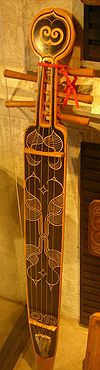
. It is unfretted and has between three and five strings, which are not stopped but instead played "open." The instrument is believed to have been developed in the Karafuto
Karafuto Prefecture
, commonly called South Sakhalin, was the Japanese administrative division corresponding to Japanese territory on Sakhalin from 1905 to 1945. Through the Treaty of Portsmouth, the portion of Sakhalin south of 50°N became a colony of Japan in 1905...
region of Sakhalin.
The instrument is constructed of Jezo Spruce
Jezo Spruce
The Jezo spruce or Yezo spruce is a large evergreen tree growing to 30-50 m tall and with a trunk diameter of up to 2 m...
with strings made of gut
Catgut
Catgut is a type of cord that is prepared from the natural fibre found in the walls of animal intestines. Usually sheep or goat intestines are used, but it is occasionally made from the intestines of cattle, hogs, horses, mules, or donkeys.-Etymology:...
or vegetable fiber. Its shape is traditionally said to resemble a woman's body, and the corresponding words are used for its parts.
The most prominent tonkori performer is Oki Kano, who often uses the instrument in contemporary and cross-cultural performances and recordings.http://www.tonkori.com/disc/index_eng.html