
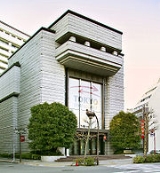
The , called or
TSE for short, is located in
Tokyo, ; officially , is one of the 47 prefectures of Japan. Tokyo is the capital of Japan, the center of the Greater Tokyo Area, and the largest metropolitan area of Japan. It is the seat of the Japanese government and the Imperial Palace, and the home of the Japanese Imperial Family...
,
JapanJapan is an island nation in East Asia. Located in the Pacific Ocean, it lies to the east of the Sea of Japan, China, North Korea, South Korea and Russia, stretching from the Sea of Okhotsk in the north to the East China Sea and Taiwan in the south...
and is the third largest
stock exchangeA stock exchange is an entity that provides services for stock brokers and traders to trade stocks, bonds, and other securities. Stock exchanges also provide facilities for issue and redemption of securities and other financial instruments, and capital events including the payment of income and...
in the world by aggregate
market capitalizationMarket capitalization is a measurement of the value of the ownership interest that shareholders hold in a business enterprise. It is equal to the share price times the number of shares outstanding of a publicly traded company...
of its listed companies. The Tokyo Stock Exchange had 2,292 listed companies with a combined market capitalization of US$3.8 trillion as of Dec 2010.
Structure
The TSE is incorporated as a
kabushiki kaishais a type of business defined under Japanese law.-Usage in language:Both kabushiki kaisha and the rendaku form kabushiki gaisha are used. The "K" spelling is much more common in the names of companies and in English-language legal literature, whereas the "G" pronunciation is dominant in...
with nine directors, four auditors and eight executive officers. Its headquarters are located at 2-1
Nihonbashi, or Nihombashi, is a business district of Chūō, Tokyo, Japan which grew up around the bridge of the same name which has linked two sides of the Nihonbashi River at this site since the 17th century. The first wooden bridge was completed in 1603, and the current bridge made of stone dates from 1911...
-kabutocho,
Chūō, Tokyois one of the 23 special wards that form the heart of Tokyo, Japan. The ward refers to itself as Chūō City in English.Its Japanese name literally means "Central Ward," and it is historically the main commercial center of Tokyo, although Shinjuku has risen to challenge it since the end of World War II...
. "Kabutocho" is the largest financial district in
JapanJapan is an island nation in East Asia. Located in the Pacific Ocean, it lies to the east of the Sea of Japan, China, North Korea, South Korea and Russia, stretching from the Sea of Okhotsk in the north to the East China Sea and Taiwan in the south...
. Its operating hours are from 9:00 to 11:00 am, and from 12:30 to 3:00 pm. From April 24, 2006, the afternoon trading session started at its usual time of 12:30 p.m.
Stocks listed on the TSE are separated into the
First Section for large companies, the
Second Section for mid-sized companies, and the section for high-growth startup companies. As of October 31, 2010, there are 1,675 First Section companies, 437 Second Section companies and 182 Mothers companies.
The main indices tracking the TSE are the
Nikkei 225The , more commonly called the Nikkei, the Nikkei index, or the Nikkei Stock Average , is a stock market index for the Tokyo Stock Exchange . It has been calculated daily by the Nihon Keizai Shimbun newspaper since 1950. It is a price-weighted average , and the components are reviewed once a year...
index of companies selected by the
Nihon Keizai Shimbunis one of the largest media corporations in Japan. Nikkei specializes in publishing financial, business and industry news. Its main news publications include:* Nihon Keizai Shimbun , a leading economic newspaper....
(Japan's largest business newspaper), the
TOPIXTokyo stock Price IndeX, commonly known as TOPIX, along with the Nikkei 225, is an important stock market index for the Tokyo Stock Exchange in Japan, tracking all domestic companies of the exchange's First Section. It is calculated and published by the TSE...
index based on the share prices of First Section companies, and the J30 index of large industrial companies maintained by Japan's major broadsheet newspapers.
94 domestic and 10 foreign securities companies participate in TSE trading.
See: Members of the Tokyo Stock Exchange
Other TSE-related institutions include:
- The exchange's press club, called the , which meets on the third floor of the TSE building. Most Kabuto Club members are affiliated with the Nihon Keizai Shimbun
is one of the largest media corporations in Japan. Nikkei specializes in publishing financial, business and industry news. Its main news publications include:* Nihon Keizai Shimbun , a leading economic newspaper....
, Kyodo Newsis a nonprofit cooperative news agency based in Minato, Tokyo. It was established in November 1945 and it distributes news to almost all newspapers, and radio and television networks in Japan. The newspapers using its news have about 50 million subscribers. K. K. Kyodo News is Kyodo News' business...
, Jiji PressJiji Press Ltd. is a leading wire service in Japan. Headquartered at Ginza, Chuo, Tokyo, Jiji has 82 branch offices, general bureau and bureau in Japan and 28 general bureau globally. Seizo Wakabayashi is the current President of Jiji Press.-External links:*...
, or business television broadcasters such as Bloomberg LP and CNBCCNBC is a satellite and cable television business news channel in the U.S., owned and operated by NBCUniversal. The network and its international spinoffs cover business headlines and provide live coverage of financial markets. The combined reach of CNBC and its siblings is 390 million viewers...
. The Kabuto Club is generally busiest during April and May, when public companies release their annual accounts.
On 15 June 2007, the TSE paid $303 million to acquire a 4.99% stake in Singapore Exchange Ltd.
Prewar history
The Tokyo Stock Exchange was established on May 15, 1878, as the
Tokyo Kabushiki Torihikijo (東京株式取引所) under the direction of then-Finance Minister
Okuma ShigenobuMarquis ; was a statesman in the Empire of Japan and the 8th and 17th Prime Minister of Japan...
and capitalist advocate Shibusawa Eiichi. Trading began on June 1, 1878.
In 1943, the exchange was combined with ten other stock exchanges in major Japanese cities to form a single . The combined exchange was shut down and reorganized shortly after the bombing of Nagasaki.
Postwar history
The Tokyo Stock Exchange reopened under its current Japanese name on May 16, 1949, pursuant to the new Securities Exchange Act.
The TSE runup from 1983 to 1990 was unprecedented, in 1990 it accounted for over 60% of the world's stock market capitalization (by far the world's largest) before falling precipitously in value and rankings today, but still remains one of the 3 largest exchanges in the world by market capitalization of listed shares.
The trading floor of the TSE was closed on April 30, 1999, and the exchange switched to electronic trading for all transactions. A new facility, called , opened on May 9, 2000. In 2010, the TSE launched its Arrowhead trading facility.
In 2001, the TSE restructured itself as a
stock companyis a type of business defined under Japanese law.-Usage in language:Both kabushiki kaisha and the rendaku form kabushiki gaisha are used. The "K" spelling is much more common in the names of companies and in English-language legal literature, whereas the "G" pronunciation is dominant in...
: before this time, it was structured as an with its members as shareholders.
Technology problems
The exchange was only able to operate for 90 minutes on November 1, 2005, due to bugs with a newly installed transactions system, developed by
Fujitsuis a Japanese multinational information technology equipment and services company headquartered in Tokyo, Japan. It is the world's third-largest IT services provider measured by revenues....
, which was supposed to help cope with higher trading volumes. The interruption in trading was the worst in the history of the exchange. Trading was suspended for four-and-a-half hours.
During the
initial public offeringAn initial public offering or stock market launch, is the first sale of stock by a private company to the public. It can be used by either small or large companies to raise expansion capital and become publicly traded enterprises...
of advertising giant
Dentsuis one of the largest advertising agencies in the world. Its headquarters are located in the Dentsu Building in the Shiodome district of Minato, Tokyo....
, in December 2001, a trader at UBS Warburg, the Swiss investment bank, sent an order to sell 610,000 shares in this company at ¥1 each, while he intended to sell 1 share at ¥610,000. The bank lost £71 million.
During yet another initial public offering, that of J-Com, on December 8, 2005, an employee at Mizuho Securities Co., Ltd. mistakenly typed an order to sell 600,000 shares at ¥1, instead of an order to sell 1 share at ¥600,000. Mizuho failed to catch the error; the Tokyo Stock Exchange initially blocked attempts to cancel the order, resulting in a net loss of US$347 million to be shared between the exchange and Mizuho. Both companies are now trying to deal with their troubles: lack of error checking, lack of safeguards, lack of reliability, lack of transparency, lack of testing, loss of confidence, and loss of profits. On 11 December, the TSE acknowledged that its system was at fault in the Mizuho trade. On 21 December, Takuo Tsurushima, chief executive of the TSE, and two other senior executives resigned over the Mizuho affair.
On January 17, 2006, the Nikkei 225 fell 2.8%, its fastest drop in nine months, as investors sold stocks across the board in the wake of a raid by prosecutors on internet company
livedooris an Internet service provider based in Tokyo, Japan, that runs a web portal and numerous other businesses. The company was founded and led in its first 10 years by Takafumi Horie, known as "Horiemon" in Japan...
. The Tokyo Stock Exchange closed early on January 18 due to the trade volume threatening to exceed the exchange's computer system's capacity of 4.5 million trades per day. This was called the "livedoor shock." The exchange quickly increased its order capacity to five million trades a day.
Hours
The exchange's normal trading sessions are from 09:00am to 11:00am and from 12:30pm to 3:00pm on all days of the week except Saturdays, Sundays and holidays declared by the Exchange in advance. The exchange is closed for the following holidays:
New Year's DayNew Year's Day is observed on January 1, the first day of the year on the modern Gregorian calendar as well as the Julian calendar used in ancient Rome...
, Coming of Age Day,
National Foundation Dayis a national holiday in Japan celebrated annually on February 11. On this day, Japanese celebrate the founding of the nation and the imperial line by its legendary first emperor, Jimmu, who according to legend established his capital in Yamato in 660 BC....
,
Vernal Equinox Dayis a public holiday in Japan that occurs on the date of the vernal equinox in Japan Standard Time , usually March 20 or 21. The date of the holiday is not declared official until February of the previous year, due to the need for recent astronomical measurements.Vernal Equinox Day became a public...
,
Shōwa Dayis a Japanese annual holiday held on April 29. It honors the birthday of the Shōwa Emperor , the reigning Emperor from 1926 to 1989. The purpose of the holiday is to encourage public reflection on the turbulent 63 years of Hirohito's reign.-History:...
,
Constitution Memorial Dayis a national holiday in Japan. It takes place on May third in celebration of the promulgation of the 1947 Constitution of Japan. It is a part of the collection of holidays known as Golden Week....
,
Greenery Dayis a Japanese holiday. Between 1989 and 2006 it was celebrated on April 29. In 2007 Greenery Day was moved to May 4.The present observation of Greenery Day as a national holiday in Japan stems from the celebration of the Emperor Shōwa's birthday on April 29 every year during the Shōwa era...
, Children's Day,
Marine Day, known as 'Ocean Day' or 'Sea Day' is a Japanese national holiday celebrated on the third Monday in July. Many people take advantage of the holiday and summer weather to take a beach trip.-History:...
,
Respect for the Aged Dayis a Japanese holiday celebrated annually to honor elderly citizens. A national holiday since 1966, this was previously held on September 15. Beginning in 2003, Respect for the Aged Day is held on the third Monday of September due to the Happy Monday System....
, Autumnal Equinox,
Health and Sports Day, also known as Health-Sports Day or Sports Day, is a national holiday in Japan held annually on the second Monday in October. It commemorates the opening of the 1964 Summer Olympics being held in Tokyo, and exists to promote sports and an active lifestyle.-History and current practice:The first ...
,
Culture Dayis a national holiday held annually in Japan on November 3 for the purpose of promoting culture, the arts, and academic endeavour. Festivities typically include art exhibitions, parades, and award ceremonies for distinguished artists and scholars.-History:...
,
Labour Thanksgiving Dayis a national holiday in Japan. It takes place annually on November 23. The law establishing the holiday cites it as an occasion for commemorating labor and production and giving one another thanks....
, and
The Emperor's Birthdayis a national holiday in the Japanese calendar. It is currently celebrated on 23 December. The date is determined by the present Emperor's birthdate. Emperor Akihito was born on this date in 1933....
.
Alliances
The
London Stock ExchangeThe London Stock Exchange is a stock exchange located in the City of London within the United Kingdom. , the Exchange had a market capitalisation of US$3.7495 trillion, making it the fourth-largest stock exchange in the world by this measurement...
(LSE) and the TSE are developing jointly traded products and share technology, marking the latest cross-border deal among bourses as international competition heats up. The TSE is also looking for some partners in Asia, and more specifically is seeking an alliance with the
Singapore ExchangeSingapore Exchange Limited is an investment holding company located in Singapore and providing different services related to securities and derivatives trading and others. SGX is a member of the World Federation of Exchanges and the Asian and Oceanian Stock Exchanges FederationSingapore Exchange...
(SGX), which is considered as becoming a leading financial hub in the Asia-Pacific region. Recently, some rumors close to the deal suggest that the TSE is preparing for a takeover of the SGX, or at least take a major stake, in the first semester of 2008. The TSE has already acquired a 5% stake in the SGX as of June 2007, deemed to be only the beginning of greater participation.
In July 2008 the
London Stock ExchangeThe London Stock Exchange is a stock exchange located in the City of London within the United Kingdom. , the Exchange had a market capitalisation of US$3.7495 trillion, making it the fourth-largest stock exchange in the world by this measurement...
(LSE) and the TSE announced a new joint venture Tokyo-based market, which will be based on the LSE's
Alternative Investment MarketAIM is a sub-market of the London Stock Exchange, allowing smaller companies to float shares with a more flexible regulatory system than is applicable to the main market....
(AIM).
Further reading