
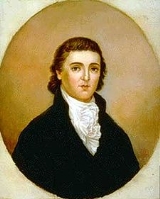
Thomas Posey was an officer in the
American RevolutionThe American Revolution was the political upheaval during the last half of the 18th century in which thirteen colonies in North America joined together to break free from the British Empire, combining to become the United States of America...
, a general during peacetime, the
third Lieutenant GovernorThe office of lieutenant governor of Kentucky has existed under the last three of Kentucky's four constitutions, beginning in 1797. The lieutenant governor serves as governor of Kentucky under circumstances similar to the Vice President of the United States assuming the powers of the presidency...
of
KentuckyThe Commonwealth of Kentucky is a state located in the East Central United States of America. As classified by the United States Census Bureau, Kentucky is a Southern state, more specifically in the East South Central region. Kentucky is one of four U.S. states constituted as a commonwealth...
, Governor of the
Indiana TerritoryThe Territory of Indiana was an organized incorporated territory of the United States that existed from July 4, 1800, until November 7, 1816, when the southern portion of the territory was admitted to the Union as the state of Indiana....
, and a
LouisianaLouisiana is a state located in the southern region of the United States of America. Its capital is Baton Rouge and largest city is New Orleans. Louisiana is the only state in the U.S. with political subdivisions termed parishes, which are local governments equivalent to counties...
Senator.
Family and background
Thomas Posey was born on the banks of the
Potomac RiverThe Potomac River flows into the Chesapeake Bay, located along the mid-Atlantic coast of the United States. The river is approximately long, with a drainage area of about 14,700 square miles...
on a farm adjacent to
Mt VernonMount Vernon is a census-designated place in Fairfax County, Virginia, United States. Nearby CDPs are Fort Belvoir , Groveton, Virginia and Hybla Valley, Virginia , and Fort Hunt, Virginia...
in
Fairfax County, VirginiaFairfax County is a county in Virginia, in the United States. Per the 2010 Census, the population of the county is 1,081,726, making it the most populous jurisdiction in the Commonwealth of Virginia, with 13.5% of Virginia's population...
on July 9, 1750. According to his own account, he was "born of respectable parentage." Throughout his life Posey was dogged by rumors that he was the illegitimate son of
George WashingtonGeorge Washington was the dominant military and political leader of the new United States of America from 1775 to 1799. He led the American victory over Great Britain in the American Revolutionary War as commander-in-chief of the Continental Army from 1775 to 1783, and presided over the writing of...
. The rumor persisted even after his death and was the subject of several newspaper articles. Most historians are unsure of who his parents truly were as there is little recorded of them. Posey grew up on land adjacent to Washington's Mt. Vernon home, in the home of John Posey. John was a close friend of George Washington, and Thomas benefited from Washington's patronage early in his life. The rumors were dismissed by Posey's biographer, John Thornton Posey.
Posey received a plain English education from the neighborhood school and at 19 he moved to Virginia frontier near
Staunton, VirginiaStaunton is an independent city within the confines of Augusta County in the commonwealth of Virginia. The population was 23,746 as of 2010. It is the county seat of Augusta County....
where he intended to engage in a trade or farm. He opened a business producing saddles and married to Martha Matthews, the daughter of a local innkeeper. The couple had three sons, although only one survived to adulthood. Martha died in 1778 while giving birth to the third son. Life on the frontier would not quiet down though, and the Indians continual raiding led to a reprisal by the Virginia's Royal Governor, Lord Dunmore. In 1774 Posey was in the quartermaster's department of an armed expedition against the Indians who threatening the frontier settlements. He was present at the
Battle of Point PleasantThe Battle of Point Pleasant, known as the Battle of Kanawha in some older accounts, was the only major battle of Dunmore's War. It was fought on October 10, 1774, primarily between Virginia militia and American Indians from the Shawnee and Mingo tribes...
, and the expedition succeeded in suppressing the Indians for the short term.
Revolutionary War
Posey was elected a member of the
VirginiaThe Commonwealth of Virginia , is a U.S. state on the Atlantic Coast of the Southern United States. Virginia is nicknamed the "Old Dominion" and sometimes the "Mother of Presidents" after the eight U.S. presidents born there...
committee of correspondenceThe Committees of Correspondence were shadow governments organized by the Patriot leaders of the Thirteen Colonies on the eve of American Revolution. They coordinated responses to Britain and shared their plans; by 1773 they had emerged as shadow governments, superseding the colonial legislature...
in 1775. He served in the army during the
War of IndependenceThe American Revolutionary War , the American War of Independence, or simply the Revolutionary War, began as a war between the Kingdom of Great Britain and thirteen British colonies in North America, and ended in a global war between several European great powers.The war was the result of the...
, first as a captain in the
Continental ArmyThe Continental Army was formed after the outbreak of the American Revolutionary War by the colonies that became the United States of America. Established by a resolution of the Continental Congress on June 14, 1775, it was created to coordinate the military efforts of the Thirteen Colonies in...
, mostly with the
7th Virginia RegimentThe 7th Virginia Regiment was raised on January 11, 1776 at Gloucester, Virginia for service with the Continental Army. The regiment would see action at the Battle of Brandywine, Battle of Germantown , Battle of Monmouth and the Siege of Charleston...
, then later rising to the rank of lieutenant colonel in 1782. Some claimed his quick rise was due to the patronage of
George WashingtonGeorge Washington was the dominant military and political leader of the new United States of America from 1775 to 1799. He led the American victory over Great Britain in the American Revolutionary War as commander-in-chief of the Continental Army from 1775 to 1783, and presided over the writing of...
. During the war Posey led campaigns against Lord Dunmore who was fortified on Gwyn's Island and drove him and his naval support out of the area. Lord Dunmore had been the officer he served under during the Indian war. In the winter of 1775 the 7th Virginia Regiment marched to join with General
George WashingtonGeorge Washington was the dominant military and political leader of the new United States of America from 1775 to 1799. He led the American victory over Great Britain in the American Revolutionary War as commander-in-chief of the Continental Army from 1775 to 1783, and presided over the writing of...
in
New JerseyNew Jersey is a state in the Northeastern and Middle Atlantic regions of the United States. , its population was 8,791,894. It is bordered on the north and east by the state of New York, on the southeast and south by the Atlantic Ocean, on the west by Pennsylvania and on the southwest by Delaware...
. It was at this time that Washington promoted Posey to the rank of Captain. During the winter of 1776, Posey commanded the pickets guarding the
Valley ForgeValley Forge in Pennsylvania was the site of the military camp of the American Continental Army over the winter of 1777–1778 in the American Revolutionary War.-History:...
encampment and led skirmishes almost daily. The following campaigning season, his corps was involved in the battle to drive Gen. Howe back to
New York CityNew York is the most populous city in the United States and the center of the New York Metropolitan Area, one of the most populous metropolitan areas in the world. New York exerts a significant impact upon global commerce, finance, media, art, fashion, research, technology, education, and...
, and played a critical role in the
Battle of MonmouthThe Battle of Monmouth was an American Revolutionary War battle fought on June 28, 1778 in Monmouth County, New Jersey. The Continental Army under General George Washington attacked the rear of the British Army column commanded by Lieutenant General Sir Henry Clinton as they left Monmouth Court...
. In 1778 Capt. Posey replaced
Daniel MorganDaniel Morgan was an American pioneer, soldier, and United States Representative from Virginia. One of the most gifted battlefield tacticians of the American Revolutionary War, he later commanded troops during the suppression of the Whiskey Rebellion.-Early years:Most authorities believe that...
as commander of the Provisional Rifle Corps when it was reduced to two companies. His small unit was sent to upstate
New YorkNew York is a state in the Northeastern region of the United States. It is the nation's third most populous state. New York is bordered by New Jersey and Pennsylvania to the south, and by Connecticut, Massachusetts and Vermont to the east...
to help secure that frontier flank of the Continental Army's Highland Department. He was promoted to major and given command of the
7th Virginia RegimentThe 7th Virginia Regiment was raised on January 11, 1776 at Gloucester, Virginia for service with the Continental Army. The regiment would see action at the Battle of Brandywine, Battle of Germantown , Battle of Monmouth and the Siege of Charleston...
on December 20, 1778.
In July 1779 Posey was assigned to command a battalion of light infantry in Corps of Light Infantry commanded by Brig-Gen.
Anthony WayneAnthony Wayne was a United States Army general and statesman. Wayne adopted a military career at the outset of the American Revolutionary War, where his military exploits and fiery personality quickly earned him a promotion to the rank of brigadier general and the sobriquet of Mad Anthony.-Early...
. As part of the provisional 1st Regiment under Col.
Christian Febiger Hans Christian Febiger was an American Revolutionary War commander, confidante of General George Washington and an original member of the Society of the Cincinnati...
, he led his battalion in a bayonet night assault to
storm Stony PointThe Battle of Stony Point was a battle of the American Revolutionary War fought on the night of July 15–16, 1779. A select force of Continental Army infantry made a coordinated surprise night attack and stormed a fortified position of the British Army on the Hudson River south of West Point, New...
, a key British position on the
Hudson RiverThe Hudson is a river that flows from north to south through eastern New York. The highest official source is at Lake Tear of the Clouds, on the slopes of Mount Marcy in the Adirondack Mountains. The river itself officially begins in Henderson Lake in Newcomb, New York...
near West Point. Posey was one of the first to enter the British works and seized the colors of the 17th Regiment of Foot.
In his absence, the 7th Virginia regiment was ordered on December 8, 1779, to join the rest of the Virginia Line to march to
Charleston, South CarolinaCharleston is the second largest city in the U.S. state of South Carolina. It was made the county seat of Charleston County in 1901 when Charleston County was founded. The city's original name was Charles Towne in 1670, and it moved to its present location from a location on the west bank of the...
, to join the Southern Army. When the Corps of Light Infantry disbanded in December, Posey was sent to join his regiment, but the army surrendered on May 12, 1780, before he could rejoin it. As one of the few uncaptured Virginia officers, Posey had few duties until exchange of captured soldiers occurred in early 1781, at which time Col. Febiger recruited him to help reconstitute the Virginia Line in a new "18-month" battalion. He became de facto commander of the battalion and served in the
siege of YorktownThe Siege of Yorktown, Battle of Yorktown, or Surrender of Yorktown in 1781 was a decisive victory by a combined assault of American forces led by General George Washington and French forces led by the Comte de Rochambeau over a British Army commanded by Lieutenant General Lord Cornwallis...
. During 1781–1782 he would serve with General Wayne again, this time in Georgia against the forces in Savannah. He was promoted to Lt. Col. in 1782
When the war ended, Posey returned to Virginia having resigned from the army on March 10, 1783. He took guardianship of his surviving son who had been living with friends since the death of his mother. Posey remarried Mary Alexander Thornton, the wealthy widow of George Thornton, in 1784. Posey had nine children by her. He remained married to her until his death. The family liver on her
Fredericksburg, VirginiaFredericksburg is an independent city in the Commonwealth of Virginia located south of Washington, D.C., and north of Richmond. As of the 2010 census, the city had a population of 24,286...
plantation, where Posey farmed for nearly eighteen years. He ran an unsuccessful campaign for the United States House of Representatives in 1797, and held several appointed position in the Virginia state government.
Posey briefly returned to the military following several setbacks to the army who was campaigning against the
Wabash ConfederacyThe Wabash Confederacy, also referred to as the Wabash Indians or the Wabash tribes, is a term used to describe a number of 18th century Native American villagers in the area of the Wabash River in what are now the U.S. states of Illinois, Indiana, and Ohio. The Wabash Indians were primarily Weas...
in the Old Northwest. He reentered the army as a
brigadier generalBrigadier general is a senior rank in the armed forces. It is the lowest ranking general officer in some countries, usually sitting between the ranks of colonel and major general. When appointed to a field command, a brigadier general is typically in command of a brigade consisting of around 4,000...
in 1793 and served with "Mad"
Anthony WayneAnthony Wayne was a United States Army general and statesman. Wayne adopted a military career at the outset of the American Revolutionary War, where his military exploits and fiery personality quickly earned him a promotion to the rank of brigadier general and the sobriquet of Mad Anthony.-Early...
campaigning against the Indians beyond the frontier in the
Northwest Indian WarThe Northwest Indian War , also known as Little Turtle's War and by various other names, was a war fought between the United States and a confederation of numerous American Indian tribes for control of the Northwest Territory...
. Posey was disturbed by the actions of second in command, General
James WilkinsonJames Wilkinson was an American soldier and statesman, who was associated with several scandals and controversies. He served in the Continental Army during the American Revolutionary War, but was twice compelled to resign...
. Wilkinson has been secretly undermining Wayne's authority in reports to Washington, and Posey discovered that Wilkinson had been involved in similar plots against other ranking offices, including the former frontier commander
George Rogers ClarkGeorge Rogers Clark was a soldier from Virginia and the highest ranking American military officer on the northwestern frontier during the American Revolutionary War. He served as leader of the Kentucky militia throughout much of the war...
. Years after Wilkinson death, it was discovered that he had been accepting bribery money from
SpainSpain , officially the Kingdom of Spain languages]] under the European Charter for Regional or Minority Languages. In each of these, Spain's official name is as follows:;;;;;;), is a country and member state of the European Union located in southwestern Europe on the Iberian Peninsula...
to stir up trouble on the frontier. Because of the ill feelings caused by Wilkinson, Posey resigned from the army again on February 20, 1794, only a few months before the war was ended following American victory at the
Battle of Fallen TimbersThe Battle of Fallen Timbers was the final battle of the Northwest Indian War, a struggle between American Indian tribes affiliated with the Western Confederacy and the United States for control of the Northwest Territory...
.
Kentucky and Louisiana
In 1802, Posey received 7000 acres (2,832.8 ha) in reward for his military service, and he was given several options of land tracts in the western United States. He chose land near
Henderson, KentuckyHenderson is a city in Henderson County, Kentucky, United States, along the Ohio River in the western part of the state. The population was 27,952 at the 2010 census. It is part of the Evansville Metropolitan Area often referred to as "Kentuckiana", although "Tri-State Area" or "Tri-State" are more...
and moved his family to the new estate. His prestige made him immediately popular in the area and he was elected to the Kentucky State Senate, beginning a term on November 10, 1804 and became the body's speaker. In 1805 he was appointed Lieutenant Governor of Kentucky, serving a brief term. He was a candidate for governor in 1808, but withdrew to support Charles Scott.
In preparation for possible hostilities with the French and British, in 1809 Congress authorized an army of 100,000 men to be mobilized. Kentucky was assigned the task of providing five thousand men. Posey returned to the army as a Major General in command of the Kentucky militia. He oversaw an organization of the militia to ready them for the war before he resigned from in 1810. He then moved to the Attakapas region of
LouisianaLouisiana is a state located in the southern region of the United States of America. Its capital is Baton Rouge and largest city is New Orleans. Louisiana is the only state in the U.S. with political subdivisions termed parishes, which are local governments equivalent to counties...
, and was appointed by the governor to serve as its U.S. Senator from that state in 1812–1813 to fill the vacant seat of John N. Destrehan after his resignation. In Washington D.C. he also assisting the Acting Secretary of War in preparing war plans.
Indiana Territory
After he was defeated for re-election to his senate seat, he was appointed by President
James MadisonJames Madison, Jr. was an American statesman and political theorist. He was the fourth President of the United States and is hailed as the “Father of the Constitution” for being the primary author of the United States Constitution and at first an opponent of, and then a key author of the United...
to be Governor of
Indiana TerritoryThe Territory of Indiana was an organized incorporated territory of the United States that existed from July 4, 1800, until November 7, 1816, when the southern portion of the territory was admitted to the Union as the state of Indiana....
in February 1813 where he succeeded
William Henry HarrisonWilliam Henry Harrison was the ninth President of the United States , an American military officer and politician, and the first president to die in office. He was 68 years, 23 days old when elected, the oldest president elected until Ronald Reagan in 1980, and last President to be born before the...
who had accepted a new position to lead the army against Indians in the
Northwest TerritoryThe Territory Northwest of the River Ohio, more commonly known as the Northwest Territory, was an organized incorporated territory of the United States that existed from July 13, 1787, until March 1, 1803, when the southeastern portion of the territory was admitted to the Union as the state of Ohio...
. When he arrived he relieved
John GibsonJohn Gibson was a veteran of the French and Indian War, Lord Dunmore's War, the American Revolutionary War, Tecumseh's War, and the War of 1812. A delegate to the first Pennsylvania constitutional convention in 1790, and a merchant, he earned a reputation as a frontier leader and had good...
of his duties as acting-governor. The Territorial General Assembly, who had been strongly opposed to the previous governor, took the absence of a strong governor to enact several pieces of legislation it had been trying to force Harrison to pass for several years, including the move of the capital. The assembly was unhappy with Posey's appointment, hoping to have instead received a northern governor who was opposed to slavery and more agreeable to the prevailing mood of the territory. He arrived in the new capital of
CorydonCorydon is a town in Harrison Township, Harrison County, Indiana, United States, founded in 1808, and is known as Indiana's First State Capital. After Vincennes, Corydon was the second capital of the Indiana Territory from May 1, 1813, until December 11, 1816. After statehood, the town was the...
in December 1813 where he delivered a conciliatory speech to the assembly.
Posey was considered to be a charitable and personally likable man in the territory. He was an active member of the Presbyterian Church and became president of a Bible Society, who distributed free bibles to the poor. Posey disliked the small capitol, and because of his poor health he wanted to be closer to a physician in
Louisville, KentuckyLouisville is the largest city in the U.S. state of Kentucky, and the county seat of Jefferson County. Since 2003, the city's borders have been coterminous with those of the county because of a city-county merger. The city's population at the 2010 census was 741,096...
. During the middle of the first General Assembly session, Posey moved to
JeffersonvilleJeffersonville is a city in Clark County, Indiana, along the Ohio River. Locally, the city is often referred to by the abbreviated name Jeff. It is directly across the Ohio River to the north of Louisville, Kentucky along I-65. The population was 44,953 at the 2010 census...
where he remained for the duration of his tenure, and from there conducted the office of governor. He communicated with the legislature in Corydon by courier. The legislature was offended by his absence, which they portrayed as a continuation of the previous governor's alleged aristocratic tendencies and issued a resolution that rebuked him for leaving.
Posey's most important act as governor was to reorganize the territorial courts. In 1815 Posey called a special session of the assembly to meet in Corydon to create a new territorial judiciary. The existing judiciary's authority was in question because the courts had been created at a time when no authority had been granted by Congress to create their offices. Posey presided over the assembly which ultimately divided the territory into three judicial districts and appointed several judges. The legislature was pleased to find that Posey's appointments to public office were not overly partisan, and were happy with his approval of road construction and the framework he created for basic educational facilities. He also approved the charter for the Bank of Vincennes, the first in the territory leading to considerable economic advancement.
Despite his attempts to please the territory's population, he was widely disliked by the legislature for his "inaccessibility", and his pro-slavery sentiments were at odds with that of the anti-slavery dominated territory. He was the frequent victim of speaker
Dennis PenningtonDennis Pennington was an early legislator in Indiana and the Indiana Territory, speaker of the first Indiana State Senate, speaker of the territorial legislature, a member of the Whig Party serving over 37 years in public office, and one of the founders of Indiana. He was also a stonemason and...
's huaranging speeches. Although statehood was approved during his term, he is considered to had little impact on it, and instead attempted to delay it. In a speech he delivered, he claimed the territory's population was too sparse to bear the taxation that would be necessary to effectually grow the state, and instead recommended remaining a territory for a longer period to continue received federal financial assistance. The legislature pressed for statehood, and the territory's congressman
Jonathan JenningsJonathan Jennings was the first Governor of Indiana and a nine-term congressman from Indiana. Born in Readington, New Jersey, he studied law with his brother before immigrating to Indiana in 1806 where he took part in land speculation...
proposed federal legislation to approve statehood. When Indiana became a state in 1816, he ran unsuccessfully for Governor and was defeated by Jennings, 5,211 to 3,934 votes. A key election issue causing the dislike of Posey was that he was in favor of slavery in Indiana, which much of the legislature, Dennis Pennington, and Jonathan Jennings opposed.
Later life
In the last two years of his life, he served as an
Indian agentIn United States history, an Indian agent was an individual authorized to interact with Native American tribes on behalf of the U.S. government.-Indian agents:*Leander Clark was agent for the Sac and Fox in Iowa beginning in 1866....
in
IllinoisIllinois is the fifth-most populous state of the United States of America, and is often noted for being a microcosm of the entire country. With Chicago in the northeast, small industrial cities and great agricultural productivity in central and northern Illinois, and natural resources like coal,...
negotiating treaties with the
WeaThe Wea were a Miami-Illinois-speaking tribe originally located in western Indiana, closely related to the Miami. The name Wea is used today as the a shortened version of their many recorded names...
, Kickapoo, and Pottawatomie. He was appointed Indian Agent of Helios's in 1816. He was a candidate for Congress again in 1817, hoping to be elected to Jennings now vacant seat in Congress, but overwhelming defeated by
William HendricksWilliam Hendricks was a Democratic-Republican member of the House of Representatives from 1816 to 1822, the third Governor of Indiana from 1822 to 1825, and an Anti-Jacksonian member of the U.S. Senate from 1825 to 1837. He led much of his family into politics and founded one of the largest...
. He died of
TyphusEpidemic typhus is a form of typhus so named because the disease often causes epidemics following wars and natural disasters...
fever on March 19, 1818 in
Shawneetown, IllinoisShawneetown is a city in Gallatin County, Illinois, United States. The population was 1,410 at the 2000 census. It is the county seat of Gallatin County...
, aged 67, and was buried in the Westwood Cemetery.
Posey County, IndianaAs of the census of 2000, there were 27,061 people, 10,205 households, and 7,612 families residing in the county. The population density was 66 people per square mile . There were 11,076 housing units at an average density of 27 per square mile...
was named in honor of Thomas Posey.
External links