
Home      Discussion      Topics      Dictionary      Almanac
Signup       Login
Thin layer chromatography

Thin layer chromatography

Overview
Thin layer chromatography (TLC) is a chromatography
Chromatography
Chromatography is the collective term for a set of laboratory techniques for the separation of mixtures....

 technique used to separate mixtures. Thin layer chromatography is performed on a sheet of glass, plastic, or aluminum foil, which is coated with a thin layer of adsorbent material, usually silica gel
Silica gel
Silica gel is a granular, vitreous, porous form of silica made synthetically from sodium silicate. Despite its name, silica gel is a solid. It is a naturally occurring mineral that is purified and processed into either granular or beaded form...

, aluminium oxide
Aluminium oxide
Aluminium oxide is an amphoteric oxide with the chemical formula 23. It is commonly referred to as alumina, or corundum in its crystalline form, as well as many other names, reflecting its widespread occurrence in nature and industry...

, or cellulose
Cellulose
Cellulose is an organic compound with the formula , a polysaccharide consisting of a linear chain of several hundred to over ten thousand β linked D-glucose units....

 (blotter paper). This layer of adsorbent is known as the stationary phase.
Discussion
Ask a question about 'Thin layer chromatography'
Start a new discussion about 'Thin layer chromatography'
Answer questions from other users
Full Discussion Forum
 
Unanswered Questions
Encyclopedia
Thin layer chromatography (TLC) is a chromatography
Chromatography
Chromatography is the collective term for a set of laboratory techniques for the separation of mixtures....

 technique used to separate mixtures. Thin layer chromatography is performed on a sheet of glass, plastic, or aluminum foil, which is coated with a thin layer of adsorbent material, usually silica gel
Silica gel
Silica gel is a granular, vitreous, porous form of silica made synthetically from sodium silicate. Despite its name, silica gel is a solid. It is a naturally occurring mineral that is purified and processed into either granular or beaded form...

, aluminium oxide
Aluminium oxide
Aluminium oxide is an amphoteric oxide with the chemical formula 23. It is commonly referred to as alumina, or corundum in its crystalline form, as well as many other names, reflecting its widespread occurrence in nature and industry...

, or cellulose
Cellulose
Cellulose is an organic compound with the formula , a polysaccharide consisting of a linear chain of several hundred to over ten thousand β linked D-glucose units....

 (blotter paper). This layer of adsorbent is known as the stationary phase.

After the sample has been applied on the plate, a solvent
Solvent
A solvent is a liquid, solid, or gas that dissolves another solid, liquid, or gaseous solute, resulting in a solution that is soluble in a certain volume of solvent at a specified temperature...

 or solvent mixture (known as the mobile phase) is drawn up the plate via capillary action
Capillary action
Capillary action, or capilarity, is the ability of a liquid to flow against gravity where liquid spontanously rise in a narrow space such as between the hair of a paint-brush, in a thin tube, or in porous material such as paper or in some non-porous material such as liquified carbon fiber, or in a...

. Because different analyte
Analyte
An analyte, or component , is a substance or chemical constituent that is of interest in an analytical procedure. Grammatically, it is important to note that experiments always seek to measure properties of analytes—and that analytes themselves can never be measured. For instance, one cannot...

s ascend the TLC plate at different rates, separation is achieved.

Thin layer chromatography can be used to:
  • Monitor the progress of a reaction
  • Identify compounds present in a given mixture
  • Determine the purity of a substance


Specific examples of these applications include:
  • analyzing ceramide
    Ceramide
    Ceramides are a family of lipid molecules. A ceramide is composed of sphingosine and a fatty acid. Ceramides are found in high concentrations within the cell membrane of cells. They are one of the component lipids that make up sphingomyelin, one of the major lipids in the lipid bilayer...

    s and fatty acid
    Fatty acid
    In chemistry, especially biochemistry, a fatty acid is a carboxylic acid with a long unbranched aliphatic tail , which is either saturated or unsaturated. Most naturally occurring fatty acids have a chain of an even number of carbon atoms, from 4 to 28. Fatty acids are usually derived from...

    s
  • detection of pesticide
    Pesticide
    Pesticides are substances or mixture of substances intended for preventing, destroying, repelling or mitigating any pest.A pesticide may be a chemical unicycle, biological agent , antimicrobial, disinfectant or device used against any pest...

    s or insecticide
    Insecticide
    An insecticide is a pesticide used against insects. They include ovicides and larvicides used against the eggs and larvae of insects respectively. Insecticides are used in agriculture, medicine, industry and the household. The use of insecticides is believed to be one of the major factors behind...

    s in food and water
  • analyzing the dye composition of fibers in forensics
  • assaying the radiochemical purity of radiopharmaceuticals, or
  • identification of medicinal plants and their constituents


A number of enhancements can be made to the original method to automate the different steps, to increase the resolution achieved with TLC and to allow more accurate quantization. This method is referred to as HPTLC
HPTLC
High performance thin layer chromatography is an enhanced form of thin layer chromatography . A number of enhancements can be made to the basic method of thin layer chromatography to automate the different steps, to increase the resolution achieved and to allow more accurate quantitative...

, or "high performance TLC".

Plate preparation


TLC plates are usually commercially available, with standard particle size ranges to improve reproducibility. They are prepared by mixing the adsorbent, such as silica gel
Silica gel
Silica gel is a granular, vitreous, porous form of silica made synthetically from sodium silicate. Despite its name, silica gel is a solid. It is a naturally occurring mineral that is purified and processed into either granular or beaded form...

, with a small amount of inert
Inert
-Chemistry:In chemistry, the term inert is used to describe a substance that is not chemically reactive.The noble gases were previously known as inert gases because of their perceived lack of participation in any chemical reactions...

 binder like calcium sulfate
Calcium sulfate
Calcium sulfate is a common laboratory and industrial chemical. In the form of γ-anhydrite , it is used as a desiccant. It is also used as a coagulant in products like tofu. In the natural state, unrefined calcium sulfate is a translucent, crystalline white rock...

 (gypsum) and water. This mixture is spread as a thick slurry on an unreactive carrier sheet, usually glass
Glass
Glass is an amorphous solid material. Glasses are typically brittle and optically transparent.The most familiar type of glass, used for centuries in windows and drinking vessels, is soda-lime glass, composed of about 75% silica plus Na2O, CaO, and several minor additives...

, thick aluminum foil, or plastic. The resultant plate is dried and activated by heating in an oven for thirty minutes at 110 °C. The thickness of the adsorbent layer is typically around 0.1 – 0.25 mm for analytical purposes and around 0.5 – 2.0 mm for preparative TLC.

Technique


The process is similar to paper chromatography
Paper chromatography
Paper chromatography is an analytical chemistry technique for separating and identifying mixtures that are or can be colored, especially pigments. This can also be used in secondary or primary colors in ink experiments. This method has been largely replaced by thin layer chromatography, however it...

 with the advantage of faster runs, better separations, and the choice between different stationary phases. Because of its simplicity and speed TLC is often used for monitoring chemical reaction
Chemical reaction
A chemical reaction is a process that leads to the transformation of one set of chemical substances to another. Chemical reactions can be either spontaneous, requiring no input of energy, or non-spontaneous, typically following the input of some type of energy, such as heat, light or electricity...

s and for the qualitative analysis of reaction products.

To run a thin layer chromatography, the following procedure is carried out:
  • A small spot of solution
    Solution
    In chemistry, a solution is a homogeneous mixture composed of only one phase. In such a mixture, a solute is dissolved in another substance, known as a solvent. The solvent does the dissolving.- Types of solutions :...

     containing the sample is applied to a plate, about 1.5 centimeters from the bottom edge. The solvent
    Solvent
    A solvent is a liquid, solid, or gas that dissolves another solid, liquid, or gaseous solute, resulting in a solution that is soluble in a certain volume of solvent at a specified temperature...

     is allowed to completely evaporate off, otherwise a very poor or no separation will be achieved. If a non-volatile solvent was used to apply the sample, the plate needs to be dried in a vacuum chamber
    Vacuum chamber
    A vacuum chamber is a rigid enclosure from which air and other gases are removed by a vacuum pump. The resulting low pressure, commonly referred to as a vacuum, allows researchers to conduct physical experiments or to test mechanical devices which must operate in outer space...

    .
  • A small amount of an appropriate solvent (elutant) is poured in to a glass beaker or any other suitable transparent container (separation chamber) to a depth of less than 1 centimeter. A strip of filter paper is put into the chamber, so that its bottom touches the solvent, and the paper lies on the chamber wall and reaches almost to the top of the container. The container is closed with a cover glass or any other lid and is left for a few minutes to let the solvent vapors ascend the filter paper and saturate the air in the chamber. (Failure to saturate the chamber will result in poor separation and non-reproducible results).
  • The TLC plate is then placed in the chamber so that the spot(s) of the sample do not touch the surface of the elutant in the chamber, and the lid is closed. The solvent
    Solvent
    A solvent is a liquid, solid, or gas that dissolves another solid, liquid, or gaseous solute, resulting in a solution that is soluble in a certain volume of solvent at a specified temperature...

     moves up the plate by capillary action
    Capillary action
    Capillary action, or capilarity, is the ability of a liquid to flow against gravity where liquid spontanously rise in a narrow space such as between the hair of a paint-brush, in a thin tube, or in porous material such as paper or in some non-porous material such as liquified carbon fiber, or in a...

    , meets the sample mixture and carries it up the plate (elutes the sample). When the solvent front reaches no higher than the top of the filter paper in the chamber, the plate should be removed (continuation of the elution will give a misleading result) and dried .


Different compounds
Chemical compound
A chemical compound is a pure chemical substance consisting of two or more different chemical elements that can be separated into simpler substances by chemical reactions. Chemical compounds have a unique and defined chemical structure; they consist of a fixed ratio of atoms that are held together...

 in the sample mixture travel at different rates due to the differences in their attraction to the stationary phase, and because of differences in solubility in the solvent. By changing the solvent, or perhaps using a mixture, the separation of components (measured by the Rf
Retardation factor
In chromatography, the retardation factor is defined as the fraction of an analyte in the mobile phase of a chromatographic system.. In planar chromatography in particular, the retardation factor is defined as the ratio of the distance traveled by the center of a spot to the distance traveled by...

 value) can be adjusted. Also, the separation achieved with a TLC plate can be used to estimate the separation of a flash chromatography
Column chromatography
Column chromatography in chemistry is a method used to purify individual chemical compounds from mixtures of compounds. It is often used for preparative applications on scales from micrograms up to kilograms.The main advantage of column chromatography is the relatively low cost and disposability...

 column.

Separation of compounds is based on the competition of the solute and the mobile phase for binding places on the stationary phase. For instance, if normal phase silica gel is used as the stationary phase it can be considered polar. Given two compounds which differ in polarity, the more polar compound has a stronger interaction with the silica and is therefore more capable to dispel the mobile phase from the binding places. Consequently, the less polar compound moves higher up the plate (resulting in a higher Rf value). If the mobile phase is changed to a more polar solvent or mixture of solvents, it is more capable of dispelling solutes from the silica binding places and all compounds on the TLC plate will move higher up the plate. It is commonly said that "strong" solvents (elutants) push the analyzed compounds up the plate, while "weak" elutants barely move them. The order of strength/weakness depends on the coating (stationary phase) of the TLC plate. For silica gel coated TLC plates, the elutant strength increases in the following order: Perfluoroalkane (weakest), Hexane
Hexane
Hexane is a hydrocarbon with the chemical formula C6H14; that is, an alkane with six carbon atoms.The term may refer to any of four other structural isomers with that formula, or to a mixture of them. In the IUPAC nomenclature, however, hexane is the unbranched isomer ; the other four structures...

, Pentane
Pentane
Pentane is an organic compound with the formula C5H12 — that is, an alkane with five carbon atoms. The term may refer to any of three structural isomers, or to a mixture of them: in the IUPAC nomenclature, however, pentane means exclusively the n-pentane isomer; the other two being called...

, Carbon tetrachloride
Carbon tetrachloride
Carbon tetrachloride, also known by many other names is the organic compound with the formula CCl4. It was formerly widely used in fire extinguishers, as a precursor to refrigerants, and as a cleaning agent...

, Benzene
Benzene
Benzene is an organic chemical compound. It is composed of 6 carbon atoms in a ring, with 1 hydrogen atom attached to each carbon atom, with the molecular formula C6H6....

/Toluene
Toluene
Toluene, formerly known as toluol, is a clear, water-insoluble liquid with the typical smell of paint thinners. It is a mono-substituted benzene derivative, i.e., one in which a single hydrogen atom from the benzene molecule has been replaced by a univalent group, in this case CH3.It is an aromatic...

, Dichloromethane
Dichloromethane
Dichloromethane is an organic compound with the formula CH2Cl2. This colorless, volatile liquid with a moderately sweet aroma is widely used as a solvent. Although it is not miscible with water, it is miscible with many organic solvents...

, Diethyl ether
Diethyl ether
Diethyl ether, also known as ethyl ether, simply ether, or ethoxyethane, is an organic compound in the ether class with the formula . It is a colorless, highly volatile flammable liquid with a characteristic odor...

, Ethylacetate, Acetonitrile
Acetonitrile
Acetonitrile is the chemical compound with formula . This colourless liquid is the simplest organic nitrile. It is produced mainly as a byproduct of acrylonitrile manufacture...

, Acetone
Acetone
Acetone is the organic compound with the formula 2CO, a colorless, mobile, flammable liquid, the simplest example of the ketones.Acetone is miscible with water and serves as an important solvent in its own right, typically as the solvent of choice for cleaning purposes in the laboratory...

, 2-Propanol/n-Butanol
N-Butanol
n-Butanol or n-butyl alcohol or normal butanol is a primary alcohol with a 4-carbon structure and the molecular formula C4H9OH. Its isomers include isobutanol, 2-butanol, and tert-butanol...

, Water
Water
Water is a chemical substance with the chemical formula H2O. A water molecule contains one oxygen and two hydrogen atoms connected by covalent bonds. Water is a liquid at ambient conditions, but it often co-exists on Earth with its solid state, ice, and gaseous state . Water also exists in a...

, Methanol
Methanol
Methanol, also known as methyl alcohol, wood alcohol, wood naphtha or wood spirits, is a chemical with the formula CH3OH . It is the simplest alcohol, and is a light, volatile, colorless, flammable liquid with a distinctive odor very similar to, but slightly sweeter than, ethanol...

, Triethylamine
Triethylamine
Triethylamine is the chemical compound with the formula N3, commonly abbreviated Et3N. It is also abbreviated TEA, yet this abbreviation must be used carefully to avoid confusion with triethanolamine, for which TEA is also a common abbreviation....

, Acetic acid
Acetic acid
Acetic acid is an organic compound with the chemical formula CH3CO2H . It is a colourless liquid that when undiluted is also called glacial acetic acid. Acetic acid is the main component of vinegar , and has a distinctive sour taste and pungent smell...

, Formic acid
Formic acid
Formic acid is the simplest carboxylic acid. Its chemical formula is HCOOH or HCO2H. It is an important intermediate in chemical synthesis and occurs naturally, most notably in the venom of bee and ant stings. In fact, its name comes from the Latin word for ant, formica, referring to its early...

 (strongest). For C18
Reversed-phase chromatography
Reversed-phase chromatography includes any chromatographic method that uses a non-polar stationary phase. The name "reversed phase" has a historical background. In the 1970s most liquid chromatography was done on non-modified silica or alumina with a hydrophilic surface chemistry and a stronger...

 coated plates the order is reverse. Practically this means that if you use a mixture of ethyl acetate and hexane as the mobile phase, adding more ethyl acetate results in higher Rf values for all compounds on the TLC plate. Changing the polarity of the mobile phase will normally not result in reversed order of running of the compounds on the TLC plate. An eluotropic series can be used as a guide in selecting a mobile phase. If a reversed order of running of the compounds is desired, an apolar stationary phase should be used, such as C18-functionalized silica.

Analysis


As the chemicals being separated may be colorless, several methods exist to visualize the spots:
  • Often a small amount of a fluorescent compound, usually manganese
    Manganese
    Manganese is a chemical element, designated by the symbol Mn. It has the atomic number 25. It is found as a free element in nature , and in many minerals...

    -activated zinc silicate, is added to the adsorbent that allows the visualization of spots under a blacklight (UV254). The adsorbent layer will thus fluoresce light green by itself, but spots of analyte quench this fluorescence.
  • Iodine
    Iodine
    Iodine is a chemical element with the symbol I and atomic number 53. The name is pronounced , , or . The name is from the , meaning violet or purple, due to the color of elemental iodine vapor....

     vapors are a general unspecific color reagent
    Reagent
    A reagent is a "substance or compound that is added to a system in order to bring about a chemical reaction, or added to see if a reaction occurs." Although the terms reactant and reagent are often used interchangeably, a reactant is less specifically a "substance that is consumed in the course of...

  • Specific color reagents exist into which the TLC plate is dipped or which are sprayed onto the plate
    • Potassium permanganate
      Potassium permanganate
      Potassium permanganate is an inorganic chemical compound with the formula KMnO4. It is a salt consisting of K+ and MnO4− ions. Formerly known as permanganate of potash or Condy's crystals, it is a strong oxidizing agent. It dissolves in water to give intensely purple solutions, the...

       - oxidation
    • Iodine
      Iodine
      Iodine is a chemical element with the symbol I and atomic number 53. The name is pronounced , , or . The name is from the , meaning violet or purple, due to the color of elemental iodine vapor....

  • In the case of lipids, the chromatogram may be transferred to a PVDF membrane and then subjected to further analysis, for example mass spectrometry
    Mass spectrometry
    Mass spectrometry is an analytical technique that measures the mass-to-charge ratio of charged particles.It is used for determining masses of particles, for determining the elemental composition of a sample or molecule, and for elucidating the chemical structures of molecules, such as peptides and...

    , a technique known as Far-Eastern blot
    Far-Eastern blot
    Far-Eastern blotting is a technique developed in 1994 by Taki and colleagues at the Tokyo Medical and Dental University, Japan for the analysis of lipids separated by high-performance thin layer chromatography...

    ting.


Once visible, the Rf value , or retardation factor
Retardation factor
In chromatography, the retardation factor is defined as the fraction of an analyte in the mobile phase of a chromatographic system.. In planar chromatography in particular, the retardation factor is defined as the ratio of the distance traveled by the center of a spot to the distance traveled by...

, of each spot can be determined by dividing the distance the product traveled from the initial spotting site by the distance the solvent front traveled from the initial spotting site. These values depend on the solvent used, and the type of TLC plate, and are not physical constants.
Eluent on the thin layer is put on top of the plate

Applications


In organic chemistry
Organic chemistry
Organic chemistry is a subdiscipline within chemistry involving the scientific study of the structure, properties, composition, reactions, and preparation of carbon-based compounds, hydrocarbons, and their derivatives...

, reactions are qualitatively monitored with TLC. Spots sampled with a capillary tube are placed on the plate: a spot of starting material, a spot from the reaction mixture, and a "co-spot" with both. A small (3 by 7 cm) TLC plate takes a couple of minutes to run. The analysis is qualitative, and it will show if the starting material has disappeared, i.e. the reaction is complete, if any product has appeared, and how many products are generated (although this might be under-estimated due to co-elution). Unfortunately, TLCs from low-temperature reactions may give misleading results, because the sample is warmed to room temperature in the capillary, which can alter the reaction—the warmed sample analyzed by TLC is not the same as what is in the low-temperature flask. One such reaction is the DIBALH reduction of ester to aldehyde.

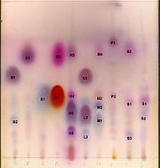
As an example the chromatography of an extract of green leaves (for example spinach
Spinach
Spinach is an edible flowering plant in the family of Amaranthaceae. It is native to central and southwestern Asia. It is an annual plant , which grows to a height of up to 30 cm. Spinach may survive over winter in temperate regions...

) in 7 stages of development. Carotene
Carotene
The term carotene is used for several related unsaturated hydrocarbon substances having the formula C40Hx, which are synthesized by plants but cannot be made by animals. Carotene is an orange photosynthetic pigment important for photosynthesis. Carotenes are all coloured to the human eye...

 elutes quickly and is only visible until step 2. Chlorophyll
Chlorophyll
Chlorophyll is a green pigment found in almost all plants, algae, and cyanobacteria. Its name is derived from the Greek words χλωρος, chloros and φύλλον, phyllon . Chlorophyll is an extremely important biomolecule, critical in photosynthesis, which allows plants to obtain energy from light...

 A and B are halfway in the final step and lutein
Lutein
Lutein is a xanthophyll and one of 600 known naturally occurring carotenoids. Lutein is synthesized only by plants and like other xanthophylls is found in high quantities in green leafy vegetables such as spinach and kale...

 the first compound staining yellow.


In one study TLC has been applied in the screening of organic reaction
Organic reaction
Organic reactions are chemical reactions involving organic compounds. The basic organic chemistry reaction types are addition reactions, elimination reactions, substitution reactions, pericyclic reactions, rearrangement reactions, photochemical reactions and redox reactions. In organic synthesis,...

s for example in the fine-tuning of BINAP
BINAP
BINAP is an abbreviation for the organophosphorus compound 2,2'-bis-1,1'-binaphthyl. This chiral ligand is widely used in asymmetric synthesis. It consists of a pair of 2-diphenylphosphinonaphthyl groups linked at the 1 and 1´ positions. This C2-symmetric framework lacks stereogenic atom, but...

 synthesis from 2-naphthol
2-Naphthol
2-Naphthol, or β-naphthol, is a colorless crystalline solid with the formula C10H7OH. It is an isomer of 1-naphthol, differing by the location of the hydroxyl group on naphthalene. The naphthols are naphthalene homologues of phenol, with the hydroxyl group being more reactive than in the phenols....

. In this method the alcohol and catalyst solution (for instance iron(III) chloride) are placed separately on the base line, then reacted and then instantly analyzed.