


The Winnipeg Grenadiers

Encyclopedia
The Winnipeg Grenadiers was an infantry
regiment
of the Canadian Army formed on 1st April 1908 under General Order No. 20. Initially it was raised with Headquarters at Morden, Manitoba
and companies at: ‘A’ Company at Morden, ‘B’ Company at Morden, ‘C’ Company at Manitou, ‘D’ Company at Carmen,‘E’ Company at Roland, 'F’ Company at Pilot Mound, ‘G’ Company at Cartwright and ‘H’ Company at Boissevain. The unit did not have any active personnel enrolled at the formation.
On 1st February 1910 all companies and headquarters were moved to Winnipeg. On 2nd May 1910 the designation was changed to the "100th Winnipeg Grenadiers". The first officers were gazetted to the Regiment on 18th May 1910. Lieutenant-Colonel Henry Norlande Ruttan who came from the Retired List commanded the Regiment on organization (General Order No. 57 (HQ 32-1-107)). The Regiment was reorganized under General Order No. 120 (1915) on the 1st October 1915 to an establishment with four companies.
The Winnipeg Grenadiers perpetuate the 11th, 78th and 100th Battalions, Canadian Expeditionary Force.
 In 1965 it was placed on the Supplementary Order of Battle
.
.
, 2nd Canadian Infantry Division
. In the spring of 1940, the battalion was sent to the British West Indies (Bermuda and Jamaica) as garrison troops tasked with guarding Axis prisoners of war and inspecting cargo and passenger ships. This task was completed in September 1941 with the battalion returning to Winnipeg in September 1941.
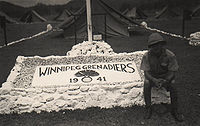
The battalion in mid October was assigned overseas duty and left Winnipeg on the 25th October 1941. It arrived in Hong Kong on the 16th November 1941. They participated in the Battle of Hong Kong
(8-25 December 1941).
A reconstituted 1st Battalion was formed in January 1942 and posted to British Columbia for coastal defence. In 1943 this battalion took part in the invasion of Kiska in the Aleutian Islands to expel Japanese troops.
In 1946 members of the Regiment through the Grenadiers Winnipeg Incorporated took the steps to reform the Cadet Corps. On 1st October 1946 the cadet corps was authorized under the title 526 The Winnipeg Grenadiers Cadet Corps (Canadian Army Order 110-4, Issue No. 12, 1946). The Cadet Corps parades at Minto Armoury in Winnipeg
, Canada.
The cadet corps in 2010 is still up and running strong.
Infantry
Infantrymen are soldiers who are specifically trained for the role of fighting on foot to engage the enemy face to face and have historically borne the brunt of the casualties of combat in wars. As the oldest branch of combat arms, they are the backbone of armies...
regiment
Regiment
A regiment is a major tactical military unit, composed of variable numbers of batteries, squadrons or battalions, commanded by a colonel or lieutenant colonel...
of the Canadian Army formed on 1st April 1908 under General Order No. 20. Initially it was raised with Headquarters at Morden, Manitoba
Morden, Manitoba
Morden is a small town with a population of 6571 located in the Pembina Valley region of southern Manitoba, Canada. Morden is less than ten minutes west of neighbouring Winkler, and a relatively short distance to Pembina Valley Provincial Park...
and companies at: ‘A’ Company at Morden, ‘B’ Company at Morden, ‘C’ Company at Manitou, ‘D’ Company at Carmen,‘E’ Company at Roland, 'F’ Company at Pilot Mound, ‘G’ Company at Cartwright and ‘H’ Company at Boissevain. The unit did not have any active personnel enrolled at the formation.
On 1st February 1910 all companies and headquarters were moved to Winnipeg. On 2nd May 1910 the designation was changed to the "100th Winnipeg Grenadiers". The first officers were gazetted to the Regiment on 18th May 1910. Lieutenant-Colonel Henry Norlande Ruttan who came from the Retired List commanded the Regiment on organization (General Order No. 57 (HQ 32-1-107)). The Regiment was reorganized under General Order No. 120 (1915) on the 1st October 1915 to an establishment with four companies.
The Winnipeg Grenadiers perpetuate the 11th, 78th and 100th Battalions, Canadian Expeditionary Force.
Supplementary Order of Battle
In Canada, a regiment is placed on the Supplementary Order of Battle when the need for the regiments existence is no longer relevant. When placed on the Supplementary Order of Battle, a regiment is considered "virtually disbanded", and will only be reformed should the need be dire...
.
The Great War
The 78th Battalion (Winnipeg Grenadiers), CEF served in France and Belgium from 13 August 1916 to 4 May 1919. It was part of the 12th Canadian Infantry Brigade, 4th Canadian Division4th Canadian Division
The Canadian Corps - 4th Canadian Division – World War I:The 4th Canadian Division was formed in the Britain in April 1916 from several existing units and others scheduled to arrive shortly thereafter. Under the command of Major-General David Watson, the Division embarked for France in August of...
.
Second World War
During the Second World War two battalions were mobilized for combat operations. The 1st Battalion, The Winnipeg Grenadiers, mobilized on 1 September 1939 as part of the 6th Canadian Infantry Brigade6th Canadian Infantry Brigade
As part of the 2nd Canadian Infantry Division mobilization started on 1 September 1939, even before the declaration of war, and the battalions were promptly fleshed out by volunteers. However, further expansion was hindered by a temporary halt in recruitment and uncertainty about overseas deployment...
, 2nd Canadian Infantry Division
2nd Canadian Infantry Division
The 2nd Canadian Infantry Division was an infantry division of the First Canadian Army, mobilized on 1 September 1939 at the outset of the Second World War. It was initially composed of volunteers within brigades established along regional lines, though a halt in recruitment in the early months of...
. In the spring of 1940, the battalion was sent to the British West Indies (Bermuda and Jamaica) as garrison troops tasked with guarding Axis prisoners of war and inspecting cargo and passenger ships. This task was completed in September 1941 with the battalion returning to Winnipeg in September 1941.
The battalion in mid October was assigned overseas duty and left Winnipeg on the 25th October 1941. It arrived in Hong Kong on the 16th November 1941. They participated in the Battle of Hong Kong
Battle of Hong Kong
The Battle of Hong Kong took place during the Pacific campaign of World War II. It began on 8 December 1941 and ended on 25 December 1941 with Hong Kong, then a Crown colony, surrendering to the Empire of Japan.-Background:...
(8-25 December 1941).
A reconstituted 1st Battalion was formed in January 1942 and posted to British Columbia for coastal defence. In 1943 this battalion took part in the invasion of Kiska in the Aleutian Islands to expel Japanese troops.
Battle honours
Those Battle Honours in bold type are emblazoned on the Regiment's colours.The Great War
- YPRES, 1915, '17
- FESTUBERT, 1915
- MOUNT SORREL
- SOMME, 1916
- Ancre Heights
- Ancre, 1916
- ARRAS, 1917, '18
- Vimy, 1917
- HILL 70
- Passchendaele
- AMIENS
- Scarpe, 1918
- Drocourt-Quéant
- HINDENBURG LINE
- Canal du Nord
- VALENCIENNES
- SAMBRE
- FRANCE AND FLANDERS, 1915, '18
Cadet Corps
The cadet corps was originally formed on 15th February 1917 and named "526 100th Grenadiers Cadet Corps (Militia Order No. 118, 30th April 1917). It was disbanded 13th November 1931 (Militia Order No. 512, 25th November 1931). Its affiliation was 100th Winnipeg Grenadiers.In 1946 members of the Regiment through the Grenadiers Winnipeg Incorporated took the steps to reform the Cadet Corps. On 1st October 1946 the cadet corps was authorized under the title 526 The Winnipeg Grenadiers Cadet Corps (Canadian Army Order 110-4, Issue No. 12, 1946). The Cadet Corps parades at Minto Armoury in Winnipeg
Winnipeg
Winnipeg is the capital and largest city of Manitoba, Canada, and is the primary municipality of the Winnipeg Capital Region, with more than half of Manitoba's population. It is located near the longitudinal centre of North America, at the confluence of the Red and Assiniboine Rivers .The name...
, Canada.
The cadet corps in 2010 is still up and running strong.