
All Topics  
The Philadelphia Inquirer


   Email Print
   Bookmark   Link


The Philadelphia Inquirer


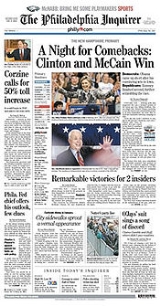
The Philadelphia Inquirer is a morning daily newspaper
Newspaper

A newspaper is a publication containing news, information and advertising, usually printed on low-cost paper called newsprint. General-interest newspapers often feature articles on Politics, crime, business, art/entertainment, society and sports....
 that serves the Philadelphia, Pennsylvania
Pennsylvania

The Commonwealth of Pennsylvania , often colloquially referred to as PA by natives and Northeasterners, is a U.S. state located in the Northeastern United States and Mid-Atlantic States regions of the United States....
, metropolitan area
Delaware Valley

The Delaware Valley is a term used widely by the media to refer, perhaps misleadingly, to the metropolitan area centered on the city of Philadelphia in the United States....
 of the United States. The newspaper was founded by John R. Walker and John Norvell
John Norvell

John Norvell was a newspaper editor and one of the first U.S. Senators from Michigan....
 in June 1829 as The Pennsylvania Inquirer and is the third-oldest surviving daily newspaper in the United States. Owned by the local group Philadelphia Media Holdings
Philadelphia Media Holdings

Philadelphia Media Holdings LLC is an American holding company located in Philadelphia, Pennsylvania, United States. Founded by Brian Tierney in 2006, the company owns The Philadelphia Inquirer and Philadelphia Daily News....
 LLC, The Inquirer has the sixteenth largest average weekday U.S.


Discussion
Ask a question about 'The Philadelphia Inquirer'
Start a new discussion about 'The Philadelphia Inquirer'
Answer questions from other users
Full Discussion Forum


Recent Posts


Encyclopedia


The Philadelphia Inquirer is a morning daily newspaper
Newspaper

A newspaper is a publication containing news, information and advertising, usually printed on low-cost paper called newsprint. General-interest newspapers often feature articles on Politics, crime, business, art/entertainment, society and sports....
 that serves the Philadelphia, Pennsylvania
Pennsylvania

The Commonwealth of Pennsylvania , often colloquially referred to as PA by natives and Northeasterners, is a U.S. state located in the Northeastern United States and Mid-Atlantic States regions of the United States....
, metropolitan area
Delaware Valley

The Delaware Valley is a term used widely by the media to refer, perhaps misleadingly, to the metropolitan area centered on the city of Philadelphia in the United States....
 of the United States. The newspaper was founded by John R. Walker and John Norvell
John Norvell

John Norvell was a newspaper editor and one of the first U.S. Senators from Michigan....
 in June 1829 as The Pennsylvania Inquirer and is the third-oldest surviving daily newspaper in the United States. Owned by the local group Philadelphia Media Holdings
Philadelphia Media Holdings

Philadelphia Media Holdings LLC is an American holding company located in Philadelphia, Pennsylvania, United States. Founded by Brian Tierney in 2006, the company owns The Philadelphia Inquirer and Philadelphia Daily News....
 LLC, The Inquirer has the sixteenth largest average weekday U.S. newspaper circulation
Newspaper circulation

A newspaper's circulation is the number of copies it distributes on an average day. Newspaper circulation rates are currently experiencing a downward trend....
 and has won eighteen Pulitzer Prize
Pulitzer Prize

The Pulitzer Prize is an United States award regarded as the highest national honor in newspaper journalism, literary achievements and musical composition....
s.

The paper has risen and fallen in prominence throughout its history. The Inquirer first became a major newspaper during the American Civil War
American Civil War

The American Civil War , also known as the War Between the States and several Naming the American Civil War, was a civil war in the United States....
 when its war coverage was popular on both sides. The paper's circulation dropped after the war, then rose by the end of the 19th century. Originally supportive of the Democratic Party
Democratic Party (United States)

The Democratic Party is one of two major party contemporary political parties in the United States, along with the Republican Party . It is the oldest political party in continuous operation in the United States and it is one of the oldest parties in the world....
, The Inquirers political affiliation eventually shifted towards the Whig Party
Whig Party (United States)

The Whig Party was a political party of the United States during the era of Jacksonian democracy. Considered integral to the Second Party System and operating from 1833 to 1856, the party was formed in opposition to the policies of President of the United States Andrew Jackson and the Democratic Party ....
 and then the Republican Party
Republican Party (United States)

The Republican Party is one of the two major party contemporary political parties in the United States, along with the Democratic Party . It is often called the Grand Old Party or the GOP....
 before officially becoming politically independent in the middle of the 20th century. By the end of the 1960s,
The Inquirer trailed its chief competitor, the Philadelphia Evening Bulletin
Philadelphia Bulletin

The Philadelphia Bulletin was a daily evening newspaper published from 1847 to 1982 in Philadelphia, Pennsylvania. It was the largest circulation newspaper in Philadelphia for 76 years and was once the largest evening newspaper in the United States....
, and lacked modern facilities and experienced staff. In the 1970s, new owners
Knight Ridder

Knight Ridder was an United States media company, specializing in newspaper and Internet publishing. Until it was bought by The McClatchy Company on June 27, 2006, it was the second-largest newspaper publisher in the United States, with 32 daily newspapers....
 and editors turned the newspaper into one of the country's most prominent, winning 17 Pulitzers in 15 years. Its prestige has since waned because of cost-cutting and a shift of focus to more local coverage.

History


The Philadelphia Inquirer was founded as The Pennsylvania Inquirer by printer John R. Walker and John Norvell
John Norvell

John Norvell was a newspaper editor and one of the first U.S. Senators from Michigan....
, former editor of Philadelphia's largest newspaper, the
Aurora & Gazette. An editorial
Editorial

Editorial guidelinesEditorials are generally printed either on their own page of a newspaper or in a clearly marked-off column, and are always labeled as editorials ....
 in the first issue of
The Pennsylvania Inquirer promised that the paper would be devoted to the right of a minority to voice their opinion and "the maintenance of the rights and liberties of the people, equally against the abuses as the usurpation of power." They pledged support to then-President Andrew Jackson
Andrew Jackson

Andrew Jackson was the List of Presidents of the United States President of the United States . He was List of governors of Florida of Florida , commander of the American forces at the Battle of New Orleans , and eponym of the era of Jacksonian democracy....
 and "home industries, American manufactures, and internal improvements that so materially contribute to the agricultural, commercial and national prosperity." Founded on June 1, 1829,
The Philadelphia Inquirer is the third oldest surviving daily newspaper in the United States. However, in 1962, an Inquirer-commissioned historian traced The Inquirer to John Dunlap
John Dunlap

John Dunlap was the Printer of the first copies of the United States Declaration of Independence and one of the most successful American printers of his era....
's
The Pennsylvania Packet, which was founded on October 28, 1771. In 1850 The Packet was merged with another newspaper The North American, which later merged with the Philadelphia Public Ledger
Public Ledger (Philadelphia)

The Public Ledger was a daily newspaper in Philadelphia, Pennsylvania published from March 25, 1836 to January 1942. Its motto was "Virtue Liberty and Independence"....
. Finally, the Public Ledger merged with The Philadelphia Inquirer in the 1930s and between 1962 and 1975, a line on The Inquirer
s front page claimed that the newspaper is the United States' oldest surviving daily newspaper.

Six months after The Inquirer was founded, with competition from eight established daily newspapers, lack of funds forced Norvell and Walker to sell the newspaper to publisher and United States Gazette associate editor Jesper Harding
Jesper Harding

Jesper Harding was an influential United States publisher in Philadelphia.Harding was born in Philadelphia, Pennsylvania and learned the printing trade from the publisher Enos Bronson and started his own business in 1818 at the age of 18....
. After Harding acquired The Pennsylvania Inquirer, it was briefly published as an afternoon paper before returning to its original morning format in January 1830. Under Harding, in 1829, The Inquirer moved from its original location between Front and Second Streets to between Second and Third Streets. When Harding bought and merged the Morning Journal in January 1830, the newspaper was moved to South Second Street. Ten years later The Inquirer again was moved, this time to its own building at the corner of Third Street and Carter's Alley. Harding expanded The Inquirers content and the paper soon grew into a major Philadelphian newspaper. The expanded content included the addition of fiction, and in 1840, Harding gained rights to publish several Charles Dickens
Charles Dickens

Charles John Huffam Dickens, Royal Society of Arts , pen-name "Boz", was the most popular English people novelist of the Victorian era, as well as a vigorous Reform movement....
 novels for which Dickens was paid a significant amount. At the time the common practice was to pay little or nothing for the rights of foreign authors' works.

Civil War to 1920s


Harding retired in 1859 and was succeeded by his son William White Harding, who had become a partner three years earlier. William Harding changed the name of the newspaper to its current name,
The Philadelphia Inquirer. Harding, in an attempt to increase circulation
Newspaper circulation

A newspaper's circulation is the number of copies it distributes on an average day. Newspaper circulation rates are currently experiencing a downward trend....
, cut the price of the paper, began delivery routes and had newsboys sell papers on the street. In 1859, circulation had been around 7,000 and by 1863 it had increased to 70,000. Part of the increase was due to the interest in news during the American Civil War
American Civil War

The American Civil War , also known as the War Between the States and several Naming the American Civil War, was a civil war in the United States....
. Twenty-five to thirty thousand copies of
The Inquirer were often distributed to Union
Union (American Civil War)

During the American Civil War, the Union was a name used to refer to the Federal government of the United States of the United States, which was supported by the twenty-three states which were not part of the secession attempt by the 11 states that formed the Confederate States of America....
 soldiers during the war and several times the U.S. government asked
The Philadelphia Inquirer to issue a special edition specifically for soldiers. The Philadelphia Inquirer supported the Union, but Harding wanted their coverage to remain neutral. Confederate
Confederate States of America

The Confederate States of America formed as the government set up from 1861 to 1865 by eleven Southern United States U.S. state of the United States of America that had declared their secession from the U.S....
 generals often sought copies of the paper, believing that the newspaper's war coverage was accurate.

Inquirer journalist Uriah Hunt Painter was at the First Battle of Bull Run
First Battle of Bull Run

The First Battle of Bull Run, also known as the First Battle of Manassas , was the first major land battle of the American Civil War, fought on July 21, 1861, near Manassas, Virginia....
 in 1861, a battle which ended in a Confederate victory. Initial reports from the government claimed a Union victory, but
The Inquirer went with Painter's firsthand account. Crowds threatened to burn The Inquirer's building down because of the report. Another report, this time about General George Meade
George Meade

George Gordon Meade was a career United States Army officer and civil engineer involved in coastal construction, including several lighthouses....
, angered Meade enough that he punished Edward Crapsey, the reporter who wrote it. Crapsey and other war correspondents later decided to attribute any victories of the Army of the Potomac
Army of the Potomac

The Army of the Potomac was the major Union Army in the Eastern Theater of the American Civil War of the American Civil War....
, Meade's command, to Ulysses S. Grant
Ulysses S. Grant

Ulysses S. Grant, born Hiram Ulysses Grant , was an United States general and the List of Presidents of the United States President of the United States ....
, commander of the entire Union army. Any defeats by the Army of the Potomac would be attributed to Meade.

During the war,
The Inquirer continued to grow with more staff being added and another move into a larger building on Chestnut Street. However, after the war, economic hits combined with Harding becoming ill, hurt The Inquirer. Despite Philadelphia's population growth, distribution fell from 70,000 during the Civil War to 5,000 in 1888. Beginning in 1889, the paper was sold to publisher James Elverson. To bring back the paper, Elverson moved The Inquirer to a new building with the latest printing technology and an increased staff. The "new" Philadelphia Inquirer premiered on March 1 and was successful enough that Elverson started a Sunday edition of the paper. In 1890, in an attempt to increase circulation further, the price of The Inquirer was cut and the paper's size was increased, mostly with classified advertisements
Classified advertising

Classified advertising is a form of advertising which is particularly common in newspapers, online and other periodicals, e.g. free ads papers or Pennysavers....
. After five years
The Inquirer had to move into a larger building on Market Street and later expanded into adjacent property.

After Elverson's death in 1911, his son by his wife Sallie Duvall, James Elverson Jr. took charge. Under Elverson Jr., the newspaper continued to grow, eventually needing to move again. Elverson Jr. bought land at Broad
Broad Street (Philadelphia)

Broad Street is a major arterial street in Philadelphia, Pennsylvania. It is Pennsylvania Route 611 for most of its length. The north-south street lies between 13th Street and 15th Street, in lieu of 14th Street....
 and Callowhill Streets and built the eighteen-story Elverson Building, now known as the Inquirer Building. The first
Inquirer issue printed at the building came out on July 13, 1925. Elverson Jr. died a few years later in 1929 and his sister, Eleanor Elverson, Mrs. Jules Patenôtre
Jules Patenotre des Noyers

Jules Paten?tre des Noyers , France diplomat, was born at Baye .Educated at the ?cole Normale Sup?rieure, he taught for some years in the lycee at Algiers before he joined the diplomatic service in 1871....
, took over.

Annenberg years


Daily Circulation
Year Weekday Sunday
1936 280,093 369,525
1938 345,422 1,035,871
1968 648,000 905,000
1984 533,000 995,000
1990 511,000 996,000
1999 402,000 802,000
2002 373,892 747,969
2006 350,457 705,965
2007 338,049 645,095


Eleanor Elverson Patenôtre ordered cuts throughout the paper, but was not really interested in managing it and ownership was soon put up for sale. Cyrus Curtis
Cyrus Hermann Kotzschmar Curtis

Cyrus Hermann Kotzschmar Curtis was an United States of America publisher....
 and Curtis-Martin Newspapers Inc. bought the newspaper on March 5, 1930. Curtis died a year later and his step son-in-law, John Charles Martin
John Charles Martin

John Charles Martin was newspaper publisher who, beginning in 1913, ran the newspapers purchased by his step father-in-law Cyrus Hermann Kotzschmar Curtis, including the Public Ledger , the New York Evening Post, the Philadelphia Inquirer and four others....
, took charge. Martin merged
The Inquirer with another paper, the Public Ledger
Public Ledger (Philadelphia)

The Public Ledger was a daily newspaper in Philadelphia, Pennsylvania published from March 25, 1836 to January 1942. Its motto was "Virtue Liberty and Independence"....
, but the Great Depression
Great Depression

File:International depression.pngThe Great Depression was a worldwide economic Recession starting in most places in 1929 and ending at different times in the 1930s or early 1940s for different countries....
 hurt Curtis-Martin Newspapers and the company defaulted
Default (finance)

In finance, default occurs when a debtor has not met his or her legal obligations according to the debt contract, e.g. has not made a scheduled payment, or has violated a loan covenant of the debt contract....
 in payments of maturity notes. Subsequently ownership of
The Inquirer returned to the Patenôtre family and Elverson Corp. Charles A. Taylor was elected president of The Inquirer Co. and ran the paper until it was sold to Moses L. Annenberg
Moses Annenberg

Moses "Moe" Louis Annenberg was a major United States newspaper publisher, who purchased The Philadelphia Inquirer, the third-oldest surviving daily newspaper in the United States....
 in 1936. During the period between Elverson Jr. and Annenberg
The Inquirer stagnated, its editors ignoring most of the poor economic news of the Depression. The lack of growth allowed J. David Stern's newspaper, the Philadelphia Record to surpass The Inquirer in circulation and become the largest newspaper in Pennsylvania.

Under Moses Annenberg,
The Inquirer turned around. Annenberg added new features, increased staff and held promotions to increase circulation. By November, 1938 Inquirer's weekday circulation increased to 345,422 from 280,093 in 1936. During that same period the Record's circulation had dropped to 204,000 from 328,322. In 1939, Annenberg was charged with income tax evasion
Tax avoidance and tax evasion

Tax avoidance is the legal utilization of the tax regime to one's own advantage, in order to reduce the amount of tax that is payable by means that are within the law....
. Annenberg pleaded guilty before his trial and was sent to prison where he died in 1942. Upon Moses Annenberg's death, his son, Walter Annenberg
Walter Annenberg

Walter Hubert Annenberg was an United States billionaire publishing, philanthropy, and diplomat....
, took over. Not long after, in 1947, the
Record went out of business and The Philadelphia Inquirer became Philadelphia's only major daily morning newspaper. While still trailing behind Philadelphia's largest newspaper, the Evening Bulletin
Philadelphia Bulletin

The Philadelphia Bulletin was a daily evening newspaper published from 1847 to 1982 in Philadelphia, Pennsylvania. It was the largest circulation newspaper in Philadelphia for 76 years and was once the largest evening newspaper in the United States....
,
The Inquirer continued to be profitable. In 1948, Walter Annenberg expanded the Inquirer Building with a new structure that housed new printing press
Printing press

A printing press is a mechanical device for applying pressure to an inked surface resting upon a medium , thereby transferring an image. The mechanical systems involved were first assembled in Germany by the goldsmith Johannes Gutenberg around 1439, based on existing screw-presses used to press cloth, grapes etc., and possibly to print wood...
es for
The Inquirer and, during the 1950s and 60s, Annenberg's other properties, Seventeen
Seventeen (magazine)

Seventeen is an United States magazine for adolescence. It was first published in 1944 by Walter Annenberg's Triangle Publications. News Corporation bought Triangle in 1988, and sold Seventeen to Primedia in 1991....
 and
TV Guide
TV Guide

TV Guide is the name of a North American weekly magazine about Broadcast programming.In addition to TV listings, the publication features television-related news, celebrity interviews, gossip and film reviews....
. In 1957 Annenberg bought the Philadelphia Daily News
Philadelphia Daily News

The Philadelphia Daily News is a tabloid newspaper that began publishing on March 31, 1925, under founding editor Lee Ellmaker. In its early years, it was dominated by crime stories, sports and sensationalism....
and combined the Daily News' facilities with The Inquirer's.

A thirty-eight day strike in 1958 hurt
The Inquirer and, after the strike ended, so many reporters had accepted buyout offers and left that the newsroom
Newsroom

A newsroom is the place where journalists?reporters, editing, and Television producers, along with other staffers?work to gather news to be published in a newspaper or magazine or broadcast on television, cable or radio....
 was noticeably empty. Furthermore, many current reporters had been copyclerks just before the strike and had little experience. One of the few star reporters of the 1950s and 60s was investigative reporter Harry Karafin. During his career Harry Karafin exposed corruption and other exclusive stories for
The Inquirer, but also extorted
Extortion

Extortion, outwresting, or exaction is a crime, which occurs, when a person unlawfully obtains either money, property or services from a person, entity, or institution, through coercion....
 money out of individuals and organizations. Karafin would claim he had harmful information and would demand money in exchange for the information not being made public. This went on from the late 1950s into the early 60s before Karafin was exposed in 1967 and convicted of extortion a year later. By the end of the 1960s, circulation and advertising revenue was in decline and the newspaper had become, according to
Time magazine
Time (magazine)

Time is a weekly United States newsmagazine, similar to Newsweek and U.S. News & World Report. A European edition is published from London....
, "uncreative and undistinguished."

Corporate ownership


Inquirerbldgfull
In 1969 Annenberg was offered US$55 Million for
The Inquirer by Samuel Newhouse
Samuel Irving Newhouse, Sr.

Samuel Irving Newhouse, Sr. was a United States of America broadcasting businessman, magazine and newspaper publisher.Born in 1895, his original name was Solomon Neuhaus....
, but having earlier promised John S. Knight
John S. Knight

John Shively Knight was an United States newspaper publisher and editor.He was born in Bluefield, West Virginia, West Virginia to Charles Landon Knight and Clara Scheifley....
 the right of first refusal of any sale offer, Annenberg sold it to Knight instead.
The Inquirer, along with the Philadelphia Daily News, became part of Knight Newspapers and its new subsidiary, Philadelphia Newspapers Inc. Five years later, Knight Newspapers merged with Ridder Publications to form Knight Ridder
Knight Ridder

Knight Ridder was an United States media company, specializing in newspaper and Internet publishing. Until it was bought by The McClatchy Company on June 27, 2006, it was the second-largest newspaper publisher in the United States, with 32 daily newspapers....
.

When
The Inquirer was bought, it was understaffed, its equipment was outdated, many of its employees were underskilled and the paper trailed its chief competitor, the Evening Bulletin, in weekday circulation. However, Eugene L. Roberts Jr., who became The Inquirer's executive editor in 1972, turned the newspaper around. Between 1975 and 1990 The Inquirer won seventeen Pulitzers
Pulitzer Prize

The Pulitzer Prize is an United States award regarded as the highest national honor in newspaper journalism, literary achievements and musical composition....
, six consecutively between 1975 and 1980, and more journalism awards than any other newspaper in the United States.
Time magazine chose The Inquirer as one of the ten best daily newspapers in the United States, calling Roberts' changes to the paper, "one of the most remarkable turnarounds, in quality and profitability, in the history of American journalism." By July 1980 The Inquirer had become the most circulated paper in Philadelphia, forcing the Evening Bulletin to shut down two years later. The Inquirer's success was not without hardships. Between 1970 and 1985 the newspaper experienced eleven strikes, the longest lasting forty-six days in 1985. The Inquirer was also criticized for covering "Karachi
Karachi

is the largest city, seaport and the International financial centre of Pakistan. It is List of metropolitan areas by population in terms of metropolitan population, and is Pakistan's premier centre of banking, industry, and trade....
 better than Kensington
Kensington, Philadelphia, Pennsylvania

Kensington is a neighborhood located in the United States city of Philadelphia, Pennsylvania. It is located in the Northeast Philadelphia section of Philadelphia, located just a couple of miles northeast of Center City, Philadelphia and just to the South of the Port Richmond, Philadelphia, Pennsylvania neighborhood....
". This did not stop the paper's growth during the 1980s, and when the
Evening Bulletin shut down, The Inquirer hired seventeen Bulletin reporters and doubled its bureaus to attract former Bulletin readers. By 1989 Philadelphia Newspapers Inc.'s editorial staff reached a peak of 721 employees.

The 1990s saw gradually dropping circulation and advertisement revenue for
The Inquirer. The decline was part of a nationwide trend, but the effects were exacerbated by, according to dissatisfied Inquirer employees, the paper's resisting changes that many other daily newspapers implemented to keep readers and pressure from Knight Ridder to cut costs. During most of Roberts's time as editor, Knight Ridder allowed him a great deal of freedom in running the newspaper. However, in the late 1980s, Knight Ridder had become concerned about The Inquirer's profitability and took a more active role in its operations. Knight Ridder pressured The Inquirer to expand into the more profitable suburbs, while at the same time cutting staff and coverage of national and international stories. Staff cuts continued until Knight Ridder was bought in 2006, with some of The Inquirer's best reporters accepting buyouts and leaving for other newspapers such as The New York Times
The New York Times

The New York Times is an American daily newspaper published in New York City. The largest metropolitan newspaper in the United States, "The Gray Lady"?named for its staid appearance and style?is regarded as a national newspaper of record....
and The Washington Post
The Washington Post

The Washington Post is the newspaper with the largest circulation in Washington, D.C., United States and is the city's oldest paper, founded in 1877....
. By the late 1990s, all of the high level editors who had worked with Eugene Roberts in the 1970s and 80s had left, none at normal retirement age. Since the 1980s, the paper has won just one Pulitzer, a 1997 award for "Explanatory Journalism." In 1998 Inquirer reporter Ralph Cipriano filed a libel
Slander and libel

In law, defamation is the communication of a statement that makes a false claim, expressly stated or implied to be factual, that may give an individual, business, product, group, government or nation a negative image....
 suit against Knight Ridder,
The Philadelphia Inquirer, and Inquirer editor Robert Rosenthal over comments Rosenthal made about Cipriano to The Washington Post. Cipriano had claimed that it was difficult reporting negative stories in The Inquirer about the Roman Catholic Archdiocese of Philadelphia
Roman Catholic Archdiocese of Philadelphia

The Roman Catholic Church Archdiocese of Philadelphia, Pennsylvania covers thePhiladelphia County, Pennsylvania as well as Bucks County, Pennsylvania, Chester County, Pennsylvania, Delaware County, Pennsylvania, and Montgomery County, Pennsylvania counties in the Pennsylvania....
 and Rosenthal later claimed that Cipriano had "a very strong personal point of view and an agenda...He could never prove [his stories]." The suit was later settled out of court in 2001.

Knight Ridder was bought by rival The McClatchy Company
The McClatchy Company

The McClatchy Company is an United States publishing company based in Sacramento, California, that operates a number of newspapers and websites....
 in June 2006.
The Inquirer and the Philadelphia Daily News were among the twelve less-profitable Knight Ridder newspapers that McClatchy put up for sale when the deal was announced in March. On June 29, 2006, The Inquirer and Daily News were sold to Philadelphia Media Holdings
Philadelphia Media Holdings

Philadelphia Media Holdings LLC is an American holding company located in Philadelphia, Pennsylvania, United States. Founded by Brian Tierney in 2006, the company owns The Philadelphia Inquirer and Philadelphia Daily News....
 LLC, a group of Philadelphian area business people, including Brian P. Tierney
Brian Tierney

Brian P. Tierney is an United States public relations executive and publisher of The Philadelphia Inquirer. Born in Upper Darby Township, Pennsylvania, Tierney created Tierney Communications, one of the largest and most successful public relations and advertising firms in Philadelphia, Pennsylvania....
, Philadelphia Media's chief executive. The new owners planned to spend US$5 million on advertisements and promotions to increase
The Inquirer's profile and readership. In the years following Philadelphia Media Holding's acquisition, The Inquirer has seen larger than expected revenue losses, mostly from national advertising, and continued loss of circulation. The revenue losses have caused management to cut four hundred jobs at The Inquirer and Daily News in the three years since the papers were bought. On August 21, 2007, Philadelphia Media Holdings announced that it was selling The Inquirer Building in a plan to help pay off the debts incurred when buying the newspapers. Despite efforts to cut costs, Philadelphia Newspapers LLC, filed for Chapter 11 bankruptcy protection
Chapter 11, Title 11, United States Code

Chapter 11 is a chapter of the United States Bankruptcy in the United States, which permits reorganization under the bankruptcy laws of the United States....
 on February 21, 2009. Philadelphia Media Holdings is about US$390 million in debt due to money borrowed to buy
The Inquirer and Daily News.

Politics


Inquirerbldg Sign
John Norvell left the
Aurora & Gazette and his job as editor because he disagreed with what he felt was the newspaper's editorial approval of a movement towards a European class system. When Norvell and John Walker founded The Inquirer they wanted the newspaper to represent all people and not just the higher classes. The newly launched newspaper supported Jeffersonian democracy
Jeffersonian democracy

Jeffersonian democracy is the set of political goals that were named after Thomas Jefferson. It dominated American politics in the years 1800-1820s....
 and President Andrew Jackson, and it declared support for the right of the minority's opinion to be heard. A legend
Legend

A legend is a narrative of human actions that are perceived both by teller and listeners to take place within human history and to possess certain qualities that give the tale verisimilitude ....
 about the founding of
The Inquirer states that Norvell said, "There could be no better name than The Inquirer. In a free state, there should always be an inquirer asking on behalf of the people: 'Why was this done? Why is that necessary work not done? Why is that man put forward? Why is that law proposed? Why? Why? Why?'"

When Norvell and Walker sold their newspaper to Jesper Harding, Harding kept the paper close to the founder's politics and backed the Democratic Party
Democratic Party (United States)

The Democratic Party is one of two major party contemporary political parties in the United States, along with the Republican Party . It is the oldest political party in continuous operation in the United States and it is one of the oldest parties in the world....
. However, disagreeing with Andrew Jackson's handling of the Second Bank of the United States
Second Bank of the United States

The Second Bank of the United States was opened in January 1817, six years after the First Bank of the United States lost its charter. The Second Bank of the United States was headquartered in Carpenters' Hall, Philadelphia, the same as the First Bank, and had branches throughout the nation....
 he began supporting the anti-Jackson wing of the Democrats. During the 1836 Presidential election
United States presidential election, 1836

The United States presidential election of 1836 is predominantly remembered for three reasons:# It was the last election until United States presidential election, 1988 to result in the elevation of an incumbent Vice President of the United States to the nation's highest office through means other than the president's death or resignation....
 Harding supported the Whig party
Whig Party (United States)

The Whig Party was a political party of the United States during the era of Jacksonian democracy. Considered integral to the Second Party System and operating from 1833 to 1856, the party was formed in opposition to the policies of President of the United States Andrew Jackson and the Democratic Party ....
 candidate over the Democratic candidate and afterwards
The Inquirer became known for its support of Whig candidates. Before the American Civil War began, The Inquirer supported the preservation of the Union, and was critical of the antislavery movement
Abolitionism

File:BLAKE10.JPGAbolitionism was a movement to end the slave trade and emancipate slaves in western Europe and the Americas. The slave system aroused little protest until the 18th century, when rationalist thinkers of the Age of Enlightenment criticized it for violating the rights of man, and Quaker and other evangelical religious groups con...
 which many felt was responsible for the Southern succession crisis. Once the war began
The Inquirer maintained an independent reporting of the war's events. However The Inquirer firmly supported the Union side. At first The Inquirer's editors were against emancipation of the slaves
Emancipation Proclamation

The Emancipation Proclamation consists of two Executive order s issued by United States President Abraham Lincoln during the American Civil War....
, but after setbacks by the Union army
The Inquirer started advocating a more pro-war and pro-Republican
Republican Party (United States)

The Republican Party is one of the two major party contemporary political parties in the United States, along with the Democratic Party . It is often called the Grand Old Party or the GOP....
 stance. In a July 1862 article
The Inquirer wrote "in this war there can be but two parties, patriots and traitors."

Republican Bible


Under James Elverson,
The Philadelphia Inquirer declared, "the new Inquirer shall be in all respects a complete, enterprising, progressive newspaper, moved by all the wide-awake spirit of the time and behind in nothing of interest to people who want to know what is going on every day and everywhere...steadily and vigorously Republican in its political policy, but just and fair in its treatment of all questions..." During the 1900 Republican convention
1900 Republican National Convention

The 1900 National Convention of the Republican Party of the United States was held June 19 to June 21 in the Exposition Auditorium, Philadelphia, Pennsylvania, Pennsylvania....
 in Philadelphia, Elverson set up a large electric banner over Broad Street that declared "Philadelphia Inquirer – Largest Republican Circulation in the World." At the turn of the 20th century the newspaper began editorial campaigns to improve Philadelphia, including the paving of major streets and stopping a corrupt plan to buy the polluted Schuylkill Canal
Schuylkill Canal

The Schuylkill Canal was an interconnected series of canal reaches and slack water pools along the Schuylkill River in the U.S. state of Pennsylvania....
 for drinking water. The newspaper continued similar politics under Elverson Jr., and by the 1920s
The Inquirer became known as the "Republican Bible of Pennsylvania".

Between 1929 and 1936, while under Patenotre and Curtis-Martin,
The Inquirer continued to support the Republican party and President Herbert Hoover
Herbert Hoover

Herbert Clark Hoover was the List of Presidents of the United States President of the United States . Besides his political career, Hoover was a professional mining engineer and author....
, noticeably by not reporting on the news of the Great Depression. Statistics on unemployment or business closings were ignored, even when they came from the government. Information about Philadelphia banks closing was relegated to the back of the financial section. When Moses Annenberg took over
The Philadelphia Inquirer, he announced that the paper would "continue to uphold the principles of the Republican Party," but in a meeting with newspaper editors shortly after, he proposed that the paper go independent and support President Franklin D. Roosevelt
Franklin D. Roosevelt

Franklin Delano Roosevelt , often referred to by his initials FDR, was the List of Presidents of the United States President of the United States....
 in the upcoming election. The editors rejected this idea and the paper remained Republican. In the late 1930s Annenberg disagreed with Roosevelt's New Deal
New Deal

The New Deal was the name that United States President of the United States Franklin D. Roosevelt gave to a sequence of central economic planning and economic stimulus programs he initiated between 1933 and 1938 with the goal of giving aid to the unemployed, reform of business and financial practices, and recovery of the Economy of the Unite...
 programs and his handling of strikes. This prompted editorials criticizing the policies of Roosevelt and his supporters. He strongly opposed Democratic Pennsylvania governor George Earle
George Howard Earle III

George Howard Earle III was an United States politician. He served as the United States Ambassador to Austria to Austria from 1933 to 1934, and as the List of Governors of Pennsylvania of Pennsylvania from 15 January 1935 to 17 January 1939....
 and had
The Inquirer support the Republican candidates in the 1938 Pennsylvania state elections. When Republicans swept the election there was a celebration at The Inquirer headquarters with red flares and the firing of cannons. The attacks against Democrats and the support given towards Republicans caught the attention of the Roosevelt administration. Annenberg had turned The Philadelphia Inquirer into a major challenger to its chief competitor the Democratic Record, and after Annenberg began focusing on politics, Democratic politicians often attacked Annenberg and accused him of illegal business practices. In 1939 Annenberg was charged with income tax evasion, pled guilty before the trial, and was sent to prison for three years. Annenberg's friends and his son, Walter, claimed that the whole trial was politically motivated and despite Annenberg actually being guilty, they claimed his sentence was harsher then it should have been.

Independent


When the
Record shut down in 1947, The Inquirer announced that it was now an independent newspaper and, frustrated with corruption in Philadelphia, supported Democratic candidates in the 1951 election. While Walter Annenberg had made The Inquirer independent he did use the paper to attack people he disliked. Sometimes when a person or group angered Annenberg, they were blacklist
Blacklist

A blacklist is a list or register of persons who, for one reason or another, are being denied a particular privilege, service, mobility, access or recognition....
ed and not mentioned anywhere within
The Inquirer. People on the blacklist were even airbrush
Airbrush

An airbrush is a small, Pneumatics tool that sprays various media including ink and dye, but most often paint by a process of nebulization. Spray guns developed from the airbrush and are still considered a type of airbrush....
ed out of images. People who were on the list at one point included Nicholas Katzenbach
Nicholas Katzenbach

Nicholas deBelleville Katzenbach is an United States lawyer who served as United States Attorney General during the Lyndon B. Johnson administration....
, Ralph Nader
Ralph Nader

Ralph Nader is an American attorney at law, author, lecturer, political activism, and perennial candidate for presidency as an independent candidate for President of the United States in United States presidential election, 2004 and United States presidential election, 2008, and a Green Party candidate in 1996 and 2000....
, Zsa Zsa Gabor
Zsa Zsa Gabor

Zsa Zsa Gabor is a Hungarian people-born American actress and socialite....
, and the basketball team the Philadelphia Warriors
Golden State Warriors

The Golden State Warriors are an USA professional basketball team based in Oakland, California, California, representing the San Francisco Bay Area....
, who were not mentioned for an entire season. In 1966, Walter Annenberg used
The Inquirer to attack Pennsylvania gubernatorial candidate Milton Shapp
Milton Shapp

Milton Jerrold Shapp was the Democratic Party governor of the U.S. state of Pennsylvania from 1971 to 1979 and was the first Jewish governor of Pennsylvania....
. During a press conference, an
Inquirer reporter asked Shapp if he had ever been a patient in a mental hospital; having never been one Shapp said no. The next day's headline in The Inquirer read "Shapp Denies Ever having been in a Mental Home." Shapp attributed his loss of the election to Annenberg's attack campaign.

Annenberg was a backer and friend of Richard Nixon
Richard Nixon

Richard Milhous Nixon was the List of Presidents of the United States President of the United States and the only president to resign the office....
. In the 1952 presidential election
United States presidential election, 1952

The United States presidential election of 1952 took place in an era when Cold War tension between the United States and the Soviet Union was escalating rapidly....
 critics later claimed Annenberg had
The Inquirer look the other way when covering accusations Nixon was misappropriating funds. Later, to avoid accusations of political bias, Annenberg had The Inquirer use only news agency
News agency

A news agency is an organization of journalists established to supply news reports to organizations in the news trade: newspapers, magazines, and All-news radio and News broadcasting broadcasters....
 sources such as the Associated Press
Associated Press

The Associated Press is an Media of the United States news agency. The AP is a cooperative owned by its contributing newspapers, Radio station and Television station stations in the United States, which both contribute stories to the AP and use material written by its staffers....
 for the 1960 and 1968 presidential elections. When Nixon was elected president in 1968, Annenberg was appointed the U.S. ambassador to the Court of St. James's
Court of St. James's

The Court of St. James's is the name of the royal court of the United Kingdom....
. A year later when Annenberg sold the newspaper to Knight Newspapers, a part of the deal stipulated that Annenberg's name would appear as "Editor and Publisher Emeritus" in
The Inquirer's masthead
Masthead (publishing)

Masthead is a list, usually found on the editorial page of a newspaper or magazine, of the members of the newspaper's editorial board. If no editorial board exists, the masthead will often feature a list of top news staff members....
. In 1970 Annenberg, already unhappy with changes in the newspaper, had his name removed from the paper after an editorial critical of Richard Nixon appeared.

Under Knight Ridder,
The Inquirer continued to be editorially independent. However, conservative blog
Blog

A blog is a type of website, usually maintained by an individual with regular entries of commentary, descriptions of events, or other material such as graphics or video....
s and commentators have labeled
The Inquirer left leaning
Liberalism in the United States

Liberalism in the United States is a broad political and philosophical mindset, favoring individual liberty, and opposing restrictions on liberty, whether they come from established religion, from government regulation, or from the existing Social class structure....
, and the paper hasn't endorsed a Republican U.S. Presidential candidate since Gerald Ford
Gerald Ford

Gerald Rudolph Ford, Jr. was the List of Presidents of the United States President of the United States, serving from 1974 to 1977, and the List of Vice Presidents of the United States Vice President of the United States serving from 1973 to 1974....
 in 1976. Throughout the 1990s and into the 21st century, groups supportive of Israel
Israel

Israel officially the State of Israel , is a country in the Middle East located on the eastern shore of the Mediterranean Sea. It borders Lebanon in the north, Syria in the northeast, Jordan in the east, and Egypt on the southwest, and contains geographically diverse features within its relatively small area....
 such as the Zionist Organization of America
Zionist Organization of America

The Zionist Organization of America , founded in 1897, was one of the first official Zionist organizations in the United States, and, especially early in the 20th century, the primary representative of the Jews of the United States to the World Zionist Organization, espousing primarily Political Zionism....
 often accused
The Inquirer of being anti-Israel
Anti-Zionism

Anti-Zionism is opposition to Zionism, the international Jewish political movement that established a homeland for the Jewish People in Palestine , and continues to support the state of Israel....
. At the same time Edward S. Herman
Edward S. Herman

Edward S. Herman is an economist and media analyst with a specialty in corporate and regulatory issues as well as political economy and the media....
, a University of Pennsylvania
University of Pennsylvania

The University of Pennsylvania is a private research university located in Philadelphia, Pennsylvania, United States. Penn is America's first university and is the fourth-oldest institution of higher education in the United States....
 media analyst, has written many articles accusing
The Inquirer of caving into conservative pressure and including a conservative slant in the paper's reporting and editorial page. In 2006, The Inquirer became one of the only major United States newspapers to print one of the Jyllands-Posten Muhammad cartoons
Jyllands-Posten Muhammad cartoons controversy

The Jyllands-Posten Muhammad cartoons controversy began after twelve editorial cartoons, most of which depicted the Islamic prophet Muhammad, were published in the Denmark newspaper Jyllands-Posten on 30 September 2005....
. Afterwards, protesting the printing of the cartoon, Muslims picketed outside The Inquirer Building.

When Philadelphia Media Holdings L.L.C. (PMH) bought the paper in 2006, Brian P. Tierney and the business people behind PMH signed a pledge promising that they would not influence the content of the paper. Tierney, a Republican activist who had represented many local groups in the Philadelphia area, had criticized
The Inquirer in the past on behalf of his clients. One of Tierney's clients had been the Roman Catholic Archdiocese of Philadelphia, which he'd represented during the Cipriano affair
Brian Tierney

Brian P. Tierney is an United States public relations executive and publisher of The Philadelphia Inquirer. Born in Upper Darby Township, Pennsylvania, Tierney created Tierney Communications, one of the largest and most successful public relations and advertising firms in Philadelphia, Pennsylvania....
. PMH membership includes Bruce E. Toll, vice chairman of Toll Brothers Inc.
Toll Brothers

Toll Brothers is a Horsham, Pennsylvania, Pennsylvania based luxury homes builder....
 Tierney says the group is aware that the fastest way to ruin its investment is to threaten the paper's editorial independence
Editorial independence

Editorial independence is the freedom of editors to make decisions without interference from the owners of a publication. Editorial independence is tested, for instance, if a newspaper runs articles that may be unpopular with its advertising customers....
. In 2009 a lawsuit was filed that accused
The Philadelphia Inquirer of writing critical stories about Chester Community Charter School's use of public funds after business negotiations between school operator Vahan H. Gureghian and Tierney failed.

Production


The Philadelphia Inquirer is headquartered in The Inquirer Building in Center City Philadelphia
Center City, Philadelphia

Center City is the "downtown" and Central Business District of Philadelphia, Pennsylvania, USA. Its 2005 population of 88,000 makes it the third most populous downtown in the United States....
 along with
The Philadelphia Daily News. The Inquirer is printed seven days a week at the Schuylkill Printing Plant in Conshohocken, Pennsylvania
Conshohocken, Pennsylvania

Conshohocken is a borough on the Schuylkill River in Montgomery County, Pennsylvania, in suburban Philadelphia. Historically a large mill town and industrial and manufacturing center, after the decline of industry in recent years Conshohocken has developed into a center of riverfront commerce and residential development....
. According to the Audit Bureau of Circulations
Audit Bureau of Circulations

The Audit Bureau of Circulations of North America is a non-profit circulation-auditing organization. It is one of several organizations, operating in different parts of the world, that audits circulation, readership, and audience information for the magazines, newspapers, and other publications produced by their members....
,
The Inquirer is the sixteenth most circulated weekday newspaper in the United States. The Sunday edition's circulation is approximately twice as large as the average weekday circulation. The Inquirer's publisher is Brian Tierney. Tierney replaced Joseph Natoli who resigned on August 1, 2006. The Inquirer's editor and executive vice-president is William Marimow. Marimow, a former Pulitzer winning Inquirer reporter, became The Inquirer's editor in November 2006, replacing previous editor Amanda Bennett. The Inquirer is operated by Philadelphia Newspapers LLC, which replaced Philadelphia Newspapers, Inc., when Philadelphia Media Holdings LLC bought PNI in 2006. Since 1995, The Inquirer has been available on the Internet at Philly.com, which, along with the Philadelphia Daily News and several other regional publications, is a division of Philadelphia Newspapers LLC.

The Inquirer's local coverage covers Philadelphia, southeastern Pennsylvania
List of counties in Pennsylvania

File:Pennsylvania counties map.png|thumb|right|300px|Pennsylvania counties poly 453 491 516 491 516 472 522 467 522 465 517 460 521 457 519 452 514 439 506 437 503 432 497 430 491 436 463 443 453 451 454 491 Adams County, Pennsylvania...
, and southern New Jersey
List of counties in New Jersey

The U.S. state of New Jersey has 21 counties. New Jersey was governed by two separate groups of proprietors as two distinct provinces, East Jersey and West Jersey, for the 28 years between 1674 and 1702....
. In Pennsylvania,
The Inquirer maintains bureaus in Conshohocken
Conshohocken, Pennsylvania

Conshohocken is a borough on the Schuylkill River in Montgomery County, Pennsylvania, in suburban Philadelphia. Historically a large mill town and industrial and manufacturing center, after the decline of industry in recent years Conshohocken has developed into a center of riverfront commerce and residential development....
; Doylestown
Doylestown, Pennsylvania

Doylestown is a borough in Bucks County, Pennsylvania, Pennsylvania, 34 miles north of Philadelphia, Pennsylvania. At the turn of the century in 1900, 3,034 people lived in the borough of Doylestown, and in 1910, 3,304 people lived there....
; Media
Media, Pennsylvania

The borough of Media is the county seat of Delaware County, Pennsylvania and is located 12 miles west of Philadelphia, Pennsylvania. Media was incorporated in 1850 at the same time that it was named the county seat....
; West Chester
West Chester, Pennsylvania

The Borough of West Chester is the county seat of Chester County, Pennsylvania, United States.Philadelphia is 25 miles to the east and Wilmington, Delaware 17 miles to the south....
; and Norristown
Norristown, Pennsylvania

Norristown is a municipality in Montgomery County, Pennsylvania, 6 miles northwest of the city limits of Philadelphia, Pennsylvania, on the Schuylkill River....
, while in New Jersey it has bureaus in Cherry Hill
Cherry Hill Township, New Jersey

Cherry Hill is a township in Camden County, New Jersey, New Jersey, in the United States. In the United States 2000 Census, the township had a total population of 69,965, making it the List of municipalities in New Jersey ....
 and Margate
Margate City, New Jersey

Margate City is a city in Atlantic County, New Jersey, New Jersey. As of the United States 2000 Census, the city population was 8,193.Margate City was originally incorporated as the Borough of South Atlantic City by an Act of the New Jersey Legislature on September 7, 1885, from portions of Egg Harbor Township, New Jersey, based on the re...
. In 2004,
The Inquirer formed a partnership with Philadelphia's NBC station, WCAU, giving the paper access to WCAU's weather forecast.


See also


The Philadelphia Inquirer people
  • Gold Seal Novel
    Gold Seal Novel

    Gold Seal Novels were illustrated novels covering a wide range of genres published in editions of the Sunday The Philadelphia Inquirer between 1934 and 1949....
  • List of newspapers in Pennsylvania
    List of newspapers in Pennsylvania

    Daily newspapers...
  • List of newspapers in the United States by circulation
    List of newspapers in the United States by circulation

    This is a list of the top 100 newspapers in the United States by daily circulation. These figures are mainly compiled by the Audit Bureau of Circulations....
  • Media of Philadelphia


External links