
|
|
|
|
Trapeze
|
| |
|
| |
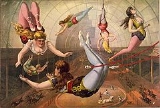
A trapeze is a short horizontal bar hung by two cords from a support to form a trapezoid. Trapezes are used by acrobats (more specifically, "aerialists") and are commonly found in circus performances.
Physical Requirements • Beyond the facts about trapeze, the most important aspects of trapeze are grace, flexibility, strength, endurance and unique style.
• You need grace so that when you swing and switch between tricks, you look nice and everything flows.
• You need to be very strong to do trapeze because the basics of trapeze involves being able to pull yourself up into tricks or beat on a flying trapeze.

Discussion
Ask a question about 'Trapeze'
Start a new discussion about 'Trapeze'
Answer questions from other users
|
Recent Posts

Encyclopedia
A trapeze is a short horizontal bar hung by two cords from a support to form a trapezoid. Trapezes are used by acrobats (more specifically, "aerialists") and are commonly found in circus performances.
Types of trapezes
- Static trapeze refers to a trapeze act in which the performer moves around the bar and ropes while the bar itself stays mostly in place. The difficulty on a static trapeze is making every move look effortless. It is like dance in that most people of a reasonable level of strength can get onto the bar for the first time and do the tricks but an experienced artist will do them with infinitely more grace and style.
- Swinging trapeze or swinging single trapeze refers to an act done while the trapeze swings. For an example of this discipline, watch the trapeze act in Alegria. The performer builds up swing from a still position, and uses the momentum of the swing to execute their tricks. There are many tricks that are only possible on a swinging trapeze and most of them are far more difficult than tricks on a static trapeze. Usually these tricks are thrown on the peaks of the swing and involve exceptional dynamic movements that require excellent timing. Most of the tricks begin with the performer sitting or standing on the bar and end with the performer catching the bar in his/her hands or in an ankle hang (hanging off of the ankles by bracing them between the rope and the bar). This act requires a great deal of strength, grace, and flexibility.
- Flying trapeze refers to a trapeze act where a performer, or "flyer," grabs the trapeze bar and jumps off a high platform, or pedestal board, so gravity creates the swing. The swing's parts are the cast out at the far end of the first swing, the beat back and rise as the performer swings back above the pedestal board, and then the trick is thrown at the far end of the second swing. The performer often releases the bar and is caught by another performer, the "catcher," who hangs by his knees on another trapeze, or sometimes on a cradle, which can be either stationary or also swinging. A flyer rarely weighs more than about 68 kg (150 pounds) to avoid damaging the catcher's shoulders, although people of any size are able to execute basic trapeze maneuvers. Flying trapeze is done over a net, or occasionally over water for a special exhibition.
The flying trapeze was invented in the late 19th Century in France by Jules Léotard. He did his act from one swinging trapeze to another that had been released by his father who was standing on a platform. He is also said to have invented the full length skin tight costume that now bears his name. The flying trapeze and its association with circuses was made even more popular by the 1867 George Leybourne song "The Daring Young Man on the Flying Trapeze", which was based on the success of trapeze artist Jules Léotard. One of the greatest flyers of all time is Alfredo Codona of Mexico who set standards of skill and style in the 1920s that many aspire to and few achieve.
- Washington trapeze, also known as "Heavy Trapeze" refers to a variation on static and swinging trapeze where a performer performs a headstand on the bar.
- Dance trapeze, also known as Single-point trapeze, refers to a low mounted trapeze used by many modern dance companies in aerial dance. The ropes of the trapeze are often together attached to a swivel, allowing the trapeze to spin.
- Doubles trapeze, also known as French trapeze, is a variation of static trapeze or swinging trapeze and features two performers working together and performing figures together on the same trapeze.
- Multiple trapeze refers to a number of different shapes and sizes of trapeze, including Double Trapeze, Triple Trapeze and larger multiples designed for use by multiple simultaneous flyers. Shaped Trapezes are apparatus that can take virtually any shape imaginable.
Physical Requirements • Beyond the facts about trapeze, the most important aspects of trapeze are grace, flexibility, strength, endurance and unique style.
• You need grace so that when you swing and switch between tricks, you look nice and everything flows.
• You need to be very strong to do trapeze because the basics of trapeze involves being able to pull yourself up into tricks or beat on a flying trapeze. Beating is when you hang from a trapeze that is still and pump your legs and arms back and forth, like on a swing, to go higher. Beating requires a lot of arm and abdominal strength.
• You need endurance for trapeze because even though it doesn’t seem like a long time, many routines are more than five minutes long and if you are not in shape aerobically, then you will not have the strength and energy to last this long.
• In order to do many tricks, you need to have flexibility in your back and your hips (to form a split).
• Style is also very important to trapeze because each trapeze artist has their own style that makes them unique. Some trapeze artists are very structured in their range of movement and some make it more like a dance in the air.
|
| |
|
|