
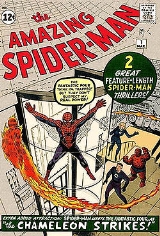
The Amazing Spider-Man is an
American comic bookAn American comic book is a small magazine originating in the United States and containing a narrative in the form of comics. Since 1975 the dimensions have standardized at 6 5/8" x 10 ¼" , down from 6 ¾" x 10 ¼" in the Silver Age, although larger formats appeared in the past...
series published by
Marvel ComicsMarvel Worldwide, Inc., commonly referred to as Marvel Comics and formerly Marvel Publishing, Inc. and Marvel Comics Group, is an American company that publishes comic books and related media...
, featuring the adventures of the fictional
superheroA superhero is a type of stock character, possessing "extraordinary or superhuman powers", dedicated to protecting the public. Since the debut of the prototypical superhero Superman in 1938, stories of superheroes — ranging from brief episodic adventures to continuing years-long sagas —...
Spider-ManSpider-Man is a fictional Marvel Comics superhero. The character was created by writer-editor Stan Lee and writer-artist Steve Ditko. He first appeared in Amazing Fantasy #15...
. Being the mainstream continuity of the franchise, it began publication in 1963 as a monthly periodical and was published continuously until it was relaunched with a new numbering order in 1999. In 2003 the series reverted to the numbering order of the first volume. The title has occasionally been published biweekly, and was published three times a month from 2008 to 2010. A
filmThe Amazing Spider-Man is an upcoming American superhero film based on the comic book of the same name that is currently in post-production. It is the fourth Columbia Pictures film based on the Marvel Comics character Spider-Man and the first film in a rebooted Spider-Man film franchise. The film...
named after the comic is set to be released in 2012.
Publication history
The character was created by writer-editor
Stan LeeStan Lee is an American comic book writer, editor, actor, producer, publisher, television personality, and the former president and chairman of Marvel Comics....
and artist and co-plotter
Steve DitkoStephen J. "Steve" Ditko is an American comic book artist and writer best known as the artist co-creator, with Stan Lee, of the Marvel Comics heroes Spider-Man and Doctor Strange....
, and the pair produced 38 issues from 1963 to 1966. Ditko left after the 38th issue, while Lee remained as writer until issue 100. Since then, many writers and artists have taken over the monthly comic through the years, chronicling the adventures of Marvel's most identifiable hero.
The Amazing Spider-Man is the character's
flagship seriesIn the context of a work of fiction, the term canon denotes the material accepted as "official" in a fictional universe's fan base. It is often contrasted with, or used as the basis for, works of fan fiction, which are not considered canonical...
, and the only monthly series to star Spider-Man until
Peter Parker, The Spectacular Spider-Man in 1976. Most of the major characters and villains of the Spider-Man saga have been introduced here, and it is where key events occur. The title was published continuously until #441 (Nov. 1998) when Marvel Comics relaunched it as vol. 2, #1 (Jan. 1999), but on Spider-Man's 40th anniversary, this new title reverted to using the numbering of the original series, beginning again with issue #500 (Dec. 2003).
The 1960s
The initial years of the book, under Lee and Ditko, chronicled Spider-Man's nascent career with his civilian life as hard-luck yet perpetually good-humored teenager Peter Parker. Parker balanced his career as Spider-Man with his job as a freelance
photographer for
The Daily Bugle (under the bombastic editor-publisher
J. Jonah JamesonJohn Jonah Jameson Junior is a supporting character of Spider-Man in the .Jameson is usually the publisher or editor-in-chief of the Daily Bugle, a fictional New York newspaper and now serves as the mayor of New York City...
) to help support himself and his frail
Aunt MayMay Reilly Parker-Jameson, commonly known as Aunt May, is a supporting character in Marvel Comics' Spider-Man series. Created by writer Stan Lee and artist Steve Ditko, she first appeared as May Parker in Amazing Fantasy #15...
. At the same time, Parker dealt with public hostility towards Spider-Man and the antagonism of his classmates
Flash ThompsonEugene "Flash" Thompson is a supporting character in Marvel Comics’s Spider-Man series. Created by writer Stan Lee and artist Steve Ditko, he first appeared in Amazing Fantasy #15 ....
and Liz Allan at Midtown High School, while also embarking on a tentative, ill-fated romance with Jameson's secretary,
Betty BrantElizabeth "Betty" Brant is a supporting character in Marvel Comics’s Spider-Man series. Created by writer Stan Lee and artist Steve Ditko, she first appeared in The Amazing Spider-Man #4 .-Fictional character biography:...
.
By focusing on Parker's everyday problems, Lee and Ditko created a groundbreakingly flawed, self-doubting superhero, and the first major teenaged superhero to be a
protagonistA protagonist is the main character of a literary, theatrical, cinematic, or musical narrative, around whom the events of the narrative's plot revolve and with whom the audience is intended to most identify...
and not a
sidekickA sidekick is a close companion who is generally regarded as subordinate to the one he accompanies. Some well-known fictional sidekicks are Don Quixote's Sancho Panza, Sherlock Holmes' Doctor Watson, The Lone Ranger's Tonto, The Green Hornet's Kato and Batman's Robin.-Origins:The origin of the...
. Ditko's quirky art provided a stark contrast to the more cleanly dynamic stylings of Marvel's most prominent artist,
Jack KirbyJack Kirby , born Jacob Kurtzberg, was an American comic book artist, writer and editor regarded by historians and fans as one of the major innovators and most influential creators in the comic book medium....
, and Ditko's Spider-Man, slightly sinister yet affectionately cartoony, combined with the humor and pathos of Lee's writing to lay the foundation for what became an enduring mythos.
Most of Spider-Man's key villains and supporting characters were introduced during this time. Issue #1 (March 1963) featured the first appearances of J. Jonah Jameson and his
astronautAn astronaut or cosmonaut is a person trained by a human spaceflight program to command, pilot, or serve as a crew member of a spacecraft....
son
John JamesonJohn Jameson is a fictional character in publications from Marvel Comics.-Publication history:...
, and the supervillain the
ChameleonThe Chameleon is a fictional character that appears in comic books published by Marvel Comics. The character first appears in The Amazing Spider-Man #1 , and was created by writer Stan Lee and artist Steve Ditko; the Chameleon is the first member of Spider-Man's rogues' gallery, based on issue...
. It also included the hero's first encounter with the superhero team The Fantastic Four. Issue #2 (May 1963) featured the first appearance of
The VultureThe Vulture is the name of six comic book supervillains in the Marvel Comics universe. The best known Vulture in the Marvel Universe is Adrian Toomes, an elderly enemy of Spider-Man created by Stan Lee and Steve Ditko in The Amazing Spider-Man #2 .-Golden Age Vulture:In Young Men #26, a scientist...
and the beginning of Parker's freelance
photographyPhotography is the art, science and practice of creating durable images by recording light or other electromagnetic radiation, either electronically by means of an image sensor or chemically by means of a light-sensitive material such as photographic film...
career at the newspaper
The Daily Bugle.
The Lee-Ditko era continued to usher in a significant number of villains and supporting characters, including
Doctor OctopusDoctor Octopus is a fictional character, a supervillain that appears in comic books published by Marvel Comics since 1963. A highly intelligent mad scientist, Doctor Octopus is one of Spider-Man's greatest foes...
in #3 (July 1963); the
SandmanSandman is a fictional character who appears in comic books published by Marvel Comics. A shapeshifter endowed through an accident with the ability to turn himself into sand, he eventually reformed, and became an ally of Spider-Man...
and Betty Brant in #4 (Sept. 1963); the
LizardThe Lizard is a fictional character, a supervillain in the Marvel Comics universe and enemy of Spider-Man. The Lizard first appeared in The Amazing Spider-Man #6 , and was created by Stan Lee and Steve Ditko...
in #6 (Nov. 1963);
ElectroElectro is a fictional character that appears in comic books published by Marvel Comics. He is a supervillain and an enemy of Spider-Man who gained the ability to control electricity after being struck by lightning while working on a power line. Created by Stan Lee and Steve Ditko, he first...
in #9 (March 1964);
MysterioMysterio is the name of three fictional characters, all of which are supervillains and enemies of Spider-Man in the . The original Mysterio was created by Stan Lee and Steve Ditko and first appears in Amazing Spider-Man #13, although it was later retconned that the aliens seen in Amazing...
in #13 (June 1964); the
Green GoblinThe Green Goblin is a fictional character, a supervillain who appears in the comic books published by Marvel Comics. The character was created by writer Stan Lee and artist Steve Ditko, and first appeared in The Amazing Spider-Man #14 ....
in #14 (July 1964);
Kraven The HunterKraven the Hunter is a fictional character, a supervillain and enemy of Spider-Man appearing in comic books published by Marvel Comics. Kraven's name is Sergei Kravinoff. He also appears as Xraven, with white-grey skin and red eyes, possessing the powers of X-Men. He is the half-brother of Dmitri...
in #15 (Aug. 1964); reporter
Ned LeedsNed Leeds is a comic book character in the Marvel Comics universe, part of the supporting cast of Spider-Man, first introduced in 1964 in The Amazing Spider-Man #18, by Stan Lee and Steve Ditko...
in #18 (Nov. 1964); the Scorpion in #20 (Jan. 1965); and the
Molten ManMolten Man is a fictional character, a supervillain in the Marvel Universe. The character was created by Stan Lee and Steve Ditko and first appeared in The Amazing Spider-Man #28 .-Fictional character biography:...
in #28 (Sept. 1965), an issue that also featured Parker's graduation from high school.
Parker began attending
Empire State UniversityEmpire State University is a fictional university in the Marvel Comics Universe, a mixture of New York University and Columbia University . It is located somewhere in New York City, in Greenwich Village near the site of New York University...
in #31 (Dec. 1965), the issue which also featured the first appearances of friends and classmates
Gwen StacyGwendolyn "Gwen" Stacy appears as a supporting character in Marvel Comics' Spider-Man series. Created by writer Stan Lee and artist Steve Ditko, she first appeared in The Amazing Spider-Man #31 ....
and
Harry OsbornHarry Osborn is a fictional character, a supporting character of Spider-Man in the . In addition to being Peter Parker's best friend, Harry was the second Green Goblin and is the son of Norman Osborn...
. Harry's father, Norman Osborn first appeared in #23 (April 1965) as a member of Jameson's country club but is not named nor revealed as Harry's father until #37 (June 1966). Probably the most celebrated issue of the Lee-Ditko run is #33 (Feb. 1966), the third part of the story arc "If This Be My Destiny", and featuring the dramatic scene of Spider-Man, through force of will and thoughts of family, escaping from being pinned by heavy machinery.
Although credited only as artist for most of his run, Ditko would eventually plot the stories as well as draw them, leaving Lee to script the dialogue. However, a rift between Ditko and Lee developed, and the two men were not on speaking terms long before Ditko completed his last issue,
The Amazing Spider-Man #38 (July 1966). The exact reasons for the Ditko-Lee split have been a source of controversy ever since. Spider-Man successor artist
John RomitaJohn Romita may refer to:*John Romita, Sr., comic book artist best known for his art on The Amazing Spider-Man for Marvel Comics in the 1960s...
, in a 2010
depositionDeposition or Depose may refer to:* Deposition , taking testimony outside of court* Deposition , molecules settling out of a solution...
, recalled that Lee and Ditko "ended up not being able to work together because they disagreed on almost everything, cultural, social, historically, everything, they disagreed on characters...."
In successor penciler John Romita Sr.'s first issue, #39 (Aug. 1966), archnemesis the Green Goblin discovers Spider-Man's secret identity and reveals his own to the captive hero. Romita's Spider-Man – more muscular and heroic-looking than Ditko's – became the model for two decades. The Lee-Romita era saw the introduction of such characters as
Daily BugleThe Daily Bugle is a fictional New York City newspaper that is a regular fixture in the Marvel Universe, most prominently in Spider-Man comic titles and their derivative media...
managing editorA managing editor is a senior member of a publication's management team.In the United States, a managing editor oversees and coordinates the publication's editorial activities...
Robbie Robertson in #52 (Sept. 1967) and NYPD Captain
George StacyGeorge Stacy is a supporting character in Marvel Comics's Spider-Man series. He first appeared in The Amazing Spider-Man #56 , and was created by Stan Lee, John Romita, Sr., and Don Heck. He is Gwen Stacy's father and he strongly approves of his daughter's relationship with Peter Parker...
, father of Parker's girlfriend
Gwen StacyGwendolyn "Gwen" Stacy appears as a supporting character in Marvel Comics' Spider-Man series. Created by writer Stan Lee and artist Steve Ditko, she first appeared in The Amazing Spider-Man #31 ....
, in #56 (Jan. 1968). The most important supporting character to be introduced during the Romita era was Mary Jane Watson, who made her first full appearance in #42, (Nov. 1966), although she first appeared in #25 (June 1965) with her face obscured and had been mentioned since #15 (Aug. 1964).
Lee and Romita toned down the prevalent sense of antagonism in Parker's world by improving Parker's relationship with the supporting characters and having stories focused as much on the social and college lives of the characters as they did on Spider-Man's adventures. The stories also became more topical, addressing issues such as
civil rightsCivil and political rights are a class of rights that protect individuals' freedom from unwarranted infringement by governments and private organizations, and ensure one's ability to participate in the civil and political life of the state without discrimination or repression.Civil rights include...
,
racismRacism is the belief that inherent different traits in human racial groups justify discrimination. In the modern English language, the term "racism" is used predominantly as a pejorative epithet. It is applied especially to the practice or advocacy of racial discrimination of a pernicious nature...
,
prisoners' rightsThe rights of civil and military prisoners are governed by both national and international law. International conventions include: the International Covenant on Civil and Political Rights; the United Nations' Minimum Rules for the Treatment of Prisoners and the European Committee for the...
, the
Vietnam WarThe Vietnam War was a Cold War-era military conflict that occurred in Vietnam, Laos, and Cambodia from 1 November 1955 to the fall of Saigon on 30 April 1975. This war followed the First Indochina War and was fought between North Vietnam, supported by its communist allies, and the government of...
, and political elections.
Issue #50 (June 1967) introduced the highly enduring criminal mastermind the
KingpinThe Kingpin is a fictional character, a supervillain in the . Kingpin is one of the most feared and powerful crime lords in the Marvel Universe. The character is a major adversary of Daredevil, the Punisher, and Spider-Man...
, who would become a major force as well in the superhero series
DaredevilDaredevil is a fictional character, a superhero in comic books published by Marvel Comics. The character was created by writer-editor Stan Lee and artist Bill Everett, with an unspecified amount of input from Jack Kirby, and first appeared in Daredevil #1 .Living in the Hell's Kitchen neighborhood...
. Other notable first appearances in the Lee-Romita era include the
RhinoThe Rhino is a fictional character that appears in comic books published by Marvel Comics. Created by writer Stan Lee and artist John Romita, Sr., the character first appeared in The Amazing Spider-Man #41 The Rhino (Aleksei Mikhailovich Sytsevich) is a fictional character that appears in comic...
in #41 (Oct. 1966), the
ShockerThe Shocker or just Shocker is a fictional character that appears in comic books published by Marvel Comics. The character first appeared in The Amazing Spider-Man #46 and was created by writer Stan Lee and artist John Romita, Sr.-Fictional character biography:Herman Schultz was born in New York...
in #46 (March 1967), the
ProwlerThe Prowler is the name of three fictional characters owned by Marvel Comics.-Publication history:The original Prowler character was a criminal-turned-superhero named Hobie Brown. He debuted in The Amazing Spider-Man #78...
in #78 (Nov. 1969), and the Kingpin's son,
Richard FiskRichard Fisk is a fictional character, a criminal in the , featured in the comic books published by Marvel Comics. He is the son of the Kingpin and his wife Vanessa Fisk...
, in #83 (April 1970).
The 1970s
Two spin-off series debuted in the 1970s:
Marvel Team-UpMarvel Team-Up is the name of several American comic book series published by Marvel Comics. The series featured two or more Marvel characters in one story...
in 1972, and
The Spectacular Spider-ManThe Spectacular Spider-Man is the name of several comic books and one magazine series starring Marvel Comics' Spider-Man.The character's main series, The Amazing Spider-Man, was extremely successful, and Marvel felt the character could support more than one title. This led the company in 1968 to...
in 1976. The flagship title's second decade took a grim turn with a story in #89-90 (Oct.-Nov. 1970) featuring the death of Captain
George StacyGeorge Stacy is a supporting character in Marvel Comics's Spider-Man series. He first appeared in The Amazing Spider-Man #56 , and was created by Stan Lee, John Romita, Sr., and Don Heck. He is Gwen Stacy's father and he strongly approves of his daughter's relationship with Peter Parker...
. This was also the first Spider-Man story to be penciled by
Gil KaneEli Katz who worked under the name Gil Kane and in one instance Scott Edward, was a comic book artist whose career spanned the 1940s to 1990s and every major comics company and character.Kane co-created the modern-day versions of the superheroes Green Lantern and the Atom for DC Comics, and...
, who would alternate drawing duties with Romita for the next year-and-a-half and would draw several landmark issues.
One such story took place in the controversial issues #96-98 (May–July 1971). Writer-editor Lee defied the
Comics Code AuthorityThe Comics Code Authority was a body created as part of the Comics Magazine Association of America, as a tool for the comics-publishing industry to self-regulate the content of comic books in the United States. Member publishers submitted comic books to the CCA, which screened them for adherence to...
with this story, in which Parker's friend Harry Osborn, was hospitalized after tripping on
LSDLysergic acid diethylamide, abbreviated LSD or LSD-25, also known as lysergide and colloquially as acid, is a semisynthetic psychedelic drug of the ergoline family, well known for its psychological effects which can include altered thinking processes, closed and open eye visuals, synaesthesia, an...
. Lee wrote this story upon a request from the US Department of Health, Education and Welfare for a story about the dangers of drugs. Citing its dictum against depicting drug use, even in an anti-drug context, the CCA refused to put its seal on these issues. With the approval of Marvel publisher
Martin GoodmanMartin Goodman born on was an American publisher of pulp magazines, paperback books, men's adventure magazines, and comic books, launching the company that would become Marvel Comics....
, Lee had the comics published without the seal. The comics sold well and Marvel won praise for its socially conscious efforts. The CCA subsequently loosened the Code to permit negative depictions of drugs, among other new freedoms.
The "Six-Arm Saga" of #100-102 (Sept.–Nov. 1971) introduced
Morbius, the Living VampireMorbius, the Living Vampire, is a fictional character appearing in comic books published by Marvel Comics. Created by writer Roy Thomas and penciler Gil Kane, the character, a living human suffering from vampiric abilities resulting from scientific rather than supernatural means, first appeared as...
. The second installment was the first
Amazing Spider-Man story not written by co-creator Lee, with
Roy ThomasRoy William Thomas, Jr. is an American comic book writer and editor, and Stan Lee's first successor as editor-in-chief of Marvel Comics. He is possibly best known for introducing the pulp magazine hero Conan the Barbarian to American comics, with a series that added to the storyline of Robert E...
taking over writing the book for several months before Lee returned to write #105-110 (Feb.-July 1972). Lee, who was going on to become Marvel Comics' publisher, with Thomas becoming editor-in-chief, then turned writing duties over to 19-year-old wunderkind
Gerry ConwayGerard F. "Gerry" Conway is an American writer of comic books and television shows. He is known for co-creating the Marvel Comics vigilante The Punisher and scripting the death of the character Gwen Stacy during his long run on The Amazing Spider-Man...
, who scripted the series through 1975. Romita penciled Conway's first half-dozen issues, which introduced the gangster
HammerheadHammerhead is a fictional character, a supervillain that has appeared in various comic book series published by Marvel Comics. He is primarily an enemy of Spider-Man and a member of organized crime who exists in Marvel's main shared universe, known as the Marvel Universe...
in #113 (Oct. 1972). Kane then succeeded Romita as penciler, although Romita would continue inking Kane for a time.
The most memorable work of the Conway/Kane/Romita team was #121-122 (June–July 1973), which featured the death of Gwen Stacy at the hands of the Green Goblin in "
The Night Gwen Stacy Died"The Night Gwen Stacy Died" is a story arc of the Marvel Comics comic book series The Amazing Spider-Man #121-122 , that became a watershed event in the life of the superhero Spider-Man, one of popular culture's most enduring and recognizable fictional characters. The two-issue story, written by...
" (#121). Her demise and the Goblin's apparent death one issue later formed a story arc widely considered as the most defining in the history of Spider-Man. The aftermath of the story also deepened both the characterization of
Mary Jane WatsonMary Jane Watson, often shortened to MJ, is a fictional supporting character appearing, originally, in Marvel comic books and, later, in multiple spin-offs and dramatizations of the Spider-Man titles as the best friend, love interest, and one-time wife of Peter Parker, the alter ego of Spider-Man...
and her relationship with Parker.
By late 1973, Gil Kane was succeeded by
Ross AndruRoss Andru was an American comic book artist and editor. He is best known for his work on Amazing Spider-Man, Wonder Woman, Flash and Metal Men....
, whose run lasted nearly 60 issues, from 1973 to 1978. Issue #129 (Feb. 1974) introduced the
PunisherThe Punisher is a fictional character, an anti-hero appearing in comic books based in the . Created by writer Gerry Conway and artists John Romita, Sr., and Ross Andru, the character made its first appearance in The Amazing Spider-Man #129 .The Punisher is a vigilante who employs murder,...
, who would become one of Marvel Comics' most popular characters. The Conway-Andru era also featured the first appearances of the
Man-WolfJohn Jameson is a fictional character in publications from Marvel Comics.-Publication history:...
in #124-125 (Sept.-Oct. 1973); the near-marriage of Doctor Octopus and Aunt May in #131 (April 1974); Harry Osborn stepping into his father's role as the Green Goblin in #135-137 (Aug.-Oct.1974); and the original "
Clone SagaThe Clone Saga or Spider-Clone Saga was a major story arc in Marvel Comics which ran from 1994 to 1996 involving many clones of Spider-Man.The story is considered to be one of the most controversial Spider-Man stories ever told...
", containing the introduction of
Spider-Man's cloneBenjamin "Ben" Reilly is a fictional character in the . He is a clone of Peter Parker , and is prominent in the "Clone Saga" story arc...
, in #147-149 (Aug.-Oct. 1975).
Archie GoodwinArchie Goodwin was an American comic book writer, editor, and artist. He worked on a number of comic strips in addition to comic books, and is best known for his Warren and Marvel Comics work...
and Gil Kane produced the title's 150th issue (Nov. 1975) before
Len WeinLen Wein is an American comic book writer and editor best known for co-creating DC Comics' Swamp Thing and Marvel Comics' Wolverine, and for helping revive the Marvel superhero team the X-Men...
became writer for two-and-a-half years. During Wein's tenure, Harry Osborn and Liz Allen dated and became engaged, J. Jonah Jameson was introduced to his eventual second wife, Marla Madison, and Aunt May suffered a heart attack. Wein's last story on
Amazing was a five-issue arc in #176-180 (Jan.-May 1978) featuring a third Green Goblin (Harry Osborn’s psychiatrist, Bart Hamilton).
Marv WolfmanMarvin A. "Marv" Wolfman is an award-winning American comic book writer. He is best known for lengthy runs on The Tomb of Dracula, creating Blade for Marvel Comics, and The New Teen Titans for DC Comics.-1960s:...
, Marvel's editor-in-chief from 1975 to 1976, succeeded Wein as writer, and in his first issue, #182 (July 1978), had Parker propose marriage to Watson (who refused, in the following issue).
Keith PollardKeith Pollard is an American comic book artist. Originally from the Detroit area, Pollard is best known for his simultaneous work on the Marvel Comics titles Fantastic Four, Thor, and The Amazing Spider-Man in the late 1970s-early 1980s.Pollard made his professional comics debut in 1974 with...
succeeded Ross Andru as artist shortly afterward, and with Wolfman introduced the likable rogue the
Black CatThe Black Cat is a fictional character, a superheroine in comic books published by Marvel Comics. Created by writer Marv Wolfman and artist Keith Pollard, she first appeared in The Amazing Spider-Man #194 ....
(Felicia Hardy) in #194 (July 1979). As a love interest for Spider-Man, the Black Cat would go on to be an important supporting character for the better part of the next decade, and remain a friend and occasional lover into the 2010s.
The 1980s
The Amazing Spider-Man #200 (Jan. 1980) featured the return and death of the
burglarThe Burglar is a fictional character in the Marvel Universe, left unnamed in most of his appearances. He is best known as the first criminal faced by Spider-Man, and as the killer of the hero's uncle and surrogate father figure, Ben Parker. The Burglar first appeared in Amazing Fantasy #15 .The...
who killed Spider-Man's Uncle Ben. Writer Marv Wolfman and penciler Keith Pollard both left the title by mid-year, succeeded by
Dennis O'NeilDennis J. "Denny" O'Neil is an American comic book writer and editor, principally for Marvel Comics and DC Comics in the 1970s, 1980s, and 1990s, and Group Editor for the Batman family of books until his retirement....
, a writer known for groundbreaking 1970s work at rival
DC ComicsDC Comics, Inc. is one of the largest and most successful companies operating in the market for American comic books and related media. It is the publishing unit of DC Entertainment a company of Warner Bros. Entertainment, which itself is owned by Time Warner...
, and penciler
John Romita, Jr.John Salvatore Romita, Jr. is an American comic book artist best known for his extensive work for Marvel Comics from the 1970s to the 2000s...
.
Roger SternRoger Stern is an American comic book author and novelist.-Early career:In the early 1970s, Stern and Bob Layton published the fanzine CPL , one of the first platforms for the work of John Byrne...
, who had written nearly 20 issues of sister title
The Spectacular Spider-ManThe Spectacular Spider-Man is the name of several comic books and one magazine series starring Marvel Comics' Spider-Man.The character's main series, The Amazing Spider-Man, was extremely successful, and Marvel felt the character could support more than one title. This led the company in 1968 to...
, took over
Amazing in late 1981. During his two years on the title, Stern augmented the backgrounds of long-established Spider-Man villains, and with Romita Jr. created the mysterious supervillain the
HobgoblinThe Hobgoblin is the alias of several fictional characters that appears in comic books published by Marvel Comics. The first and best-known Hobgoblin is Roderick Kingsley. He first appeared in The Amazing Spider-Man #238, and was created by Roger Stern and John Romita, Sr...
in #238-239 (March–April 1983). Fans engaged with the mystery of the Hobgoblin's secret identity, which continued throughout #244-245 and 249-251 (Sept.-Oct. 1983 & Feb.-April 1984). One lasting change was the reintroduction of
Mary Jane WatsonMary Jane Watson, often shortened to MJ, is a fictional supporting character appearing, originally, in Marvel comic books and, later, in multiple spin-offs and dramatizations of the Spider-Man titles as the best friend, love interest, and one-time wife of Peter Parker, the alter ego of Spider-Man...
as a much more serious, mature woman who becomes Peter's confidante after she reveals that she knows his secret identity.
By mid-1984,
Tom DeFalcoTom DeFalco is an American comics writer and editor, well known for his association with Marvel Comics and in particular for his work with Spider-Man.-Career:...
and
Ron FrenzRonald Wade Frenz is an American comic book artist known for his work for Marvel Comics. He is well-known for his 1980s work on Amazing Spider-Man, and more recently, for his work on Spider-Girl...
took over scripting and penciling. DeFalco helped establish the maturation in Parker and Watson's relationship, laying the foundation for the character's eventual wedding. Notably, in #257 (Oct. 1984), Watson tells Parker that she knows he is Spider-Man, and in #259 (Dec. 1984), she reveals to Parker the extent of her troubled childhood. Other notable issues of the DeFalco-Frenz era include #252 (May 1984), with the first appearance of Spider-Man's black costume, which the hero would wear almost exclusively for the next four years' worth of comics; the debut of criminal mastermind the
RoseRichard Fisk is a fictional character, a criminal in the , featured in the comic books published by Marvel Comics. He is the son of the Kingpin and his wife Vanessa Fisk...
, in #253 (June 1984); the revelation in #258 (Nov. 1984) that the black costume is a living being, a symbiote; and the introduction of the female mercenary
Silver SableSilver Sable is a fictional character from Marvel Comics, a female mercenary, hunter of war criminals, the leader of the Wild Pack, and CEO of Silver Sable International...
in #265 (June 1985).
Tom DeFalco and Ron Frenz were both removed from
The Amazing Spider-Man in 1986 by editor Owsley under acrimonious circumstances. A succession of artists including
Alan KupperbergAlan Kupperberg is an American comic artist known for working in both comic books and newspaper strips.-Career:Kupperberg began writing and drawing for Marvel Comics in 1974, mostly doing fill-ins and one-shots...
,
John Romita, Jr.John Salvatore Romita, Jr. is an American comic book artist best known for his extensive work for Marvel Comics from the 1970s to the 2000s...
, and
Alex SaviukAlex Saviuk is an American comic book artist primarily known for his work on the Marvel Comics character Spider-Man.-Biography:Saviuk was born on August 17, 1952 Alex Saviuk (born August 17, 1953) is an American comic book artist primarily known for his work on the Marvel Comics character...
penciled the book from 1987 to 1988; Owsley wrote the book for the first half of 1987, scripting the five-part "Gang War" story (#284-288) that DeFalco plotted. Former
Spectacular Spider-Man writer
Peter DavidPeter Allen David , often abbreviated PAD, is an American writer of comic books, novels, television, movies and video games...
scripted #289 (June 1987), which revealed Ned Leeds as being the Hobgoblin (although this was retconned in 1996 by Roger Stern into Leeds not being the original Hobgoblin after all).
David Michelinie-Biography:Some of his earliest work is for DC Comics's House of Secrets and a run on Swamp Thing , following Len Wein and preceding Gerry Conway, illustrated by Nestor Redondo. Michelinie did a run on Aquaman in Adventure Comics which led to the revival of the Sea King's own title in 1977...
took over as writer in the next issue, for a story arc in #290-292 (July-Sept. 1987) that led to the marriage of Peter Parker and Mary Jane Watson in
Amazing Spider-Man Annual #21. Issue #298 (March 1988) was the first Spider-Man comic to be drawn by future industry star
Todd McFarlaneTodd McFarlane is a Canadian cartoonist, writer, toy designer and entrepreneur, best known for his work in comic books, such as the fantasy series Spawn....
, the first regular artist on
The Amazing Spider-Man since Frenz's departure. McFarlane revolutionized Spider-Man's look. His depiction – large-eyed, with wiry, contorted limbs, and messy, knotted, convoluted webbing – influenced the way virtually all subsequent artists would draw the character. McFarlane's other significant contribution to the Spider-Man canon was the design for what would become one of Spider-Man's most wildly popular antagonists, the
supervillainA supervillain or supervillainess is a variant of the villain character type, commonly found in comic books, action movies and science fiction in various media.They are sometimes used as foils to superheroes and other fictional heroes...
VenomEddie Brock is a fictional character created by David Michelinie and Todd McFarlane. A comic book supervillain, Brock's earliest appearance is a cameo in Web of Spider-Man #18 before making his first full appearance in The Amazing Spider-Man #299 as Venom...
. Issue #299 (April 1988) featured Venom's first appearance (a last-page cameo) before his first full appearance in #300 (May 1988). The latter issue also featured Spider-Man reverting to his original red-and-blue costume.
Other notable issues of the Michelinie-McFarlane era include #312 (Feb. 1989), featuring the Green Goblin vs. the Hobgoblin; and #315-317 (May–July 1989), with the return of Venom. After the editorial and creative turmoil that beset
The Amazing Spider-Man in 1987, the Michelinie/McFarlane team at the tail-end of the 1980s restored a sense of creative consistency and quality to the book, and set the tone for Spider-Man for the next decade.
The 1990s
With a civilian life as a married man, the Spider-Man of the 1990s was different from the superhero of the previous three decades. McFarlane left the title in 1990 to write and draw a new series titled simply
Spider-ManPeter Parker: Spider-Man is the name of two comic book series published by Marvel Comics, both of which feature the character Spider-Man.-Volume One :...
. His successor,
Erik LarsenErik J. Larsen is an American comic book writer, artist and publisher. He is best known for his work on Savage Dragon, as one of the founders of Image Comics, and for his work on Spider-Man for Marvel Comics.-Early life:...
, penciled the book from early 1990 to mid-1991. After issue #350, Larsen was succeeded by
Mark BagleyMark Bagley is an American comic book artist. He has worked for Marvel Comics and DC Comics on such titles as The Amazing Spider-Man, Thunderbolts, New Warriors, and Ultimate Spider-Man.- Early life and career :...
, who had won the 1986 Marvel Tryout Contest and was assigned a number of low-profile penciling jobs followed by a run on
New WarriorsThe New Warriors is a Marvel Comics superhero team, traditionally consisting of young adult heroes. They first appeared in The Mighty Thor #411 .-General publication history:...
in 1990. Bagley penciled the flagship Spider-Man title from 1991 to 1996, with his art forming the basis for most Spider-Man licensed merchandise of the decade and onward.
Issues #361-363 (April–June 1992) introduced
CarnageCarnage is a fictional character, a supervillain in the . The character first appears in The Amazing Spider-Man #344 , and was created by writer David Michelinie and artist Mark Bagley. The character is frequently depicted as an enemy of Spider-Man...
, a second symbiote nemesis for Spider-Man. The series' 30th-anniversary issue, #365 (Aug. 1992), was a double-sized, hologram-cover issue with the cliffhanger ending of Peter Parker's parents, long thought dead, reappearing alive. It would be close to two years before they were revealed to be impostors, who are killed in #388 (April 1994), scripter Michelinie's last issue. His 1987–1994 stint gave him the second-longest run as writer on the title, behind Stan Lee.
With #389, writer
J. M. DeMatteisJohn Marc DeMatteis is an American writer of comic books.-Early career:Born in Brooklyn, DeMatteis graduated from Midwood High School and Empire State College. He worked as a music critic before getting his start in comic books at DC Comics in the late 1970s...
, whose Spider-Man credits included the 1987 "
Kraven's Last Hunt"Kraven's Last Hunt" is a comic book storyline by J.M. DeMatteis and Mike Zeck published in 1987, featuring the final battle between Marvel Comics characters Kraven the Hunter and Spider-Man...
" story arc and a 1991–1993 run on
The Spectacular Spider-ManThe Spectacular Spider-Man is the name of several comic books and one magazine series starring Marvel Comics' Spider-Man.The character's main series, The Amazing Spider-Man, was extremely successful, and Marvel felt the character could support more than one title. This led the company in 1968 to...
, took over the title. From October 1994 to June 1996,
Amazing stopped running stories exclusive to it, and ran installments of multi-part stories that crossed over into all the Spider-Man books. One of the few self-contained stories during this period was in #400 (April 1995), which featured the death of Aunt May — later revealed to have been faked (although the death still stands in the MC2 continuity). The "
Clone SagaThe Clone Saga or Spider-Clone Saga was a major story arc in Marvel Comics which ran from 1994 to 1996 involving many clones of Spider-Man.The story is considered to be one of the most controversial Spider-Man stories ever told...
" culminated with the revelation that the Spider-Man who had appeared in the previous 20 years of comics was a clone of the real Spider-Man. This plot twist was massively unpopular with many readers, and was later reversed in the "Revelations" story arc that crossed over the Spider-Man books in late 1996.
The Clone Saga tied into a publishing gap after #406 (Oct. 1995), when the title was temporarily replaced by
The Amazing Scarlet Spider #1-2 (Nov.-Dec. 1995), featuring
Ben ReillyBenjamin "Ben" Reilly is a fictional character in the . He is a clone of Peter Parker , and is prominent in the "Clone Saga" story arc...
. The series picked up again with #407 (Jan. 1996), with
Tom DeFalcoTom DeFalco is an American comics writer and editor, well known for his association with Marvel Comics and in particular for his work with Spider-Man.-Career:...
returning as writer. Bagley completed his 5½-year run by September 1996. A succession of artists, including
Ron GarneyRon Garney is a comic book writer/artist, known for his work on books such as JLA,The Amazing Spider-Man, Silver Surfer, Hulk, Daredevil and Captain America.-Career:...
,
Steve SkroceSteve Skroce is a Canadian comic book and movie storyboard artist. He is of Croatian origin.-Biography:Skroce broke into comics in 1993 on the Clive Barker series Ectokid for Marvel Comics' Razorline imprint. He went to work on the Marvel series Cable and X-Man before moving onto The Amazing...
, Joe Bennett, and
Rafael KayananRafael Kayanan is a Filipino-born naturalised American comic book artist and Filipino Martial Arts master in the Sayoc Kali system.-Biography:...
, penciled the book until the final issue, #441 (Nov. 1998), after which Marvel rebooted the title with vol. 2, #1 (Jan. 1999).
Relaunch and the 2000s
Marvel began
The Amazing Spider-Man anew with vol. 2, #1 (Jan. 1999).
Howard MackieHoward Mackie is an American comic book editor and writer. He has worked almost exclusively for Marvel Comics.- Childhood :...
wrote the first 29 issues. The relaunch proved controversial with the Sandman being regressed to his criminal ways and the "death" of Mary Jane, which was ultimately reversed due to fan backlash. Other elements included the introduction of a new Spider-Woman (who was spun off into her own short-lived series) and references to John Byrne's controversial "
Spider-Man: Chapter OneSpider-Man: Chapter One is a comic book limited series starring Spider-Man published by Marvel Comics for 13 issues from December 1998 to October 1999. The entire series was written and drawn by John Byrne....
", which launched at the same time as the reboot. Mackie's run ended with
The Amazing Spider-Man Annual 2001, which saw the return of Mary Jane, who then left Parker upon reuniting with him.
With #30 (June 2001),
J. Michael StraczynskiJoseph Michael Straczynski , known professionally as J. Michael Straczynski and informally as Joe Straczynski or JMS, is an American writer and television producer. He works in films, television series, novels, short stories, comic books, and radio dramas. He is a playwright, a former journalist,...
took over as writer. While his arrival saw the title regain lost readers, Straczynski oversaw additional controversial storylines — most notably his lengthy "Spider-Totem" arc, which raised the issue of whether Spider-Man's powers were magic-based, rather than as the result of a radioactive spider's bite. Additionally, Straczynski resurrected the plot point of Aunt May discovering her nephew was Spider-Man, and returned Mary Jane, with the couple reuniting in
The Amazing Spider-Man #50. Straczynski also gave Spider-Man a new profession, having Parker teach at his former high school.
Issue #30 began a dual numbering system, with the original series numbering (#471) returned and placed alongside the volume-two number on the cover. Other longtime, rebooted Marvel Comics titles, including
Fantastic FourThe Fantastic Four is a fictional superhero team appearing in comic books published by Marvel Comics. The group debuted in The Fantastic Four #1 , which helped to usher in a new level of realism in the medium...
, likewise were given the dual numbering around this time. In October 2000,
John Romita, Jr.John Salvatore Romita, Jr. is an American comic book artist best known for his extensive work for Marvel Comics from the 1970s to the 2000s...
succeeded John Byrne as artist. After vol. 2, #58 (Nov. 2003), the title reverted completely to its original numbering for #500 (Dec. 2003), with vol. 2, #1-58 considered #442-499 of the original run. Mike Deodato, Jr. penciled the book from mid-2004 until 2006.
That year Peter Parker revealed his Spider-Man identity on live television in the company-crossover storyline "Civil War", in which the superhero community is split over whether to conform to the federal government's new Superhuman Registration Act. This knowledge was erased from the world with the event of the four-part, crossover story arc, "
One More Day"One More Day" is a four-part, 2007 comic book crossover storyline, connecting the six main Spider-Man series concurrently published by Marvel Comics at the time. Written by J. Michael Straczynski and Joe Quesada, with art by Quesada, this story arc concludes the fallout of Spider-Man's actions...
", written partially by
J. Michael StraczynskiJoseph Michael Straczynski , known professionally as J. Michael Straczynski and informally as Joe Straczynski or JMS, is an American writer and television producer. He works in films, television series, novels, short stories, comic books, and radio dramas. He is a playwright, a former journalist,...
and illustrated by
Joe QuesadaJoseph "Joe" Quesada is an American comic book editor, writer and artist. He became known in the 1990s for his work on various Valiant Comics books, such as Ninjak and Solar, Man of the Atom...
, running through
The Amazing Spider-Man #544-545 (Nov.-Dec. 2007),
Friendly Neighborhood Spider-Man #24 (Nov. 2007) and
The Sensational Spider-Man #41 (Dec. 2007), the final issues of those two titles. Here. the
demoncall - 1347 531 7769 for more infoIn Ancient Near Eastern religions as well as in the Abrahamic traditions, including ancient and medieval Christian demonology, a demon is considered an "unclean spirit" which may cause demonic possession, to be addressed with an act of exorcism...
MephistoMephisto is a fictional character that appears in comic books published by Marvel Comics. The character first appears in Silver Surfer #3 and was created by Stan Lee and John Buscema, loosely modeled on Mephistopheles - a character from the Faust legend.Debuting in the Silver Age of comic books,...
makes a
Faustian bargainDeal With The Devil is the fifth studio album by the American heavy metal band Lizzy Borden released in 2000 .A return to form, featuring a cover by Todd McFarlane.2 covers were recorded...
with Parker and Mary Jane, offering to save Parker's dying
Aunt MayMay Reilly Parker-Jameson, commonly known as Aunt May, is a supporting character in Marvel Comics' Spider-Man series. Created by writer Stan Lee and artist Steve Ditko, she first appeared as May Parker in Amazing Fantasy #15...
if the couple will allow their marriage to have never existed, rewriting that portion of their pasts. This story arc marked the end of Straczynski's six-and-a-half years as writer (from 2001 to 2007) on the title after 75 issues (including issues of
Friendly Neighborhood Spider-Man and
The Sensational Spider-Man as part of crossovers).
Following this, Marvel made
The Amazing Spider-Man the company's sole Spider-Man title, increasing its frequency of publication to three issues monthly, and inaugurating the series with a sequence of "back to basics" story arcs under the banner of "
Brand New Day"Brand New Day" is the title of a run of comic book storylines in The Amazing Spider-Man, published by Marvel Comics in 2008. It chronicles the start of Spider-Man's adventures in the aftermath of the big status quo change in the "One More Day" storyline, and continues afterwards into "Spider-Man:...
". Parker now exists in a changed world where he and Mary Jane had never married, and Parker has no memory of being married to her, with
domino effectThe domino effect is a chain reaction that occurs when a small change causes a similar change nearby, which then will cause another similar change, and so on in linear sequence. The term is best known as a mechanical effect, and is used as an analogy to a falling row of dominoes...
differences in their immediate world. The most notable of these revisions to Spider-Man continuity are the return of Harry Osborn, whose death in
The Spectacular Spider-ManThe Spectacular Spider-Man is the name of several comic books and one magazine series starring Marvel Comics' Spider-Man.The character's main series, The Amazing Spider-Man, was extremely successful, and Marvel felt the character could support more than one title. This led the company in 1968 to...
#200 (May 1993) is erased; and the reestablishment of Spider-Man's secret identity, with no one except Mary Jane able to recall that Parker is Spider-Man (although he soon reveals his secret identity to the New Avengers and the
Fantastic FourThe Fantastic Four is a fictional superhero team appearing in comic books published by Marvel Comics. The group debuted in The Fantastic Four #1 , which helped to usher in a new level of realism in the medium...
). The alternating regular writers were initially
Dan SlottDan Slott is an American comic book writer best known for The Amazing Spider-Man, Arkham Asylum: Living Hell and She-Hulk. He is the current writer of the twice monthly The Amazing Spider-Man.-Early writing:...
,
Bob GaleMichael Robert "Bob" Gale is an American screenwriter who co-wrote the science fiction film Back to the Future with writing partner Robert Zemeckis, and the screenplays for the film's two sequels. Gale also co-produced all three films....
,
Marc GuggenheimMarc Guggenheim is an American television writer-producer and a writer for Marvel Comics and DC Comics. His brother is screenwriter Eric Guggenheim.-Television:...
,
Fred Van LenteFred Van Lente is an American writer, primarily of comic books and graphic novels.-Career:Van Lente is the co-founder, along with artist Ryan Dunlavey, of Evil Twin Comics, which produces his and Dunlavey’s non-fiction comic books, the first and most famous of which is Action Philosophers.Recent...
, and
Zeb WellsZeb Wells is an American comic book writer known for his work at Marvel Comics, as well as his work on Robot Chicken.-Career:Wells is an Emmy and Annie Award winning writer and actor for the TV show Robot Chicken, including the Emmy-nominated Robot Chicken: Star Wars Episode II.Wells has written...
, joined by a rotation of artists that included
Chris BachaloChris Bachalo is an American comic book illustrator known for his quirky, cartoon-like style. He became well known for stints on DC Comics’ Shade, the Changing Man and Neil Gaiman's two Death series...
,
Phil JimenezPhil Jimenez is an American comic book writer, artist and penciller, known for his work as writer/artist on Wonder Woman from 2000 to 2003, as one of the five pencilers of the 2005-2006 miniseries Infinite Crisis, and his collaborations with writer Grant Morrison on New X-Men and The...
,
Mike McKoneMichael "Mike" McKone is a British comic book artist.-Career:McKone's first published works for the major companies included DC Comics' Justice League of America and Justice League International for DC Comics and The Punisher War Zone for Marvel Comics...
,
John Romita, Jr.John Salvatore Romita, Jr. is an American comic book artist best known for his extensive work for Marvel Comics from the 1970s to the 2000s...
and
Marcos MartínMarcos Martín is a Spanish comic book artist who worked for American comics, illustrating Batgirl: Year One, Doctor Strange: The Oath, Breach. He is the current artist of The Amazing Spider-Man...
.
Joe KellyJoseph "Joe" Kelly is an American comic book writer, penciler and editor who has written such titles as Deadpool, Uncanny X-Men, Action Comics, and JLA...
,
Mark WaidMark Waid is an American comic book writer. He is well known for his eight-year run as writer of the DC Comics' title The Flash, as well as his scripting of the limited series Kingdom Come and Superman: Birthright, and his work on Marvel Comics' Captain America...
and
Roger SternRoger Stern is an American comic book author and novelist.-Early career:In the early 1970s, Stern and Bob Layton published the fanzine CPL , one of the first platforms for the work of John Byrne...
later joined the writing team and
Barry KitsonBarry Kitson is a British comics artist best known as a penciler of major superhero comic books published by Marvel and DC.-Biography:Kitson's first professional work was Spider-Man for Marvel UK...
the artist roster.
With issue #648 (January 2011), the series became a twice-monthly title with
Dan SlottDan Slott is an American comic book writer best known for The Amazing Spider-Man, Arkham Asylum: Living Hell and She-Hulk. He is the current writer of the twice monthly The Amazing Spider-Man.-Early writing:...
as sole writer. Eight additional pages were added per issue. These were initially published under the banner of "
Big Time"Big Time" is the title of a run of comic book storylines in The Amazing Spider-Man, published by Marvel Comics starting in 2010 and ending in 2011. It follows the 101 consecutive issues of the "Brand New Day" publishing scheme and is the first shift in publishing for The Amazing Spider-Man since...
". The most recent story heading is "
Spider-Island"Spider-Island" is a comic book storyline starting in The Amazing Spider-Man and crossing over into other comic books published by Marvel Comics in 2011.-Infested:...
", which runs through November, 2011.
External links