


Team racing

Encyclopedia
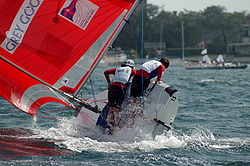
Team racing, also known as teams racing, is a popular form of yacht racing
. As opposed to fleet racing
where boats are scored on an individual basis, in team racing teams consisting of 2, 3 or 4 boats compete together. As in fleet racing the low point scoring system is used. A boat is awarded points based on the place it finishes a race. For example a boat that finishes 1st earns 1 point, a boat that finishes 2nd earns 2 points, etc. In team racing the winning team is decided by adding together the places of all the boats in each team. The team with the fewest points win.
racing, combining the need for boat speed with good teamwork and communication.
Consider the following situation for 3-boat teams (the most common format): If one boat is in 1st place and his teammates are in 5th & 6th then his team's entire points, upon finishing will be 1 + 5 + 6 = 12 points, whereas the opposition will have 2 + 3 + 4 = 9 points. Therefore to win the race, the boat in 1st will have to try and maneuver his vessel in such a way as to hinder the other team's progress to let his teammates overtake them. He can do this by using the Racing Rules of Sailing
(RRS), including Appendix D, to his advantage – e.g., positioning himself in such a way that the opposition has to get out of his way, or they are the keep clear boat. If one boat feels that another has breached the Racing Rules of Sailing
she may hail protest. If the protested boat does not exonerate herself with a one-turn penalty the protesting boat may hail 'umpire'. An on-the-water umpire will then make a decision, almost instantly, and impose a two-turn penalty on any boat that he believes has broken a rule.
There are two main 'moves' in team racing; the 'pass back' and the 'mark trap.' The goal of the pass back is to slow an opposing team's boat in order for the boat that the opposing team was covering to either tack away from the covering boat, or sail ahead faster than the boat. A pass back involves three boats sailing upwind. The most windward boat, and the most leeward boat are on the same team. A pass back is initiated when the windward boat sails into a position where it is covering the middle boat's breeze, allowing the most leeward boat to hopefully be able to sail faster, or tack without the middle boat being able to tack simultaneously.
The mark trap is slightly more complicated. It involves stopping at a mark in a position where the opposing team's boats must sail into a position where the original boat can use the racing rules of sailing to incapacitate the other boat, allowing friendly team members to sail ahead.
s are often held amongst universities and secondary schools that field teams in the Intercollegiate Sailing Association
and the Interscholastic Sailing Association. Additionally many yacht club
s field teams and compete against each other in team racing regattas.
Because team racing must be conducted in equal boats the most popular boats for team racing are one-design dinghies or keelboat
s. The Optimist
, 420
, Vanguard 15
, Firefly
or Flying Junior
are the dinghies most frequently used for team racing. Also, for keelboats, the Sonar is becoming popular and is used in the yearly team race format Kirby Cup regatta.
In the U.K, the birthplace of the sport, the Firefly
, a 12 foot, 2 sailed dinghy, designed by Uffa Fox
, is the most commomnly used boat. Fireflys are ideal to use due to a lack of a high performance features e.g. spinnakers and trapezes. Initially there were issues with these boats not being robust enough; many regarded the GRP construction and poor fittings as a liability. However a series of subtle but effective reinforcements were introduced under the guidance of Spinnaker Sailing Club Bosun, Allenyne Copstake, as he found himself regularly repairing the boats after and even during events! These reinforcements were later adopted by other important team racing clubs in the UK including West Kirby Sailing Club and Sevenoaks School.
Table 1: Winning/losing combinations for 3-boat team racing >
Winning Team
Losing Team
1,2,3 = 6
4,5,6 = 15
1,2,4 = 7
3,5,6 = 14
1,2,5 = 8
3,4,6 = 13
1,2,6 = 9
3,4,5 = 12
1,2,DSQ(7) = 10
3,4,5 = 12
1,3,4 = 8
2,5,6 = 13
1,3,5 = 9
2,4,6 = 12
1,3,6 = 10
2,4,5 = 11
2,4,5 = 11
1,3,DSQ(7) = 11
2,3,5 = 10
1,4,6 = 11
1,4,5 = 10
2,3,6 = 11
2,3,4 = 9
1,5,6 = 12
In the case of a points tie, (e.g., 1,2,7,8 vs 3,4,5,6) the team with first place loses. This reflects the fact that the first place skipper showed poor play by finishing when his team was not winning.
Contemporary Team Racing 2005 - 2008 Animated CD http://www.sailingeducation.com/products.html
Yacht racing
Yacht racing is the sport of competitive yachting.While sailing groups organize the most active and popular competitive yachting, other boating events are also held world-wide: speed motorboat racing; competitive canoeing, kayaking, and rowing; model yachting; and navigational contests Yacht racing...
. As opposed to fleet racing
Fleet racing
Fleet racing is a form of competitive sailing that involves sailboats racing one another over a set course. It is the most common form of sailboat racing and contrasts with match racing and team racing....
where boats are scored on an individual basis, in team racing teams consisting of 2, 3 or 4 boats compete together. As in fleet racing the low point scoring system is used. A boat is awarded points based on the place it finishes a race. For example a boat that finishes 1st earns 1 point, a boat that finishes 2nd earns 2 points, etc. In team racing the winning team is decided by adding together the places of all the boats in each team. The team with the fewest points win.
Team Racing Tactics
Team Racing is a very tactical and technical branch of sailboatSailboat
A sailboat or sailing boat is a boat propelled partly or entirely by sails. The term covers a variety of boats, larger than small vessels such as sailboards and smaller than sailing ships, but distinctions in the size are not strictly defined and what constitutes a sailing ship, sailboat, or a...
racing, combining the need for boat speed with good teamwork and communication.
Consider the following situation for 3-boat teams (the most common format): If one boat is in 1st place and his teammates are in 5th & 6th then his team's entire points, upon finishing will be 1 + 5 + 6 = 12 points, whereas the opposition will have 2 + 3 + 4 = 9 points. Therefore to win the race, the boat in 1st will have to try and maneuver his vessel in such a way as to hinder the other team's progress to let his teammates overtake them. He can do this by using the Racing Rules of Sailing
Racing Rules of Sailing
The Racing Rules of Sailing govern the conduct of yacht racing, windsurfing, kitesurfing, model boat racing, dinghy racing and virtually any other form of racing around a course with more than one vessel while powered by the wind...
(RRS), including Appendix D, to his advantage – e.g., positioning himself in such a way that the opposition has to get out of his way, or they are the keep clear boat. If one boat feels that another has breached the Racing Rules of Sailing
Racing Rules of Sailing
The Racing Rules of Sailing govern the conduct of yacht racing, windsurfing, kitesurfing, model boat racing, dinghy racing and virtually any other form of racing around a course with more than one vessel while powered by the wind...
she may hail protest. If the protested boat does not exonerate herself with a one-turn penalty the protesting boat may hail 'umpire'. An on-the-water umpire will then make a decision, almost instantly, and impose a two-turn penalty on any boat that he believes has broken a rule.
There are two main 'moves' in team racing; the 'pass back' and the 'mark trap.' The goal of the pass back is to slow an opposing team's boat in order for the boat that the opposing team was covering to either tack away from the covering boat, or sail ahead faster than the boat. A pass back involves three boats sailing upwind. The most windward boat, and the most leeward boat are on the same team. A pass back is initiated when the windward boat sails into a position where it is covering the middle boat's breeze, allowing the most leeward boat to hopefully be able to sail faster, or tack without the middle boat being able to tack simultaneously.
The mark trap is slightly more complicated. It involves stopping at a mark in a position where the opposing team's boats must sail into a position where the original boat can use the racing rules of sailing to incapacitate the other boat, allowing friendly team members to sail ahead.
Team Racing Today
Team racing is growing in popularity among sailors who enjoy the fast-paced action and challenge. Team Racing regattaRegatta
A regatta is a series of boat races. The term typically describes racing events of rowed or sailed water craft, although some powerboat race series are also called regattas...
s are often held amongst universities and secondary schools that field teams in the Intercollegiate Sailing Association
Intercollegiate Sailing Association
The Inter-Collegiate Sailing Association is a volunteer organization that serves as the governing authority for all sailing competition at colleges and universities throughout the United States and in some parts of Canada.-History:...
and the Interscholastic Sailing Association. Additionally many yacht club
Yacht club
A yacht club is a sports club specifically related to sailing and yachting.-Description:Yacht Clubs are mostly located by the sea, although there are some that have been established at a lake or riverside locations...
s field teams and compete against each other in team racing regattas.
Because team racing must be conducted in equal boats the most popular boats for team racing are one-design dinghies or keelboat
Keelboat
Keelboat has two distinct meanings related to two different types of boats: one a riverine cargo-capable working boat, and the other a classification for small- to mid-sized recreational sailing yachts.-Historical keel-boats:...
s. The Optimist
Optimist (dinghy)
The Optimist is a small, single-handed sailing dinghy intended for use by children up to the age of 15. Nowadays boats are usually made of fiber reinforced plastic, although wooden boats are still built....
, 420
420 (dinghy)
The International 420 Class Dinghy is a double-handed monohull planing dinghy with centreboard, bermuda rig and centre sheeting. The name describes the overall length of the boat in centimetres . The hull is fibreglass with internal buoyancy tanks. The 420 is equipped with spinnaker and optional...
, Vanguard 15
Vanguard 15
The Vanguard 15 is a popular one design racing dinghy designed by Bob Ames. It is a double-handed monohull sailboat with a sloop rig . Ideally the combined weight of the crew is between 270 and and both members hike off the boat to keep it flat...
, Firefly
Firefly (dinghy)
The Firefly is a two-sail, wooden or GRP sailing dinghy with no spinnaker, designed by Uffa Fox in 1938. Although designed as a double hander, it was selected as the single handed class for the 1948 Olympics but was subsequently replaced by the Finn class. The class then became popular as a double...
or Flying Junior
Flying Junior
thumb|Coen Gulcher helming one of the first Flying Juniors The International Flying Junior or FJ is a sailing dinghy which was originally designed in 1955 in the Netherlands by renowned boat designer Van Essen and Olympic sailor Conrad Gülcher. The FJ was built to serve as a training boat for the...
are the dinghies most frequently used for team racing. Also, for keelboats, the Sonar is becoming popular and is used in the yearly team race format Kirby Cup regatta.
In the U.K, the birthplace of the sport, the Firefly
Firefly (dinghy)
The Firefly is a two-sail, wooden or GRP sailing dinghy with no spinnaker, designed by Uffa Fox in 1938. Although designed as a double hander, it was selected as the single handed class for the 1948 Olympics but was subsequently replaced by the Finn class. The class then became popular as a double...
, a 12 foot, 2 sailed dinghy, designed by Uffa Fox
Uffa Fox
Uffa Fox CBE was an English boat designer and sailing enthusiast.-Life:Uffa Fox was born on the Isle of Wight and was raised in East Cowes. He lived for a while in Puckaster on the Isle of Wight.-Work:...
, is the most commomnly used boat. Fireflys are ideal to use due to a lack of a high performance features e.g. spinnakers and trapezes. Initially there were issues with these boats not being robust enough; many regarded the GRP construction and poor fittings as a liability. However a series of subtle but effective reinforcements were introduced under the guidance of Spinnaker Sailing Club Bosun, Allenyne Copstake, as he found himself regularly repairing the boats after and even during events! These reinforcements were later adopted by other important team racing clubs in the UK including West Kirby Sailing Club and Sevenoaks School.
Winning/Losing combinations
A well-seasoned team racer will know whether they are winning or losing at any point in the race. The most-common combinations of results are given below. A good crew will be able to tell the helms person whether the team is winning or losing and which position to attack to win.3 boat team racing
Rules of Thumb:- 10points or less wins.
- 1-2-anything wins ("Play 1")
- 1-3-anything except DSQ wins (assuming that DSQ is 7 points)
- 2-3-4 ("Play 2")
- 2-3-5
- 1-4-5 ("Play 4")
4-boat team racing
There are many more combinations.In the case of a points tie, (e.g., 1,2,7,8 vs 3,4,5,6) the team with first place loses. This reflects the fact that the first place skipper showed poor play by finishing when his team was not winning.
Books
- "Team Racing for Sailboats" by Steve Tylecote, ISBN 1-898660-85-9 for learning tactics.
Contemporary Team Racing 2005 - 2008 Animated CD http://www.sailingeducation.com/products.html