

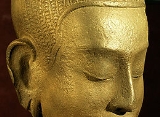
Tathagata

Encyclopedia
Tathāgata in Pali
and Sanskrit
) is the name the Buddha
of the scriptures
uses when referring to himself. The term means, paradoxically, both one who has thus gone (tathā-gata) and one who has thus come (tathā-āgata). Hence, the Tathagata is beyond all coming and going – beyond all transitory phenomena. He is one who has found the truth.
The Buddha is reported as referring to himself as the Tathagata instead of using the pronouns me, I or myself. This serves to emphasize by implication that the teaching is uttered by one who has transcended the human condition, one beyond the otherwise endless cycle of rebirth
, beyond all death
and dying, beyond suffering
.
The term also occurs as a synonym for arahant, identifying one who has attained the ultimate in the holy life. There is even a sense in which such a one is no longer human... "a tathāgata, a superior state of being (uttama-puriso)".
) indicating simply that it (reality) is what it is.
A Buddha or an arahant is defined as someone who "knows and sees reality as-it-is" (yathā bhūta ñāna dassana). Gata "gone" is the past passive participle of the verbal root gam "go, travel". Āgata "come" is the past passive participle of the verb meaning "come, arrive".
Thus in this interpretation Tathāgata means literally either, “The one who has gone to suchness” or, "The one who has arrived at suchness".
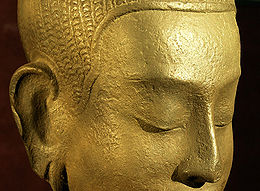
A number of passages affirm that a tathāgata, or arahant, is "immeasurable", "inscrutable", "hard to fathom", and "not apprehended". A tathāgata has abandoned that clinging to the skandhas (personality factors) that render citta
(the mind) a bounded, measurable entity, and is instead "freed from being reckoned by" all or any of them, even in life. The aggregates of form, feeling, perception, mental formations, and cognizance that comprise personal identity have been seen to be dukkha
(a burden), and an enlightened individual is one with "burden dropped"..The Buddha explains "that for which a monk has a latent tendency, by that is he reckoned, what he does not have a latent tendency for, by that is he not reckoned.. These tendencies are ways in which the mind becomes involved in and clings to conditioned phenomena
. Without them, an enlightened person cannot be "reckoned" or "named"; he or she is beyond the range of other beings, and cannot be "found" by them, even by gods, or Mara
. In one passage, Sariputta states that the mind of the Buddha cannot be "encompassed" even by him.
The Buddha and Sariputta, in similar passages, when confronted with speculation as to the status of an arahant after death, bring their interlocutors to admit that they cannot even apprehend an arahant that is alive. As Sariputta puts it, his questioner Yamaka "can't pin down the Tathagata as a truth or reality even in the present life." These passages imply that condition of the arahant, both before and after parinirvana
, lies beyond the domain where the descriptive powers of ordinary language are at home; that is, the world of the skandhas and the greed, hatred, and delusion that are "blown out" with nirvana.
In the Aggi-Vacchagotta Sutta
, an ascetic named Vaccha questions the Buddha on a variety of metaphysical issues. When Vaccha asks about the status of an arahant after death, the Buddha asks him in which direction a fire goes when it has gone out. Vaccha replies that the question "does not fit the case ... For the fire that depended on fuel ... when that fuel has all gone, and it can get no other, being thus without nutriment, it is said to be extinct." The Buddha then explains: "In exactly the same way ..., all form by which one could predicate the existence of the saint, all that form has been abandoned, uprooted, pulled out of the ground like a palmyra-tree, and become non-existent and not liable to spring up again in the future. The saint ... who has been released from what is styled form is deep, immeasurable, unfathomable, like the mighty ocean." The same is then said of the other aggregates. A variety of similar passages make it clear that the metaphor "gone out, he cannot be defined" (atthangato so na pamanam eti) refers equally to liberation in life. In the Aggi-Vacchagotta Sutta itself, it is clear that the Buddha is the subject of the metaphor, and the Buddha has already "uprooted" or "annihilated" the five aggregates. In Sn 1074, it is stated that the sage cannot be "reckoned" because he is freed from the category "name" or, more generally, concepts. The absence of this precludes the possibility of reckoning or articulating a state of affairs; "name" here refers to the concepts or apperceptions that make propositions possible.
A similar response citing immeasurability occurs in another sutta, when the Buddha is asked to pick between two alternatives regarding the arahant after death: annihilation or eternal freedom from illness. The Buddha responds: "There is no measure of him who had achieved the goal. That by which one could define him, that is not for him. When all phenomena (dhamma) are removed, then all means of description are also removed."
Nagarjuna
expressed this understanding in the nirvana chapter of his Mulamadhyamakakarika
: "It is not assumed that the Blessed One exists after death. Neither is it assumed that he does not exist, or both, or neither. It is not assumed that even a living Blessed One exists. Neither is it assumed that he does not exist, or both, or neither."
In the Dhammapada
, the actions of an arahant are described as without trace (ananuvejja) or 'trackless (apada), like the birds in the sky' (ākāse'va sakuntānam gati tesam durannayā ).
Páli
- External links :* *...
and Sanskrit
Sanskrit
Sanskrit , is a historical Indo-Aryan language and the primary liturgical language of Hinduism, Jainism and Buddhism.Buddhism: besides Pali, see Buddhist Hybrid Sanskrit Today, it is listed as one of the 22 scheduled languages of India and is an official language of the state of Uttarakhand...
) is the name the Buddha
Gautama Buddha
Siddhārtha Gautama was a spiritual teacher from the Indian subcontinent, on whose teachings Buddhism was founded. In most Buddhist traditions, he is regarded as the Supreme Buddha Siddhārtha Gautama (Sanskrit: सिद्धार्थ गौतम; Pali: Siddhattha Gotama) was a spiritual teacher from the Indian...
of the scriptures
Pāli Canon
The Pāli Canon is the standard collection of scriptures in the Theravada Buddhist tradition, as preserved in the Pāli language. It is the only completely surviving early Buddhist canon, and one of the first to be written down...
uses when referring to himself. The term means, paradoxically, both one who has thus gone (tathā-gata) and one who has thus come (tathā-āgata). Hence, the Tathagata is beyond all coming and going – beyond all transitory phenomena. He is one who has found the truth.
The Buddha is reported as referring to himself as the Tathagata instead of using the pronouns me, I or myself. This serves to emphasize by implication that the teaching is uttered by one who has transcended the human condition, one beyond the otherwise endless cycle of rebirth
Rebirth (Buddhism)
Rebirth in Buddhism is the doctrine that the evolving consciousness or stream of consciousness upon death , becomes one of the contributing causes for the arising of a new aggregation...
, beyond all death
Death
Death is the permanent termination of the biological functions that sustain a living organism. Phenomena which commonly bring about death include old age, predation, malnutrition, disease, and accidents or trauma resulting in terminal injury....
and dying, beyond suffering
Dukkha
Dukkha is a Pali term roughly corresponding to a number of terms in English including suffering, pain, discontent, unsatisfactoriness, unhappiness, sorrow, affliction, social alienation, anxiety,...
.
The term also occurs as a synonym for arahant, identifying one who has attained the ultimate in the holy life. There is even a sense in which such a one is no longer human... "a tathāgata, a superior state of being (uttama-puriso)".
Etymology & interpretation
Sanskrit grammar offers two possibilities for breaking up the compound: either tathā and āgata or tathā and gata. Tathā means thus in Sanskrit and Pali, and Buddhist thought takes this to refer to what is called reality as-it-is (yathā-bhūta). This reality is also referred to as thusness or suchness (tathatāTathata
Tathata is variously translated as "thusness" or "suchness". It is a central concept in Buddhism, and is of particular significance in Zen Buddhism...
) indicating simply that it (reality) is what it is.
A Buddha or an arahant is defined as someone who "knows and sees reality as-it-is" (yathā bhūta ñāna dassana). Gata "gone" is the past passive participle of the verbal root gam "go, travel". Āgata "come" is the past passive participle of the verb meaning "come, arrive".
Thus in this interpretation Tathāgata means literally either, “The one who has gone to suchness” or, "The one who has arrived at suchness".
Hard to fathom
A number of passages affirm that a tathāgata, or arahant, is "immeasurable", "inscrutable", "hard to fathom", and "not apprehended". A tathāgata has abandoned that clinging to the skandhas (personality factors) that render citta
Citta
Citta was one of the chief lay disciples of the Buddha. He was a wealthy merchant from Savatthi. His life and character were so pure that near his death, had he wished to be a chakravartin, it would've been granted. However, he turned down this wish as it was temporal...
(the mind) a bounded, measurable entity, and is instead "freed from being reckoned by" all or any of them, even in life. The aggregates of form, feeling, perception, mental formations, and cognizance that comprise personal identity have been seen to be dukkha
Dukkha
Dukkha is a Pali term roughly corresponding to a number of terms in English including suffering, pain, discontent, unsatisfactoriness, unhappiness, sorrow, affliction, social alienation, anxiety,...
(a burden), and an enlightened individual is one with "burden dropped"..The Buddha explains "that for which a monk has a latent tendency, by that is he reckoned, what he does not have a latent tendency for, by that is he not reckoned.. These tendencies are ways in which the mind becomes involved in and clings to conditioned phenomena
Sankhara
' or ' is a term figuring prominently in the teaching of the Buddha. The word means "that which has been put together" and "that which puts together". In the first sense, refers to conditioned phenomena generally but specifically to all mental "dispositions"...
. Without them, an enlightened person cannot be "reckoned" or "named"; he or she is beyond the range of other beings, and cannot be "found" by them, even by gods, or Mara
Mara (demon)
In Buddhism, Māra is the demon that tempted Gautama Buddha by trying to seduce him with the vision of beautiful women who, in various legends, are often said to be Mara's daughters. In Buddhist cosmology, Mara personifies unwholesome impulses, unskillfulness, the "death" of the spiritual life...
. In one passage, Sariputta states that the mind of the Buddha cannot be "encompassed" even by him.
The Buddha and Sariputta, in similar passages, when confronted with speculation as to the status of an arahant after death, bring their interlocutors to admit that they cannot even apprehend an arahant that is alive. As Sariputta puts it, his questioner Yamaka "can't pin down the Tathagata as a truth or reality even in the present life." These passages imply that condition of the arahant, both before and after parinirvana
Parinirvana
In Buddhism, parinirvana is the final nirvana, which occurs upon the death of the body of someone who has attained complete awakening...
, lies beyond the domain where the descriptive powers of ordinary language are at home; that is, the world of the skandhas and the greed, hatred, and delusion that are "blown out" with nirvana.
In the Aggi-Vacchagotta Sutta
Aggi-Vacchagotta Sutta
The Aggi-Vacchagotta Sutta is a Buddhist sutta in the Majjhima Nikaya of the Tripitaka. In this sutta, Gautama Buddha clarifies his views on the nature of existence and explains the nature of nirvana to Vacchagotta by means of a simile...
, an ascetic named Vaccha questions the Buddha on a variety of metaphysical issues. When Vaccha asks about the status of an arahant after death, the Buddha asks him in which direction a fire goes when it has gone out. Vaccha replies that the question "does not fit the case ... For the fire that depended on fuel ... when that fuel has all gone, and it can get no other, being thus without nutriment, it is said to be extinct." The Buddha then explains: "In exactly the same way ..., all form by which one could predicate the existence of the saint, all that form has been abandoned, uprooted, pulled out of the ground like a palmyra-tree, and become non-existent and not liable to spring up again in the future. The saint ... who has been released from what is styled form is deep, immeasurable, unfathomable, like the mighty ocean." The same is then said of the other aggregates. A variety of similar passages make it clear that the metaphor "gone out, he cannot be defined" (atthangato so na pamanam eti) refers equally to liberation in life. In the Aggi-Vacchagotta Sutta itself, it is clear that the Buddha is the subject of the metaphor, and the Buddha has already "uprooted" or "annihilated" the five aggregates. In Sn 1074, it is stated that the sage cannot be "reckoned" because he is freed from the category "name" or, more generally, concepts. The absence of this precludes the possibility of reckoning or articulating a state of affairs; "name" here refers to the concepts or apperceptions that make propositions possible.
A similar response citing immeasurability occurs in another sutta, when the Buddha is asked to pick between two alternatives regarding the arahant after death: annihilation or eternal freedom from illness. The Buddha responds: "There is no measure of him who had achieved the goal. That by which one could define him, that is not for him. When all phenomena (dhamma) are removed, then all means of description are also removed."
Nagarjuna
Nagarjuna
Nāgārjuna was an important Buddhist teacher and philosopher. Along with his disciple Āryadeva, he is credited with founding the Mādhyamaka school of Mahāyāna Buddhism...
expressed this understanding in the nirvana chapter of his Mulamadhyamakakarika
Mulamadhyamakakarika
The Mūlamadhyamakakārikā , or Fundamental Verses on the Middle Way, is a key text by Nagarjuna, one of the most important Buddhist philosophers.-Competing interpretations:...
: "It is not assumed that the Blessed One exists after death. Neither is it assumed that he does not exist, or both, or neither. It is not assumed that even a living Blessed One exists. Neither is it assumed that he does not exist, or both, or neither."
In the Dhammapada
Dhammapada
The Dhammapada is a versified Buddhist scripture traditionally ascribed to the Buddha himself. It is one of the best-known texts from the Theravada canon....
, the actions of an arahant are described as without trace (ananuvejja) or 'trackless (apada), like the birds in the sky' (ākāse'va sakuntānam gati tesam durannayā ).
See also
- NirvanaNirvanaNirvāṇa ; ) is a central concept in Indian religions. In sramanic thought, it is the state of being free from suffering. In Hindu philosophy, it is the union with the Supreme being through moksha...
- Enlightenment (religious)
- Buddhism and HinduismBuddhism and HinduismThe practices and goals of Buddhism and Hinduism have similarities and differences. The Theravada Buddhism is relatively conservative, and generally closest to the early form of Buddhism. The Mahayana and Vajrayana beliefs developed later...
- Tathagatagarbha
- Tathagatagarbha SutraTathagatagarbha SutraThe Tathāgatagarbha Sūtra is an influential and doctrinally striking Mahayana Buddhist scripture which treats of the existence of the "Tathagatagarbha" within all sentient creatures. The Buddha reveals how inside each person's being there exists a great Buddhic "treasure that is eternal and...
External links
- 12. Vision of the Universe Abhirati and the Tathagata Aksobhya from Vimalakirti Nirdesa Sutra