
All Topics  
Taps and dies

 
Taps and Dies

   Email Print
   Bookmark   Link


Taps and dies


Taps and dies are cutting tools used to create screw thread
Screw thread

A screw thread is a helix structure used to convert between rotational and linear movement or force.A screw thread may be thought of as an inclined plane wrapped around a cylinder or cone ....
s in solid substances including, but not limited to, metal
Metal

In chemistry, a metal is a chemical element whose atoms readily lose electrons to form positive ions , and form metallic bonds between other metal atoms and ionic bonds between nonmetal atoms....
, wood
Wood

Wood is an organic material; in the strict sense wood is produced as secondary xylem in the stems of woody plants, notably trees but also shrubs, etc....
, and plastic
Plastic

Plastic is the general common term for a wide range of synthetic or semisynthetic organic chemistry solid materials suitable for the manufacture of industrial products....
. A tap is used to cut the female portion of the mating pair (e.g. a nut). A die is used to cut the male portion of the mating pair (e.g. a bolt). The process of cutting the threads in a hole is called "tapping" the hole. The process of cutting with a die is called "threading" (or sometimes "chasing", although "chasing" as a technical term can have restricted meanings).

e modern taps and dies are routinely made of metal
Metal

In chemistry, a metal is a chemical element whose atoms readily lose electrons to form positive ions , and form metallic bonds between other metal atoms and ionic bonds between nonmetal atoms....
, this was not the case in earlier ages, when woodworking
Woodworking

Woodworking is the process of building, making or carving something using wood....
 tools were employed to fashion very large wooden bolts and nuts for use in winch
Winch

A winch is a mechanical device that is used to pull in or let out or otherwise adjust the "tension" of a rope or wire rope . In its simplest form it consists of a spool and attached hand crank ....
es, windmill
Windmill

A windmill is a machine that is powered by the energy of the wind. It is designed to convert the energy of the wind into more useful forms using rotating blades or sails....
s, watermill
Watermill

A watermill is a structure that uses a water wheel or water turbine to drive a mechanical process such as flour, lumber or textile production, or metal shaping ....
s, and flour mills of the Middle Ages
Middle Ages

File:Karl 1 mit papst gelasius gregor1 sacramentar v karl d kahlen.jpgThe Middle Ages of European history are a period in history which lasted for roughly a millennium, commonly dated from the fall of the Roman Empire in the 5th century to the beginning of the Early Modern Period in the 16th century, marked by the division of Western Christi...
; the ease of cutting and replacing wooden parts was balanced by the need to resist large amounts of torque
Torque

Torque is the tendency of a force to rotate an object about an axis . Just as a force is a push or a pull, a torque can be thought of as a twist....
, and bear up against ever heavier loads of weight.


Discussion
Ask a question about 'Taps and dies'
Start a new discussion about 'Taps and dies'
Answer questions from other users
Full Discussion Forum


Recent Posts


Encyclopedia


Taps and dies are cutting tools used to create screw thread
Screw thread

A screw thread is a helix structure used to convert between rotational and linear movement or force.A screw thread may be thought of as an inclined plane wrapped around a cylinder or cone ....
s in solid substances including, but not limited to, metal
Metal

In chemistry, a metal is a chemical element whose atoms readily lose electrons to form positive ions , and form metallic bonds between other metal atoms and ionic bonds between nonmetal atoms....
, wood
Wood

Wood is an organic material; in the strict sense wood is produced as secondary xylem in the stems of woody plants, notably trees but also shrubs, etc....
, and plastic
Plastic

Plastic is the general common term for a wide range of synthetic or semisynthetic organic chemistry solid materials suitable for the manufacture of industrial products....
. A tap is used to cut the female portion of the mating pair (e.g. a nut). A die is used to cut the male portion of the mating pair (e.g. a bolt). The process of cutting the threads in a hole is called "tapping" the hole. The process of cutting with a die is called "threading" (or sometimes "chasing", although "chasing" as a technical term can have restricted meanings).

History

While modern taps and dies are routinely made of metal
Metal

In chemistry, a metal is a chemical element whose atoms readily lose electrons to form positive ions , and form metallic bonds between other metal atoms and ionic bonds between nonmetal atoms....
, this was not the case in earlier ages, when woodworking
Woodworking

Woodworking is the process of building, making or carving something using wood....
 tools were employed to fashion very large wooden bolts and nuts for use in winch
Winch

A winch is a mechanical device that is used to pull in or let out or otherwise adjust the "tension" of a rope or wire rope . In its simplest form it consists of a spool and attached hand crank ....
es, windmill
Windmill

A windmill is a machine that is powered by the energy of the wind. It is designed to convert the energy of the wind into more useful forms using rotating blades or sails....
s, watermill
Watermill

A watermill is a structure that uses a water wheel or water turbine to drive a mechanical process such as flour, lumber or textile production, or metal shaping ....
s, and flour mills of the Middle Ages
Middle Ages

File:Karl 1 mit papst gelasius gregor1 sacramentar v karl d kahlen.jpgThe Middle Ages of European history are a period in history which lasted for roughly a millennium, commonly dated from the fall of the Roman Empire in the 5th century to the beginning of the Early Modern Period in the 16th century, marked by the division of Western Christi...
; the ease of cutting and replacing wooden parts was balanced by the need to resist large amounts of torque
Torque

Torque is the tendency of a force to rotate an object about an axis . Just as a force is a push or a pull, a torque can be thought of as a twist....
, and bear up against ever heavier loads of weight. As the loads grew ever heavier, bigger and stronger bolts were needed to resist breakage. Some nuts and bolts were measured by the foot or yard. This evolutionary development eventually led to a complete replacement of wood parts with metal parts of an identical measure. When a wooden part broke, it usually snapped, ripped, or tore. The splinters having been sanded off, the remaining parts were encased in a makeshift mold of clay
Clay

Clay is a naturally occurring material composed primarily of fine-grained minerals, which show plasticity through a variable range of water content, and which can be hardened when dried and/or fired....
, and molten metal poured into the mold, so that an identical replacement could be made on the spot.

Metalworking taps and dies were often made by their users during the 18th and 19th centuries (especially if the user was skilled in toolmaking), using such tools as lathes
Lathe (metal)

Metal lathe or metalworking lathe are generic terms for any of a large class of lathes designed for precisely machining relatively hard materials....
 and files
File (tool)

A file is a hand tool used to shape material by cutting. A file typically takes the form of a hardened steel bar, mostly covered with a series of sharp, parallel ridges or teeth....
. Thus builders of, for example, locomotives, firearms, or textile machinery were likely to make their own taps and dies. During the 19th century the machining
Machining

Conventional machining, one of the most important material removal methods, is a collection of material-working processes in which power-driven machine tools, such as Lathe s, milling machines, and drill presses are used with a sharp cutting tool to mechanically cut the material to achieve the desired geometry....
 industries evolved greatly, and the practice of buying taps and dies from businesses specializing in them gradually supplanted most such in-house work. With the introduction of more advanced milling
Milling machine

A milling machine is a machine tool used for the shaping of metal and other solid materials. Its basic form is that of a rotating cutter which rotates about the spindle axis , and a table to which the workpiece is affixed....
 practice in the 1860s and 1870s, tasks such as cutting a tap's flutes with a hand file became a thing of the past. In the early 20th century, thread-grinding
Grinding machine

A grinding machine is a machine tool used for Grinding operations, which is a type of machining using an grinding wheel as the Cutting tool . Each grain of abrasive on the wheel's surface cuts a small chip from the workpiece via shear deformation....
 practice went through significant evolution, further advancing the state of the art (and applied science) of cutting screw threads, including those of taps and dies.

The first and largest tap and die company to exist in the United States was Greenfield Tap & Die (GTD) of Greenfield, Massachusetts. GTD was so irreplaceably vital to the Allied war effort from 1940-1945 that anti-aircraft guns were placed around its campus in anticipation of possible Axis air attack. Greenfield's descendant companies comprise the majority of the U.S.'s modern domestic tap and die industry.

Tap

Threadingtaps
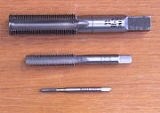
A tap cuts a thread on the inside surface of a hole, creating a female surface which functions like a nut
Nut (hardware)

A nut is a type of hardware fastener with a screw thread hole. Nuts are almost always used opposite a mating screw#Bolt to fasten a stack of parts together....
. The three taps in the image illustrate the basic types commonly used by most machinist
Machinist

A machinist is a person who uses machine tools to make or modify parts, primarily metal parts, a process known as machining. This is accomplished by using machine tools to cut away excess material much as a woodcarver cuts away excess wood to produce his work....
s:

  • Bottoming tap or plug tap: The tap illustrated in the top of the image has a continuous cutting edge with no taper. This feature enables a bottoming tap to cut threads to the bottom of a blind hole. A bottoming tap is never used to cut threads in an unthreaded hole, as the cutting edges lack the taper required to successfully start into such a hole. In the US they are commonly known as bottoming taps, but in Australia and Britain they are also known as plug taps.


  • Intermediate tap, second tap, or plug tap: The tap illustrated in the middle of the image has tapered cutting edges, which assist in aligning and starting the tap into an untapped hole. Plug taps are the most commonly used type of tap. In the US they are commonly known as plug taps, whereas in Australia and Britain they commonly known as second taps.


  • Taper tap: The small tap illustrated at the bottom of the image is similar to a plug tap but has a more pronounced taper to the cutting edges. This feature gives the taper tap a very gradual cutting action that is less aggressive than that of the plug tap. A taper tap is most often used when the material to be tapped is difficult to work (e.g., alloy steel) or the tap is of a very small diameter and thus prone to breakage.


The above illustrated taps are generally referred to as hand taps, since they are, by design, intended to be manually operated. During operation, it is necessary with a hand tap to periodically reverse rotation to break the chip formed during the cutting process, thus preventing an effect called "crowding" that may cause breakage. Periodic reversing is usually not practical when power tapping is involved, and thus has led to the development of taps suitable for continuous rotation in the cutting direction.

The most common type of power driven tap is the "spiral point" plug tap (also referred to as a "gun tap"), whose cutting edges are angularly displaced relative to the tap centerline. This feature causes the tap to continuously break the chip and eject it into the flutes, preventing crowding. Another version of the spiral point plug tap is the spiral flute
Flute (cutting tool)

A cutting tool flute is a recessed portion of the tool's cross-section that conveys chips away from a cutting edge as the tool rotates. In the common drill bit#Twist_drill, two flutes are usually provided, one for each cutting edge....
 tap, whose flutes
Flute (cutting tool)

A cutting tool flute is a recessed portion of the tool's cross-section that conveys chips away from a cutting edge as the tool rotates. In the common drill bit#Twist_drill, two flutes are usually provided, one for each cutting edge....
 resemble those of a twist drill
Drill bit

Drill bits are cutting tools used to create cylindrical holes. Bits are held in a tool called a drill, which rotates them and provides torque and axial force to create the hole....
. Spiral flute taps are widely used in high speed, automatic tapping operations due to their ability to work well in blind holes.

Whether manual or automatic, the processing of tapping begins with forming and slightly countersink
Countersink

A countersink is a Cone hole cut into a manufactured object, or the cutter used to cut such a hole. A common usage is to allow the head of a countersunk bolt or screw, when placed in the hole, to sit flush with or below the surface of the surrounding material....
ing a hole (usually by drilling
Drill bit

Drill bits are cutting tools used to create cylindrical holes. Bits are held in a tool called a drill, which rotates them and provides torque and axial force to create the hole....
) with a diameter slightly smaller than the tap's major diameter
Major diameter

Sorry, no overview for this topic
. The correct hole diameter may be determined by consulting a drill and tap size chart
Drill and tap size chart

Below is a comprehensive drill and tap size chart for all drills, Imperial unit and Metric system, and taps up to 36.5 mm. A version is available as a quick reference....
, a standard reference item found in many machine shops. If the hole is to be drilled, the proper diameter is called the tap drill
Drill bit

Drill bits are cutting tools used to create cylindrical holes. Bits are held in a tool called a drill, which rotates them and provides torque and axial force to create the hole....
 size.

In lieu of a tap drill chart
Drill and tap size chart

Below is a comprehensive drill and tap size chart for all drills, Imperial unit and Metric system, and taps up to 36.5 mm. A version is available as a quick reference....
, it is possible with inch sized taps to compute the correct tap drill
Drill bit

Drill bits are cutting tools used to create cylindrical holes. Bits are held in a tool called a drill, which rotates them and provides torque and axial force to create the hole....
 diameter as follows:

where is the tap drill
Drill bit

Drill bits are cutting tools used to create cylindrical holes. Bits are held in a tool called a drill, which rotates them and provides torque and axial force to create the hole....
 size, is the major diameter
Major diameter

Sorry, no overview for this topic
 of the tap (e.g., ? inch for a ?"-16 tap), and is the number of threads per inch (16 in the case of a ?"-16 tap). For a ?"-16 tap, the above formula would produce as a result, which is the correct tap drill
Drill bit

Drill bits are cutting tools used to create cylindrical holes. Bits are held in a tool called a drill, which rotates them and provides torque and axial force to create the hole....
 diameter for a ?"-16 tap. The result produces a tap drill
Drill bit

Drill bits are cutting tools used to create cylindrical holes. Bits are held in a tool called a drill, which rotates them and provides torque and axial force to create the hole....
 size that results in an approximate 75 percent thread (recommended for most applications).

With soft or average hardness materials, such as plastic
Plastic

Plastic is the general common term for a wide range of synthetic or semisynthetic organic chemistry solid materials suitable for the manufacture of industrial products....
, aluminum or carbon steel, the common practice is to use a plug tap to cut the threads. If the threads are to extend to the bottom of a blind hole, the plug tap will be used to cut threads until the point of the tap reaches bottom, after which a bottoming tap will be used to finish the hole. Frequent ejection of the chips must be made in such an operation to avoid jamming and possibly breaking the tap.

With hard materials, the machinist
Machinist

A machinist is a person who uses machine tools to make or modify parts, primarily metal parts, a process known as machining. This is accomplished by using machine tools to cut away excess material much as a woodcarver cuts away excess wood to produce his work....
 may start with a taper tap, whose less severe diameter transition reduces the amount of torque required to cut the threads. If threads are to be cut to the bottom of a blind hole, the taper tap will be followed by an intermediate (plug) tap and then a bottoming tap to finish the operation.

In metal working, the use of a tap lubricant
Lubricant

A lubricant is a substance introduced between two moving surfaces to reduce the friction between them, improving efficiency and reducing wear....
 is essential to achieve cleanly formed threads and to minimize friction. Failure to use the correct lubricant
Lubricant

A lubricant is a substance introduced between two moving surfaces to reduce the friction between them, improving efficiency and reducing wear....
 may result in ragged threads, as well as a substantial increase in the amount of torque
Torque

Torque is the tendency of a force to rotate an object about an axis . Just as a force is a push or a pull, a torque can be thought of as a twist....
 required to turn the tap, possibly resulting in breakage.

Practical use and safety with taps is discussed in the tap wrench
Tap wrench

A tap wrench is a hand tool used to operate any small tool that has a square driving head as part of its body. These are usually cutting tools, of which the most common are Taps and dies....
 article.

Machine tapping


Tapping is essentially the internal threading of a hole. This may either be achieved by hand tapping by using a set of taps (first tap, second tap & final (finish) tap or using a machine to do the tapping, such as a lathe
Lathe

A lathe is a machine tool which spins a block of material to perform various operations such as cutting, sanding, knurling, drilling, or Deformation_ with tools that are applied to the workpiece to create an object which has rotational symmetry about an axis of rotation....
, radial drill
Drill

A drill is a tool with a rotating drill bit used for drilling holes in various materials. Drills are commonly used in woodworking, metalworking, construction and most "Do it yourself" projects....
ing machine, bench type drill M/c, pillar type drill M/c, vertical milling
Milling

Milling may refer to:*Grinding grain or other materials in a mill *Cutting and shaping materials into products with milling machines*Part of the leather crusting process...
 machines, HMCs, VMCs. Machine tapping is faster, generally more accurate as human error is eliminated, final tapping is achieved with single tap.

Although in general machine tapping is more accurate, tapping operations have traditionally been very tricky to execute due to frequent tap breakage & inconsistent quality of tapping.

Research has shown that the important reasons causing tap breakage are as follows:

  • Tap related problems:
    • Wearing of tap cannot be easily quantified (use of worn out taps)
    • Use of tap with improper tap geometry for a particular application.
    • Use of non standard/inferior quality taps.
  • Chip clogging
  • Tapping does not follow the pre-tap hole (misalignment)
  • Mismatch of machine feed & tap feed may cause the tap to break in tension/compression.
  • Use of improper cutting fluid.
  • No safety mechanism to limit torque
    Torque

    Torque is the tendency of a force to rotate an object about an axis . Just as a force is a push or a pull, a torque can be thought of as a twist....
     below torque breakage value of tap.


In order to overcome these problems special tool holders are required to minimize the chances of tap breakage during tapping.

These are usually classified as conventional tool holders & CNC tool holders. Addressed in detail in section below.

Precautions to be taken while tapping


  1. Taps have self feed (Taps once engaged get pulled into the job) due to helical angle & hence length compensation arrangement is required in tool holder to avoid breakage of tap.
  2. High carbon taps should not be used as they cannot sustain high speed. These were used for hand tapping earlier.
  3. Only HS taps should be used.
  4. In order to retract tap from the hole, the machine should be reversible.
  5. Proper cutting compound should be used during tapping.


Tool holders for tapping operations


Various tool holders may be used for tapping depending on the requirements of the user:

Aids for hand-tapping (simple jigs and fixtures)


The biggest problem with simple hand-tapping is accurately aligning the tap with the hole so that they are coaxial—in other words, going in straight instead of on an angle. The operator must get this alignment rather close to ideal in order to (a) produce good threads and (b) avoid tap breakage. The deeper the depth of thread, the more pronounced the effect of the angular error becomes. With a depth of 1 or 2 diameters, it matters little. With depths beyond 2 diameters, the error becomes too pronounced to ignore. Another fact about this alignment task is that the first thread or two that is cut establishes the direction that the rest of the threads will follow. In other words, you can't make corrections to the angle once you have cut the first thread or two.

To help with this alignment task, several kinds of jigs
Jig (tool)

A jig is any of a large class of tools in woodworking, metalworking, and some other crafts that help to control the location or motion of a tool....
 and fixtures
Fixture (tool)

A fixture is a tool of the manufacturing industry used in mass production. Fixtures are used to hold objects in place and clamp them to machines or operating surfaces, so that the object can be machined or assembled....
 can be used to provide the correct geometry (i.e., accurate coaxiality with the hole) without having to use freehand skill to approximate it:

  • Hand-tapper: A simple fixture
    Fixture (tool)

    A fixture is a tool of the manufacturing industry used in mass production. Fixtures are used to hold objects in place and clamp them to machines or operating surfaces, so that the object can be machined or assembled....
     analogous to an arbor press in its basic shape. Its spindle is thus held accurately perpendicular to the work. Standard taps are held in the spindle, and the operator turns the spindle manually via a handlebar. This fixture obviates the need for the operator to carefully and skillfully approximate perpendicularity, which even for a skilled operator can easily result in a 2°-5° error.
  • Tapping guide, or "tap and reamer aligner/holder", a simple conical guide slipped over a tap when using a regular tap handle. As with a hand-tapper, the basic principle is simply that of a jig or fixture to provide the correct alignment.


Heads for machine tool spindles

  • Tapping attachments: these may be normal (available in a range of tap sizes) or quick-change
  • Quick-change drilling & tapping chucks (variations available for both CNC & manual-control tools)
  • Rigid tapping attachments (for CNC)


Generally the following features are required of tapping holders:

  • Twin chucking: tap is held both, on diameter as well as on the square thus giving it positive drive.
  • Safety clutch: The built in safety mechanism, operates as soon as the set torque limit is crossed & save the tap from breakage.
  • Float radial parallel: small misalignments are taken care of by this float.
  • Length compensation: built in length compensation takes care of small push or pull to the spindle or feed difference.


Tapping case studies with typical examples of tapping operations in various environments are shown on source machinetoolaid.com

Tapping stations

  • Tapping stations are worktables with a tapping head attached to the end of a pantograph
    Pantograph

    A pantograph is a Linkage connected in a special manner based on parallelograms so that the movement of one specified point is an amplified version of the movement of another point....
    -style arm similar to that of a balanced-arm lamp. The operator guides the tapping head to each (already-drilled) hole and quickly taps it.
  • Drilling and tapping centers, whose name sounds similar to that of tapping stations, are actually light-duty, affordable machining center
    Milling machine

    A milling machine is a machine tool used for the shaping of metal and other solid materials. Its basic form is that of a rotating cutter which rotates about the spindle axis , and a table to which the workpiece is affixed....
    s of 2, 2.5, or 3 axes that are designed for a life of mainly drilling and tapping with limited milling use.


Die

Threadingdies
The die cuts a thread on a preformed cylindrical rod, which creates a male threaded piece which functions like a bolt
Screw

A screw is a shaft with a helix groove or screw thread formed on its surface and provision at one end to turn the screw. Its main uses are as a threaded fastener used to hold objects together, and as a simple machine used to translate torque into linear force....
. The dies shown are
  • top left: an older split die, with top adjusting screw
  • bottom left: a one piece die with top adjusting screw
  • center: a one piece die with side adjusting screw (barely visible on the full image)
  • right: two dies without adjusting screws


A cylindrical blank, which is usually slightly less than the required diameter, is machined with a taper
Machine taper

A machine taper is a system for securing cutting bits and other accessories to a machine tool's powered rotating spindle....
 (chamfer) at the threaded end. This chamfer allows the die to ease onto the blank before it cuts a sufficient thread to pull itself along.

The adjusting screws allow the die to be compressed or expanded to accommodate slight variations in size, due to material, manufacture, or die sharpness. The two rightmost dies shown in the image have no adjusting screws. However the die holder can exert pressure and decrease the size if required.

Each tool is used independently, but are usually sold in paired sets of both types, one die and three taps. Some sets may provide a lesser number of taps. The common sets shown are designed for hand operation, but different types such as helical or spiral may be used in production tools such as CNC machining tools.

Tap drill bit size table


Imperial Tap & drill bit size table Metric Tap & drill bit size table
Tap Fractional Drill Bit Number Drill Bit Letter Drill Bit
0-80 3/64 - -
1-64 - 53 -
2-56 - 50 -
3-48 - 47 -
4-40 3/32 43 -
5-40 - 38 -
6-32 7/64 36 -
8-32 - 29 -
10-24 5/32 25 -
10-32 5/32 21 -
12-24 11/64 16 -
1/4-20 13/64 7 -
1/4-28 7/32 3 -
5/16-18 17/64 - F
5/16-24 - - I
3/8-16 5/16 - -
3/8-24 21/64 - Q
7/16-14 23/64 - U
7/16-20 25/64 - -
1/2-13 27/64 - -
1/2-20 29/64 - -
9/16-12 31/64 - -
9/16-18 33/64 - -
5/8-11 17/32 - -
5/8-18 37/64 - -
3/4-10 21/32 - -
3/4-16 11/16 - -
Drill sizes are for 75% depth of thread.
Tap Metric Drill Imperial Drill
3 mm x 0.5 2.5 mm -
4 mm x 0.7 3.4 mm -
5 mm x 0.8 4.3 mm -
6 mm x 1.0 5.0 mm -
7 mm x 1.0 6.1 mm 15/64
8 mm x 1.25 6.9 mm 17/64
8 mm x 1.0 7.1 mm -
10 mm x 1.5 8.7 mm -
10 mm x 1.25 8.8 mm 11/32
10 mm x 1.0 9.1 mm -
12 mm x 1.75 10.5 mm -
12 mm x 1.5 10.7 mm 27/64
14 mm x 2.0 12.2 mm -
14 mm x 1.5 12.7 mm -
16 mm x 2.0 14.2 mm 35/64
16 mm x 1.5 14.7 mm -
Drill sizes are for 75% depth of thread.


Pipe

Threaded pipe
Threaded pipe

A threaded pipe is a Pipe with screw-threaded ends for assembly....
 is often used in plumbing and pneumatic applications. Because pipe joints must form a seal, the threaded portion is slightly conical rather than cylindrical. As a result, threaded pipe requires specialized taps and dies. Conventional pipe threads must be assembled with pipe dope
Pipe dope

Pipe dope is slang for anaerobic chemical sealant that is used to make a pipe thread joint leak proof and pressure tight. Although common pipe threads are tapered and therefore will achieve an interference fit during proper assembly, machining and finishing variances usually result in a fit that does not result in 100 percent contact between...
 in order to achieve a leak proof seal.

A modified form of the basic pipe thread shape is the Dry-Seal thread. The Dry-Seal thread is formed so that during assembly, the tips of the male threads are slightly crushed into the roots of the female threads, effecting, in theory, a liquid-tight fit. In practice, a small amount of pipe dope
Pipe dope

Pipe dope is slang for anaerobic chemical sealant that is used to make a pipe thread joint leak proof and pressure tight. Although common pipe threads are tapered and therefore will achieve an interference fit during proper assembly, machining and finishing variances usually result in a fit that does not result in 100 percent contact between...
 is usually necessary to assure a pressure-tight seal, and to prevent galling
Galling

Galling, according to ASTM standard G40 , is: ?a form of surface damage arising between sliding solids, distinguished by microscopic, usually localized, roughening and creation of protrusions above the original surface?....
 of the mating parts.

BSP (British Standard Pipe) parallel threads are available in sizes 1/8, 1/4, 3/8, 1/2, 5/8, 3/4, 1 inch. They are also available in Tapered thread-form and called BSPT (British Standard Pipe Tapered) for British pipe sizes. North American equivalents to BSPT are called NPT (National Pipe Tapered), and range from 1/16 inch through large integral
Integer

The integers are natural numbers including 0 and their negative and non-negative numberss . They are numbers that can be written without a fractional or decimal component, and fall within the set ....
 sizes. Although BSPT and NPT are functionally identical, they are not mechanically interchangeable.

Rolled and formed threads

Not all threads are made by cutting. In large production runs or where great strength is required, the threads may be rolled (male) or formed (female).

In the case of the tap there are no cutting edges but instead the tap is lobed. The tap is forced into the hole and the material is deformed by the lobes into the required thread form. The male portion (bolt) is fed between rollers that have the full thread form ground into their outer diameter. The action of feeding the rollers into the work piece deforms the material into the required shape.

Rolled or formed threads have the advantage of increased strength (the material flows into shape via cold forming
Cold forming

Cold forming is a metalworking process in which metal is shaped at a temperature below its recrystallization temperature, usually at the ambient temperature....
) along with reduced material cost as the bar or rod used is actually smaller than the finished size due to the material squeezing into shape.

A
Roll tap is especially effective when driven by machinery, whether in a hand-fed vertical mill or in fully automatic machinery. Since the tap does not produce chips, there is no need to periodically back out the tap to clear away chips, which in a cutting tap can jam and cause tap breakage. Also, since no chips are produced the tap need not be reverse driven a short distance to break the chips, as is done when hand tapping with a cutting tap. Thus the roll tap can be driven in one run to the full length of the tap, but with precaution to not overdrive in depth when the hole is not completely through the workpiece. Note that the tap drill size differs from that used for a cutting tap and that proper lubrication is essential. Depending upon the metal tapped, a roll tap may produce a stronger base for the screw used since some amount of work hardening
Work hardening

Work hardening, strain hardening, or cold work is the strength of materials by, macroscopically speaking, plastic deformation . As the material becomes increasingly saturated with new dislocations, more dislocations are prevented from nucleating ....
 may occur, not present when the threads are cut with a conventional tap.

Thread classes and callouts

The Unified and American National Threads callout for a thread is usually shown as follows: 4-40UNF-2A or 1/4"-20UNC-2B
Where (A) - (B) (C) - (D) (E) mean the following:
A: major diameter of the thread in inches (or No. size)
B: threads per inch
C: Unified Nation Coarse(UNC) or Unified Nation Fine(UNF)
D: class of fit. 1 for loose tolerance. 2 for general purpose. 3 for tight tolerance
E: external or internal threads - A for external - B for internal

Metric threads are usually called out as follows: M5X0.8-6g
Where M (A) X (B) - (C) (D) mean the following:
M: ISO metric thread
A: nominal major diameter in millimeters
B: thread pitch in millimeters (distance from crest to crest on thread)
C: tolerance from 3 to 9. 3 being fine. 9 being coarse.
D: thread class as E,G or H. E being large allowance. G being tight allowance. H being no allowance. External threads are shown as lower-case e,g,or h. Internal threads are shown as upper-case E,G,or H.

Lubricants


The use of a suitable lubricant is essential with most tapping and reaming operations. Recommended lubricants for some common materials are as follows:

Carbon steel: Petroleum
Petroleum

Petroleum or crude oil is a naturally occurring, flammable liquid found in rock formations in the Earth consisting of a complex mixture of hydrocarbons of various molecular weights, plus other organic compounds....
-based or synthetic
Chemical synthesis

In chemistry, chemical synthesis is purposeful execution of chemical reactions in order to get a product , or several products. This happens by physics and chemical manipulations usually involving one or more reactions....
 cutting oil. Alloy steel: Petroleum-based cutting oil mixed with a small amount (approximately 10%) of kerosene
Kerosene

Kerosene, sometimes spelled kerosine in scientific and industrial usage, also known as paraffin, is a combustible hydrocarbon liquid....
 or mineral spirits
Mineral spirits

Mineral Spirits, also called Stoddard solvent [CAS 8052-41-3], is a petroleum distilate commonly used as a paint thinner and mild solvent. Outside of the United States and Canada, it is referred to as white spirit....
. This mixture is also suitable for use with stainless steel
Stainless steel

In metallurgy, stainless steel is defined as a steel alloy with a minimum of 10% chromium content by mass. Stainless steel does not stain, corrode, or rust as easily as ordinary steel , but it is not stain-proof....
. Cast iron
Cast iron

Cast iron usually refers to Gray iron, but also identifies a large group of ferrous alloys, which solidify with a eutectic. The color of a fractured surface can be used to identify an alloy....
: No lubricant. An air blast should be used to clear chips. Aluminium
Aluminium

Aluminium or aluminum is a silvery white and ductile member of the boron group of chemical elements. It has the symbol Al; its atomic number is 13....
: Kerosene or mineral spirits mixed with a small amount (15-25%) of petroleum-based cutting oil. Other oils also work, including WD-40
WD-40

| genre = lubrication| foundation = 1953| location = San Diego, California| industry = lubrication| products = lubrication|...
, 3-In-One Oil
3-In-One Oil

3-in-One Oil is a general purpose lubricating oil sold in small cans and squeezable containers for home and do-it-yourself use. It was originally formulated in 1894....
, and mineral oil
Mineral oil

Mineral oil or liquid petroleumis a by-product in the distillation of petroleum to produce gasoline and other petroleum based products from crude oil....
. Brass
Brass

Brass is any alloy of copper and zinc; the proportions of zinc and copper can be varied to create a range of brasses with varying properties. In comparison, bronze is principally an alloy of copper and tin....
: Kerosene or mineral spirits. Bronze
Bronze

Bronze is a metal alloy consisting primarily of copper, usually with tin as the main additive, but sometimes with other chemical element such as phosphorus, manganese, aluminium, or silicon....
: Kerosene or mineral spirits mixed with a small amount (10-15%) of petroleum-based cutting oil.

In power tapping and reaming operations, the tool and workpiece should be continuously flooded with lubricant.

Other uses

An ordinary
tap and die can also be used for repairing threads in stripped holes or bolts. Die nuts are dies made for cleaning up old threads, they have no split for resizing and are made from a hexagonal bar so that a wrench
Wrench

A wrench or spanner is a tool used to provide a mechanical advantage in applying torque to turn screw, Nut or other items designed to interface with a wrench....
 or shifter spanner can be used to apply them (rather than the purpose built die wrench). Dienuts are only for cleaning threads (not for cutting threads).

Bibliography

  • .
  • .