

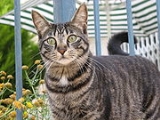
Tabby cat

Encyclopedia
A tabby is any cat
that has a distinctive coat that features stripes, dots, lines or swirling patterns, usually together with an "M" mark on its forehead. Tabbies are sometimes erroneously assumed to be a cat breed. In fact, the tabby pattern is found in many breeds of cat, as well as among the general mixed-breed population. The tabby pattern is a naturally occurring feature that may be related to the coloration of the domestic cat's direct ancestor, the African Wildcat.
In cat genetics, pattern is unrelated to color, and so the tabby coat pattern can show up in combination with a variety of coat colors, including tortoiseshell (Tortoiseshell Tabby cats are often called 'Torbies'). A cat's coat can be described as red tabby or gray tabby. Black and blue are colors that usually show up without tabby markings, but with some cats, a faint tabby pattern can actually be noticed. Bi-color cats can have the tabby pattern show up on the colored patches of their coat. For example, Tortoiseshell cats
sometimes display a pattern where the red-based and black-based tortoiseshell pattern is mixed with tabby markings. White spotting of any level can also appear in combination with tabby patterns; however, white is the only coat color that does not have any tabby markings.
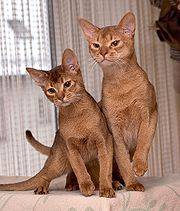 There are four tabby patterns that have been shown to be genetically distinct:
A fifth includes tabby as part of another basic color pattern, the "patched" tabby, which may be a calico or tortoiseshell
cat with tabby patches (the latter is called a "torbie").
All those patterns have been observed in random-bred populations. Several additional patterns are found in specific breeds. A modified Classic Tabby is found in the Sokoke
breed. Some are due to the interaction of wild and domestic genes. Rosetted and marbled patterns are found in the Bengal
breed.
fish. Mackerel is the most common tabby pattern.
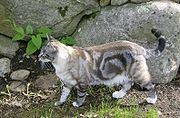
, Bengal
, Egyptian Mau
, Maine Coon
, and Ocicat
breeds.
loci and one modifier:
The agouti gene
, A/a, controls whether or not the tabby pattern is expressed. The dominant A reveals the underlying tabby pattern, while the recessive non-agouti or "hypermelanistic" allele, a, prevents it. Solid-color (black or blue) cats have the aa combination, hiding the tabby pattern, although sometimes a suggestion of the underlying pattern can be seen (called "ghost striping"). However, the O gene for orange color suppresses the aa genotype, so there is no such thing as a solid orange cat.
The primary tabby pattern gene, Mc/mc, sets the basic pattern of stripes that underlies the coat. Mc is the wild-type tabby gene and produces what is called a 'Mackerel Striped' Tabby. 'Classic' Tabbies are cats who also possess mc, a recessive mutant gene that produces the blotched pattern.
The Ticked Tabby pattern is on a different gene locus than the Mackerel and Classic Tabby patterns and is epistatic
to the other patterns. A dominant mutation, Ta / ta, masks any other Tabby pattern, producing a non-patterned, or 'Agouti' Tabby, with virtually no stripes or bars. If the Ticked Tabby pattern gene is present, any other tabby pattern is masked. Cats homozygous for the ticked allele
(Ta / Ta) have less barring than cats heterozygous for the ticked allele. When a cat of this genetic make up is selectively bred for lack of barring and wide banding on the hair shaft the resulting pattern is referred to as shaded.
noted that William Laud
, the Archbishop of Canterbury
was "a great lover of Catts " and "was presented with some Cyprus
-catts, i.e. our Tabby-catts". He then claimed that "I doe well remember that the common English Catt, was white with some blewish piednesse : sc, a gallipot blew. The race or breed of them are now almost lost."
Cat
The cat , also known as the domestic cat or housecat to distinguish it from other felids and felines, is a small, usually furry, domesticated, carnivorous mammal that is valued by humans for its companionship and for its ability to hunt vermin and household pests...
that has a distinctive coat that features stripes, dots, lines or swirling patterns, usually together with an "M" mark on its forehead. Tabbies are sometimes erroneously assumed to be a cat breed. In fact, the tabby pattern is found in many breeds of cat, as well as among the general mixed-breed population. The tabby pattern is a naturally occurring feature that may be related to the coloration of the domestic cat's direct ancestor, the African Wildcat.
In cat genetics, pattern is unrelated to color, and so the tabby coat pattern can show up in combination with a variety of coat colors, including tortoiseshell (Tortoiseshell Tabby cats are often called 'Torbies'). A cat's coat can be described as red tabby or gray tabby. Black and blue are colors that usually show up without tabby markings, but with some cats, a faint tabby pattern can actually be noticed. Bi-color cats can have the tabby pattern show up on the colored patches of their coat. For example, Tortoiseshell cats
Tortoiseshell cat
Tortoiseshell describes a coat coloring found mostly in female cats. Cats of this color are mottled, with patches of orange or cream and chocolate, black or blue. They are sometimes called torties...
sometimes display a pattern where the red-based and black-based tortoiseshell pattern is mixed with tabby markings. White spotting of any level can also appear in combination with tabby patterns; however, white is the only coat color that does not have any tabby markings.
Tabby patterns
- mackerel
- classic
- spotted
- ticked
A fifth includes tabby as part of another basic color pattern, the "patched" tabby, which may be a calico or tortoiseshell
Tortoiseshell cat
Tortoiseshell describes a coat coloring found mostly in female cats. Cats of this color are mottled, with patches of orange or cream and chocolate, black or blue. They are sometimes called torties...
cat with tabby patches (the latter is called a "torbie").
All those patterns have been observed in random-bred populations. Several additional patterns are found in specific breeds. A modified Classic Tabby is found in the Sokoke
Sokoke
The Sokoke is a breed of cat. The original name of the breed was Khadzonzos. This name was given to the cat by the local people, the Giriama tribe, who had known of the cat for a considerable time. It is speculated that this breed of cat had been around for possibly centuries before the...
breed. Some are due to the interaction of wild and domestic genes. Rosetted and marbled patterns are found in the Bengal
Bengal (cat)
The Bengal is a relatively new hybrid breed of cat, formed by the cross of a domestic feline and an Asian Leopard Cat .Bengal cats have "wild-looking" markings, such as large spots, rosettes, and a light/white belly, and a body structure reminiscent of the Asian Leopard Cat...
breed.
Mackerel tabby
The Mackerel Tabby pattern has vertical, gently curving stripes on the side of the body. The stripes are narrow, and may be continuous or broken into bars and spots on the flanks and stomach. Often, an 'M' shape appears on the forehead. Mackerels also feature a 'peppered' nose, where black spots appear along the pink tip of the nose. Mackerels are also called 'Fishbone Tabbies' probably because they are named after the mackerelMackerel
Mackerel is a common name applied to a number of different species of fish, mostly, but not exclusively, from the family Scombridae. They may be found in all tropical and temperate seas. Most live offshore in the oceanic environment but a few, like the Spanish mackerel , enter bays and can be...
fish. Mackerel is the most common tabby pattern.
Classic tabby
The most commonly identified kind of tabby, the Classic (or 'Blotched') Tabby, tends to have a pattern of dark browns, ochres, and black. The uniform or nearly uniform striping around the circumference of the tail indicates feral origins in that particular cat's family tree. Classic Tabbies have an 'M' pattern on the head similar to that of Mackerel Tabbies, but the body markings are different, having a whirled and swirled pattern with wider stripes that make what are referred to as "butterfly" patterns on their shoulders, and usually a bullseye or oyster pattern on the flank. The legs and tail are more heavily barred and the pattern is variable with respect to the width of the bands.Ticked tabby
The Ticked Tabby pattern produces hairs with distinct bands of color on them, breaking up the tabby patterning into a salt-and-pepper appearance. Residual ghost striping or "barring" can often be seen on the lower legs, face and belly and sometimes at the tail tip.Spotted tabby
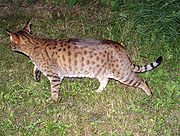
The Spotted Tabby may not be a true pattern, but a modifier that breaks up the Mackerel Tabby pattern so that the stripes appear as spots. Similarly, the stripes of the Classic Tabby pattern may be broken into larger spots. Both large spot and small spot patterns can be seen in the Australian MistAustralian Mist
The Australian Mist is a breed of cat developed in Australia.-History:This breed was developed by Dr Truda Straede in Australia commencing in 1976, hence its name. The breed was developed by crossing the Burmese, Abyssinian, and Domestic shorthair cats to create a shorthaired cat with a spotted coat...
, Bengal
Bengal Cat
Bengal Cat may refer to:*Leopard Cat*Bengal , a domestic cat breed...
, Egyptian Mau
Egyptian Mau
Egyptian Maus are a small-medium sized short-haired cat breed. Along with the Bahraini Dilmun Cat, they are one of the few naturally spotted breeds of domesticated cat. The spots on an Egyptian Mau are not only on the coat; a shaved Mau has spots on its skin...
, Maine Coon
Maine Coon
The Maine Coon is a breed of domestic cat with a distinctive physical appearance and valuable hunting skills. It is one of the oldest natural breeds in North America, specifically native to the state of Maine, where it is the official State Cat....
, and Ocicat
Ocicat
The Ocicat is an all-domestic breed of cat which resembles a 'wild' cat but has no wild blood. The breed is unusual in that it is spotted like a wild cat but has the temperament of a domestic animal. It is named for its resemblance to the ocelot....
breeds.
Genetic explanations
The tabby patterns are due to 3 distinct geneGene
A gene is a molecular unit of heredity of a living organism. It is a name given to some stretches of DNA and RNA that code for a type of protein or for an RNA chain that has a function in the organism. Living beings depend on genes, as they specify all proteins and functional RNA chains...
loci and one modifier:
The agouti gene
Agouti gene
The Agouti gene is responsible for determining whether a mammal's coat is banded or of a solid color . The chief product of the Agouti gene is Agouti signalling peptide , but there are a number of alternative splice products....
, A/a, controls whether or not the tabby pattern is expressed. The dominant A reveals the underlying tabby pattern, while the recessive non-agouti or "hypermelanistic" allele, a, prevents it. Solid-color (black or blue) cats have the aa combination, hiding the tabby pattern, although sometimes a suggestion of the underlying pattern can be seen (called "ghost striping"). However, the O gene for orange color suppresses the aa genotype, so there is no such thing as a solid orange cat.
The primary tabby pattern gene, Mc/mc, sets the basic pattern of stripes that underlies the coat. Mc is the wild-type tabby gene and produces what is called a 'Mackerel Striped' Tabby. 'Classic' Tabbies are cats who also possess mc, a recessive mutant gene that produces the blotched pattern.
The Ticked Tabby pattern is on a different gene locus than the Mackerel and Classic Tabby patterns and is epistatic
Epistasis
In genetics, epistasis is the phenomenon where the effects of one gene are modified by one or several other genes, which are sometimes called modifier genes. The gene whose phenotype is expressed is called epistatic, while the phenotype altered or suppressed is called hypostatic...
to the other patterns. A dominant mutation, Ta / ta, masks any other Tabby pattern, producing a non-patterned, or 'Agouti' Tabby, with virtually no stripes or bars. If the Ticked Tabby pattern gene is present, any other tabby pattern is masked. Cats homozygous for the ticked allele
Allele
An allele is one of two or more forms of a gene or a genetic locus . "Allel" is an abbreviation of allelomorph. Sometimes, different alleles can result in different observable phenotypic traits, such as different pigmentation...
(Ta / Ta) have less barring than cats heterozygous for the ticked allele. When a cat of this genetic make up is selectively bred for lack of barring and wide banding on the hair shaft the resulting pattern is referred to as shaded.
Etymology
The English term "tabby" comes from the French tabis, "striped silk taffeta", "a rich, watered silk," from Middle French atabis (14c.), from Arabic attabiya, from Attabiy, a neighborhood of Baghdad where such cloth was first made, named for prince 'Attab of the Umayyad dynasty.History
Since the tabby pattern is a common wild type, it might be assumed that medieval cats were of tabby type. However, one writer believed this to be untrue, at least in England. Some time after the mid-17th century, the curious antiquary John AubreyJohn Aubrey
John Aubrey FRS, was an English antiquary, natural philosopher and writer. He is perhaps best known as the author of the collection of short biographical pieces usually referred to as Brief Lives...
noted that William Laud
William Laud
William Laud was Archbishop of Canterbury from 1633 to 1645. One of the High Church Caroline divines, he opposed radical forms of Puritanism...
, the Archbishop of Canterbury
Archbishop of Canterbury
The Archbishop of Canterbury is the senior bishop and principal leader of the Church of England, the symbolic head of the worldwide Anglican Communion, and the diocesan bishop of the Diocese of Canterbury. In his role as head of the Anglican Communion, the archbishop leads the third largest group...
was "a great lover of Catts " and "was presented with some Cyprus
Cyprus
Cyprus , officially the Republic of Cyprus , is a Eurasian island country, member of the European Union, in the Eastern Mediterranean, east of Greece, south of Turkey, west of Syria and north of Egypt. It is the third largest island in the Mediterranean Sea.The earliest known human activity on the...
-catts, i.e. our Tabby-catts". He then claimed that "I doe well remember that the common English Catt, was white with some blewish piednesse : sc, a gallipot blew. The race or breed of them are now almost lost."