


Szeged Synagogue

Encyclopedia
Szeged
' is the third largest city of Hungary, the largest city and regional centre of the Southern Great Plain and the county town of Csongrád county. The University of Szeged is one of the most distinguished universities in Hungary....
, Hungary
Hungary
Hungary , officially the Republic of Hungary , is a landlocked country in Central Europe. It is situated in the Carpathian Basin and is bordered by Slovakia to the north, Ukraine and Romania to the east, Serbia and Croatia to the south, Slovenia to the southwest and Austria to the west. The...
. It is a 1907 building designed by the Jewish Hungarian architect Lipót Baumhorn
Lipót Baumhorn
Lipót Baumhorn was a Hungarian architect.- Career :Baumhorn studied in Vienna under Freiherr von Ferstel, who was the designer of the Votive Church there. He set up a practice after further study under Ödön Lechner. His style ranged from historicism to those inspired by the rising nationalism of...
(1860–1932,), whose work is considered to contain the finest examples of the unique fin de siecle Hungarian blending of Art Nouveau
Art Nouveau
Art Nouveau is an international philosophy and style of art, architecture and applied art—especially the decorative arts—that were most popular during 1890–1910. The name "Art Nouveau" is French for "new art"...
and Historicist styles sometimes known as Magyar style.
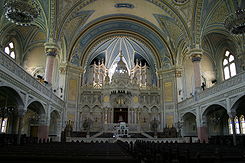
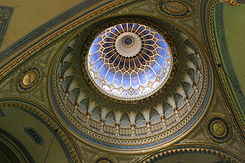
The building's interior, with its 48.5 meter (158,5 feet) tall domed ceiling, draws on multiple historical styles to produce its overall Art Nouveau/Moorish Revival
Moorish Revival
Moorish Revival or Neo-Moorish is one of the exotic revival architectural styles that were adopted by architects of Europe and the Americas in the wake of the Romanticist fascination with all things oriental...
style. The rib-like wall above the organ has Gothic origins, while the columns supporting the galleries are Roman.
The interior of the great dome, and all of the building's stained glass, are the work of the artist Miksa Róth.
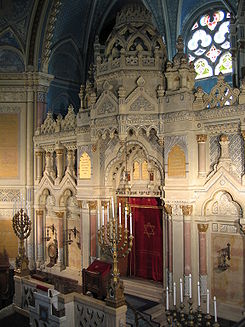
The design of the Torah Ark alludes to the Holy of Holies in the Temple of Solomon by using sittimwood from the banks of Nile
Nile
The Nile is a major north-flowing river in North Africa, generally regarded as the longest river in the world. It is long. It runs through the ten countries of Sudan, South Sudan, Burundi, Rwanda, Democratic Republic of the Congo, Tanzania, Kenya, Ethiopia, Uganda and Egypt.The Nile has two major...
, the wood called for in the building of the Temple of Solomon in 1 Kings. The hinges are in the shape of the Hysop plant, a plant used in the ancient Temple service.