


Syntax of programming languages

Encyclopedia

Computer science
Computer science or computing science is the study of the theoretical foundations of information and computation and of practical techniques for their implementation and application in computer systems...
, the syntax of a programming language
Programming language
A programming language is an artificial language designed to communicate instructions to a machine, particularly a computer. Programming languages can be used to create programs that control the behavior of a machine and/or to express algorithms precisely....
is the set of rules that define the combinations of symbols that are considered to be correctly structured program
Computer program
A computer program is a sequence of instructions written to perform a specified task with a computer. A computer requires programs to function, typically executing the program's instructions in a central processor. The program has an executable form that the computer can use directly to execute...
s in that language. The syntax of a language defines its surface form. Text-based programming languages are based on sequences of characters, while visual programming languages are based on the spatial layout and connections between symbols (which may be textual or graphical).
The lexical grammar
Lexical grammar
In computer science, a lexical grammar can be thought of as the syntax of tokens. That is, the rules governing how a character sequence is divided up into subsequences of characters, each part of which represents an individual token....
of a textual language specifies how characters must be chunked into tokens. Other syntax rules specify the permissible sequences of these tokens and the process of assigning meaning to these token sequences is part of semantics
Semantics
Semantics is the study of meaning. It focuses on the relation between signifiers, such as words, phrases, signs and symbols, and what they stand for, their denotata....
.
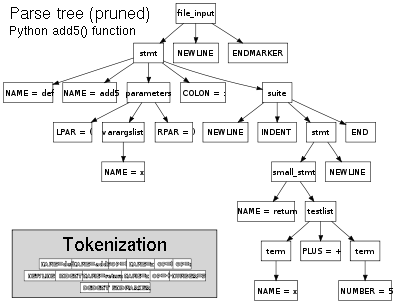
The syntactic analysis of source code usually entails the transformation of the linear sequence of tokens into a hierarchical syntax tree (abstract syntax tree
Abstract syntax tree
In computer science, an abstract syntax tree , or just syntax tree, is a tree representation of the abstract syntactic structure of source code written in a programming language. Each node of the tree denotes a construct occurring in the source code. The syntax is 'abstract' in the sense that it...
s are one convenient form of syntax tree). This process is called parsing
Parsing
In computer science and linguistics, parsing, or, more formally, syntactic analysis, is the process of analyzing a text, made of a sequence of tokens , to determine its grammatical structure with respect to a given formal grammar...
, as it is in syntactic analysis
Syntax
In linguistics, syntax is the study of the principles and rules for constructing phrases and sentences in natural languages....
in linguistics
Linguistics
Linguistics is the scientific study of human language. Linguistics can be broadly broken into three categories or subfields of study: language form, language meaning, and language in context....
. Tools have been written that automatically generate parsers from a specification of a language grammar written in Backus-Naur form, e.g., Yacc
Yacc
The computer program yacc is a parser generator developed by Stephen C. Johnson at AT&T for the Unix operating system. The name is an acronym for "Yet Another Compiler Compiler." It generates a parser based on an analytic grammar written in a notation similar to BNF.Yacc used to be available as...
(yet another compiler compiler).
Syntax definition
Regular expression
In computing, a regular expression provides a concise and flexible means for "matching" strings of text, such as particular characters, words, or patterns of characters. Abbreviations for "regular expression" include "regex" and "regexp"...
s (for lexical
Lexical analysis
In computer science, lexical analysis is the process of converting a sequence of characters into a sequence of tokens. A program or function which performs lexical analysis is called a lexical analyzer, lexer or scanner...
structure) and Backus-Naur Form (for grammatical
Context-free grammar
In formal language theory, a context-free grammar is a formal grammar in which every production rule is of the formwhere V is a single nonterminal symbol, and w is a string of terminals and/or nonterminals ....
structure) to inductively specify syntactic categories
Syntactic category
A syntactic category is either a phrasal category, such as noun phrase or verb phrase, which can be decomposed into smaller syntactic categories, or a lexical category, such as noun or verb, which cannot be further decomposed....
(nonterminals) and terminal symbols. Syntactic categories are defined by rules called productions, which specify the values that belong to a particular syntactic category. Terminal symbols are the concrete characters or strings of characters (for example keyword
Keyword (computer programming)
In computer programming, a keyword is a word or identifier that has a particular meaning to the programming language. The meaning of keywords — and, indeed, the meaning of the notion of keyword — differs widely from language to language....
s such as define, if, let, or void) from which syntactically valid programs are constructed.
Below is a simple grammar, based on Lisp
Lisp programming language
Lisp is a family of computer programming languages with a long history and a distinctive, fully parenthesized syntax. Originally specified in 1958, Lisp is the second-oldest high-level programming language in widespread use today; only Fortran is older...
, which defines productions for the syntactic categories expression, atom, number, symbol, and list:
expression ::= atom | list
atom ::= number | symbol
number ::= [+-]?['0'-'9']+
symbol ::= ['A'-'Z'
list ::= '(' expression* ')'
This grammar specifies the following:
- an expression is either an atom or a list;
- an atom is either a number or a symbol;
- a number is an unbroken sequence of one or more decimal digits, optionally preceded by a plus or minus sign;
- a symbol is a letter followed by zero or more of any characters (excluding whitespace); and
- a list is a matched pair of parentheses, with zero or more expressions inside it.
Here the decimal digits, upper- and lower-case characters, and parentheses are terminal symbols.
The following are examples of well-formed token sequences in this grammar: '
12345', '(a b c232 (1))'The grammar needed to specify a programming language can be classified by its position in the Chomsky hierarchy
Chomsky hierarchy
Within the field of computer science, specifically in the area of formal languages, the Chomsky hierarchy is a containment hierarchy of classes of formal grammars....
. The syntax of most programming languages can be specified using a Type-2 grammar, i.e., they are context-free grammar
Context-free grammar
In formal language theory, a context-free grammar is a formal grammar in which every production rule is of the formwhere V is a single nonterminal symbol, and w is a string of terminals and/or nonterminals ....
s. However, there are exceptions. In some languages like Perl and Lisp the specification (or implementation) of the language allows constructs that execute during the parsing phase. Furthermore, these languages have constructs that allow the programmer to alter the behavior of the parser. This combination effectively blurs the distinction between parsing and execution, and makes syntax analysis an undecidable problem
Undecidable problem
In computability theory and computational complexity theory, an undecidable problem is a decision problem for which it is impossible to construct a single algorithm that always leads to a correct yes-or-no answer....
in these languages, meaning that the parsing phase may not finish. For example, in Perl it is possible to execute code during parsing using a
BEGIN statement, and Perl function prototypes may alter the syntactic interpretation, and possibly even the syntactic validity of the remaining code. Similarly, Lisp macroMacro
A macro in computer science is a rule or pattern that specifies how a certain input sequence should be mapped to an output sequence according to a defined procedure...
s introduced by the
defmacro syntax also execute during parsing, meaning that a Lisp compiler must have an entire Lisp run-time system present. In contrast C macros are merely string replacements, and do not require code execution.Syntax versus semantics
The syntax of a language describes the form of a valid program, but does not provide any information about the meaning of the program or the results of executing that program. The meaning given to a combination of symbols is handled by semantics (either formalFormal semantics of programming languages
In programming language theory, semantics is the field concerned with the rigorous mathematical study of the meaning of programming languages and models of computation...
or hard-coded in a reference implementation). Not all syntactically correct programs are semantically correct. Many syntactically correct programs are nonetheless ill-formed, per the language's rules; and may (depending on the language specification and the soundness of the implementation) result in an error on translation or execution. In some cases, such programs may exhibit undefined behavior. Even when a program is well-defined within a language, it may still have a meaning that is not intended by the person who wrote it.
Using natural language
Natural language
In the philosophy of language, a natural language is any language which arises in an unpremeditated fashion as the result of the innate facility for language possessed by the human intellect. A natural language is typically used for communication, and may be spoken, signed, or written...
as an example, it may not be possible to assign a meaning to a grammatically correct sentence or the sentence may be false:
- "Colorless green ideas sleep furiouslyColorless green ideas sleep furiously"Colorless green ideas sleep furiously" is a sentence composed by Noam Chomsky in his 1957 Syntactic Structures as an example of a sentence that is grammatically correct but semantically nonsensical. The term was originally used in his 1955 thesis "Logical Structures of Linguistic Theory"...
." is grammatically well-formed but has no generally accepted meaning. - "John is a married bachelor." is grammatically well-formed but expresses a meaning that cannot be true.
The following C language fragment is syntactically correct, but performs an operation that is not semantically defined (because p is a null pointer, the operations p->real and p->im have no meaning):
complex *p = NULL;
complex abs_p = sqrt (p->real * p->real + p->im * p->im);
See also
- To quickly compare syntax of various programming languages take a look at the list of hello world program examplesHello world program examplesThe Hello world program is a simple computer program that prints the string "Hello World". It is typically one of the simplest programs possible in almost all computer languages, and often used as first program to demonstrate a programming language. As such it can be used to quickly compare syntax...
External links
- Various syntactic constructs used in computer programming languages