

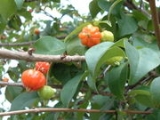
Surinam Cherry

Encyclopedia
The Surinam Cherry, Brazilian Cherry, or Cayenne Cherry (Eugenia uniflora) is a plant in the family Myrtaceae
, native to tropical America. Known as Pitanga throughout Brazil
or Ñangapirí in surrounding countries, it is a large shrub or small tree with a conical form, growing slowly to 8 meters in height. The leaves are glossy green, up to 4 cm long, and new leaves are copper-colored. Fragrant white flowers mature into reddish fruits up to 2 cm in diameter. The taste ranges from sweet to sour, depending on the cultivar
and level of ripeness (the darker red to black range is quite sweet, while the green to orange range is strikingly tart).
The Surinam Cherry is often used in gardens as a hedge or screen. The fruit is high in Vitamin C
, and its predominant food use is as a flavoring and base for jams and jellies. The tree was introduced to Bermuda
for ornamental purposes but is out of control, and is now listed as invasive in Bermuda.
For Brazilian Cherry also see Jatobá
.
Myrtaceae
The Myrtaceae or Myrtle family are a family of dicotyledon plants, placed within the order Myrtales. Myrtle, clove, guava, feijoa, allspice, and eucalyptus belong here. All species are woody, with essential oils, and flower parts in multiples of four or five...
, native to tropical America. Known as Pitanga throughout Brazil
Brazil
Brazil , officially the Federative Republic of Brazil , is the largest country in South America. It is the world's fifth largest country, both by geographical area and by population with over 192 million people...
or Ñangapirí in surrounding countries, it is a large shrub or small tree with a conical form, growing slowly to 8 meters in height. The leaves are glossy green, up to 4 cm long, and new leaves are copper-colored. Fragrant white flowers mature into reddish fruits up to 2 cm in diameter. The taste ranges from sweet to sour, depending on the cultivar
Cultivar
A cultivar'Cultivar has two meanings as explained under Formal definition. When used in reference to a taxon, the word does not apply to an individual plant but to all those plants sharing the unique characteristics that define the cultivar. is a plant or group of plants selected for desirable...
and level of ripeness (the darker red to black range is quite sweet, while the green to orange range is strikingly tart).
The Surinam Cherry is often used in gardens as a hedge or screen. The fruit is high in Vitamin C
Vitamin C
Vitamin C or L-ascorbic acid or L-ascorbate is an essential nutrient for humans and certain other animal species. In living organisms ascorbate acts as an antioxidant by protecting the body against oxidative stress...
, and its predominant food use is as a flavoring and base for jams and jellies. The tree was introduced to Bermuda
Bermuda
Bermuda is a British overseas territory in the North Atlantic Ocean. Located off the east coast of the United States, its nearest landmass is Cape Hatteras, North Carolina, about to the west-northwest. It is about south of Halifax, Nova Scotia, Canada, and northeast of Miami, Florida...
for ornamental purposes but is out of control, and is now listed as invasive in Bermuda.
For Brazilian Cherry also see Jatobá
Jatobá
Hymenaea courbaril is a tree common to the Caribbean, Central, and South America. It is a hardwood that is used for furniture, flooring and decorative purposes....
.
External links
- Information and facts about Surinam cherry
- Purdue University New Crop Resource Online Program
- Eugenia uniflora in the Global Invasive Species Database
- Eugenia uniflora information from the Pacific Island Ecosystems at Risk project (PIER)
- Weed risk assessment for Eugenia uniflora for Hawaii/Pacific Retrieved 2010-06-20.
- Bermuda Department of Conservation Services, Invasive Species Page for Suriname Cherry.