

Sucre Department

Encyclopedia
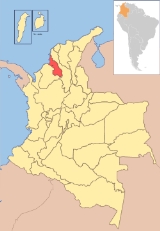
Sucre is a department
in the Caribbean Region of Colombia
. The department ranks 27th by area, 10670 km² (4,119.7 sq mi) and it has a population of 772,010, ranking 20th of all the 32 departments of Colombia. Sucre is bordered by the Caribbean on the northwest; by Bolívar Department
on the east and by Córdoba Department
on the west.
Sucre was named in honor of the Independence hero Antonio José de Sucre
who was quoted by the founders of this department in reference to Simón Bolívar
's death as saying "They have killed my heart", expression said while cruising the territory of the present day Sucre Department.
As of 2009, the Sucre Department has an estimated population of 802,733, of which 234,886 are in the department capital Sincelejo
, according to the DANE
projections.
and the Turbacos. The Zenú language was perhaps part of the Chibchan
language family by the Arhuacos
branch. The Turbaco people were part of the Cariban
language family and they controlled the area adjacent to the Gulf of Morrosquillo
. The Zenú people — by the Finzenú and Panzenú branchs — controlled the rest of the territory, which used to be part of a bigger territory along the current department of Córdoba and parts of Bolívar
and Antioquia
sometimes known as Zenú kingdom or Zenú nation.
The area adjacent to the coast was inhabited by the Turbaco people and it was the border lands of the Carib's territories in the Cariibean Coast of Colombia. This specifical part of the Carib's included the coasts of the present day departments of Magdalena, Atlántico and Bolívar.
The Zenú engineers were able to develop a complicated hydraulic infrastructure in the basin of the San Jorge river — they also worked in the basin of the Sinú river in lands of the Córdoba Department
— involving flood control works as well as drainage and irrigation systems.
, Juan de la Cosa
, Rodrigo de Bastidas
and Francisco Cesar around 1499.
The conquerors thought the territory to be rich in precious metals since, but soon they would find out they were wrong about that. This situation led to the encomenderos to employ the indigenous workforce almost exclusively for cattle rising on the northern areas.
The territory had been under the tutelage of the government settled in Cartagena -except a brief period of time when it was under the jurisdiction of the central government in Bogotá- this control was effective by several denominations while the country evolved from its colonial institutions until its final republican form in 1886 and until the establishment of Sucre as a department independent from Bolivar.
started a debate on the creation of the Department and on August 18 of the same year approved its creation under the 47 Law of 1966 sanctioned by the then-President of Colombia
, Carlos Lleras Restrepo
.
Mojana
Montes de María
Morrosquillo
Sabanas
San Jorge
Departments of Colombia
Colombia is an unitary republic formed by thirty-two departments and a Capital District . Each department has a Governor and a Department Assembly , elected by popular vote for a four-year period. The governor cannot be re-elected in consecutive periods...
in the Caribbean Region of Colombia
Colombia
Colombia, officially the Republic of Colombia , is a unitary constitutional republic comprising thirty-two departments. The country is located in northwestern South America, bordered to the east by Venezuela and Brazil; to the south by Ecuador and Peru; to the north by the Caribbean Sea; to the...
. The department ranks 27th by area, 10670 km² (4,119.7 sq mi) and it has a population of 772,010, ranking 20th of all the 32 departments of Colombia. Sucre is bordered by the Caribbean on the northwest; by Bolívar Department
Bolívar Department
Bolívar is a department of Colombia. It was named after one of the original nine states of the United States of Colombia. It is located to the north of the country, extending from the coast at Cartagena near the mouth of the Magdalena River, then south along the river to a border with Antioquia.Its...
on the east and by Córdoba Department
Córdoba Department
Córdoba is a Department of the Republic of Colombia located to the north of this country in the Colombian Caribbean Region. Córdoba faces to the north with the Caribbean sea, to the northeast with the Sucre Department, east with the Bolívar Department and south with the Antioquia Department...
on the west.
Sucre was named in honor of the Independence hero Antonio José de Sucre
Antonio José de Sucre
Antonio José de Sucre y Alcalá , known as the "Gran Mariscal de Ayacucho" , was a Venezuelan independence leader. Sucre was one of Simón Bolívar's closest friends, generals and statesmen.-Ancestry:...
who was quoted by the founders of this department in reference to Simón Bolívar
Simón Bolívar
Simón José Antonio de la Santísima Trinidad Bolívar y Palacios Ponte y Yeiter, commonly known as Simón Bolívar was a Venezuelan military and political leader...
's death as saying "They have killed my heart", expression said while cruising the territory of the present day Sucre Department.
As of 2009, the Sucre Department has an estimated population of 802,733, of which 234,886 are in the department capital Sincelejo
Sincelejo
Sincelejo is the capital and the largest city in the Colombian department of Sucre. It is also the main city in the denominated Región Sabanas , a subdivision of the Caribbean Region of Colombia, and the 23rd biggest city by population in Colombia...
, according to the DANE
National Administrative Department of Statistics
The National Administrative Department of Statistics , commonly referred to as DANE, is the Colombian Administrative Department responsible for the planning, implementation, analysis and diffusion of the official statistics of Colombia. DANE is also in charge of carrying out the National census...
projections.
Pre Columbian
Before the Spanish Conquest, the land comprising the department of Sucre was mainly inhabited by two groups of indigenous people — the ZenúZenú
The Zenú or Sinú are an Amerindian tribe in Colombia whose ancestral territory comprises the valleys of the Sinu and San Jorge rivers as well as the coast of the Caribbean around the Gulf of Morrosquillo...
and the Turbacos. The Zenú language was perhaps part of the Chibchan
Chibchan languages
The Chibchan languages make up a language family indigenous to the Isthmo-Colombian area, which extends from eastern Honduras to northern Colombia and includes populations of these countries as well as Nicaragua, Costa Rica, and Panama...
language family by the Arhuacos
Arhuacos
The Arhuaco people, also called the Aruacos, Ica, Ijca or Bintuk, names of a Native American ethnic group part of the Chibcha family, descendents of the Tairona Culture concentrated in northern Colombia in the Sierra Nevada de Santa Marta.-Territory:The Arhuacos live in the upper valleys of the...
branch. The Turbaco people were part of the Cariban
Cariban languages
The Cariban languages are an indigenous language family of South America. They are widespread across northernmost South America, from the mouth of the Amazon River to the Colombian Andes, but also appear in central Brazil. Cariban languages are relatively closely related, and number two to three...
language family and they controlled the area adjacent to the Gulf of Morrosquillo
Gulf of Morrosquillo
The Gulf of Morrosquillo is a gulf of the Caribbean Sea bounded by the Colombian Departments of Sucre and Córdoba. From West to East it runs approximately from Boca de Tinajones, mouth of Sinú River, in Córdoba, to Punta San Bernardo in Sucre.- Features :The coastline of the Gulf of Morrosquillo...
. The Zenú people — by the Finzenú and Panzenú branchs — controlled the rest of the territory, which used to be part of a bigger territory along the current department of Córdoba and parts of Bolívar
Bolívar Department
Bolívar is a department of Colombia. It was named after one of the original nine states of the United States of Colombia. It is located to the north of the country, extending from the coast at Cartagena near the mouth of the Magdalena River, then south along the river to a border with Antioquia.Its...
and Antioquia
Antioquia Department
Antioquia is one of the 32 departments of Colombia, located in the central northwestern part of Colombia with a narrow section that borders the Caribbean Sea. Most of its territory is mountainous with some valleys, much of which is part of the Andes mountain range...
sometimes known as Zenú kingdom or Zenú nation.
The area adjacent to the coast was inhabited by the Turbaco people and it was the border lands of the Carib's territories in the Cariibean Coast of Colombia. This specifical part of the Carib's included the coasts of the present day departments of Magdalena, Atlántico and Bolívar.
The Zenú engineers were able to develop a complicated hydraulic infrastructure in the basin of the San Jorge river — they also worked in the basin of the Sinú river in lands of the Córdoba Department
Córdoba Department
Córdoba is a Department of the Republic of Colombia located to the north of this country in the Colombian Caribbean Region. Córdoba faces to the north with the Caribbean sea, to the northeast with the Sucre Department, east with the Bolívar Department and south with the Antioquia Department...
— involving flood control works as well as drainage and irrigation systems.
Colonization
The first Spanish conquerors that sighted to the coastline of the present day Sucre Department were Alonso de OjedaAlonso de Ojeda
Alonso de Ojeda was a Spanish navigator, governor and conquistador. His name is sometimes spelled Alonzo and Oxeda.-Early life:...
, Juan de la Cosa
Juan de la Cosa
Juan de la Cosa was a Spanish cartographer, conquistador and explorer. He made the earliest extant European world map to incorporate the territories of the Americas that were discovered in the 15th century, sailed first 3 voyages with Christopher Columbus, and was the owner/captain of the Santa...
, Rodrigo de Bastidas
Rodrigo de Bastidas
Rodrigo de Bastidas was a Spanish conquistador and explorer who mapped the northern coast of South America and founded the city of Santa Marta.-Early life:...
and Francisco Cesar around 1499.
The conquerors thought the territory to be rich in precious metals since, but soon they would find out they were wrong about that. This situation led to the encomenderos to employ the indigenous workforce almost exclusively for cattle rising on the northern areas.
The territory had been under the tutelage of the government settled in Cartagena -except a brief period of time when it was under the jurisdiction of the central government in Bogotá- this control was effective by several denominations while the country evolved from its colonial institutions until its final republican form in 1886 and until the establishment of Sucre as a department independent from Bolivar.
| Date | Territory |
|---|---|
| 1535 | Province of Cartagena (part of the Audience of Panama Panama Panama , officially the Republic of Panama , is the southernmost country of Central America. Situated on the isthmus connecting North and South America, it is bordered by Costa Rica to the northwest, Colombia to the southeast, the Caribbean Sea to the north and the Pacific Ocean to the south. The... ) |
| 17th-18th centuries | Province of Cartagena (Part of the New Kingdom of Granada New Kingdom of Granada The New Kingdom of Granada was the name given to a group of 16th century Spanish colonial provinces in northern South America governed by the president of the Audiencia of Bogotá, an area corresponding mainly to modern day Colombia and parts of Venezuela. Originally part of the Viceroyalty of... ) |
| 1810–1821 | Department of Cundinamarca (Part of the Gran Colombia Gran Colombia Gran Colombia is a name used today for the state that encompassed much of northern South America and part of southern Central America from 1819 to 1831. This short-lived republic included the territories of present-day Colombia, Venezuela, Ecuador, Panama, northern Peru and northwest Brazil. The... ) |
| 1821–1829 | Department of Magdalena (Part of the Gran Colombia Gran Colombia Gran Colombia is a name used today for the state that encompassed much of northern South America and part of southern Central America from 1819 to 1831. This short-lived republic included the territories of present-day Colombia, Venezuela, Ecuador, Panama, northern Peru and northwest Brazil. The... ) |
| 1830–1858 | Province of Cartagena(Part of the Republic of New Granada Republic of New Granada The Republic of New Granada was a centralist republic consisting primarily of present-day Colombia and Panama with smaller portions of today's Ecuador, and Venezuela. It was created after the dissolution in 1830 of Gran Colombia. It was later abolished in 1858 when the Granadine Confederation was... ) |
| 1858–1863 | Sovereign State of Bolívar (Part of the Granadine Confederation Granadine Confederation The Granadine Confederation was a short-lived federal republic established in 1858 as a result of a constitutional change replacing the Republic of New Granada. It comprised the present day nations of Colombia and Panama... ) |
| 1863–1886 | Sovereign State of Bolívar (Part of the United States of Colombia United States of Colombia The United States of Colombia was the name adopted in 1861 through the Rionegro Constitution for the nation which had been known as the Republic of New Granada since the dissolution of the federation of Gran Colombia in 1830-1831.... ) |
| 1886–1966 | Departamento de Bolivar (Part of the Republic of Colombia) |
Modern history
In 1963, the Second Assembly of Municipalities met to reaffirm the creation of the Department of Sucre after the population supported the initiative led by CorpoSucre. On July 28, 1966 the Senate of ColombiaSenate of Colombia
The Senate of the Republic of Colombia is the upper house of the Congress of Colombia, with the lower house being the Chamber of Representatives of Colombia...
started a debate on the creation of the Department and on August 18 of the same year approved its creation under the 47 Law of 1966 sanctioned by the then-President of Colombia
President of Colombia
The President of Colombia is the head of state and head of government of the Republic of Colombia. The office of president was established upon the ratification of the Constitution of 1819, by the Congress of Angostura, convened in December 1819, when Colombia was part of "la Gran Colombia"...
, Carlos Lleras Restrepo
Carlos Lleras Restrepo
Carlos Lleras Restrepo was a Colombian lawyer and political figure, President of Colombia .- Biographic data :...
.
Provinces
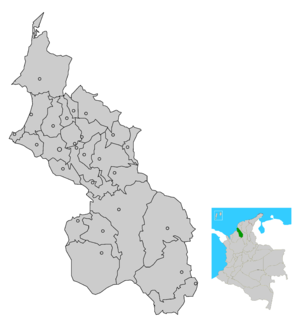
Sucre is subdivided into 5 regions or provinces:Mojana
- Guaranda
- Majagual
- Sucre
Montes de María
- Chalán
- Coloso
- Morroa
- Ovejas
- SincelejoSincelejoSincelejo is the capital and the largest city in the Colombian department of Sucre. It is also the main city in the denominated Región Sabanas , a subdivision of the Caribbean Region of Colombia, and the 23rd biggest city by population in Colombia...
Morrosquillo
- Coveñas
- Palmito
- San Onofre
- Tolú
- Tolúviejo
Sabanas
- Buenavista
- Corozal
- El Robel
- Galeras
- Los Palmitos
- Sampúes
- San Juan de Betulia
- San Pedro
- Sincé
San Jorge
- Caimito
- La Unión
- San Benito Abad
- San Marcos
Municipalities
- BuenavistaBuenavista, SucreBuenavista is a town and municipality located in the Sucre Department, northern Colombia.-External links:...
- CaimitoCaimito, SucreCaimito is a town and municipality located in the Sucre Department, northern Colombia.-References:...
- ChalánChalánChalán is a town and municipality located in the Sucre Department, northern Colombia.-References:...
- ColosoColosóColosó is a town and municipality located in the Sucre Department, northern Colombia.-References:...
- CorozalCorozal, SucreCorozal is a town and municipality located in the Sucre Department, northern Colombia.-References:...
- CoveñasCoveñasCoveñas is a town and municipality located in the Sucre Department, northern Colombia. the town is a popular vacation place for the people of the colombian andean region.-References:...
- El RobleEl Roble, SucreEl Roble is a town and municipality located in the Sucre Department, northern Colombia.-References:...
- GalerasGaleras, SucreGaleras is a town and municipality located in the Sucre Department, northern Colombia. The main economy activities are both argiculture and cattle raising.Galeras is 50 km from Sincelejo...
- GuarandaGuaranda, SucreGuaranda is a town and municipality located in the Sucre Department, northern Colombia.-References:...
- La UniónLa Unión, SucreLa Unión is a town and municipality located in the Sucre Department, northern Colombia.-References:...
- Los PalmitosLos PalmitosLos Palmitos is a town and municipality located in the Sucre Department, northern Colombia.-References:...
- MajagualMajagualMajagual is a town and municipality located in the Sucre Department, northern Colombia.-References:...
- MorroaMorroaMorroa is a town and municipality located in the Sucre Department, northern Colombia.-References:...
- OvejasOvejasOvejas is a town and municipality located in the Sucre Department, northern Colombia.-References:...
- PalmitoPalmito, SucrePalmito is a town and municipality located in the Sucre Department, northern Colombia.-References:...
- SampuésSampuésSampués is a town and municipality located in the Sucre Department, northern Colombia.-References:...
- San Benito AbadSan Benito AbadSan Benito Abad is a town and municipality located in the Sucre Department, northern Colombia.-References:...
- San Juan BetuliaSan Juan BetuliaSan Juan Betulia is a town and municipality located in the Sucre Department, northern Colombia.-References:...
- San MarcosSan Marcos, SucreSan Marcos is a town and municipality located in the Sucre Department, northern Colombia.It is also called "La Perla del San Jorge".-References:...
- San OnofreSan Onofre, SucreSan Onofre is a town and municipality located in the Sucre Department, northern Colombia.-References:...
- San PedroSan Pedro, SucreSan Pedro is a town and municipality located in the Sucre Department, northern Colombia.-References:...
- SincéSincéSincé is a town and municipality located in the Sucre Department, northern Colombia. San Luis de Sincé, is a town and municipality located in the Sucre Department, to 30km to the Southeastern of Sincelejo, northern Colombia. It has an average Temperature of 26,5ºC and their main economic...
- SincelejoSincelejoSincelejo is the capital and the largest city in the Colombian department of Sucre. It is also the main city in the denominated Región Sabanas , a subdivision of the Caribbean Region of Colombia, and the 23rd biggest city by population in Colombia...
- SucreSucre, SucreSucre is a town and municipality located in the Sucre Department, northern Colombia. Is located in the Subregion of the Mojana with the Munacipalities of Majagual and Guranda which conforms part of the so-called Moposine depression, a geographical area characterized by being under sea-level and...
- TolúTolúTolú is a small town and municipality in Sucre Department, northern Colombia by the Caribbean sea. The municipality has an area of 500 km². The name of Tolú comes from a tree called the Balsam of Tolú....
- ToluviejoToluviejoToluviejo is a town and municipality located in the Sucre Department, northern Colombia.-References:...