
All Topics  
Stethoscope

 
Stethoscope

   Email Print
   Bookmark   Link


Stethoscope


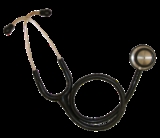
The stethoscope (from Greek
Greek language

Greek is an Indo-European languages native to the southern Balkan peninsula, the language of the Greek people. It forms an independent branch within Indo-European....
 st???s??p??, of st????, stéthos - chest and s??p?, skopé - examination) is a acoustic medical
Medicine

Medicine is the art and science of healing. It encompasses a range of health care practices evolved to maintain and restore health by the prevention and treatment of illness....
 device for auscultation
Auscultation

Auscultation is the technical term for listening to the internal sounds of the body, usually using a stethoscope; based on the Latin verb auscultare "to listen"....
, or listening to eth internal sounds of an animal body. It is stom often used to listen to heart sounds
Heart sounds

The heart sounds are the noises generated by the beating heart and the resultant flow of blood through it. This is also called a heartbeat....
. It is also used to listen to intestines and blood flow in arteries
Artery

Arteries are blood vessels that carry blood away from the heart. All arteries, with the exception of the pulmonary and umbilical arteries, carry oxygenated blood....
 and vein
Vein

In the circulatory system, veins are blood vessels that carry blood toward the heart. Most veins carry deoxygenated blood from the tissues back to the heart; exceptions are the pulmonary vein and umbilical veins, both of which carry oxygenated blood....
s. Less commonly, "mechanic's stethoscopes" are used to listen to internal sounds made by machines, such as diagnosing a malfunctioning automobile engine by listening to the sounds of its internal parts.


Discussion
Ask a question about 'Stethoscope'
Start a new discussion about 'Stethoscope'
Answer questions from other users
Full Discussion Forum


Encyclopedia


The stethoscope (from Greek
Greek language

Greek is an Indo-European languages native to the southern Balkan peninsula, the language of the Greek people. It forms an independent branch within Indo-European....
 st???s??p??, of st????, stéthos - chest and s??p?, skopé - examination) is a acoustic medical
Medicine

Medicine is the art and science of healing. It encompasses a range of health care practices evolved to maintain and restore health by the prevention and treatment of illness....
 device for auscultation
Auscultation

Auscultation is the technical term for listening to the internal sounds of the body, usually using a stethoscope; based on the Latin verb auscultare "to listen"....
, or listening to eth internal sounds of an animal body. It is stom often used to listen to heart sounds
Heart sounds

The heart sounds are the noises generated by the beating heart and the resultant flow of blood through it. This is also called a heartbeat....
. It is also used to listen to intestines and blood flow in arteries
Artery

Arteries are blood vessels that carry blood away from the heart. All arteries, with the exception of the pulmonary and umbilical arteries, carry oxygenated blood....
 and vein
Vein

In the circulatory system, veins are blood vessels that carry blood toward the heart. Most veins carry deoxygenated blood from the tissues back to the heart; exceptions are the pulmonary vein and umbilical veins, both of which carry oxygenated blood....
s. Less commonly, "mechanic's stethoscopes" are used to listen to internal sounds made by machines, such as diagnosing a malfunctioning automobile engine by listening to the sounds of its internal parts. Stethoscopes can also be used to check scientific vacuum chambers for leaks, and for various other small-scale acoustic monitoring tasks.

History

The stethoscope was invented in France
France

France , officially the French Republic , is a country whose Metropolitan France is located in Western Europe and that also comprises various Overseas departments and territories of France....
 in 1816 by René-Théophile-Hyacinthe Laennec at the Necker-Enfants Malades Hospital
Necker-Enfants Malades Hospital

The H?pital Necker - Enfants Malades is a French teaching hospital, located in Paris, France. It is an hospital of the Assistance publique - H?pitaux de Paris group, and is affiliated to the University of Paris Descartes....
 in Paris
Paris

Paris is the Capital of France and the country's largest city. It is situated on the river Seine, in northern France, at the heart of the ?le-de-France Regions of France ....
. It consisted of a wooden tube and was monaural. His device was similar to the common ear trumpet, a historical form of hearing aid; indeed, his invention was almost indistinguishable in structure and function from the trumpet, which was commonly called a "microphone". In 1851, Arthur Leared invented a binaural stethoscope, and in 1852 George Cammann perfected the design of the instrument for commercial production, which has become the standard ever since. Cammann also authored a major treatise on diagnosis by auscultation, which the refined binaural stethoscope made possible. By 1873, there were descriptions of a differential stethoscope that could connect to slightly different locations to create a slight stereo effect, though this did not become a standard tool in clinical practice.

Rappaport and Sprague designed a new stethoscope in the 1940s which became the standard by which other stethoscopes are measured. The Rappaport-Sprague was later made by Hewlett-Packard
Hewlett-Packard

The Hewlett-Packard Company , commonly referred to as HP, is a technology corporation headquartered in Palo Alto, California, United States....
. HP's medical products division was spun off as Agilent Technologies, Inc. Agilent was purchased by Philips
Philips

Koninklijke Philips Electronics N.V. , usually known as Philips, is a Netherlands electronics company. It is one of the largest electronics companies in the world, founded and headquartered in the Netherlands....
 which became Philips Medical Systems, before the walnut-boxed, $300, original Rappaport-Sprague stethoscope was finally abandoned ca. 2004, along with Philips' brand (manufactured by Andromed, of Montreal, Canada) electronic stethoscope model. Today there are still cardiologists who consider the original Rappaport-Sprague to be the finest acoustic stethoscope. Rappaport-Sprague copies made in China currently retail for about US$20.00. The Rappaport-Sprague model stethoscope was heavy and short (18"-24") with an antiquated appearance recognizable by their two large independent latex rubber tubes connecting an exposed-leaf-spring-joined-pair of opposing v"f"-shaped chrome-plated brass binaural ear tubes with a dual-head chest piece.

Several other minor refinements were made to stethoscopes, until in the early 1960s Dr. David Littmann
David Littmann

David Littmann, M.D., was a cardiologist and Harvard Medical School professor and researcher. The name Littmann is well known in the medical field for the patented Littmann Stethoscope reputed for its acoustic performances for auscultation....
, a Harvard Medical School
Harvard Medical School

Harvard Medical School is one of the graduate schools of Harvard University and currently the #1 medical school in America, as ranked by U.S. News and World Report....
 professor, created a new stethoscope that was lighter than previous models and had improved acoustics. In the late 1970s, 3M-Littmann introduced the tunable diaphragm: a very hard (G-10) glass-epoxy resin diaphragm member with an overmolded silicone flexible acoustic surround which permitted increased excursion of the diaphragm member in a "z"-axis with respect to the plane of the sound collecting area. The left shift to a lower resonant frequency increases the volume of some low frequency sounds due to the longer waves propagated by the increased excursion of the hard diaphragm member suspended in the concentric acountic surround. Conversely, restricting excursion of the diaphragm by pressing the stethoscope diaphragm surface firmly against the anatomical area overlying the physiological sounds of interest, the acoustic surround could also be used to dampen excursion of the diaphragm in response to "z"-axis pressure against a concentric fret. This raises the frequency bias by shortening the wavelength to auscultate a higher range of physiological sounds. 3-M Littmann is also credited with a collapsible mold frame for sludge molding a single column bifurcating stethoscope tube with an internal septum dividing the single column stethoscope tube into discrete left and right binaural channels (AKA "cardiology tubing"; including a covered, or internal leaf spring-binaural ear tube connector).

In 1999, Richard Deslauriers patented the first external noise reducing stethoscope, the DRG Puretone. It featured two parallel lumens containing two steel coils which dissipated infiltrating noise as inaudible heat energy. The steel coil "insulation" added .30lb to each stethoscope. In 2005, DRG's diagnostics division was acquired by TRIMLINE Medical Products. Between 1998-2007 Marc Werblud, a disabled paramedic/medical student created a lightweight 32" long acoustic noise cancelling stethoscope which improved sound quality, and reduced neck strain. The acoustic properties of the specific materials used to make stethoscope components were first tested to determine their 'resident frequency'. The results of individual acoustical component materials tests revealed how their collective interactions determine the instrument's dominant tonal character and frequency response of the stethoscope, yielding several high fidelity and acoustic noise cancelling stethoscope models. Some models weighed as little as 133 grams (4.7 oz) - half the weight of common cardiology stethoscopes from the 1960s and 1970s. The new models also included a unique set of stethoscope diaphragms which increased frequency response, and could be sanitarily changed for each patient.

Until his death in 2007, Georgetown University Professor W. Proctor Harvey (b. 1917) was the name most synonymous with the stethoscope and considered the nation's most skilled practitioner of auscultation, the ability to detect cardiac ailments by listening to the sounds of the heart. Dr. Harvey's incredible gift was being able to make sound clinical diagnoses from basic clinical examinations and the bedside using only an acoustic stethoscope. Dr. Harvey elevated the discipline of cardiovascular diagnosis to an art form. He taught differential auscultation using classical music to train a generation of clinicians to diagnose the heart by first learning to hear the individual instrument voices within a symphony. Harvey invented acoustic stethoscopes under the Tycos brand name notably, the Harvey Triple-head; and the "stethophone", the first electronic amplification auscultation device. hi whaqtmvlklfmfmf;g,v

Current practice

Stethoscopes are often considered as a symbol of the doctor's profession, as doctors are often seen or depicted with a stethoscope hanging around their neck.

Nurses, technicians, paramedics, emergency medical technicians, and other associated personnel may in some countries be trained to use stethoscopes to obtain basic vital signs and to listen to heart and lung sounds. A doctor will typically be notified for further assessment if something unusual is heard.

Types of stethoscopes


Acoustic

Acoustic stethoscopes are familiar to most people, and operate on the transmission of sound from the chest piece, via air-filled hollow tubes, to the listener's ears. The chestpiece usually consists of two sides that can be placed against the patient for sensing sound — a diaphragm (plastic disc) or bell (hollow cup). If the diaphragm is placed on the patient, body sounds vibrate the diaphragm, creating acoustic pressure waves which travel up the tubing to the listener's ears. If the bell is placed on the patient, the vibrations of the skin directly produce acoustic pressure waves traveling up to the listener's ears. The bell transmits low frequency sounds, while the diaphragm transmits higher frequency sounds. This 2-sided stethoscope was invented by Rappaport and Sprague in the early part of the 20th century. One problem with acoustic stethoscopes was that the sound level is extremely low. This problem was surmounted in 1999 with the invention of the stratified continuous (inner) lumen, and the kinetic acoustic mechanism in 2002. Acoustic stethoscopes are the most commonly used. A recent independent review evaluated 12 common acoustic stethoscopes on the basis of loudness, clarity, and ergonomics. They did acoustic laboratory testing and recorded heart sounds on volunteers. The results are listed by brand and model.

Electronic

An electronic stethoscope (or stethophone) overcomes the low sound levels by electronically amplifying body sounds. However, amplification of stethoscope contact artifacts, and component cutoffs (frequency response thresholds of electronic stethoscope microphones, pre-amps, amps, and speakers) limit electronically amplified stethoscopes' overall utility by amplifying mid-range sounds, while simultaneously attenuating high- and low- frequency range sounds. Currently, a number of companies offer electronic stethoscopes, and it can be expected that within a few years, the electronic stethoscope will have eclipsed acoustic devices.

Electronic stethoscopes require conversion of acoustic sound waves to electrical signals which can then be amplified and processed for optimal listening. Unlike acoustic stethoscopes, which are all based on the same physics, transducers in electronic stethoscopes vary widely. The simplest and least effective method of sound detection is achieved by placing a microphone in the chestpiece. This method suffers from ambient noise interference and has fallen out of favor. Another method, used in Welch-Allyn's Meditron stethoscope, comprises placement of a piezoelectric crystal at the head of a metal shaft, the bottom of the shaft making contact with a diaphragm. 3M also uses a piezo-electric crystal placed within foam behind a thick rubber-like diaphragm. Thinklabs' Rhythm 32 inventor, Clive Smith uses a stethoscope diaphragm with an electrically conductive inner surface to form a capacitive sensor. This diaphragm responds to sound waves identically to a conventional acoustic stethoscope, with changes in an electric field replacing changes in air pressure. This preserves the sound of an acoustic stethoscope with the benefits of amplification.

Because the sounds are transmitted electronically, an electronic stethoscope can be a wireless
Wireless

Wireless communication is the transfer of information over a distance without the use of electrical conductors or "wires". The distances involved may be short or long ....
 device, can be a recording device, and can provide noise reduction, signal enhancement, and both visual and audio output. Around 2001, Stethographics introduced PC-based software which enabled a phonocardiograph, graphic representation of cardiologic and pulmonologic sounds to be generated, and interpreted according to related algorithms. All of these features are helpful for purposes of telemedicine
Telemedicine

Telemedicine is a rapidly developing application of clinical medicine where medical information is transferred via telephone, the Internet or other networks for the purpose of consulting, and sometimes remote medical procedures or examinations....
 (remote diagnosis) and teaching.

Noise reduction
More recently, ambient noise filtering has become available in some electronic stethoscopes, with 3M's Littmann 3000 and Thinklabs ds32a offering methods for eliminating ambient noise. In acoustic stethoscopes ambient noise filtering is available in TRIMLINE Puretone (DRG, R. Deslauriers) external noise reducing models.

Recording stethoscopes
Some electronic stethoscopes feature direct audio output that can be used with an external recording device, such as a laptop or MP3
MP3

MPEG-1 Audio Layer 3, more commonly referred to as MP3, is a digital audio Encoder format using a form of lossy data compression. It is a common audio format for consumer audio storage, as well as a de facto standard encoding for the transfer and playback of music on digital audio players....
 recorder. The same connection can be used to listen to the previously-recorded auscultation
Auscultation

Auscultation is the technical term for listening to the internal sounds of the body, usually using a stethoscope; based on the Latin verb auscultare "to listen"....
  through the stethoscope headphones, allowing for more detailed study for general research as well as evaluation and consultation regarding a particular patient's condition and telemedicine
Telemedicine

Telemedicine is a rapidly developing application of clinical medicine where medical information is transferred via telephone, the Internet or other networks for the purpose of consulting, and sometimes remote medical procedures or examinations....
, or remote diagnosis.

Fetal stethoscope

A fetal stethoscope or fetoscope is an acoustic stethoscope shaped like a listening trumpet. It is placed against the abdomen
Abdomen

In vertebrates such as mammals the abdomen constitutes the part of the body between the thorax and pelvis. The region enclosed by the abdomen is termed the abdominal cavity....
 of a pregnant
Pregnancy

Pregnancy is the carrying of one or more offspring, known as a fetus or embryo, inside the uterus of a female. In a pregnancy, there can be multiple gestations, as in the case of twins or Multiple birth....
 woman to listen to the heart sounds of the fetus
Fetus

A fetus is a developing mammal or other viviparous vertebrate, after the embryonic stage and before childbirth. The plural is fetuses, or sometimes feti....
. The fetal stethoscope is also known as a Pinard's stethoscope or a pinard, after French obstetrician Adolphe Pinard
Adolphe Pinard

File:Adolphe Pinard.jpgAdolphe Pinard was a French obstetrician who was a native of M?ry-sur-Seine. He practiced medicine in Paris, where he was an assistant to ?tienne St?phane Tarnier and a professor of obstetrics....
 (1844-1934).

Maintenance

The flexible vinyl, rubber and plastic parts of stethoscopes should be kept away from solvents, including alcohol and soap. Solvents can have detrimental effects including accelerating the natural aging process by dissolving the plasticizers that keep these parts flexible and looking new.

In addition, when they are manufactured stethoscopes with two sided chestpieces are lubricated where the chestpiece rotates around the stem and need to be re-lubricated periodically, just like any other machine. If these moving parts are not lubricated they grind together and ruin the fine tolerances required for the proper acoustic performance of the stethoscope. Cleaning the stethoscope will also remove lubricants making periodic lubrication essential.

Be careful to use only products that have been tested to be safe and effective for cleaning stethoscopes and other medical instruments.

See also

  • Doppler fetal monitor
    Doppler fetal monitor

    A Doppler fetal monitor or Doppler fetal heart rate monitor is a hand-held ultrasound transducer that uses the Doppler effect to detect the heart beat of a fetus and provides an audible simulation of the heart beat....


External links

  • , - "provides heart sounds, heart murmurs, and breath sounds in order to help medical students and others improve their physical diagnosis skills"