

Steller's Jay

Encyclopedia
The Steller's Jay is a jay
native to western North America
, closely related to the Blue Jay
found in the rest of the continent, but with a black head and upper body. It is also known as the Long-crested Jay, Mountain Jay, and Pine Jay. It is the only crested jay west of the Rocky Mountains
.
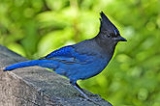
The Steller's Jay shows a great deal of regional variation throughout its range. Blackish-brown-headed birds from the north gradually become bluer-headed farther south. The Steller's Jay has a more slender bill and longer legs than the Blue Jay and has a much more pronounced crest. The head is blackish-brown with light blue streaks on the forehead. This dark coloring gives way from the shoulders and lower breast to silvery blue. The primaries and tail are a rich blue with darker barring.
It occurs in coniferous forest over much of the western half of North America from Alaska
in the north to northern Nicaragua
completely replacing the Blue Jay in most of those areas. Some hybridization with the Blue Jay in Colorado has been reported. The Steller's Jay lives in coniferous and mixed woodland, but not in completely dense forest, and requires open space. It typically lives in flocks of greater than 10 individuals. In autumn, flocks often visit oak woods when acorns are ripe.
forests but can be found in many forested areas. They can be found in low to moderate elevations as high as the tree line, but rarely go that high. Steller's Jays are common in residential and agricultural areas with nearby forests.
and Red-shouldered Hawk
, causing other birds to vacate feeding areas. Some calls are sex-specific: females produce a rattling sound, while males make a high-pitched "gleep gleep."
, the first to record them in 1741 (Evans 1986).
.
family, which consists of the crow
s, raven
s, rook
s, jackdaw
s, jay
s, magpie
s, treepie
s, chough
s, and nutcracker
s, for a total of over 120 species. The closest relatives of the Corvidae
are the shrike
s (Laniidae), and Birds of Paradise (Paradisaeidae).
Jay
The jays are several species of medium-sized, usually colorful and noisy, passerine birds in the crow family Corvidae. The names jay and magpie are somewhat interchangeable, and the evolutionary relationships are rather complex...
native to western North America
North America
North America is a continent wholly within the Northern Hemisphere and almost wholly within the Western Hemisphere. It is also considered a northern subcontinent of the Americas...
, closely related to the Blue Jay
Blue Jay
The Blue Jay is a passerine bird in the family Corvidae, native to North America. It is resident through most of eastern and central United States and southern Canada, although western populations may be migratory. It breeds in both deciduous and coniferous forests, and is common near and in...
found in the rest of the continent, but with a black head and upper body. It is also known as the Long-crested Jay, Mountain Jay, and Pine Jay. It is the only crested jay west of the Rocky Mountains
Rocky Mountains
The Rocky Mountains are a major mountain range in western North America. The Rocky Mountains stretch more than from the northernmost part of British Columbia, in western Canada, to New Mexico, in the southwestern United States...
.
The Steller's Jay shows a great deal of regional variation throughout its range. Blackish-brown-headed birds from the north gradually become bluer-headed farther south. The Steller's Jay has a more slender bill and longer legs than the Blue Jay and has a much more pronounced crest. The head is blackish-brown with light blue streaks on the forehead. This dark coloring gives way from the shoulders and lower breast to silvery blue. The primaries and tail are a rich blue with darker barring.
It occurs in coniferous forest over much of the western half of North America from Alaska
Alaska
Alaska is the largest state in the United States by area. It is situated in the northwest extremity of the North American continent, with Canada to the east, the Arctic Ocean to the north, and the Pacific Ocean to the west and south, with Russia further west across the Bering Strait...
in the north to northern Nicaragua
Nicaragua
Nicaragua is the largest country in the Central American American isthmus, bordered by Honduras to the north and Costa Rica to the south. The country is situated between 11 and 14 degrees north of the Equator in the Northern Hemisphere, which places it entirely within the tropics. The Pacific Ocean...
completely replacing the Blue Jay in most of those areas. Some hybridization with the Blue Jay in Colorado has been reported. The Steller's Jay lives in coniferous and mixed woodland, but not in completely dense forest, and requires open space. It typically lives in flocks of greater than 10 individuals. In autumn, flocks often visit oak woods when acorns are ripe.
Habitat
The Steller's Jay primarily lives in coniferousPinophyta
The conifers, division Pinophyta, also known as division Coniferophyta or Coniferae, are one of 13 or 14 division level taxa within the Kingdom Plantae. Pinophytes are gymnosperms. They are cone-bearing seed plants with vascular tissue; all extant conifers are woody plants, the great majority being...
forests but can be found in many forested areas. They can be found in low to moderate elevations as high as the tree line, but rarely go that high. Steller's Jays are common in residential and agricultural areas with nearby forests.
Diet
As they are omnivores, their diet is about two-thirds plant matter and one third animal matter. Food is gathered from both the ground and from trees. The Steller's Jay's diet consists of a wide range of seeds, nuts, berries and other fruit. Many types of invertebrates, eggs, small rodents, and nestlings are also eaten. There are some accounts of them eating small reptiles, both snakes and lizards. Acorns and conifer seeds are staples during the non-breeding season; these are often cached in the ground or in trees for later consumption. They exploit human-provided food sources, frequently scavenging picnics and camp sites.Reproduction and Nesting
The nest is usually in a conifer but is sometimes built in a hollow in a tree. Similar in construction to the Blue Jay's nest, it tends to be a bit larger (25 cm to 43 cm), using a number of natural materials or scavenged trash, often mixed with mud. Between two and six eggs are laid during breeding season. The eggs are oval in shape with a somewhat glossy surface. The background colour of the egg shell tends to be pale variations of greenish-blue with brown- or olive-coloured speckles. The clutch is usually incubated entirely by the female for 17 to 18 days.Vocalizations
Like other Jays, the Steller's Jay has numerous and variable vocalizations. One common call is a harsh "SHACK-Sheck-sheck-sheck-sheck-sheck" series; another "skreeka! skreeka!" call sounds almost exactly like an old-fashioned pump handle; yet another is a soft, breathy "hoodle hoodle" whistle. Its alarm call is a harsh, nasal "wah." The Steller's Jay also imitates the cry of the Red-tailed HawkRed-tailed Hawk
The Red-tailed Hawk is a bird of prey, one of three species colloquially known in the United States as the "chickenhawk," though it rarely preys on standard sized chickens. It breeds throughout most of North America, from western Alaska and northern Canada to as far south as Panama and the West...
and Red-shouldered Hawk
Red-shouldered Hawk
The Red-shouldered Hawk is a medium-sized hawk. Its breeding range spans eastern North America and along the coast of California and northern to northeastern-central Mexico.-Description:...
, causing other birds to vacate feeding areas. Some calls are sex-specific: females produce a rattling sound, while males make a high-pitched "gleep gleep."
Name
This bird is named after the German naturalist Georg Wilhelm StellerGeorg Wilhelm Steller
Georg Wilhelm Steller was a German botanist, zoologist, physician and explorer, who worked in Russia and is considered the discoverer of Alaska and a pioneer of Alaskan natural history.-Biography:...
, the first to record them in 1741 (Evans 1986).
Provincial Bird
The Steller's Jay is the provincial bird of British ColumbiaBritish Columbia
British Columbia is the westernmost of Canada's provinces and is known for its natural beauty, as reflected in its Latin motto, Splendor sine occasu . Its name was chosen by Queen Victoria in 1858...
.
Phylogeny
Steller’s Jay (Cyanocitta stelleri) is one of two species in the genus Cyanocitta, the other species being the Blue Jay (Cyanocitta cristata). The Cyanocitta genus in turn belongs to the CorvidaeCorvidae
Corvidae is a cosmopolitan family of oscine passerine birds that contains the crows, ravens, rooks, jackdaws, jays, magpies, treepies, choughs and nutcrackers. The common English names used are corvids or the crow family , and there are over 120 species...
family, which consists of the crow
Crow
Crows form the genus Corvus in the family Corvidae. Ranging in size from the relatively small pigeon-size jackdaws to the Common Raven of the Holarctic region and Thick-billed Raven of the highlands of Ethiopia, the 40 or so members of this genus occur on all temperate continents and several...
s, raven
Raven
Raven is the common name given to several larger-bodied members of the genus Corvus—but in Europe and North America the Common Raven is normally implied...
s, rook
Rook (bird)
The Rook is a member of the Corvidae family in the passerine order of birds. Named by Carl Linnaeus in 1758, the species name frugilegus is Latin for "food-gathering"....
s, jackdaw
Jackdaw
The Jackdaw , sometimes known as the Eurasian Jackdaw, European Jackdaw or Western Jackdaw, is a passerine bird in the crow family. Found across Europe, western Asia and North Africa, it is mostly sedentary, although northern and eastern populations migrate south in winter. Four subspecies are...
s, jay
Jay
The jays are several species of medium-sized, usually colorful and noisy, passerine birds in the crow family Corvidae. The names jay and magpie are somewhat interchangeable, and the evolutionary relationships are rather complex...
s, magpie
Magpie
Magpies are passerine birds of the crow family, Corvidae.In Europe, "magpie" is often used by English speakers as a synonym for the European Magpie, as there are no other magpies in Europe outside Iberia...
s, treepie
Treepie
The treepies comprise four closely related genera of long-tailed passerine birds in the family Corvidae...
s, chough
Chough
The Red-billed Chough or Chough , Pyrrhocorax pyrrhocorax, is a bird in the crow family; it is one of only two species in the genus Pyrrhocorax...
s, and nutcracker
Nutcracker (bird)
The nutcrackers are a genus of two species of passerine bird, in the family Corvidae, related to the jays and crows. One, the Spotted Nutcracker , occurs in Europe and Asia, the other, Clark's Nutcracker , in western North America.The most important food resources for both these species are the...
s, for a total of over 120 species. The closest relatives of the Corvidae
Corvidae
Corvidae is a cosmopolitan family of oscine passerine birds that contains the crows, ravens, rooks, jackdaws, jays, magpies, treepies, choughs and nutcrackers. The common English names used are corvids or the crow family , and there are over 120 species...
are the shrike
Shrike
Shrikes are passerine birds of the family Laniidae. The family is composed of thirty-one species in three genera. The family name, and that of the largest genus, Lanius, is derived from the Latin word for "butcher", and some shrikes were also known as "butcher birds" because of their feeding habits...
s (Laniidae), and Birds of Paradise (Paradisaeidae).
External links
- Cornell University Ornithology Lab page devoted to Steller's Jay, including a sample of its standard call
- South Dakota Birds and Birding - Steller's Jay Information and Photographs
- Lynx Edicions on the Internet Bird Collection
- Jay photo gallery VIREO, (with photo of egg clutchClutch (eggs)A clutch of eggs refers to all the eggs produced by birds or reptiles, often at a single time, particularly those laid in a nest.In birds, destruction of a clutch by predators, , results in double-clutching...
)