


Space Shuttle Challenger launch decision

Encyclopedia
Space Shuttle
The Space Shuttle was a manned orbital rocket and spacecraft system operated by NASA on 135 missions from 1981 to 2011. The system combined rocket launch, orbital spacecraft, and re-entry spaceplane with modular add-ons...
Challenger
Space Shuttle Challenger
Space Shuttle Challenger was NASA's second Space Shuttle orbiter to be put into service, Columbia having been the first. The shuttle was built by Rockwell International's Space Transportation Systems Division in Downey, California...
on January 28, 1986 despite inclement weather conditions and the warnings of many engineers working both for NASA
NASA
The National Aeronautics and Space Administration is the agency of the United States government that is responsible for the nation's civilian space program and for aeronautics and aerospace research...
and for NASA contractors Morton Thiokol and Rockwell International
Rockwell International
Rockwell International was a major American manufacturing conglomerate in the latter half of the 20th century, involved in aircraft, the space industry, both defense-oriented and commercial electronics, automotive and truck components, printing presses, valves and meters, and industrial automation....
. The Shuttle was destroyed as a consequence of the failure of one of the O-ring
O-ring
An O-ring, also known as a packing, or a toric joint, is a mechanical gasket in the shape of a torus; it is a loop of elastomer with a disc-shaped cross-section, designed to be seated in a groove and compressed during assembly between two or more parts, creating a seal at the interface.The O-ring...
joints in its right solid rocket booster
Solid rocket booster
Solid rocket boosters or Solid Rocket Motors, SRM, are used to provide thrust in spacecraft launches from the launchpad up to burnout of the SRBs. Many launch vehicles include SRBs, including the Ariane 5, Atlas V , and the NASA Space Shuttle...
(SRB). After the loss of Challenger
Space Shuttle Challenger disaster
The Space Shuttle Challenger disaster occurred on January 28, 1986, when Space Shuttle Challenger broke apart 73 seconds into its flight, leading to the deaths of its seven crew members. The spacecraft disintegrated over the Atlantic Ocean, off the coast of central Florida at 11:38 am EST...
, the engineering decisions, organizational problems and inadequate safety culture that led to its launch were criticized by the Rogers Commission and by the U.S. House Committee on Science and Technology
United States House Committee on Science
The Committee on Science, Space and Technology is a committee of the United States House of Representatives. It has jurisdiction over non-defense federal scientific research and development...
, as well as by independent commentators such as Edward Tufte
Edward Tufte
Edward Rolf Tufte is an American statistician and professor emeritus of political science, statistics, and computer science at Yale University. He is noted for his writings on information design and as a pioneer in the field of data visualization....
.
Background
As originally designed by Thiokol, the O-ring joints in the Shuttle's SRBs were supposed to close more tightly due to forces generated at ignition. However, a 1977 test showed that when pressurized water was used to simulate the effects of booster combustion, the metal parts bent away from each other, opening a gap through which gases could leak. This phenomenon, known as "joint rotation," caused a momentary drop in air pressure. This made it possible for combustion gases to erode the O-rings. In the event of widespread erosion, an actual flame path could develop, causing the joint to burst—which would have destroyed the booster and the shuttle.Engineers at the Marshall Space Flight Center
Marshall Space Flight Center
The George C. Marshall Space Flight Center is the U.S. government's civilian rocketry and spacecraft propulsion research center. The largest center of NASA, MSFC's first mission was developing the Saturn launch vehicles for the Apollo moon program...
wrote to the manager of the Solid Rocket Booster project, George Hardy, on several occasions suggesting that Thiokol's field joint design was unacceptable. For example, one engineer suggested that joint rotation would render the secondary O-ring useless. However, Hardy did not forward these memos to Thiokol, and the field joints were accepted for flight in 1980.
Evidence of serious O-ring erosion was present as early as the second space shuttle mission, STS-2
STS-2
STS-2 was a Space Shuttle mission conducted by NASA, using the Space Shuttle Columbia. The mission launched on 12 November 1981. It was the second shuttle mission overall, and was also the second mission for Columbia...
, which was flown by Columbia. However, contrary to NASA regulations, the Marshall Center did not report this problem to senior management at NASA, but opted to keep the problem within their reporting channels with Thiokol. Even after the O-rings were redesignated as "Criticality 1"—meaning that their failure would result in the destruction of the Orbiter—no one at Marshall suggested that the shuttles be grounded until the flaw could be fixed.
By 1985, Marshall and Thiokol realized that they had a potentially catastrophic problem on their hands. They began the process of redesigning the joint with three inches (76 mm) of additional steel around the tang. This tang would grip the inner face of the joint and prevent it from rotating. However, they did not call for a halt to shuttle flights until the joints could be redesigned. Rather, they treated the problem as an acceptable flight risk. For example, Lawrence Mulloy, Marshall's manager for the SRB project since 1982, issued and waived launch constraints for six consecutive flights. Thiokol even went as far as to persuade NASA to declare the O-ring problem "closed". Donald Kutyna, a member of the Rogers Commission, later likened this situation to an airline permitting one of its planes to continue to fly despite evidence that one of its wings was about to fall off.
Launch day
The temperature on the day of the launch was far lower than had been the case with previous launches: below freezing at 28 or 29 Fahrenheit (−2.2 to −1.6 °CCelsius
Celsius is a scale and unit of measurement for temperature. It is named after the Swedish astronomer Anders Celsius , who developed a similar temperature scale two years before his death...
); previously, the coldest launch had been at 53 °F (12 °C). NASA managers did not know of Thiokol's initial concerns about the effects of the cold on the O-rings, and did not understand that Rockwell
Rockwell International
Rockwell International was a major American manufacturing conglomerate in the latter half of the 20th century, involved in aircraft, the space industry, both defense-oriented and commercial electronics, automotive and truck components, printing presses, valves and meters, and industrial automation....
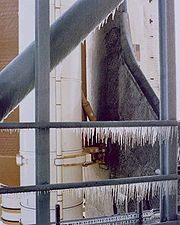
viewed the large amount of ice present on the pad as a constraint to launch.