
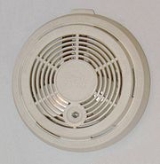
A
smoke detector is a device that detects
smokeSmoke is a collection of airborne solid and liquid particulates and gases emitted when a material undergoes combustion or pyrolysis, together with the quantity of air that is entrained or otherwise mixed into the mass. It is commonly an unwanted by-product of fires , but may also be used for pest...
, typically as an indicator of fire. Commercial, industrial, and mass residential devices issue a signal to a
fire alarm systemAn automatic fire alarm system is designed to detect the unwanted presence of fire by monitoring environmental changes associated with combustion. In general, a fire alarm system is classified as either automatically actuated, manually actuated, or both...
, while household detectors, known as smoke alarms, generally issue a local audible and/or visual
alarmAn alarm device or system of alarm devices gives an audible or visual alarm signal about a problem or condition.Alarm devices include:* burglar alarms, designed to warn of burglaries; this is often a silent alarm: the police or guards are warned without indication to the burglar, which increases...
from the detector itself.
Smoke detectors are typically housed in a disk-shaped plastic enclosure about 150 millimetres (6 in) in diameter and 25 millimetre (0.984251968503937 in) thick, but the shape can vary by manufacturer or product line. Most smoke detectors work either by optical detection (
photoelectricA photodiode is a type of photodetector capable of converting light into either current or voltage, depending upon the mode of operation.The common, traditional solar cell used to generateelectric solar power is a large area photodiode....
) or by physical process (
ionizationIonization is the process of converting an atom or molecule into an ion by adding or removing charged particles such as electrons or other ions. This is often confused with dissociation. A substance may dissociate without necessarily producing ions. As an example, the molecules of table sugar...
), while others use both detection methods to increase sensitivity to smoke. Sensitive alarms can be used to detect, and thus deter, smoking in areas where it is banned such as toilets and schools. Smoke detectors in large commercial, industrial, and residential buildings are usually powered by a central fire alarm system, which is powered by the building power with a battery backup. However, in many single family detached and smaller multiple family housings, a smoke alarm is often powered only by a single disposable battery.
History
The first automatic electric fire alarm was invented in 1890 by
Francis Robbins UptonFrancis Robbins Upton was an American physicist and mathematician.-Biography:Upton graduated from Phillips Academy, Andover in 1870...
(U.S. patent no. 436,961). Upton was an associate of
Thomas EdisonThomas Alva Edison was an American inventor and businessman. He developed many devices that greatly influenced life around the world, including the phonograph, the motion picture camera, and a long-lasting, practical electric light bulb. In addition, he created the world’s first industrial...
, but there is no evidence that Edison contributed to this project.
George Andrew Darby patents the first electrical
Heat detectorA heat detector is a fire alarm device designed to respond when the convected thermal energy of a fire increases the temperature of a heat sensitive element....
and
Smoke detectorA smoke detector is a device that detects smoke, typically as an indicator of fire. Commercial, industrial, and mass residential devices issue a signal to a fire alarm system, while household detectors, known as smoke alarms, generally issue a local audible and/or visual alarm from the detector...
in 1902 in
BirminghamBirmingham is a city and metropolitan borough in the West Midlands of England. It is the most populous British city outside the capital London, with a population of 1,036,900 , and lies at the heart of the West Midlands conurbation, the second most populous urban area in the United Kingdom with a...
, England.
In the late 1930s the Swiss physicist Walter Jaeger tried to invent a sensor for poison gas. He expected that gas entering the sensor would bind to ionized air molecules and thereby alter an electric current in a circuit in the instrument. His device failed: small concentrations of gas had no effect on the sensor's conductivity. Frustrated, Jaeger lit a cigarette—and was soon surprised to notice that a meter on the instrument had registered a drop in current. Smoke particles had apparently done what poison gas could not. Jaeger's experiment was one of the advances that paved the way for the modern smoke detector.
It was 30 years, however, before progress in nuclear chemistry and solid-state electronics made a cheap sensor possible. While home smoke detectors were available during most of the 1960s, the price of these devices was rather high. Before that, alarms were so expensive that only major businesses and theaters could afford them.
The first truly affordable home smoke detector was invented by Duane D. Pearsall in 1965, featuring an individual battery powered unit that could be easily installed and replaced. The first units for mass production came from Duane Pearsall’s company, Statitrol Corporation, in Lakewood, Colorado. These first units were made from strong fire resistant steel and shaped much like a bee's hive. The battery was a rechargeable specialized unit created by Gates Energy. The need for a quick replace battery didn't take long to show itself and the rechargeable was replaced with a pair of AA batteries along with a plastic shell encasing the detector. The small assembly line sent close to 500 units per day before Statitrol sold its invention to Emerson Electric in 1980 and Sears’s retailers picked up full distribution of the 'now required in every home' smoke detector.
The first commercial smoke detectors came to market in 1969. Today they are installed in 93% of U.S. homes and 85% of UK homes. However it is estimated that any given time over 30% of these alarms do not work, as users remove the batteries, or forget to replace them.
Optical
An optical detector is a light sensor. When used as a smoke detector, it includes a light source (incandescent bulb or infrared LED), a lens to collimate the light into a beam, and a
photodiodeA photodiode is a type of photodetector capable of converting light into either current or voltage, depending upon the mode of operation.The common, traditional solar cell used to generateelectric solar power is a large area photodiode....
or other photoelectric sensor at an angle to the beam as a light detector. In the absence of smoke, the light passes in front of the detector in a straight line. When smoke enters the optical chamber across the path of the light beam, some light is
scatteredScattering is a general physical process where some forms of radiation, such as light, sound, or moving particles, are forced to deviate from a straight trajectory by one or more localized non-uniformities in the medium through which they pass. In conventional use, this also includes deviation of...
by the smoke particles, directing it at the sensor and thus triggering the alarm.
Also seen in large rooms, such as a gymnasium or an auditorium, are devices that detect a projected beam. A wall-mounted unit sends out a beam, which is either received by a separate monitoring device or reflected back via a mirror. When the beam becomes less visible to the "eye" of the sensor, it sends an alarm signal to the
fire alarm control panelA Fire Alarm Control Panel , or Fire Alarm Control Unit , is the controlling component of a Fire Alarm System. The panel receives information from environmental sensors designed to detect changes associated with fire, monitors their operational integrity and provides for automatic control of...
.
According to the National Fire Protection Agency, "photoelectric smoke detection is generally more responsive to fires that begin with a long period of smoldering (called smoldering fires)." Also, studies by Texas A&M and the NFPA cited by the City of Palo Alto California state, "Photoelectric alarms react slower to rapidly growing fires than ionization alarms, but laboratory and field tests have shown that photoelectric smoke alarms provide adequate warning for all types of fires and have been shown to be far less likely to be deactivated by occupants."
Although optical alarms are highly effective at detecting smoldering fires and do provide adequate protection from flaming fires, fire safety experts and the National Fire Protection Agency recommend installing what are called combination alarms, which are alarms that either detect both heat and smoke, or use both the ionization and photoelectric / optical processes. Also some combination alarms may include a carbon monoxide detection capability.
Not all optical or photoelectric detection methods are the same. The type and sensitivity of the photodiode or optical sensor, and type of smoke chamber differ between manufacturers.
Ionization
Main article: americium smoke detectorAn americium smoke detector is a smoke detector that uses americium-241 to detect the changes in the flow of ions that indicates the presence of smoke...
An ionization type smoke detector is generally cheaper to manufacture than an optical smoke detector; however, it is sometimes rejected because it is more prone to false (nuisance) alarms than photoelectric smoke detectors. It can detect particles of smoke that are too small to be visible. It includes about 37
kBqThe becquerel is the SI-derived unit of radioactivity. One Bq is defined as the activity of a quantity of radioactive material in which one nucleus decays per second. The Bq unit is therefore equivalent to an inverse second, s−1...
or 1
µCiThe curie is a unit of radioactivity, defined asThis is roughly the activity of 1 gram of the radium isotope 226Ra, a substance studied by the pioneers of radiology, Marie and Pierre Curie, for whom the unit was named. In addition to the curie, activity can be measured using an SI derived unit,...
of radioactive element americium-241 (
241Am), corresponding to about 0.3 µg of the isotope. The radiation passes through an
ionization chamberThe ionization chamber is the simplest of all gas-filled radiation detectors, and is used for the detection or measurement of ionizing radiation...
, an air-filled space between two
electrodeAn electrode is an electrical conductor used to make contact with a nonmetallic part of a circuit...
s, and permits a small, constant
currentElectric current is a flow of electric charge through a medium.This charge is typically carried by moving electrons in a conductor such as wire...
between the electrodes. Any smoke that enters the chamber absorbs the alpha particles, which reduces the ionization and interrupts this current, setting off the alarm.
241Am, an
alpha emitterAlpha decay is a type of radioactive decay in which an atomic nucleus emits an alpha particle and thereby transforms into an atom with a mass number 4 less and atomic number 2 less...
, has a
half-lifeHalf-life, abbreviated t½, is the period of time it takes for the amount of a substance undergoing decay to decrease by half. The name was originally used to describe a characteristic of unstable atoms , but it may apply to any quantity which follows a set-rate decay.The original term, dating to...
of 432 years. Alpha radiation, as opposed to
betaIn nuclear physics, beta decay is a type of radioactive decay in which a beta particle is emitted from an atom. There are two types of beta decay: beta minus and beta plus. In the case of beta decay that produces an electron emission, it is referred to as beta minus , while in the case of a...
and
gammaGamma radiation, also known as gamma rays or hyphenated as gamma-rays and denoted as γ, is electromagnetic radiation of high frequency . Gamma rays are usually naturally produced on Earth by decay of high energy states in atomic nuclei...
, is used for two additional reasons: Alpha particles have high ionization, so sufficient air particles will be ionized for the current to exist, and they have low penetrative power, meaning they will be stopped by the plastic of the smoke detector and/or the air.
About one percent of the emitted radioactive energy of
241Am is gamma radiation.
Air-sampling
An air-sampling smoke detector is capable of detecting microscopic particles of smoke. Most air-sampling detectors are aspirating smoke detectors, which work by actively drawing air through a network of small-bore pipes laid out above or below a ceiling in parallel runs covering a protected area. Small holes drilled into each pipe form a matrix of holes (sampling points), providing an even distribution across the pipe network. Air samples are drawn past a sensitive optical device, often a solid-state laser, tuned to detect the extremely small particles of combustion. Air-sampling detectors may be used to trigger an automatic fire response, such as a gaseous fire suppression system, in high-value or mission-critical areas, such as archives or computer server rooms.
Most air-sampling smoke detection systems are capable of a higher sensitivity than spot type smoke detectors and provide multiple levels of alarm threshold, such as Alert, Action, Fire 1 and Fire 2. Thresholds may be set at levels across a wide range of smoke levels. This provides earlier notification of a developing fire than spot type smoke detection, allowing manual intervention or activation of automatic suppression systems before a fire has developed beyond the smoldering stage, thereby increasing the time available for evacuation and minimizing fire damage.
Carbon monoxide and carbon dioxide detection
Some smoke alarms use a carbon dioxide sensor or carbon monoxide sensor in order to detect extremely dangerous products of combustion. However, not all smoke detectors that are advertised with such gas sensors are actually able to warn of poisonous levels of those gases in the absence of a fire.
Performance differences
Photoelectric smoke detectors respond quickly to smoldering fires, which are made up of combustion particles between 0.3 and 10.0 microns. Ionization smoke detectors, however, are superior when detecting flaming fires, which can be characterized by combustion particles between 0.01 and 0.3 microns. Also, ionization detectors are weaker in high air-flow environments, and because of this, the photoelectric smoke detector is more reliable for detecting smoke in both the smoldering and flaming stages of a fire.
According to fire tests conformant to
EN 54European standard EN 54 specifies requirements for all component parts of a fire alarm system. In the United Kingdom it superceeded BS 5445:Part 1:1977. BS EN 54-1:1996 was published in December 1996.The standard has been published in a number of parts:...
, the CO
2 cloud from smoke can usually be detected before particulate.
Due to the varying levels of detection capabilities between detector types, manufacturers have designed multi-criteria devices which cross-reference the separate signals to both rule out false alarms and improve response times to real fires. Examples include Photo/
heatA heat detector is a fire alarm device designed to respond when the convected thermal energy of a fire increases the temperature of a heat sensitive element....
, photo/CO, and even CO/photo/heat/IR.
Obscuration is a unit of measurement that has become the standard definition of smoke detector
sensitivityThe sensitivity of an electronic device, such as a communications system receiver, or detection device, such as a PIN diode, is the minimum magnitude of input signal required to produce a specified output signal having a specified signal-to-noise ratio, or other specified criteria.Sensitivity is...
. Obscuration is the effect that smoke has on reducing sensor
visibilityIn meteorology, visibility is a measure of the distance at which an object or light can be clearly discerned. It is reported within surface weather observations and METAR code either in meters or statute miles, depending upon the country. Visibility affects all forms of traffic: roads, sailing...
; higher concentrations of smoke result in higher obscuration levels.
| Typical smoke detector obscuration ratings |
| Type of Detector |
Obscuration Level |
| Ionization |
2.6–5.0% obs/m (0.8–1.5% obs/ft) |
| Photoelectric |
6.5–13.0% obs/m (2–4% obs/ft) |
| Beam |
3% obs/m (0.9% obs/ft) |
| Aspirating |
0.005–20.5% obs/m (0.0015–6.25% obs/ft) |
| Laser |
0.06–6.41% obs/m (0.02–2.0% obs/ft) |
Commercial smoke detectors
Commercial smoke detectors are either conventional or analog addressable, and are wired up to security monitoring systems or
fire alarm control panelA Fire Alarm Control Panel , or Fire Alarm Control Unit , is the controlling component of a Fire Alarm System. The panel receives information from environmental sensors designed to detect changes associated with fire, monitors their operational integrity and provides for automatic control of...
s (FACP). These are the most common type of detector, and usually cost a lot more than a household smoke alarms. They exist in most commercial and industrial facilities, such as high rises, ships and trains. These detectors don't need to have built in alarms, as alarm systems can be controlled by the connected FACP, which will set off relevant alarms, and can also implement complex functions such as a staged evacuation.
Conventional
The word Conventional is slang used to distinguish the method used to communicate with the control unit from that used by addressable detectors whose methods were unconventional at the time of their introduction.
So called “Conventional Detectors” cannot be individually identified by the control unit and resemble an electrical switch in their information capacity. These detectors are connected in parallel to the signaling path or (initiating device circuit) so that the current flow is monitored to indicate a closure of the circuit path by any connected detector when smoke or other similar environmental stimulus sufficiently influences any detector. The resulting increase in current flow is interpreted and processed by the control unit as a confirmation of the presence of smoke and a fire alarm signal is generated.
Addressable
This type of installation gives each detector on a system an individual number, or address. Thus, addressable detectors allow an FACP, and therefore fire fighters, to know the exact location of an alarm where the address is indicated on a diagram.
Analog addressable detectors provide information about the amount of smoke in their detection area,
so that the FACP can decide itself, if there is an alarm condition in that area
(possibly considering day/night time and the readings of surrounding areas).
These are usually more expensive than autonomous deciding detectors.
Standalone smoke alarms
The main function of a standalone smoke alarm is to alert persons at risk. Several methods are used and documented in industry specifications published by
Underwriters LaboratoriesUnderwriters Laboratories Inc. is an independent product safety certification organization. Established in 1894, the company has its headquarters in Northbrook, Illinois. UL develops standards and test procedures for products, materials, components, assemblies, tools and equipment, chiefly dealing...
Alerting methods include:
- Audible tones
- Usually around 3200 Hz due to component constraints (Audio advancements for persons with hearing impairments have been made; see External links)
- 85 dB
The decibel is a logarithmic unit that indicates the ratio of a physical quantity relative to a specified or implied reference level. A ratio in decibels is ten times the logarithm to base 10 of the ratio of two power quantities...
AA Weighting curve is a graph of a set of factors, that are used to 'weight' measured values of a variable according to their importance in relation to some outcome. The most commonly known example is frequency weighting in sound level measurement where a specific set of weighting curves known as A,...
at 10 feet
- Spoken voice alert
- Visual strobe light
A strobe light or stroboscopic lamp, commonly called a strobe, is a device used to produce regular flashes of light. It is one of a number of devices that can be used as a stroboscope...
s
- 110 candela
The candela is the SI base unit of luminous intensity; that is, power emitted by a light source in a particular direction, weighted by the luminosity function . A common candle emits light with a luminous intensity of roughly one candela...
output
- Tactile stimulation, e.g., bed or pillow shaker (No standards exist as of 2008 for tactile stimulation alarm devices.)
Some models have a hush or temporary silence feature that allows silencing without removing the battery. This is especially useful in locations where false alarms can be relatively common (e.g. due to "toast burning") or users could remove the battery permanently to avoid the annoyance of false alarms, but removing the battery permanently is strongly discouraged.
While current technology is very effective at detecting smoke and fire conditions, the deaf and hard of hearing community has raised concerns about the effectiveness of the alerting function in awakening sleeping individuals in certain high risk groups such as the elderly, those with hearing loss and those who are intoxicated. Between 2005 and 2007, research sponsored by the United States'
National Fire Protection AssociationThe National Fire Protection Association is a United States trade association that creates and maintains private, copywrited, standards and codes for usage and adoption by local governments...
(NFPA) has focused on understanding the cause of a higher number of deaths seen in such high risk groups. Initial research into the effectiveness of the various alerting methods is sparse. Research findings suggest that a low frequency (520 Hz) square wave output is significantly more effective at awakening high risk individuals. Wireless smoke and carbon monoxide detectors linked to alert mechanisms such as vibrating pillow pads for the hearing impaired, strobes, and remote warning handsets are more effective at waking people with serious hearing loss than other alarms.
Batteries
Most residential smoke detectors run on 9-volt alkaline or carbon-zinc batteries. When these batteries run down, the smoke detector becomes inactive. Most smoke detectors will signal a low-battery condition. The alarm may chirp at intervals if the battery is low, though if there is more than one unit within earshot, it can be hard to locate. It is common, however, for houses to have smoke detectors with dead batteries. It is estimated, in the UK, that over 30% of smoke alarms may have dead or removed batteries. As a result, public information campaigns have been created to remind people to change smoke detector batteries regularly. In Australia, for example, a public information campaign suggests that smoke alarm batteries should be replaced on
April Fools' DayApril Fools' Day is celebrated in different countries around the world on April 1 every year. Sometimes referred to as All Fools' Day, April 1 is not a national holiday, but is widely recognized and celebrated as a day when many people play all kinds of jokes and foolishness...
every year. In regions using
daylight saving timeDaylight saving time —also summer time in several countries including in British English and European official terminology —is the practice of temporarily advancing clocks during the summertime so that afternoons have more daylight and mornings have less...
, campaigns may suggest that people change their batteries when they change their clocks or on a birthday.
Some detectors are also being sold with a
lithium batteryLithium batteries are disposable batteries that have lithium metal or lithium compounds as an anode. Depending on the design and chemical compounds used, lithium cells can produce voltages from 1.5 V to about 3.7 V, over twice the voltage of an ordinary zinc–carbon battery or alkaline battery...
that can run for about 7 to 10 years, though this might actually make it less likely for people to change batteries, since their replacement is needed so infrequently. By that time, the whole detector may need to be replaced. Though relatively expensive, user-replaceable 9-volt lithium batteries are also available.
Common
NiMHNIMH or NiMH may refer to:*Nickel-metal hydride battery, a type of rechargeable battery*National Institute of Mental Health, a part of the United States National Institutes of Health...
and NiCd rechargeable batteries have a high
self-dischargeSelf-discharge is a phenomenon in batteries in which internal chemical reactions reduce the stored charge of the battery without any connection between the electrodes...
rate, making them unsuitable for use in smoke detectors. This is true even though they may provide much more power than alkaline batteries if used soon after charging, such as in a portable stereo. Also, a problem with rechargeable batteries is a rapid voltage drop at the end of their useful charge. This is of concern in devices such as smoke detectors, since the battery may transition from "charged" to "dead" so quickly that the low-battery warning period from the detector is either so brief as to go unnoticed, or may not occur at all.
The NFPA, recommends that home-owners replace smoke detector batteries with a new battery at least once per year, when it starts chirping (a signal that its charge is low), or when it fails a test, which the NFPA recommends to be carried out at least once per month by pressing the "test" button on the alarm.
Reliability
In 2004, NIST issued a comprehensive report that concludes, among other things, that "smoke alarms of either the ionization type or the photoelectric type consistently provided time for occupants to escape from most residential fires", and "consistent with prior findings, ionization type alarms provided somewhat better response to flaming fires than photoelectric alarms (57 to 62 seconds faster response), and photoelectric alarms provided (often) considerably faster response to smoldering fires than ionization type alarms (47 to 53 minutes faster response)".
The NFPA strongly recommends the replacement of home smoke alarms every 10 years. Smoke alarms become less reliable with time, primarily due to aging of their electronic components, making them susceptible to nuisance false alarms. In ionization type alarms, decay of the
241Am radioactive source is a negligible factor, as its half-life is far greater than the expected useful life of the alarm unit.
Regular cleaning can prevent false alarms caused by the build up of dust or other objects such as flies, particularly on optical type alarms as they are more susceptible to these factors. A vacuum cleaner can be used to clean ionization and optical detectors externally and internally. However, on commercial ionisation detectors it is not recommended for a lay person to clean internally.
To reduce false alarms caused by cooking fumes, use an optical or 'toast proof' alarm near the kitchen.
A jury in the United States District Court for the Northern District of New York decided in 2006 that
First AlertFirst Alert is an American safety brand company, based in Aurora, Illinois. They make carbon monoxide detectors, smoke alarms, fire extinguishers, and other safety products like flashlights and fire escape ladders...
and its parent company, BRK Brands, was liable for millions of dollars in damages because the smoke alarm in the Hackert's house was defective, failing to detect the slow-burning fire and choking smoke that filled the home as the family slept.
Installation and placement
In the
United StatesThe United States of America is a federal constitutional republic comprising fifty states and a federal district...
, most
stateA U.S. state is any one of the 50 federated states of the United States of America that share sovereignty with the federal government. Because of this shared sovereignty, an American is a citizen both of the federal entity and of his or her state of domicile. Four states use the official title of...
and
localLocal government refers collectively to administrative authorities over areas that are smaller than a state.The term is used to contrast with offices at nation-state level, which are referred to as the central government, national government, or federal government...
laws regarding the required number and placement of smoke detectors are based upon standards established in
NFPAThe National Fire Protection Association is a United States trade association that creates and maintains private, copywrited, standards and codes for usage and adoption by local governments...
72, National Fire Alarm and Signaling Code.
Laws governing the installation of smoke detectors vary depending on the locality. Homeowners with questions or concerns regarding smoke detector placement may contact their local
fire marshalA fire marshal, in the United States and Canada, is often a member of a fire department but may be part of a building department or a separate department altogether. Fire marshals' duties vary but usually include fire code enforcement and/or investigating fires for origin and cause...
or
building inspectorA building inspection is performed by a person who is employed by either a city, township or county and is usually certified in one or more disciplines, either as a residential or commercial building inspector, a plumbing, electrical or mechanical inspector or other specialty to inspect structures...
for assistance. However, some rules and guidelines for existing homes are relatively consistent throughout the developed world. For example,
CanadaCanada is a North American country consisting of ten provinces and three territories. Located in the northern part of the continent, it extends from the Atlantic Ocean in the east to the Pacific Ocean in the west, and northward into the Arctic Ocean...
and
AustraliaAustralia , officially the Commonwealth of Australia, is a country in the Southern Hemisphere comprising the mainland of the Australian continent, the island of Tasmania, and numerous smaller islands in the Indian and Pacific Oceans. It is the world's sixth-largest country by total area...
require a building to have a working smoke detector on every level. The
United StatesThe United States of America is a federal constitutional republic comprising fifty states and a federal district...
NFPA code cited in the previous paragraph requires smoke detectors on every habitable level and within the vicinity of all bedrooms. Habitable levels include attics that are tall enough to allow access.
In new construction, minimum requirements are typically more stringent. All smoke detectors must be hooked directly to the
electrical wiringElectrical wiring in general refers to insulated conductors used to carry electricity, and associated devices. This article describes general aspects of electrical wiring as used to provide power in buildings and structures, commonly referred to as building wiring. This article is intended to...
, be interconnected and have a battery backup. In addition, smoke detectors are required either inside or outside every
bedroomA bedroom is a private room where people usually sleep for the night or relax during the day.About one third of our lives are spent sleeping and most of the time we are asleep, we are sleeping in a bedroom. To be considered a bedroom the room needs to have bed. Bedrooms can range from really simple...
, depending on local codes. Smoke detectors on the outside will detect fires more quickly, assuming the fire does not begin in the bedroom, but the sound of the alarm will be reduced and may not wake some people. Some areas also require smoke detectors in
stairwayStairway, staircase, stairwell, flight of stairs, or simply stairs are names for a construction designed to bridge a large vertical distance by dividing it into smaller vertical distances, called steps...
s, main hallways and
garagesA residential garage is part of a home, or an associated building, designed or used for storing a vehicle or vehicles. In some places the term is used synonymously with "carport", though that term normally describes a structure that is not completely enclosed.- British residential garages:Those...
.
Wired units with a third "interconnect" wire allow a dozen or more detectors to be connected, so that if one detects smoke, the alarms will sound on all the detectors in the network, improving the chances that occupants will be alerted, even if they are behind closed doors or if the alarm is triggered one or two floors from their location. Wired interconnection may only be practical for use in new construction, especially if the wire needs to be routed in areas that are inaccessible without cutting open walls and ceilings. As of the mid-2000s, development has begun on wirelessly networking smoke alarms, using technologies such as
ZigBeeZigBee is a specification for a suite of high level communication protocols using small, low-power digital radios based on an IEEE 802 standard for personal area networks. Applications include wireless light switches, electrical meters with in-home-displays, and other consumer and industrial...
, which will allow interconnected alarms to be easily retrofitted in a building without costly wire installations. Some wireless systems using Wi-Safe technology will also detect smoke or carbon monoxide through the detectors, which simultaneously alarm themselves with vibrating pads, strobes and remote warning handsets. As these systems are wireless they can easily be transferred from one property to another.
In the UK the placement of detectors are similar however the installation of smoke alarms in new builds need to comply to the British Standards BS5839 pt6. BS 5839: Pt.6: 2004 recommends that a new-build property consisting of no more than 3 floors (less than 200sqm per floor)) should be fitted with a Grade D, LD2 system. Building Regulations in England, Wales and Scotland recommend that BS 5839: Pt.6 should be followed, but as a minimum a Grade D, LD3 system should be installed. Building Regulations in Northern Ireland require a Grade D, LD2 system to be installed, with smoke alarms fitted in the escape routes and the main living room and a heat alarm in the kitchen, this standard also requires all detectors to have a main supply and a battery back up.
External links