

Sinistral

Encyclopedia
Sinistral and dextral are scientific terms that describe chirality
(“handedness”) or relative direction
in a number of disciplines.
The terms are derived from the Latin
words for “left” (sinister) and “right” (dexter).
Other disciplines have different terms (such as dextro- and laevo-rotary, in chemistry
, or clockwise and anticlockwise in physics
) or simply use left and right (as in anatomy)
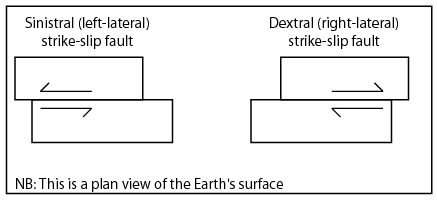 In geology the terms sinistral and dextral refer to the horizontal component of movement of blocks on either side of a fault or the sense of movement within a shear zone
. These are terms of relative direction, as the movement of the blocks are described relative to each other when viewed from above.
Movement is sinistral (left-handed) if the block on the other side of the fault moves to the left, or if straddling the fault the left side moves toward the observer.
Movement is dextral (right-handed) if the block on the other side of the fault moves to the right, or if straddling the fault the right side moves toward the observer.
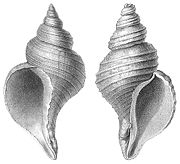 Because the coiled shells of gastropods are asymmetrical, they possess a quality called chirality
, the "handedness" of an asymmetrical structure.
By far the majority (over 90 %)
of gastropod species have dextral (right-handed) shells in their coiling, but a small minority of species and genera are virtually always sinistral (left-handed), and a very few species (for example Amphidromus perversus
)
show an even mixture of dextral and sinistral individuals.
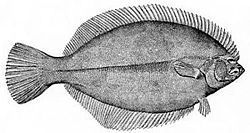 In flatfish, other than their flatness, their most obvious characteristic is their asymmetry, since both eyes are on the same side of the head in the adult fish. In some families of flatfish, the eyes are always on the right side of the body (dextral or right-eyed flatfish), and in others, they are always on the left (sinistral or left-eyed flatfish). The primitive spiny turbot
s include equal numbers of right and left sided individuals, and are generally less asymmetrical than the other families.
Chirality
Chirality is a property of asymmetry important in several branches of science. It may refer to:* Chirality , a property of molecules having a non-superimposable mirror image...
(“handedness”) or relative direction
Relative direction
The most common relative directions are left, right, forward, backward, up, and down. No absolute direction corresponds to any of the relative directions. This is a consequence of the translational invariance of the laws of physics: nature, loosely speaking, behaves the same no matter what...
in a number of disciplines.
The terms are derived from the Latin
Latin
Latin is an Italic language originally spoken in Latium and Ancient Rome. It, along with most European languages, is a descendant of the ancient Proto-Indo-European language. Although it is considered a dead language, a number of scholars and members of the Christian clergy speak it fluently, and...
words for “left” (sinister) and “right” (dexter).
Other disciplines have different terms (such as dextro- and laevo-rotary, in chemistry
Chirality (chemistry)
A chiral molecule is a type of molecule that lacks an internal plane of symmetry and thus has a non-superimposable mirror image. The feature that is most often the cause of chirality in molecules is the presence of an asymmetric carbon atom....
, or clockwise and anticlockwise in physics
Chirality (electromagnetism)
The term chiral describes an object, especially a molecule, which has or produces a non-superimposeable mirror image of itself. In chemistry, such a molecule is called an enantiomer or is said to exhibit chirality or enantiomerism...
) or simply use left and right (as in anatomy)
Geology
Shear zone
A shear zone is a very important structural discontinuity surface in the Earth's crust and upper mantle. It forms as a response to inhomogeneous deformation partitioning strain into planar or curviplanar high-strain zones. Intervening blocks stay relatively unaffected by the deformation...
. These are terms of relative direction, as the movement of the blocks are described relative to each other when viewed from above.
Movement is sinistral (left-handed) if the block on the other side of the fault moves to the left, or if straddling the fault the left side moves toward the observer.
Movement is dextral (right-handed) if the block on the other side of the fault moves to the right, or if straddling the fault the right side moves toward the observer.
Gastropods
Chirality
Chirality is a property of asymmetry important in several branches of science. It may refer to:* Chirality , a property of molecules having a non-superimposable mirror image...
, the "handedness" of an asymmetrical structure.
By far the majority (over 90 %)
of gastropod species have dextral (right-handed) shells in their coiling, but a small minority of species and genera are virtually always sinistral (left-handed), and a very few species (for example Amphidromus perversus
Amphidromus perversus
Amphidromus perversus is a species of air-breathing land snail, a terrestrial pulmonate gastropod mollusk in the family Camaenidae.Amphidromus perversus is the type species of the genus Amphidromus, by the subsequent designation of Eduard von Martens .- Subspecies :There are six subspecies of...
)
show an even mixture of dextral and sinistral individuals.
Flatfish
Spiny turbot
The spiny turbots are a family, Psettodidae, of relatively large, primitive flatfish found in the tropical waters of the east Atlantic and Indo-Pacific. The family contains just three species, all in the same genus, Psettodes...
s include equal numbers of right and left sided individuals, and are generally less asymmetrical than the other families.
See also
- ChiralityChiralityChirality is a property of asymmetry important in several branches of science. It may refer to:* Chirality , a property of molecules having a non-superimposable mirror image...
- Left and right (disambiguation)
- LateralityLateralityLaterality is the preference that most humans show for one side of their body over the other. Examples include right-handedness or left-footedness. It may also apply to other animals, or to plants.- Human laterality :...
- Helicity (disambiguation)